
From a collector’s point of view, the issue size of a limited-edition item is of major importance; it’s therefore disconcerting if the artist or manufacturer plays fast and loose with that particular attribute.
The concept of marketing retail items as “limited editions” didn’t become widespread until the 1960s. The Boehm Porcelain studio was one of the first to do this, during the 1950s, and Cybis followed suit with its’ first four limited edition pieces in 1960. By the end of the 1960s the term “limited edition collectible” was firmly established in commerce; in large part we can thank or blame The Franklin Mint for that. The Beanie Baby bubble of the 1990s, fueled by the burgeoning internet and by eBay in particular, is a textbook example of the limited-edition marketing technique run amok.
In today’s online collectibles market, where hundreds of Cybis listings can be seen on any given day, the limited edition sculptures should command most of the attention. (However, given the current market, that’s an open question!) What about instances when the “official” Cybis literature’s edition size conflicts with reality? That is, when the stated edition size is contradicted by a higher number appearing on an actual piece. One would think that the sculptures should have been numbered in sequence as created, or nearly so. If a catalog published by Cybis cites an edition size of 325 for a sculpture, we should not find any bearing a number in the high 300s or 400s, but such pieces do exist. Why?
One possible explanation is that the Cybis publication is in error regarding the final edition size. If that were true, that would mean that the 1978/79 catalog appendix, which is the only reference that Cybis themselves produced, must have many edition-size errors in it. So let’s take the Cybis literature at face value and assume that when they say that only 325 were available for retail sale, that’s how many they made. But that doesn’t explain why pieces with higher sculpture numbers exist.
Another theory is that Cybis deliberately did some occasional out-of-sequence “over-numbering” to make it appear (to collectors, retailers, and competing porcelain art companies who were ‘scouting’ retailer shelf stock) that the sculpture was selling out faster than it actually was. I have heard this theory proposed; I suppose it is possible and as they say: All’s fair in love, war, and business. However, I do take this notion with more than a grain of salt.
What did the studio mean by the phrase “final issue”? In Cybis parlance the terms ‘Declared Issue’ and ‘Final Issue’ meant “how many of these sculptures we intend to make” and “how many were actually physically made”; it did NOT necessarily mean “there will be 500 pieces, numbered from 1 to 500” or “there were 325 pieces, numbered from 1 to 325.” So, one could see an edition size reduced from 500 to 325, but still have pieces that went out of the door bearing a sculpture number between 326 and 500. In fact, I own a such a piece myself: It is #253 of an edition that was declared at 500 in 1977 but was reduced to 225 in 1980 and shown as “completed” at that point.
However, this doesn’t explain how a sculpture could be numbered #501 when the original and unreduced final edition size was only 500! There is no reason why any piece should be numbered higher than the largest quantity that the studio ever stated that they would made…but some do exist, and they are not replicas or reproductions.
The Most Likely Explanation
The most probable reason for ‘over-numbered’ Cybis pieces lies in their production process, i.e., when any given limited-edition sculpture was assigned its number. You would think (as I once did) that sculpture numbers would be assigned as each piece was physically produced, but that wasn’t how Cybis did it. The studio instead assigned the sculpture number when retailers placed the order for that piece. And it was definitely not a case of “first order, first made”! If a retailer cancelled an order, the sculpture number(s) assigned to their original ordered piece(s) would then be given to a different retailer who was on a waiting list.
It’s important to understand that the physical production of any sculpture did NOT necessarily coincide with when the order for it was placed; certain retailers were given preference over others because they were high-volume galleries. Brielle Galleries not only got precedence but was given a higher percentage of each piece overall, in exchange for them placing regular ads in high-end magazines such as Architectural Digest (thus saving Cybis that expense.) This is not hearsay; the arrangement appears in Ira Jacobson’s published memoir about the gallery. If the edition size of a sculpture was reduced after higher sculpture numbers were already assigned (say, sculpture numbers 201 and 210 for an edition that was subsequently reduced from 350 to only 200), and those higher numbers were in an order from a ‘preferred’ retailer, that retailer still got their sculptures…each one numbered exactly as originally assigned to those pieces before the edition size was reduced.
This scenario (a higher assigned sculpture number than what the final manufactured number of pieces was) no doubt accounts for most of the over-numbered pieces that were produced during the 1960s, 1970s, and probably at least the first half of the 1980s. However, there is another possible explanation that cannot be entirely ruled out.
When ‘Completed’ Doesn’t Mean What It Says
The following is a new (as of 2020) and disturbing insight into why some ‘over-numbered’ pieces may exist.
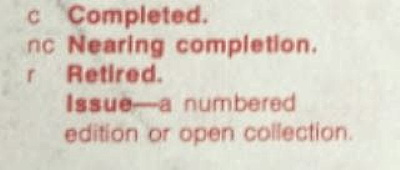
Cybis collectors have always believed what the studio said in its advertising literature and price lists: That when a limited edition was “completed”, that was that. No more will be made. Finito. The end. After all, we saw as early as Page 5 of the very first Cybis catalog (1964) that “Limited editions are never renewed.”
 This appears on the last page of all Cybis price lists during the 1970s, under ‘Legend’ and sounds quite definitive.
Major Cybis retailers touted the exclusiveness of Cybis limited editions, such as on page 1 of Brielle Galleries’ full-color spring 1980 catalog showing Queen Esther and Lady Macbeth under the heading From Portraits in Porcelain, never again to be made…
 Ah, but on the Summer 1982 price list, the ‘legend’ area has changed from what it was during the 1970s. There is no mention anymore of designs being destroyed after edition-completion or retirement.
 The February 1989 Cybis price list has changed even more. Sculptures are no longer shown if they are not actively available for sale. However, there is this line added:
 I had always assumed this meant “We can tell you what a piece is if you don’t see it here.” However, I have recently learned that this is not what this line of text meant.
What this actually meant was “If you want a completed edition, don’t worry, we can probably make it for you anyway.”
I don’t know exactly when “completed” lost its original meaning but the studio was definitely willing to do this in the 2000s and I suspect during the 1990s as well. That would dovetail with the change in price-list wording. The fact that they were offering to produce supposedly-never-to-be-made again pieces (if the purchaser was willing to pay the hefty price) proves that the design molds were not, in fact, ever destroyed. In fact, when the studio building was finally sold, I was told that there was a large dumpster full of molds in the parking lot. They had all been stored in the separate warehouse building in case they were ever wanted.
This discovery creates an additional explanation for an over-numbered piece. Let’s imagine that in 1998, Jane Doe wants a Mary Mary whose edition was completed in 1979. Of course nobody is selling one, not even on eBay (remember this is a hypothetical!) so she contacts the studio just in case they still might have one left. She’s told that they don’t, but for $$$$ dollars they can make one for her (so much for “destroyed molds”) and they will assign it a sculpture number. What sculpture number will she get?
The 1979 catalog says that Mary Mary‘s original edition of 750 was reduced to 500 before it was completed. So theoretically, the Mary Mary that Jane eventually receives from Cybis in the 1990s might bear any sculpture number that had not physically gone out the studio door before they declared the edition “completed.” The only question is whether Jane’s would be numbered #501 if the studio really did send 500 of those out to retailers during the 1970s.
And it gets better. Let’s continue our hypothesis and say that Cybis really did send 500 of those out the door decades ago. Jane Doe can still get a brand-new Mary Mary, because during the 1990s the studio invented a “10% Policy” regarding pieces marked A.P. (Artist Proof.) They told prospective purchasers that up to an additional 10% of any limited edition could be sold as an ‘Artist Proof’. Thus, they might make as many as 50 more of Mary Mary and simply mark those all A.P. instead of number, thus bringing the possible final quantity created to 550. This discovery makes the A.P. designation much less significant than most people believe and, in some cases, it is completely meaningless; see the newly-revised Editions post for more information about the studio adding A.P. to 1940s pieces during the 2000s.
I am not saying that every over-numbered Cybis piece is a 1990s or 2000s ‘fresh out of the oven’ item; but the possibility cannot be discounted, now that we know the studio was doing this in the 2000s and probably the 1990s as well. For most of the limited editions that were completed during the 1960s and 1970s, one of the other scenarios (custom numbering by retailer or customer request, retailer-order sculpture number assignment, or jumping ahead in sculpture numbers to give the impression that the edition was going to be closed fairly soon) is a far more likely explanation. But it’s well to keep in mind that Cybis edition sizes are not something that anyone should regard as written in stone when looking at the quantity that the studio showed for them.
Name Index of Cybis Sculptures
Visual Index (for human figures/busts only)
About the Cybis Reference Archive
What is Cybis?
Images of Cybis porcelain sculptures are provided for informational and educational purposes only. All photographs are copyrighted by their owner as indicated via watermark. Please see the copyright notice in the footer and sidebar for important information regarding the text that appears within this website.
The Cybis Archive provides the most comprehensive range of information about Cybis within a single source. It is not and never has been part of the Cybis Porcelain studio, which is no longer in business.
 THE CYBIS ARCHIVE