
The Limnettes were a unique product of the Cybis studio during the first half of the 1970s. They are small porcelain plaques that were designed by freelance artist George Ivers in 1971. He was actually working for Lenox at the time but later joined Cybis as their Art Director in 1973 and remained in that post for thirteen years.
Update, June 2024: Newfound information has occasioned a major update to the information in this post.
Why ‘Limnette’?
Cybis registered the copyright for these designs in 1971, then applied for trademark registration of the word Limnette in 1972 and was granted it in 1974; that is why many of the actual pieces are signed Limnette™ which indicates an item that is awaiting approval of a trademark registration application. Once the registration was granted, the designation properly changed to Limnette® instead. A United States trademark registration initially lasts for seven years, as long as the owner of the trademark continues to use it in commerce and can prove this to the USPTO by scheduled Maintenance Filings between years five and six, nine and ten, and then every decade after that. According to the USPTO database, Cybis did not submit any of the required Maintenance Filings and as a result, their trademark registration of the word Limnette expired in 1981.
The separate Spring 1972 introductory brochure for the Limnettes is quite interesting, both for what it says and what it does not say!
The title of the brochure is
CYBIS LIMNETTES
Small designs in porcelain brought to you by artists with the gift of enchantment.
 This is the explanatory text in the first foldout section. Putting on my Nerd Hat (okay, well, I never really take it off) I can spot five errors here, which I will enumerate at at the end of this post! But the important thing to notice in this text is the description of the Limnettes only as “porcelain sentiments” […] “in jewel-like colours on porcelain, with porcelain mounts.” I’ll come back to that description a bit later.
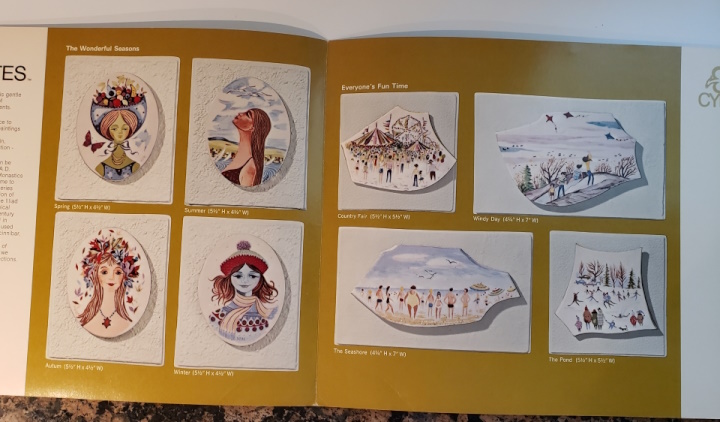 This is the inside of the double-gatefold brochure, showing two of the three series. Many of these pieces are physically dated 1971 even though the official introduction year was 1972.
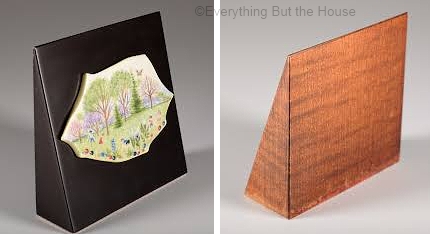 Based on the wording of the brochure, it sounds as if most (perhaps all) of the 1971-signed pieces were produced with the porcelain mounts but at some point a switch was made to using wood mounts instead. I own an Autumn on a dark wood mount; the porcelain oval is dated 1972.
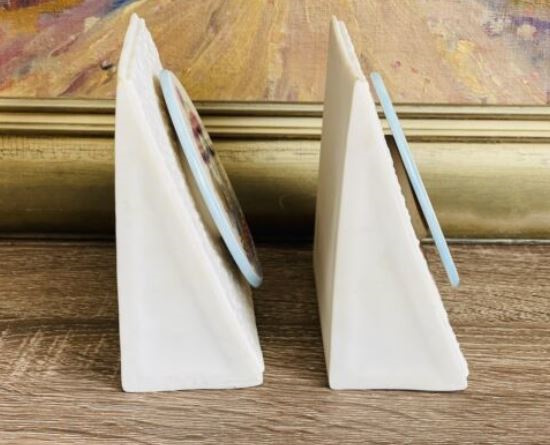 The attachment method differs according to the type of mount. The wood mounts have a hole the center into which the back of the porcelain can fit; the porcelain sits flat against the wood with almost no gap between them. The porcelain mounts, however, are quite different as can be seen in the photo above.
What Edition Size?
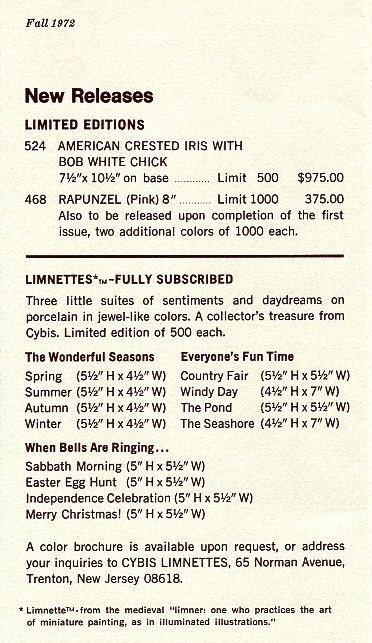 According to the brochure and also this snip of the Fall 1972 price list, each series of 12 designs was an edition of 500. This appears to mean that they will produce 500 of the Spring Limnettes, 500 of Easter Egg Hunt, 500 of Country Fair, and so on, for a total of 6000 individual, numbered Limnettes. Wow, that’s a whole lotta Limnettes!! And notice that this price list says that the editions are already “Fully subscribed” which supposedly meant that retailers had already sent in orders for a total of 1500 sets of four. In Cybis parlance, all three editions were now completed. Really?? in less than six months? That was quick, almost at warp speed. There are no prices shown here because theoretically all 6000 Limnettes have already been spoken for by retailers.
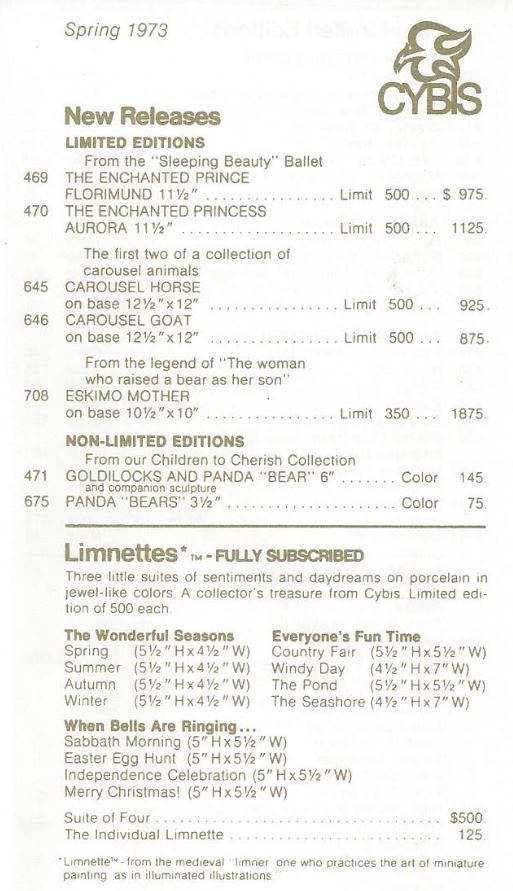 But were they really? Here is a snip from my Spring 1973 price list. It still says “fully subscribed”, but now there are prices shown. Notice that there is no ‘quantity discount’; the price of an individual Limnette x 4 is the same as the price of the “suite of four”.
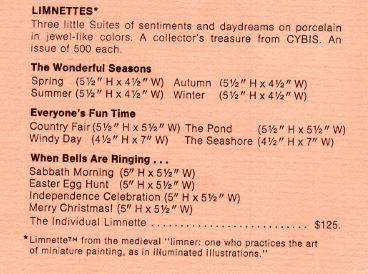 The Spring and Fall 1974 price lists no longer offer a “suite of four” for $500, but only “The Individual Limnette” at $125. It also no longer says “fully subscribed”! What’s going on here?
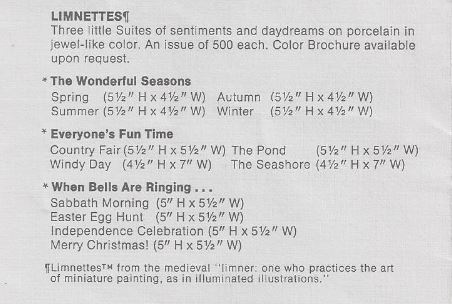 The Fall 1975 price list shows each series as finally completed, via the asterisk next to each series title. There is no pricing at all, but notice that the edition size still claims 500. They have changed the footnote symbol from the original asterisk to a paragraph symbol, probably in order to not confuse it with the “edition completed” designation.
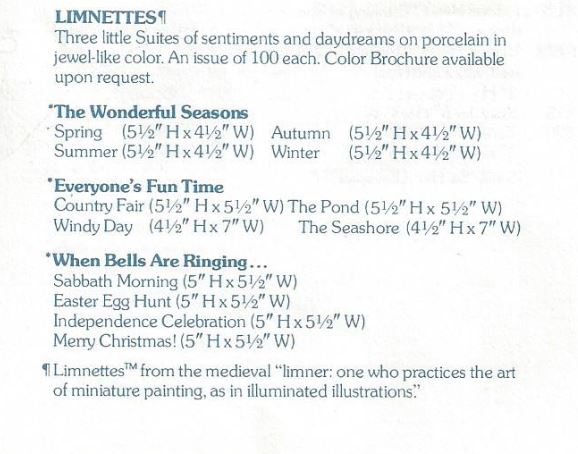 Look what has happened on their Spring 1976 price list! The Limnettes are still shown as completed, but the edition size (“issue”) is now shown as only 100 rather than the 500 that it was advertised as for the previous four years. The Spring 1977 price list shows them this same way. They do not appear at all on the Fall 1977 list. Starting in Spring 1978, Cybis price lists no longer include historical completed/retired edition names.
When Cybis published their 1978 catalog, which includes an Appendix, the Limnettes series are shown as Declared Issue of 500 each in 1972, and a Final Issue of 100 each in 1975 (even though the Spring and Fall 1975 price lists still said 500.) Their price is shown as $125 per each individual Limnette design.
Okay, well, fine: They reduced the total quantity to be produced from 6000 (500 x 12 designs) to 1200 (100 x 12 designs); an 80% reduction. Let’s be honest, the likelihood of them actually filling orders for 6000 of these was rather far-fetched from the get-go. But then why claim that the series were “sold out” when they weren’t? It is possible, I suppose, that they got a spate of retailer orders during 1972 and 1973 that were later cancelled, thus prompting the inclusion of prices in the 1973 and 1974 price lists. I suspect that it was at some point during 1974 that the studio admitted that collector interest just wasn’t what they had anticipated, and that 1200 was the most that they were ever going to end up selling.
Of course there is a glitch in this theory, and that glitch is the ‘overnumbering’ that we find on these. Even though some of these were marked A.P. and others were (for whatever reason), never numbered at all, here are the numbered Limnettes that have sold online in recent years: #13, #58, #59, #62, #121, #143, #181, #185, #235, #236, #279, #281, and #333. Some of them have the number plus the edition size (such as 143/500 and 241/500; those tend to be the ones on a porcelain mount) while others simply have a number without an edition size noted. The fact that the assigned numbers went up as high as 333, and yet the final quantity of numbered pieces was supposedly no more than 100, points to a very large number of orders that were either cancelled by retailers or were unable to be fulfilled by Cybis. See this post for an explanation of the way that Cybis assigned limited-edition sculpture numbers; it was not according to actual physical production.
Another interesting thing that emerged from looking at those now-sold listing descriptions is that when a date was included in the Cybis signature, it was always either 1971, 1972 or 1973. I have never seen a Limnette listing showing or describing it as having 1974 on it. That said, not all Limnettes have a year on them.
Now let’s look at the three series which were entitled “The Wonderful Seasons”, “Everyone’s Fun Time” and “When Bells Are Ringing.”
The Wonderful Seasons
Each of the four portraits depicts a lady dressed to represent Spring, Summer, Autumn and Winter.
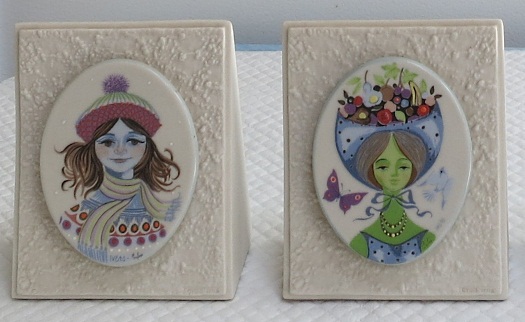 The earliest ones were produced with these bisque porcelain mounts that had a textured front surface. Here are Winter and Spring. I really wish that Cybis had not decided that Spring would have green skin because, every time I look at one, I can’t help thinking that she looks like the Wicked Witch of the West playing Chiquita Banana!
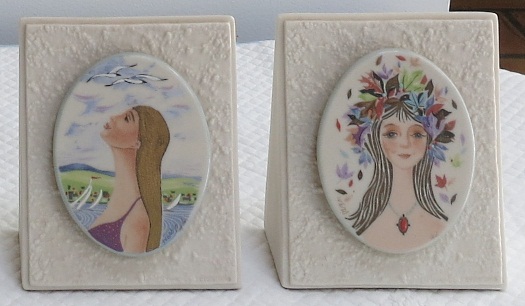 Followed by Summer and Autumn. The oval porcelain plaques are 4” high and about 3.25” across at the widest point.
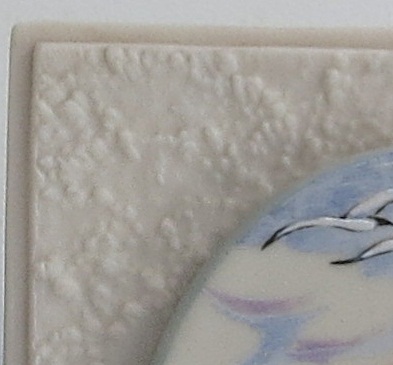 The texturizing on the front was not done by hand but is instead in the wedge mold itself.
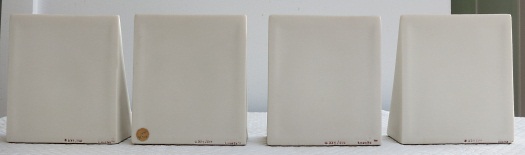 The sides and back of the wedge/mount are smooth. Each is signed on the back. These four have matching numbers and are from the John S. Minton collection. Many thanks to his family for providing these photographs for inclusion in the Archive!
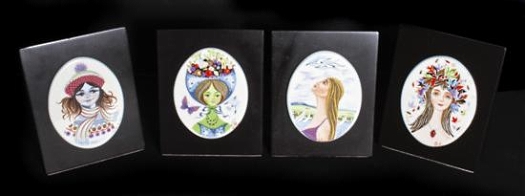 The studio subsequently switched to these black-painted wood mounts, no doubt to save on production time and costs because they took up less of both than did the original bisque ones. The wood mount is 5.5” high x 4.25” wide. The dark color provides more contrast to the white porcelain oval, but it also makes it more noticeable if the plaque was mounted onto it slightly askew.
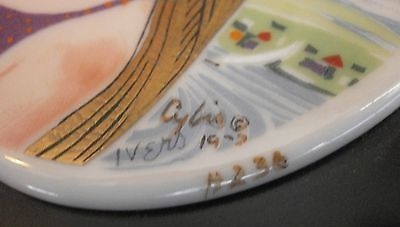
Because the wood mounts could not be signed on the reverse, that information had to be relocated to the plaque itself… making things a bit crowded along the edge.
Everyone’s Fun Time
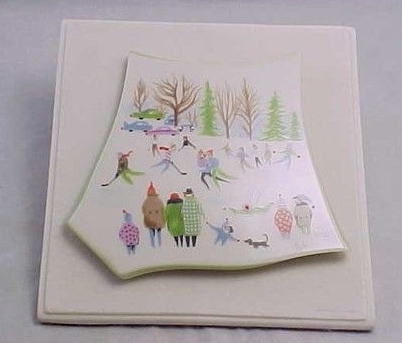 The concept of this series was simple: people having fun. The Pond is a winter scene complete with ice skaters and hockey players.
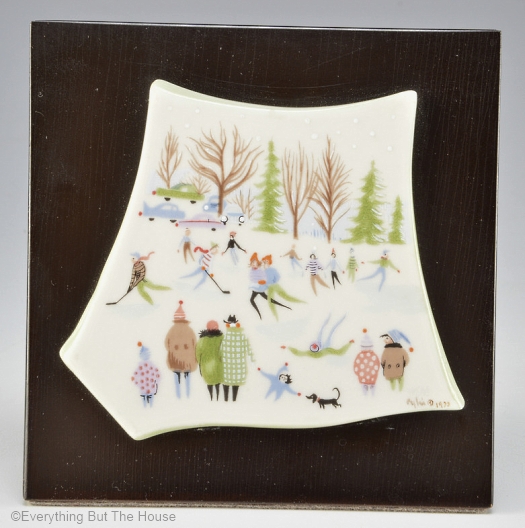 This example is dated 1973 and is 5.5”high x 6” wide.
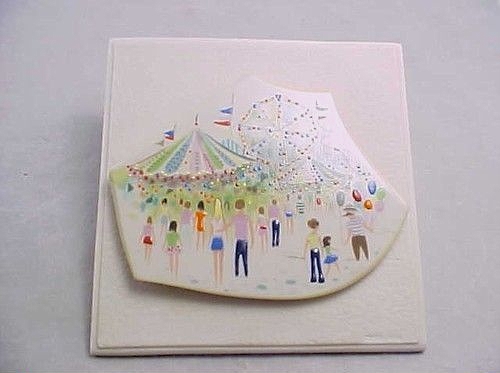
 Country Fair is complete with a Ferris wheel and carousel. The original 1971 copyright registration for this item gave its name as The Carnival.
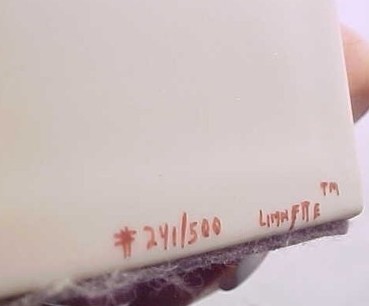 This example is dated 1971 on the front and is numbered #241/500 on the back of the mount. The numbering format is very strange because Cybis almost never included the edition size in their signatures.
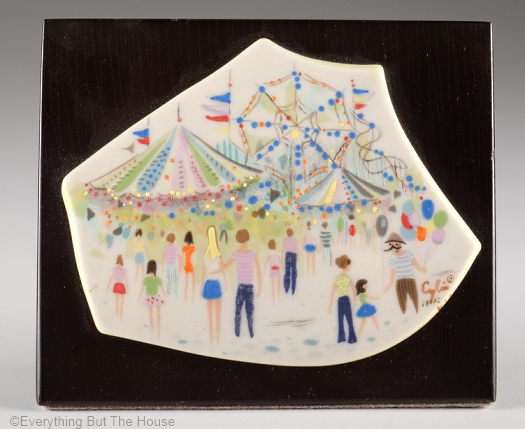 This example on a dark wood mount is dated 1972 near the Cybis signature and is numbered 13; the dimensions are 5.5” x 5.5”.
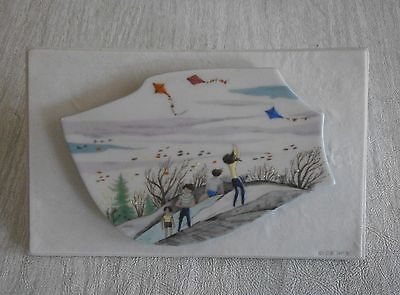
 Windy Day was originally copyright-registered as Windy Afternoon. This is obviously a 1971 piece; it is 4.5” high and 7” wide overall, with the plaque being about 3.5” x 5.5”.
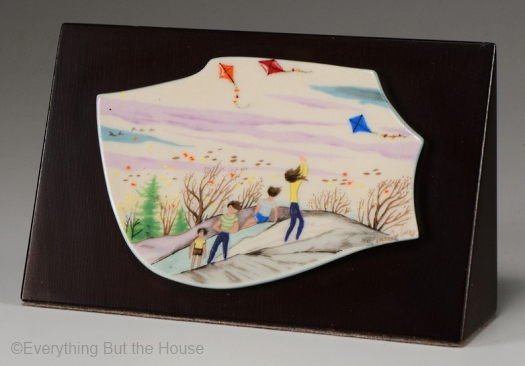 Here is Windy Day on wood, dated 1973.
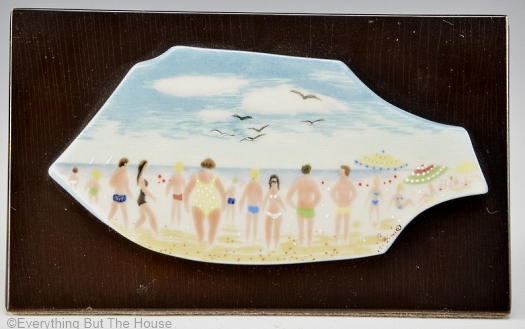 A fanciful day at The Seashore. The original copyright registration name for this piece was On The Beach. As shown on the wood mount it is 4.25” high x 7” wide overall. Signatures, dates, and numbers were omitted from its description.
I have no idea why the original copyrighted titles of these four Limnettes were not the ones applied to them when they were actually introduced at retail.
When Bells Are Ringing
Although it’s perhaps a bit of a stretch to directly correlate bells with more than two of these subjects, three of them do also represent holiday celebrations.
 Easter Egg Hunt measures 5” high and 5.5” wide.
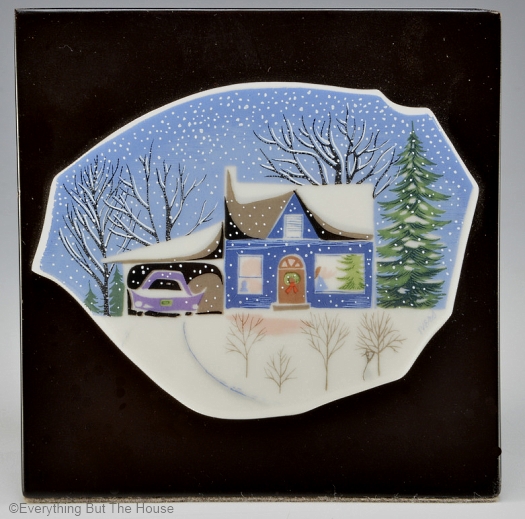 This scene is called Merry Christmas. The plaque is 3.75” h x 5” wide, with the mounted piece being 5” x 5.5”…. not much wiggle room on the sides!
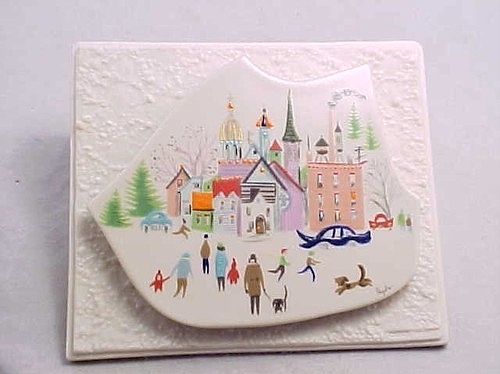

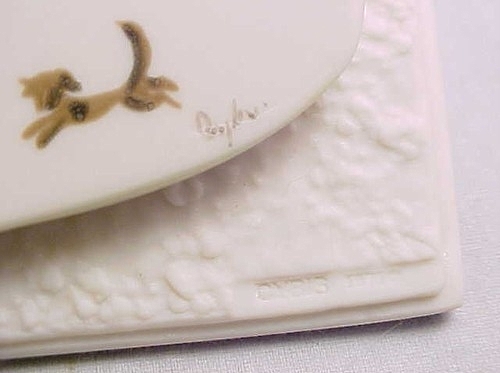 This winter scene is entitled Sabbath Morning. This example dates from 1971 and is numbered #241/500. A different example of this Limnette®, also mounted on wood, was dated 1972 and numbered simply 333.
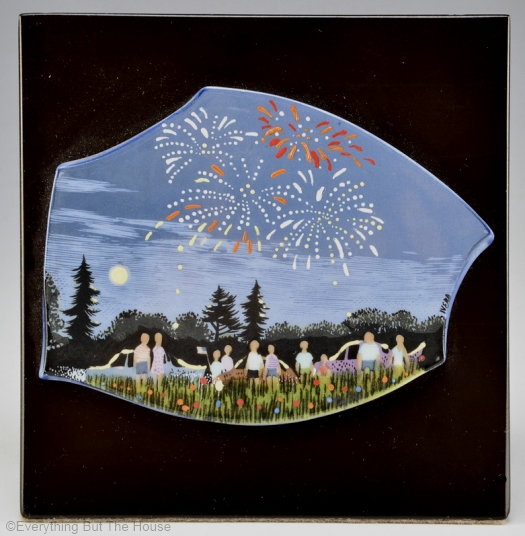 Independence Celebration is obviously a July Fourth scene (perhaps it’s the Liberty Bell that’s ringing?). This is 5.75” high and 5.5” wide overall.
Having only ever seen fully-assembled Limnettes for sale, I had assumed that the flat back of the porcelain was simply glued onto the front of the wood (or porcelain) wedge that supported it. But, thanks to the gift of an unmounted example from a Cybis artist, we can now see how the wood-mounting was actually done.
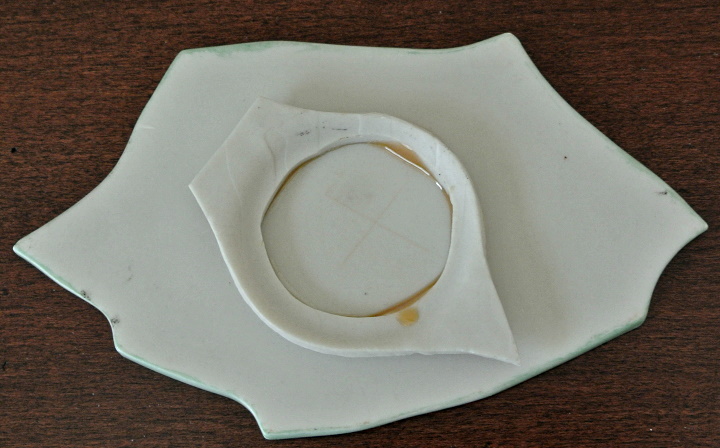 The X marks the center point of the porcelain mold and the piece which looks rather like a Ouija-board pointer was meant to be centered on it. We must assume that this fit into a cut-out on the face of the wood plaque, and then turned slightly in order to ‘lock’ it in place. One would have thought that something else (glue?) would have been required for a more secure attachment, however. Although I do own one Limnette (Autumn) I’m not inclined to try to separate it from its mount in order to test this theory!
Painted or Not?
With one possible exception (the Rose Plaque), the Limnettes appear to be the only modern (meaning post-1950s) Cybis items on which the majority of the decoration is not hand-painted: Each Limnette design was applied to the porcelain piece via a full-color decal. The Ivers name is part of the decal design, although the Cybis signature and marks were applied with brown paint as usual. The small accents and highlights were applied by hand to the Limnettes but the majority of the image area is a fired-on decal.
That is why the Cybis brochure describes the Limnettes as “in jewel-like colours on porcelain”. They were very careful to avoid saying “painted in jewel-like colours” because that could have implied that all of the colors on the Limnettes were applied with paint – which is definitely not the case. Thus, any online listings that describe these as being “hand painted by George Ivers” are incorrect; the accent touches were applied by the in-house Cybis decorators to the fired-on decal.
The Five Errors in the Brochure Text
Okay, here goes.
(1) ‘Monastics’ should never be capitalized, because it is not the name of a religion. When used in the singular it is an adjective (“Friar Tuck lived a rather boring monastic life before he met Robin Hood”) and thus is not capitalized. When used in the plural (“The group of elderly monastics became bored with their vow of silence and decided to form a barbershop quartet”) it is not capitalized either.
(2) ‘Monasteries’ should not be capitalized because here it is describing the entire class of that kind of institution (medieval monasteries), rather than a specific named monastery (e.g., the Monastery of Santa Maria de las Cuevas in southern Spain).
(3) The title of Homer’s famous epic poem is The Iliad, spelled with only one L…not two, as the Cybis brochure writer incorrectly has it.
(4) The correct spelling of the first semi-precious material mentioned in the brochure is cinnabar, not “cinnibar”.
(5) There is a missing article in the final sentence, which should correctly be With the advent of the printing press, the art of the Limner waned. Unfortunately, the fourth the is missing. As a result, the line actually reads “..the art of Limner waned” which sounds as if Limner was the name of a specific artist whose creative energies were fatally sapped by the new technology.
And whilst I am quibbling, I’d like to know why a studio that made their American origin such a huge point of pride (“the oldest American porcelain art studio”) chose to use a British spelling (colours) rather than the standard American one for that word. I checked all of my other Cybis publications (brochures, catalogs, and price lists) and this appears to be the only one in which the British spelling was used. Not that there is anything wrong with that – my ancestry is British and so I can hardly complain! – but it does seem odd in these circumstances and, dare I say it, rather smacks of affectation. But as for the other items in the text, well, those are errors no matter which side of the Atlantic Ocean one is on. :-)
Name Index of Cybis Sculptures
Visual Index (for human figures/busts only)
About the Cybis Reference Archive
What is Cybis?
Images of Cybis porcelain sculptures are provided for informational and educational purposes only. All photographs are copyrighted by their owner as indicated via watermark. Please see the copyright notice in the footer and sidebar for important information regarding the text that appears within this website.
The Cybis Archive provides the most comprehensive range of information about Cybis within a single source. It is not and never has been part of the Cybis Porcelain studio, which is no longer in business.
 THE CYBIS ARCHIVE