
They say imitation is the sincerest form of flattery, but when it comes to things like copyright infringement there’s such a thing as being a little too flattering! So herewith the Archive inaugurates a Hall of Shame displaying blatant knockoffs of Cybis Porcelain copyrighted designs.
There is one item that I dithered over adding to this post, and that is the extremely close copy of the Cybis Court Jester that was produced by the Seymour Mann Company. Personally I would consider this to be an unauthorized copy BUT there are enough slight differences to keep a few lawyers busily arguing (while collecting fees) for a while. That knockoff/copy/whatever is shown in a dedicated post, The Cybis Court Jester (or, Send in the Clone) for your perusal.
I’d also like to point out that the sellers who offered the Hall of Shame examples shown below are probably not the same people who created them in the first place! The sellers who took these photos were merely offering an item which they most likely had no idea is an illegal copy of something else. So in this post I have deliberately omitted any identifying watermarks, in order to protect innocent resellers.
New items are added to the Hall of Shame as discovered, at the end of the post.
The Madonna with Bird copies
 This copy of the 1956 Madonna with Bird appeared for sale on eBay in 2008 within a mixed lot of religious jewelry (some of which festoons and surrounds the sculpture) and other items. There was only this one photograph, and the only detail the seller included was that it was “signed Slovenia on the bottom”. That is a mystery in itself and I wish a photo had been included!
Other than the colors being different from any of the three legitimate Cybis editions of this sculpture (the original – shown below – and the two later reissues shown in the Later Madonnas post) there are other red flags. The bird is not cast from the same mold as the one Cybis used; look at the wings and also the shape of the end of the tail. The position of the sleeve/hands mold pieces, where they join with the torso mold, is also “off and the cloak edge is completely in the wrong place. The position of her hands and their fingers does not correspond exactly to the genuine piece. And lastly, the vertical braid sections do not exist in the original, and the neckline is plain rather than trimmed. The mystery here is where and how a Slovenian maker acquired a mold (or even a piece from which to cast a “negative”) of an Ispanky piece that was created by him in the USA.
 Here’s another example, this time with a very garishly-patterned veil! This is almost certainly a hobbyist version. In addition to the ‘bling’, Mary has been given eyelashes – the first time I have seen that on one of these knockoffs.
 This knockoff/copy lacks the bird but otherwise is from the same mold as the previous two. Residue on the underside suggests that at one point this had a felt covering but the mold is unmarked. Height was cited as 9″ as shown.

 Here’s another copy which does have the bird but here Mary appears as a peasant woman: I’ve never seen a madonna depicted wearing a headscarf! Multiple further tweaks include smoothing out her hair and an entirely new shirt and shawl/jacket. Not only are her hands in different positions but the right (bird-perch) one has the fingers in a different orientation as well. The seller’s description gives its height at 6.75″ which is considerably smaller than the original’s 11″, even accounting for the base upon which the Cybis one sits. The only discernable mark on the underside is a stamped 6355. It’s too bad there’s no way to date this example; is it possible that this could have been the original inspiration for the Cybis piece?? It’s a known fact that quite a few Cybis pieces were either close adaptations or outright copies of pieces found elsewhere. It does seem odd that any company would go to quite as much trouble to not only change but downsize a knockoff of a Cybis piece. I suspect that there are secrets yet to be discovered about the history of this particular mold, especially since it appears to have been made in at least two colorways (the wood base under the pink one was a seller’s prop.)
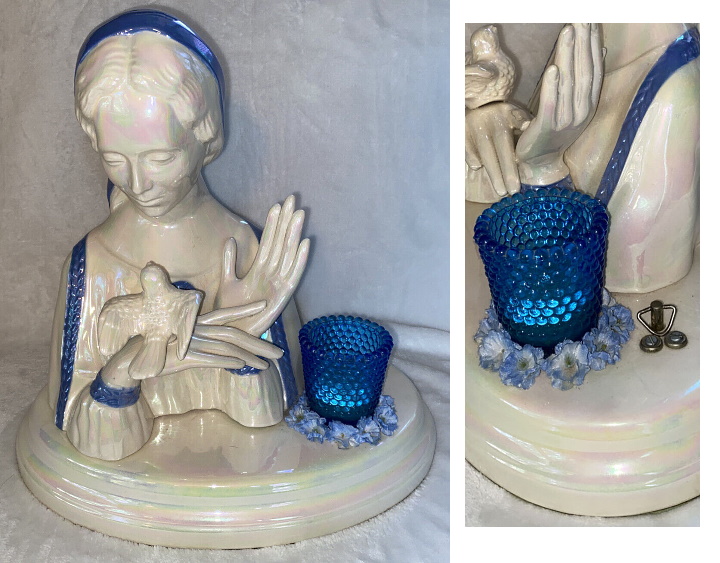 And in the “something completely different” category, we have a copy that not only incorporates a votive-candle holder but is also a music box (the seller didn’t mention what tune it plays). The iridescent glaze covering the entire item is an…..’unusual’ touch.
 This is the actual Cybis Madonna with Bird.
The Mr. Snowball Copies
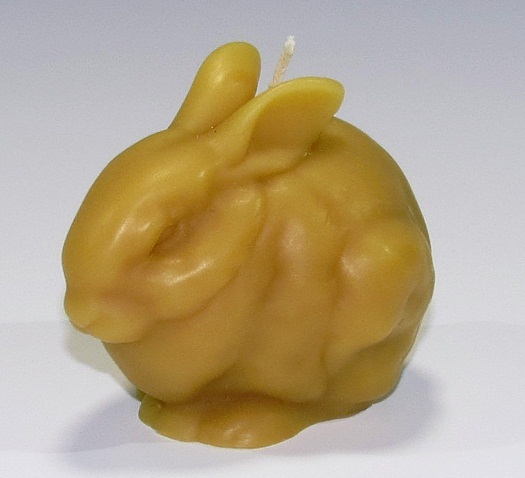 This knockoff is not a ceramic at all; it’s a candle! It is, of course, the iconic Mr. Snowball bunny from 1962, but here cast in beeswax. This is the only such example I have found, and I reached out to the seller to inquire if perhaps the mold was currently being sold commercially to candle and/or chocolate makers. Alas, it turns out that the mold was included in a liquidation sale of a former candlemaker several years ago and so it’s impossible to trace its source.
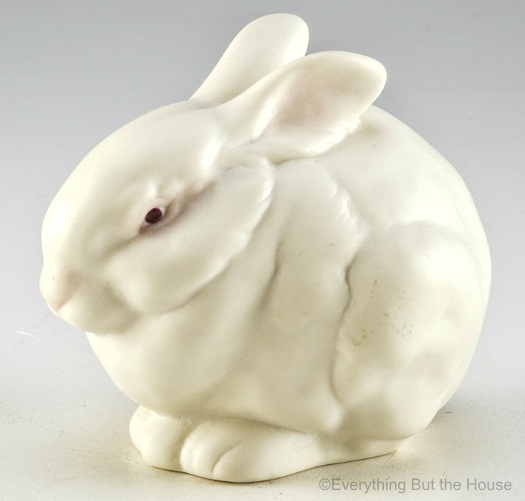 I must say that the candle is quite a faithful copy of the porcelain Mr. Snowball, and it’s deliciously ironic that a design named “snowball” would end up being reproduced in a medium that would, by its very nature, eventually melt and disappear!
 At the extreme other end of the materials spectrum is this cement/concrete casting/copy which was probably intended to be a garden ornament.
 I am admittedly perplexed by this mini copy of Mr. Snowball, shown next to a real one, and here’s why.
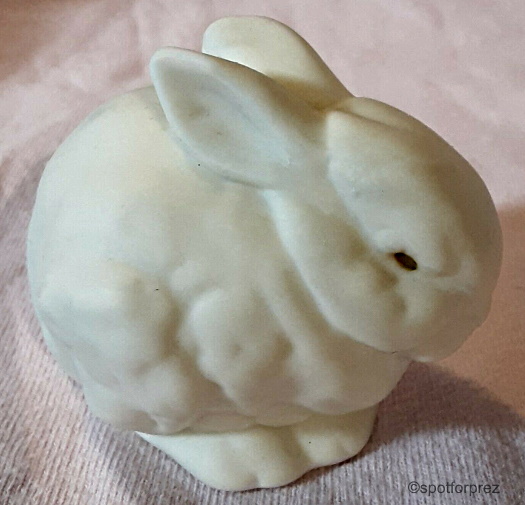 The real Mr. Snowball is only 3.5″ high, making it one of Cybis’ small pieces right from the get-go. This mini one is only 2″ high, which begs the question: Why?? Two inches is basically netsuke-sized. Why would anyone go to the trouble of taking a cast of the actual piece and then downsizing it into an even smaller mold? Because the mini is close enough to the real piece to make that obvious, although the finer details have been lost. The inside of the ears are not tinted, and the eye painting is just a dab of red, but then again, that’s a REALLY small eye area!
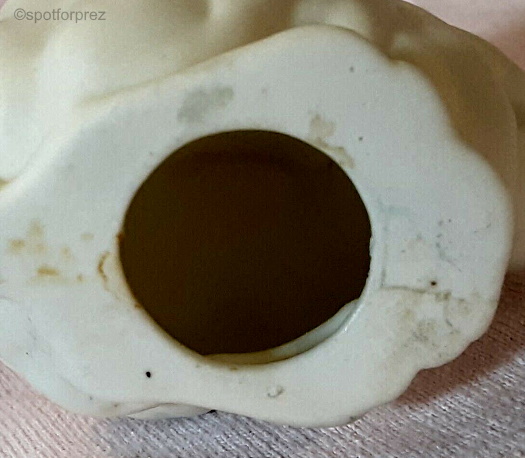 The mini is not signed, which is the strongest argument for it not having originated at the Cybis studio. However, there’s a partial outline in dirty glue residue of what once was some kind of label or price sticker on the underside. I’d totally dismiss it as a copy except for that faintest hint of blue in the same area; Cybis did use blue paint sometimes for their 1950s “Cybis” name stamp. But… Mr. Snowball was not introduced until 1962, and on a piece this tiny, the Cybis name stamp would be bigger in relation to the underside real estate. And still there’s that pesky question of Why Make One This Small?? Logic points several fingers at this being a ‘shrunk‘ bootleg copy of the actual Cybis piece.
Lefton China Copies of Cybis Porcelains
One of the most egregious offenders when it came to copyright infringement of Cybis pieces was Lefton China. I won’t go into their company history because it’s well-documented elsewhere; they operated as a ‘collectibles’ importer starting in the mid-1940s. The original family-owned company was sold in the early 2000s to OMT Enterprises who still utilizes the Lefton brand name as part of their mass-market import items portfolio. The Cybis pirating dates from the 1960s, 1970s and 1980s; I am giving them their own separate section in this Hall of Shame!

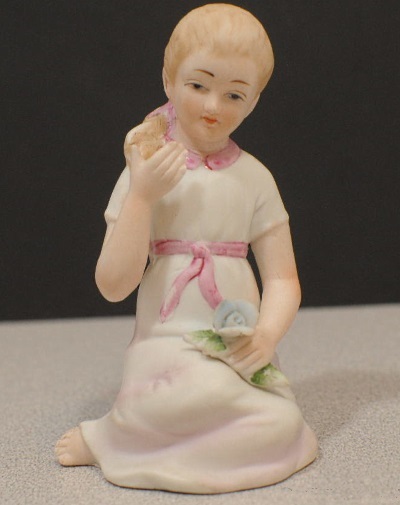
 What’s really puzzling about Lefton’s knockoff of Springtime is that the mold is reversed! She is a mirror image of the actual Cybis piece which is shown in the third image. Before we discuss timeframes I also want to show a second Lefton knockoff piece from the same era.
 This is the Lefton copy of Wendy. For this they used an actual Cybis mold with absolutely no alterations. A clearer case of copyright infringement can scarcely be imagined!
 Both of the Wendys shown in this photo were made by Cybis. The standard version is on the left; the one with the floral decoration was made specially for a retail gallery event.
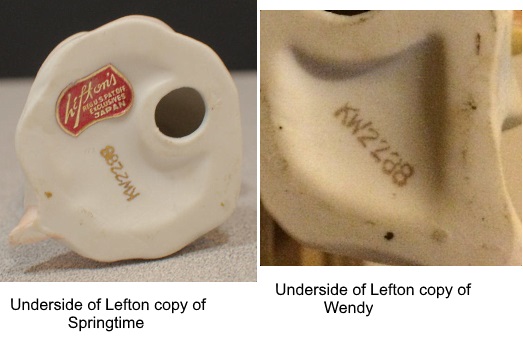 Both of these knockoffs are clearly identifiable as Lefton products. The Springtime knockoff still has its original sticker that was used between 1953 and 1971. (The real Cybis Springtime was produced between 1963 and 1969.) The Wendy knockoff no longer has its sticker but it has the stamped item number: KW2288, which is the same as on the phony Springtime. Why? Because when Lefton made something to be sold as a pair, set, or other ‘associated’ group, they gave both/all of those designs the same product number. Thus, we know that Lefton sold these as a pair or at least as companion pieces. The KW in the Lefton stamp indicates that these were made in the Kowa Toki factory in Japan. Cybis first produced Wendy in 1957 and continued to keep her in the line until the 1980s. Thus, the Cybis Wendy and the Cybis Springtime were ripe for the Lefton plucking as companion items starting in 1963, and the Lefton sticker narrows their production timeframe to between 1963 and 1971.
 This is a slightly different case: Was Lefton knocking off the Holland Mold Company (the original creator of this madonna bust mold), or Cybis (who chose to decorate their version with a lace trimmed veil and central floral), or both? The mold itself was sold by Holland to anyone who had a few dollars to spend, so it was fine for Lefton to use it (if they paid for it, which I rather doubt.) However, the choice of decoration approach was clearly lifted from one of the Cybis versions. That said, Lefton did add hair to theirs. The Cybis studio did three iterations of this mold with the lace trim added: in the 1950s (those were glazed), as white bisque in 1960, and finally a color bisque version in 1992. This was Cybis design number 202, indicating that it was one of their very first religious issues. There are several known Lefton product/item numbers for this piece, such as KW3042, KW3043 and KW3207. All of them look exactly like the one shown above, however. Lefton numbers starting with KW indicate that the item was a Kowa Toki, Japan factory piece made between 1953 and 1971.
 Lefton was still up to their old Cybis-design-snatching tricks as recently as the late 1980s and early 1990s. I spotted not just one, but two, separate instances of them knocking off the Shepherd from the second Cybis nativity set.
 No sane intellectual-property judge would agree that George Lefton actually originated this design, but that didn’t stop the company from claiming so. This is the backstamp on the 1987 knockoff, which was part of their ‘Christopher Collection.’ The sticker noting the Taiwan origin matches the history of the company; in the early to mid 1980s they shifted production from Japan to Taiwan. Most sources pinpoint this as happening between 1984 and 1986. Other factory locations were in Malaysia and China.

Five years later (1992) Lefton brought out another nativity series, dubbed it the ‘Spirit of Bethlehem’ collection, dusted off the 1987 Cybis knockoff, tweaked a couple of surfaced (such as the blanket), gave him a fresh paint job, and tossed him into it. The pieces in this series were not given individual Lefton item numbers, following the company format of giving all items that were part of a pair, set or series the same item number. This series was also made in Taiwan, based on the stickers.

 Lefton pirated both of the first two pieces that appeared in the 1975 Cybis ‘Caprice Collection’ and turned them into trinket boxes several years later. Lefton assigned item number 658 to both. This is a very dirty example of their knockoff of Cybis’ Turtle ‘The Baron’.
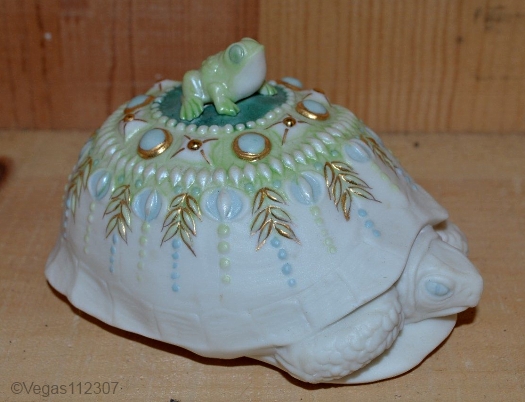 It is almost exactly the same size as the Cybis piece (2.5″ high x 4″ wide, versus 3″ high x 5″ wide for the real thing, shown above.)
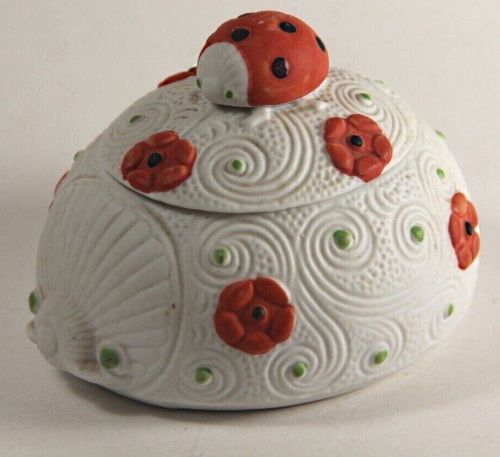
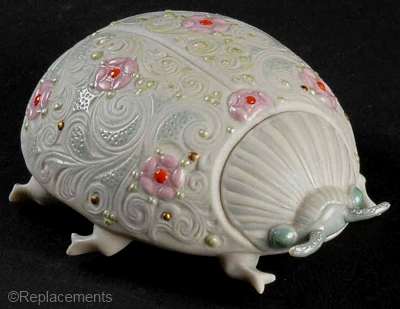 And here is the knockoff of the Cybis Ladybug ‘Duchess of Seven Rosettes’. Because Lefton wanted to make it into a trinket box, they added a small ladybug at the top to serve as the ‘handle’; no need to do that with the Cybis turtle because The Baron already had a frog as a rider! Lefton also eliminated the Duchess’ antennae and feet as extraneous. Both Lefton pieces were made in Taiwan, which dates them to the 1980s; but they did not get the typical Lefton red-and-gold sticker. Instead, the copies I have seen only have a plain, narrow gold foil strip saying Taiwan. They do have the normal Lefton stamp and item number, however.
Other Copies of Cybis Designs
 This unsigned ceramic was a clear attempt to copy the 1977 Cybis piece Rusty and Jonny (Playing Marbles). I have seen more than one of these appear for sale on the internet, which means that they were made by either a prolific hobbyist or a company that only used a sticker to identify themselves by brand.
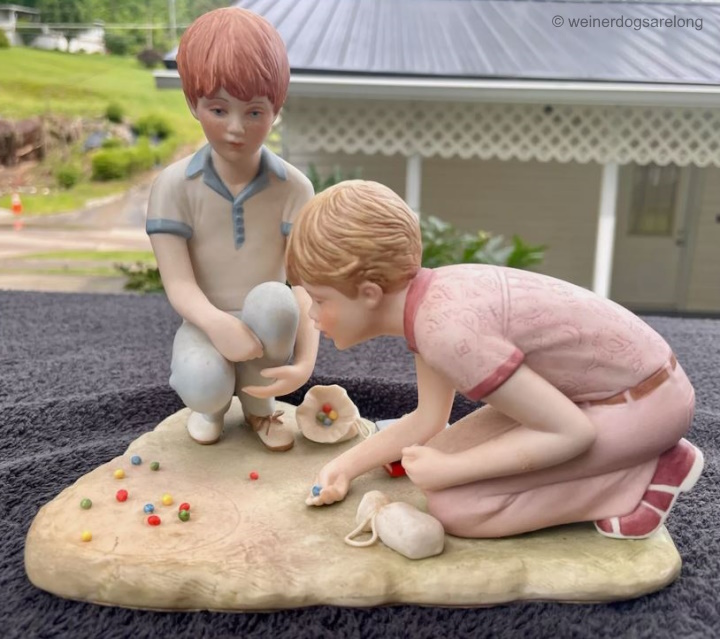 In this case the knockoff’s maker tried to copy the colorway of the original Cybis piece (shown here) as well.

 This is a really clunky attempt at copying the Wood Wren with Dogwood, but a knockoff nonetheless. A photo of the underside wasn’t provided, nor were any marks (or size) cited.
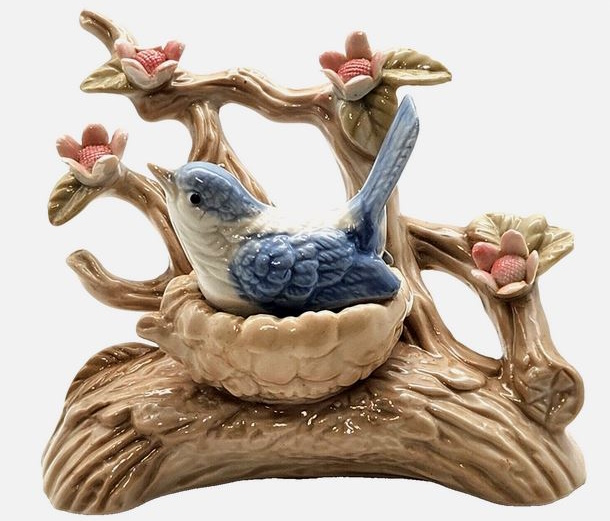 Was the knockoff’s manufacturer trying to copy the ‘Cypia’ shading? It certainly looks that way, with all that heavy-handed brown.
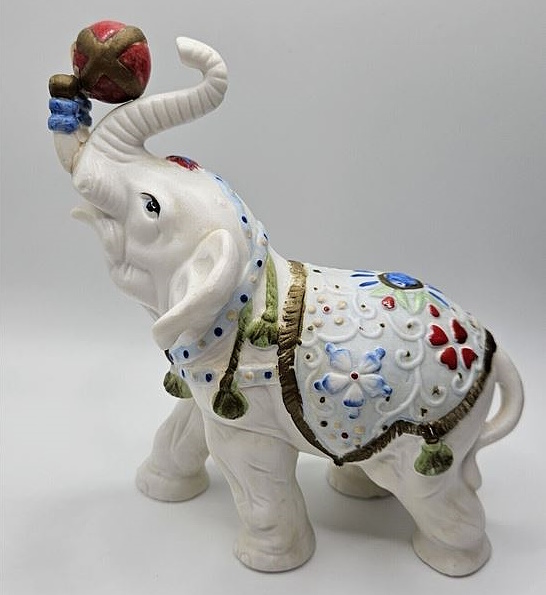
 Here’s a shameless knockoff of Cybis’ 1975 circus elephant, Alexander ‘He’s the Greatest’….and with a broken/re-attached left tusk and right ear, to boot! The eBay seller of this item did describe it as a “replica.”
 The knockoff’s creator even attempted to copy the colors of the Cybis original.
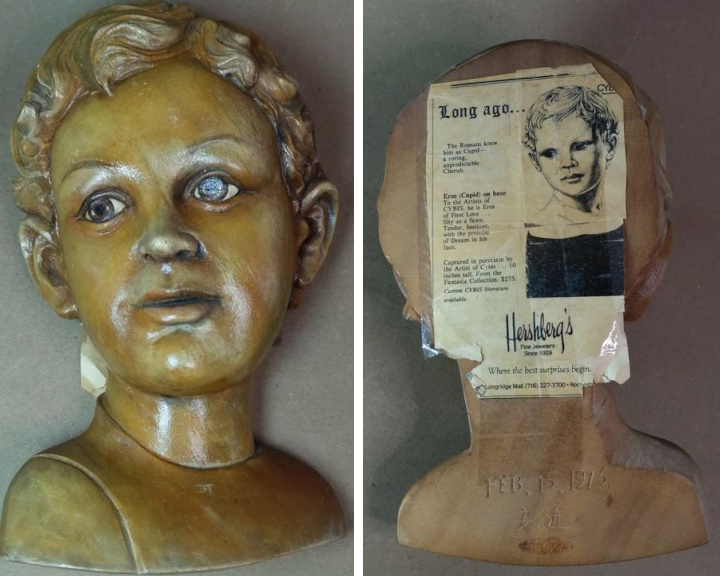 Although this is not a direct-from-mold copy, it is close enough to show clear intent. This 1976 offshore knockoff in what looks like wood(?) definitely fooled someone more than once, because the Etsy seller who offered this described it as an “antique art deco era cybis porcelain” – none of which is true. It looks as if the Hershberg’s newspaper ad for an actual Cybis Eros has been taped to it for a while, and I will give the Etsy seller the benefit of the doubt and assume he/she acquired it that way. However, there’s no excuse for describing a a dated 1976 item as being “antique art deco” and it’s also clear that the material is not porcelain!

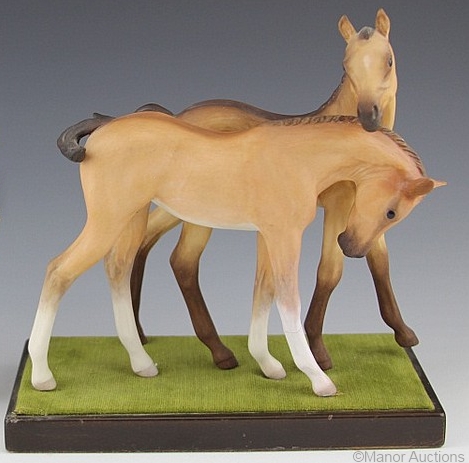 This Japanese knockoff of Darby and Joan is the first equine copy that I’ve spotted. There is no manufacturer name on the underside; only a stamped design number (A399) and a small foil Made in Japan sticker. Unfortunately, it was listed on eBay purporting to be the actual Cybis piece, and sold for an undisclosed amount under $200. I hope the purchaser was aware of what they were actually buying!

 Although these aren’t technically Cybis knockoffs, I’m including them here because of the way they were offered for sale. The curl at the girl’s forehead, indicated by the red arrows, proves that these were cast from the standard Holland Mold Company molds instead of being pirated from the actual Cybis sculptures. However, the auctioneer’s lot was titled “4 Cybis Bisque Porcelain Head/Busts of Boys and Girls” and their rather wonky description was
“Wow! We have four porcelain busts, consisting of two boys and two girls. These are CYBIS porcelain heads and our [sic] mounted on a ceramic base. These came from an estate and painted from [sic] a local late Cheshire Connecticut artist. The eyes and lips have been painted and quality products, with all figures having blue eyes, and if you should choose, you may finish each head with your own color scheme. Head/bust measures approximately 6 inches in height and the base of each is a 5×5.”
First of all, these aren’t “CYBIS” heads, they are Holland Mold heads! Second, they appear to be chalkware rather than porcelain. On the underside of each base is inscribed the name Viv (the artist, we assume) and two of them also have a year (1970.) Anyway, the point being that things like this should never be described as ‘being’ a Cybis anything. They are Holland Mold hobbyist-made heads, 100%, no question, case closed! (yeesh)
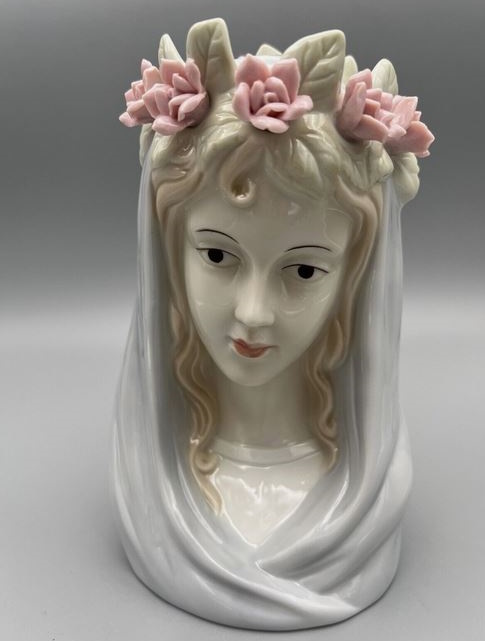
 Here’s an unusual twist: A very obvious knockoff of the Cybis Queen of Angels, and also given a different name: “St. Theresa of the Flowers.” The George Good Corporation was an importer from the late 1950s until 1985 when the founder retired and sold the company. This was likely one of their earlier retail offerings.

 It wasn’t only Asian-based companies who occasionally copied Cybis designs. This Royal Doulton piece called ‘Knight of the Crusades’ is a slightly-adapted Sir Henry, the Knight because of the chronology. Royal Doulton introduced it in 2009 as limited-edition design #HN5371 and credited it to an artist named Shane Ridge; this mold is 16.75” high. The edition size isn’t known. Then in 2013 they produced an identical but downsized version (only 5” tall) as an edition of 2500, design #HN5657 with the artist now shown as Peggy Davies. That said….I was told by a former Cybis employee that the 1980s Sir Henry was itself an adaptation of an already-existing piece, although the person could not recall who manufactured the original!

 This glazed copy of Alice in Wonderland has no manufacturer’s name anywhere on it, which probably means that it was sold with only a small gummed sticker to identify the commercial maker. It showed up in a 2025 online estate sale, mistakenly identified as Cybis. The actual Alice, in the second photo, is the earlier version which has the more delicate lace trim.


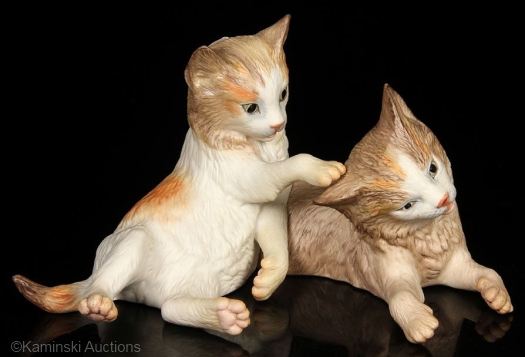 A helpful Archive reader alerted me to this knockoff of Ruffles and Truffles and I must admit that this is one of only two knockoffs that were actually done pretty well, the other being the aforementioned Court Jester. The third photo is the actual Cybis piece; it illustrates how the fur-painting is the downfall of the knockoff. But as for the casting, I am downright shocked at how good the forger’s molds are. This is a better copy than anything else shown in this post, by far (other than Mr. Snowball who is ridiculously easy to copy.)
 It’s a shame that the only identifying mark is the made-in-Taiwan sticker, because I am now morbidly curious as to what company went to such lengths to manufacture the reproduction mold so precisely. It’s obvious that they had an actual Cybis piece to start from, and I’m wondering whether a scanner and 3-D printer were involved in the mold-making process. Many thanks to Benji Parker of B&D Vintage Goods for bringing this reproduction to my attention!
Name Index of Cybis Sculptures
Visual Index (for human figures/busts only)
About the Cybis Archive
What is Cybis?
Images of Cybis porcelain sculptures are provided for informational and educational purposes only. All photographs are copyrighted by their owner as indicated via watermark. Please see the copyright notice in the footer and sidebar for important information regarding the text that appears within this website.
The Cybis Archive is a continually-updated website that provides the most comprehensive range of information about Cybis within a single source. It is not and never has been part of the Cybis Porcelain studio, which is no longer in business.
 THE CYBIS ARCHIVE