
One of the most enjoyable things about creating the Cybis Archive has been hearing from readers who have questions about Cybis or information to share. This is particularly true in regard to the 1940s and 1950s pieces, many of which were either never documented by Cybis or their original information has been lost. An especially fascinating and lovely example has come to light, thanks to a helpful reader, and I immediately knew that she deserved her own Archive post.
The Cybis lady in question is definitely from the 1940s and is a stellar example of the “bridge” between the Cordey items and what most people today recognize as Cybis. But let’s begin with some photos first, and then move on to a more detailed discussion of her very interesting qualities. I must say that in my opinion she has the most beautiful face that I have ever seen on either a Cordey-marked or Cordey/Cybis marked piece.
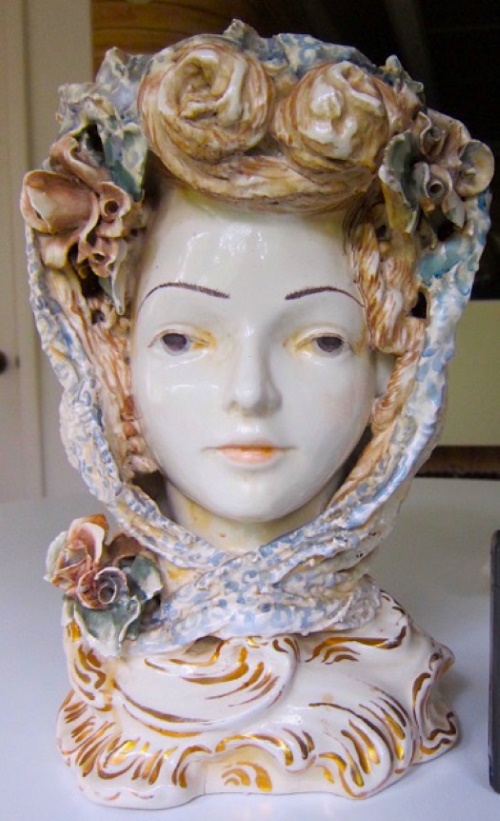
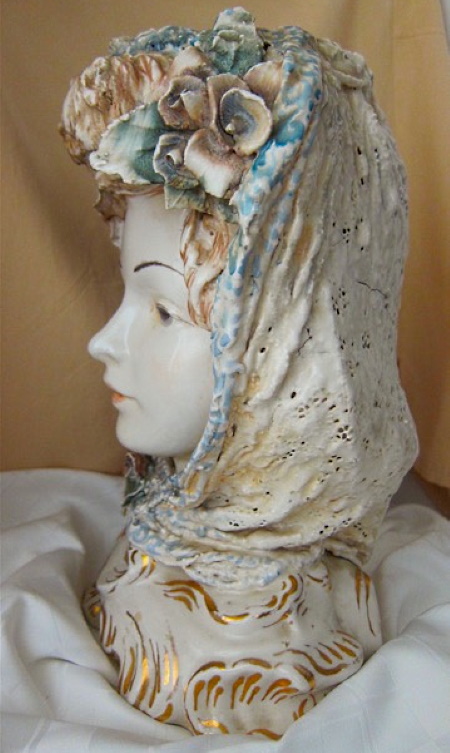

 She is about 13 inches high overall, and her owner describes her as being quite heavy. She is about 8 inches across at the widest point. Now let’s examine her more closely!
Face Sculpt and Painting
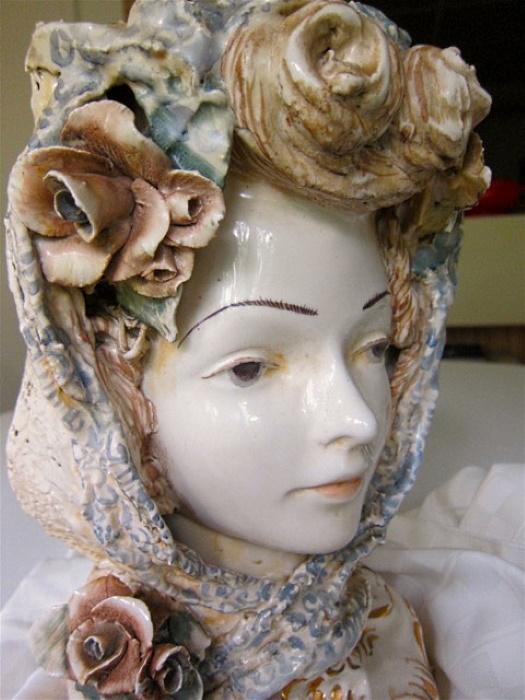 To my eyes, the painting on this lady’s face resembles several of the later Golden Age (1960s-70s) Cybis portrait busts such as Juliet. There is a serenity and elegance about her face that Cordey busts normally don’t achieve.
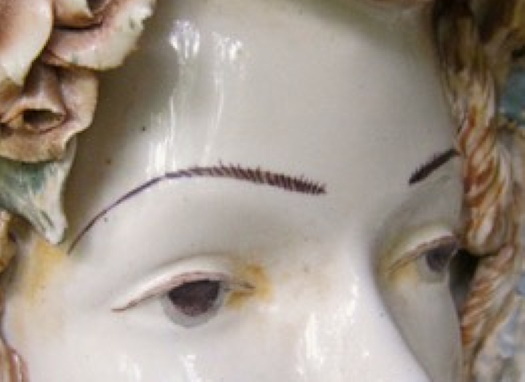 Even her eyebrows show attention to detail.
The Signature
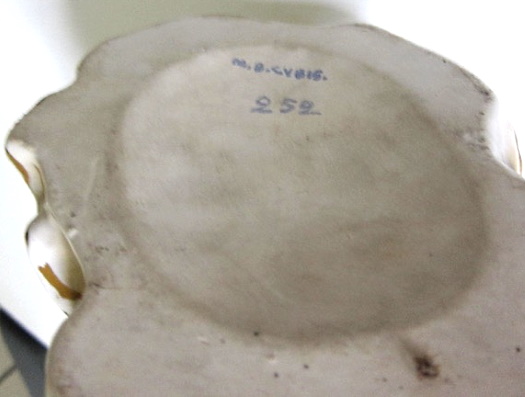
The first of several surprises is that she is signed M.B. Cybis and also has what appears to be a design number: 252. While she is not the only Cordey-esque piece to be marked M.B. Cybis either instead of or in addition to Cordey (there is no Cordey mark on this bust), she is the first that I have found to have this much of a “Cybis look” to her face. The 252 immediately presents us with a mystery, because it doesn’t correspond to either the Cordey or Cybis design-code assignments. This post addresses the question of numbers appearing on some M.B. Cybis items.
Dipped Lace
This lady wears the “dipped lace” accessory that the studio used on many of their Cordey items. The process was relatively simple: A piece of lace was dipped into a vat of liquid porcelain (“slip”) mixed to a thinner than normal consistency, and then draped around the greenware bust or figure as desired. When the piece was put into the kiln for the bisque firing, the high heat would vaporize the lace and leave only the porcelain coating behind. Voila! Porcelain lace. The same technique was used for pieces of solid fabric as well. Our 1940s lady wears a dipped-lace headscarf with a solid-fabric edge trim.
 This photo illustrates what can happen if the ‘slip’ coating on the lace is not completely uniform. In fairness, it was probably very difficult for the caster to get the process exactly right every time and I’m sure some lace pieces worked better for this than others. Anyway, the result can be areas where the porcelain ends up thicker as a result of “drips” and perhaps a bit more prone to cracking where those sections overlap. Such may have been the case here, or maybe someone put just a bit too much pressure on that area when handling it one day. A professional repair could possibly be made, using very thin “slip”, but it would still probably be noticeable because it would be unlikely to match.
Turning for a moment to the solid-fabric edge, the same painted blue-curlicues design has been seen on some other Cybis pieces.
 This madonna bust has been seen in two colorways, the other having brown hair and a darker blue paint for the design. Sadly, no signature photo was provided for either, so we don’t know how either of them are signed.
Another Surprise
Our mystery lady has another surprise in store: She is “topless” (in a very civilized way)!
 This view shows that she was cast with an open top. One can clearly see how the solid fabric strip was pleated and tucked inside for the firing process. There is no evidence of breakage or glue along the top, so it seems that she was made that way. Is it possible that she was intended to be a vase? (a mental picture that I am immediately dismissing!)
Similar Pieces and Dating
So, where does this pretty girl fall in the chronology of 1940s Cybis pieces? We have seen three of her “sisters” already, here and there.
 This 1945 ad from the B. Altman department store has a sketch of a bust on the identical base, cited as being by “the artist Cybis” ….. note that Cordey is not mentioned, despite the fact that Cordey-branded items had already been on retail shelves for two or three years.
 Here’s a hatted lady on the same base. Unfortunately, there was only this one small photo and a very short description mentioning an M.B. Cybis signature and the same physical dimensions as our dipped-lace belle; her face sculpt is also the same although IMHO not as nicely painted. Her hairstyle (bangs) appears to match the one in the B. Altman ad sketch. Of course, I’m now dying of curiosity as to whether there was a design number on this one and, if so, what it was.
 And lastly, we have another ‘sister’ bust…..as a lamp! The face sculpt and base are the same, and luckily the old description gave a tiny bit more information as well as a signature photo: M.B. Cybis and although not seen in the photo the description mentions a number: 105. The fact that she has an open top was mentioned although not shown. Notice the round hole in the base which is absent in the lady being profiled here. I would guess that a candelabra bulb might fit through it? The seller noted the height as being about 16” overall. It must have been quite heavy! This remains the only lamp that I have seen to date that is marked Cybis in any way; lamps were very much the Cordey-operation thing.
In any event, this lovely bust is a wonderful early Cybis retail sculpture and I’m very grateful to her owner who shared her with the Archive and the world at large. She certainly deserves the spotlight!
Name Index of Cybis Sculptures
Visual Index (for Cybis human figures/busts only; no Cordey)
About the Cybis Reference Archive
What is Cybis?
Images of Cybis porcelain sculptures are provided for informational and educational purposes only. All photographs are copyrighted by their owner as indicated via watermark. Please see the copyright notice in the footer and sidebar for important information regarding the text that appears within this web site.
The Cybis Archive is a continually-updated website that provides the most comprehensive range of information about Cybis within a single source. It is not and never has been part of the Cybis Porcelain studio, which is no longer in business.
 THE CYBIS ARCHIVE