
It was rather a surprise when I recently realized that between the Cybis and Cordey studio operations, they produced 15 ducks in various designs and iterations from the early 1950s until the end of the 1980s. I honestly hadn’t thought that ducks were that big of a deal at Cybis, but they actually outnumber the arguably-more-popular owls. That prompted me to take a dive into the Cybis duck-pond.
The two biggest genres of 1950s-produced Cybis items were the religious and the bird pieces. Because they bought almost all of their molds from other companies during that decade, rather than designing new items in-house, they often relied on the painting details to separate one bird issue from another when both utilized the exact same mold(s.)
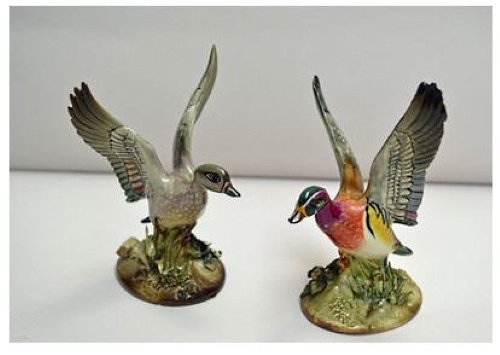 This is the basic “duck with open wings” mold that the studio used for several different designs. They are the same mold, just painted differently to represent a male and female wood duck. They are small: only 5” high and 4” across the wings.
 The 1979 Cybis catalog has this piece pictured as the Wild Duck. According to the Appendix it was made from 1957 to either 1960 or 1962 or 1963 (depending on which Cybis publication you read) in white ($50) and color ($60.) The size is given as 7” high and 6” wide.
 For this iteration the wood base and branch are gone, in favor of a porcelain base decorated to resemble a pond. I can’t come up with a species match of a dark cap + these body colors, so it’s best to simply call this the Wild Duck at Waterside. My guess is that it was made earlier than the Wild Duck on the base, e.g., early to mid 1950s.
 So, from this open-winged duck mold we get three glazed Cybis pieces: male Wood Duck “in grass”, female Wood Duck ditto, and Wild Duck at Waterside. These are probably from 1953-1956. We also have a fourth and last iteration appearing in 1957, on a branch and wood base, possibly in a bisque finish.
The studio also bought another duck mold from Holland Mold Company which they turned into two double-duck issues.
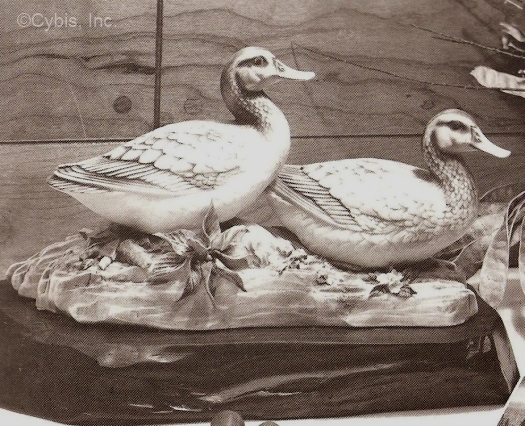
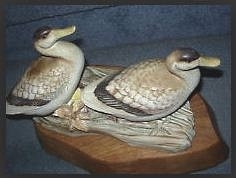 This is the 1979 catalog image of the Golden Mallards which also appeared in that very ducky year, 1957. Supposedly these were only made in color, which the smaller photo of an actual piece illustrates. (I hope to find better photos of this one someday.) It is two of the same Holland duck mold, placed on a base mold which they also sold, and then atop a wood base. This piece sold for $125 until its retirement in 1962. Oddly, the appendix says this piece is a “pair” even though both are on the same base and not two different sculptures. Due to the double bases it is 11” high and 12.5” long.
There is no actual duck species of “golden mallard” but it is a color mutation of the typical mallard. The painting pattern appears the same as the Wild Duck at Waterside, so perhaps that one was meant to be a ‘golden mallard’ also. The Cybis design number for this piece/this name is 303M (the M indicating Mallard.)
The studio also painted the same piece differently and issued them under a separate name, Teal Ducks, during the same time period and for the same price. The actual retirement year was either 1960 (as per Cybis in Retrospect) or 1962 (as per the 1979 catalog.) The design number for the Teal Ducks colorway is 303T (for teal.) I’ve never seen a color photo of these but would like to, for comparison purposes to the Golden Mallards.
The 1973 catalog has a one-page, text-only list of names of some known Cybis sculptures; it includes a Pintail Duck but of course with no other details. Given the requisite sharp narrow tail, this piece should be easy to identify if one should ever show up on eBay or elsewhere! I do wonder whether the studio simply modified either the wings-out mallard or the swimming mallard/teal mold to give it a narrow, pointed tail!
After the 1950s ducks were retired, the studio introduced four original-design Cybis ducks, including just one limited-edition design.
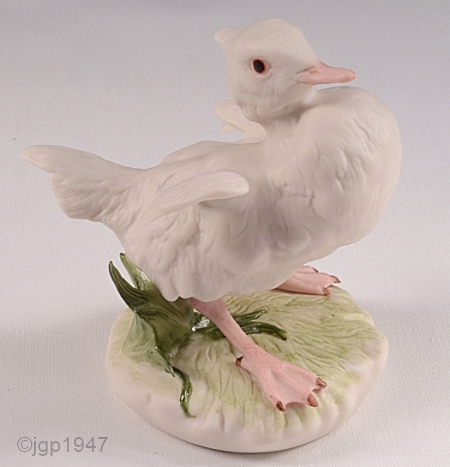 The first ‘modern’ Cybis duck was Duckling ‘Baby Brother’ who is 4.5” high and hatched in 1962 at $35. He flew off to retirement in 1979 at $95. A 1960s Cybis catalog captions his photo with the statement that he is an “adorable baby merganser”, but he cannot be that because merganser ducklings are not white: Their juvenile feathers already have the patterning typical of the species. His bill is also the wrong shape for a merganser. However, he is very cute!
 The Wood Duck was the most colorful and also the only limited-edition duck that Cybis made. Seventeen different paint colors were required for this piece, which is 10” high. The edition of 500 debuted in 1968 and was completed in 1972, at $325 throughout.
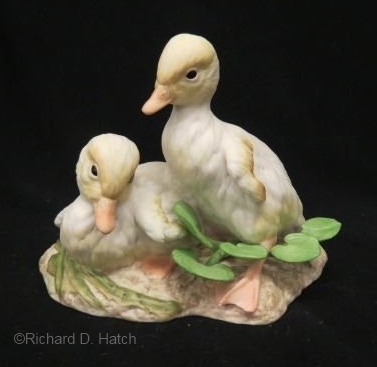 During the 1970s, Cybis made several two-bird (and two-animal) pieces. For the ducks, it was Ducklings ‘Buttercup and Daffodil’ in 1977 which was introduced at $165. This piece is 5” high and remained in the studio’s retail lineup for almost 20 years.
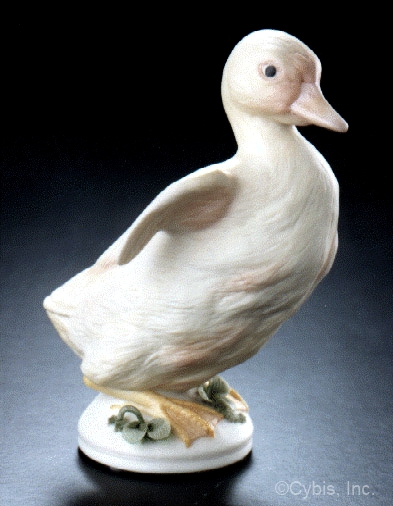
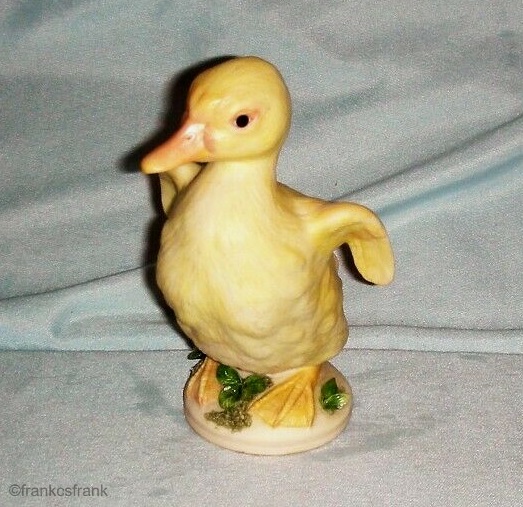 The final Cybis duck appeared after the “twins” had been retired. Similar in design to the previous duckling issues but not from the same molds, this was called Baby Duckling on the studio’s 1989 price list. Unlike the earlier designs, however, this one was apparently made in two colorways: white or yellow. It’s also possible that a color change was done at some point after introduction. His issue price was $150 and he is 5.5” high. Because this was introduced in 1989, they should theoretically bear the special 50th Anniversary backstamp; unfortunately the seller of the yellow one did not provide a photo of the signature area.
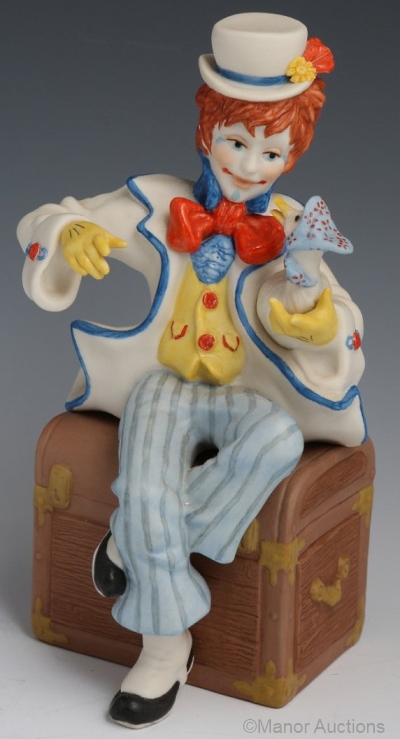 Honorable mention, for a duck as a secondary element in a human piece, goes to the feathered little lady who shares the spotlight in Jumbles and Friend. This was originally a limited edition in 1985, whose unusual story will be the subject of a future Archive post.
Clearly, the Cybis studio did a quackerjack job in making the most of the duck molds they began with in the 1950s. Although the painting of some examples can make species-identification confusing, it’s fairly easy to quack the case without using fowl language. And if you do decide to ever go quackers over collecting Cybis ducks, at least they will be a silent flock that won’t wake you up at the quack of dawn! Wouldn’t that be just ducky?
Name Index of Cybis Sculptures
Visual Index (for human figures/busts only)
About the Cybis Reference Archive
What is Cybis?
Images of Cybis porcelain sculptures are provided for informational and educational purposes only. All photographs are copyrighted by their owner as indicated via watermark and are used here only as reference material. Please see the copyright notice in the footer and sidebar for important information regarding the text that appears within this website.
The Cybis Archive is a continually-updated website that provides the most comprehensive range of information about Cybis within a single source. It is not and never has been part of the Cybis Porcelain studio, which is no longer in business.
 THE CYBIS ARCHIVE