
The most important elements in authenticating a sculpture that appears, or is claimed, to be Cybis involve the painting/decoration, mold impressions, and applied marks.
Painting and Decoration
This is the subtlest factor in determining whether a piece of Cybis is genuine and is the most challenging to master. The more Cybis sculptures one sees (if not in person then by careful study of photos of genuine pieces) the easier it will become to recognize the style of painting which has been typical of Cybis through the decades.
There is a very specific and consistent use of colors, tints, and above all the detail of faces and clothing that can only be described as “the Cybis look”. And if there is one area that is make-or-break, it is how the eyes, lips, and face tints are done… most especially the eye area. There is a delicacy and accuracy of touch, and a consistency of style, that identifies a Cybis piece. If an artist could not produce the traditional ‘Cybis face’, that artist was not employed there very long.
There are a couple of style characteristics that have remained consistent throughout the studio’s history. These are:
(1) Gold paint is not used for facial features (lips, eyes, or eyebrows.) There are, however, some 1950s religious pieces in which all of the figure’s exposed skin is covered in gold paint.
(2) Upper eyelashes are not painted as individual hairs; instead, they are merely suggested by a thin solid line along the upper lid and resemble eyeliner rather than eyelashes. Lower eyelashes are not drawn or indicated at all. However, one circa-1950s exception to the ‘no painted eyelashes’ rule can be seen in the Angels post, although it’s not known how many others (if any) were painted in that way.
Cybis sculptures fall into one of three main (as named by Cybis) categories of decoration:
“Bisque” (aka “white bisque“) = plain white matte surface throughout, with absolutely no applied color. It should be noted, though, that the bunny Mr. Snowball was categorized by the studio as a “bisque” sculpture even though he has very pale pink eyes. There is no other color anywhere else on the piece.
“Bisque with Gold” (aka “white with gold”) = This category of decoration appeared in the late1980s within the second Nativity set, which was available in both a color version and one in which the only color applied is gold leaf. This technique was subsequently used for the Collectors Society pieces in the mid 1990s.
“Decorated” (aka “bisque decorated” or “color”) = a sculpture that has a color, a tint, or gold leaf applied to the original plain white bisque ground, in any quantity or location. The surface is still matte (with the exception of any 24k gold paint decoration which by its nature is not a matte surface; a large gilt decoration such as a crown may also be lightly glazed). The majority of Cybis sculptures are of this “decorated” type but quite a few were made in both white bisque and decorated versions. The white bisque version was almost always less expensive.
“Stained glass” = this was the 1950s Cybis studio’s term for what most people would call a glazed porcelain. It is shiny and smooth to the touch. The glaze is applied to the entire sculpture, not merely to specific parts of it, and it is highly fired. The piece may also be decorated with gold as well. Sometimes the colors are deeper and richer than the more typical shades. Many of the small madonnas and saints done as special commissions for local churches were done in this type of decoration, with gold paint also decorating a halo, a cross that the figure may be carrying, and so forth. The stained-glass style of decoration was used far less often on retail pieces than the bisque (matte finish) styles. However, many of the sculptures dating from the early to mid 1950s have the high-gloss/stained glass finish.
There was also “Cypia” which was only used during the 1950s. It was a form of stained glass decoration in which the contours of a white bisque sculpture were subtly highlighted with a soft sepia-tone paint in order to give them even more dimension; the piece was then glazed and re-fired.
The 1970s Cybis catalogs describe a decoration called “old coin gold” which was the gold decoration with the addition of a Cypia tint in order to create a specific finish, and that this technique was developed by the Cybis studio. This, too, was only used during the 1950s.
If a piece has applied decorations such as flowers, ribbons, and so forth, this is another area that is usually difficult for a copyist to imitate successfully. It takes great skill to properly fashion those elements.
Mold Impressions
The location of the mold impression(s) varies by sculpture and there are sculptures – especially the 1950s ones – that have no mold impression at all. A few of the late 1940s or early 1950s pieces have a convex (raised) mold mark; later mold impressions are concave (recessed into the surface.) Examples of raised mold marks discovered thus far are the Eagle Mark, the Overlapping Double C mark and, in at least one instance, a raised Cybis signature. See the Signatures post for photographs of these.
On pieces that are not attached to a base and have a flat underside offering sufficient available space, the mold marks are often on the underside.
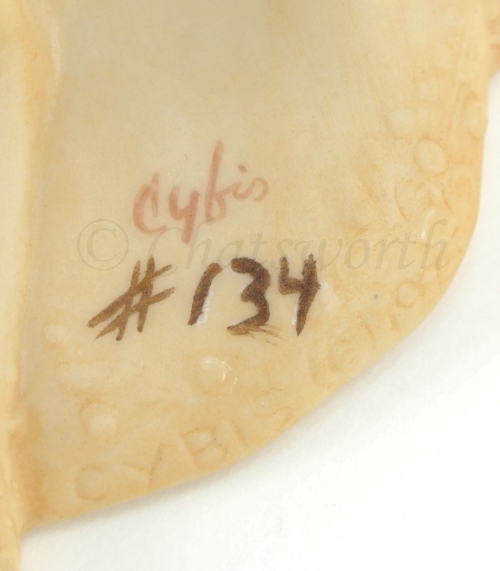 However, this is not a hard and fast rule because quite a few pieces have their mold impression elsewhere (such as on the hem of Lady Macbeth’s skirt, where three impressions appear along the edge as shown here). All sculptures that are attached to a base are designed so that the mold impressions are in a visible location. Likewise any design produced with felt covering the entire bottom will also have the mold marks elsewhere.
The mold impression of the Cybis name is in block capitals. Depending on the piece, the mold may or may not also bear the copyright symbol impression but none of the 1940s or 1950s items will have that. Quite a few of the 1980s and/or 1990s editions are also marked either USA or U.S.A. in the mold.
 You may also find — again according to the specific sculpture — one of several versions of the Cybis logo which is a stylized phoenix. The exact shape of the phoenix has evolved somewhat over the decades but until the late 1980s both wings were outspread and visible; the latest iteration depicts the bird in profile, flying to the left, as shown here. Again it is the newer sculptures that are the most likely to have one or both of the latter two mold impressions; older pieces were often made with simply the Cybis name impression.
Some sculptures (not all) also have a year mold-mark. This represents the year that the sculpture design was copyrighted, which may be a year earlier than the actual retail introduction year. It does not indicate the year in which that individual piece was actually created in the studio. This is an important point to remember when dealing with long-running open editions and limited editions that can often take several decades to be completed. The studio also re-purposed some pieces that had been retired long ago, but never changed the copyright-year impression for the newer ones. It is impossible to know, by its impression or markings, the year in which any individual sculpture was actually made, in other words when it left the hands of the Cybis artist.
Thus a given sculpture may possibly have as few as only one mold impression (the Cybis name) or as many as five (the Cybis name, the copyright symbol, a year, USA or U.S.A, and the phoenix logo).
The Cybis Signature
Any given Cybis sculpture design may have any combination of signature, limited edition number, or in-the-mold impression(s). The location of the Cybis signature will vary by sculpture but it will always be in the same location in all such pieces. For instance the signature appearing on all of the original 1960s/70s Head of Girl sculptures is always located behind her left shoulder: It will not be in the center, nor behind her right shoulder, nor in the area where her arm would be if the bust was longer. The signature on the Baby Harp Seal is on the underside of the piece. The signature and sculpture number on Lady Godiva are found on the undecorated side of the part of her horse’s trappings that touches the ground, even though that area faces the viewer (an atypical location for a markings, which normally are on the “back” or on the underside, but on that particular sculpture that is where it always occurs); it will never appear on the shorter end of the trappings nor on the end of the horse’s tail. And so on.
At some point the Cybis studio began adding U.S.A (sometimes written USA with no periods between the letters) to the painted signature on some sculpture designs. Not all designs will have this designation and its absence should not be cause for concern. It is unusual to have the entire phrase “Made in USA” written by hand in paint but it has appeared on at least two designs thus far. Pieces with Trenton N.J. in the signature area are typically from the 1980s or later.
 This circa-1950s piece is the only one that I have so far seen with a paint-stamped ‘Made in U.S.A.’ The Cybis name is also stamped, as is the copyright symbol.
2020 Update: Please see this newly added post describing new signatures added to old pieces, and vice versa, as a result of actions the studio took in the 1990s and 2000s.
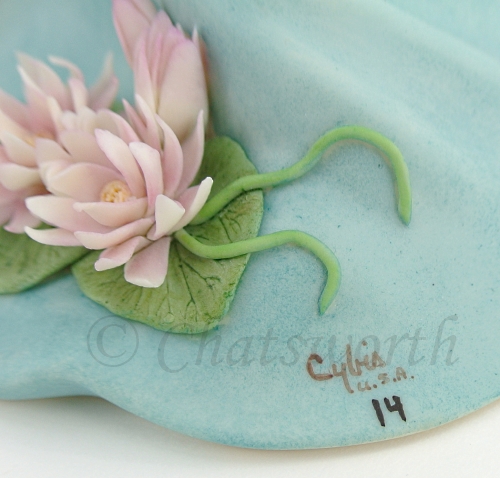 The actual number on a limited edition sculpture can be written either with or without a # symbol preceding it; either is legitimate. The previous photo of the Lady Macbeth markings shows the # symbol preceding the number, while the example above (on a Lady of the Lake) designates that the sculpture is number 14 of that limited edition. The lack of the # symbol is no cause for concern.
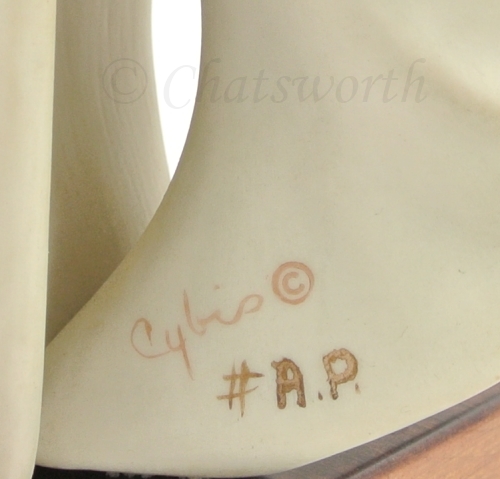 Likewise, an artist’s proof sculpture can be designated with either an AP or an A.P. … even, in at least one instance, written as # A.P. , as it appears on this genuine artist’s proof. However, it was never marked with the word “proof” or “sample”. However, do not assume that A.P. means that the piece is a so-called artist’s proof; see this post for the many different things that those letters on a Cybis piece can actually mean (it does NOT indicate a true artist’s proof by the actual definition of the phrase.)
Another signature factor is paint color. With only a few exceptions, all signatures on post-1960 Cybis are painted in some shade of brown or occasionally in metallic gold, although some 1950s signatures were also done in blue, black/dark charcoal, or red which may fade to a dull pink. Signatures and Marks includes examples of these older paint colors. One exception to the ‘modern browns’ is the Twelve Drummers Drumming holiday ornament issued in 2000, at least one of which was signed in green paint; the Signatures post includes a photo of this.
On limited editions it is very common for the sculpture number to be in a darker shade than the Cybis name; this does not indicate a fake or a fake limited edition, it is simply because the numbering is always done as the absolute last step in its production after the last firing. The only legitimate metallic paint signature color is gold and even that is not often seen. Gold is most often used when the signature must be on the sculpture (rather than the underside) and the color of the sculpture itself is in shades of brown. Whether or not the painted signature appears immediately adjacent to any mold impressions is something that will vary between sculptures and is often based on the available space for it on that design.
Lastly, please remember that the sculpture number (or A.P.) is not fired onto the porcelain as all of the other colors were. This means that it can be removed by cleaning, especially if a strong cleanser or vigorous rubbing is employed.
Fake Cybis Markings
The following is a list of illegitimate markings. If any of the following designations appear on the sculpture, it is not an actual Cybis.
Suspicious and/or Fake Marks:
“Made in America”
“Made by Cybis” or “Made in USA by Cybis”
Limited Edition or Ltd Ed or Ltd. [an exception to this general rule is the hand painted LE followed by the pound sign and a number which has appeared on at least two examples of Scheherazade.]
“Cybis China”, as this exact phrase on a single line and not including the word “Fine” anywhere. A blue paint samp that says “Cybis Fine China” IS legitimate.
“Cybis Ltd”
“Fine Porcelain” [definitely indicates a fake]
the phoenix logo as a paint stamp rather than freehand or mold impression
and finally,
the actual word porcelain anywhere on the piece.
There is a separate Hall of Shame post devoted to Cybis copies and knockoffs.
Name Index of Cybis Sculptures
Visual Index (for human figures/busts only)
About the Cybis Reference Archive
What is Cybis?
Images of Cybis porcelain sculptures are provided for informational and educational purposes only. All photographs are copyrighted by their owner as indicated via watermark. Please see the copyright notice in the footer and sidebar for important information regarding the text that appears within this website.
The Cybis Archive provides the most comprehensive range of information about Cybis within a single source. It is not and never has been part of the Cybis Porcelain studio, which is no longer in business.
 THE CYBIS ARCHIVE