
Cybis had differing motivations when it came to doing color variations on certain sculptures, and it can cause considerable confusion when seeing (or selling) them in the secondary market. This is because a color variation may have been done for any one of several purposes.
(Note: This article does not apply to the Hall of Fame sculptures which often have different colors, but they will also be a slightly smaller overall size than the original piece upon which it is based.)
Gallery Event Color Variant(s)
As explained in this 2021 Archive post, one possible reason for a color variant is that it was a special edition produced for a retail gallery event; none of them appear in any official Cybis publications.
 This is the standard-color open edition called Young Rose, who is 9” tall and was introduced in 1987, into a one-time category rather wordily called the “Lovely Lady/Wedding/Sweetheart Collection” as Young Rose (Bridesmaid). Her issue price was $295. The 1988 price list put her into the studio’s new stand-alone Wedding category at $325 and identifies her only as Young Rose. By 1993 she had been shifted into Children to Cherish for $375, even though she is clearly NOT a child.
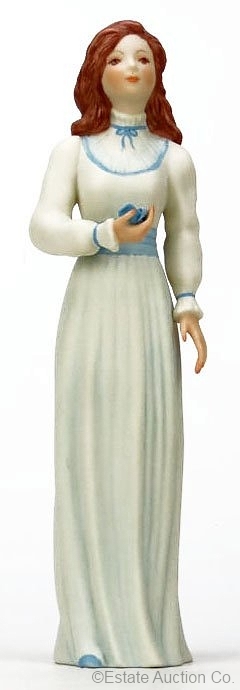
 This is the blue variant that was done for a retail gallery event in 1996 and made available to attendees as an edition named Roberta because the first ‘event’ retailer that year was a store called Roberta’s Gallery. Some (not all) of these were autographed T Rose (by Theresa Rose Chorlton, an owner of the studio) on the underside. Not all of the Roberta figures are numbered.
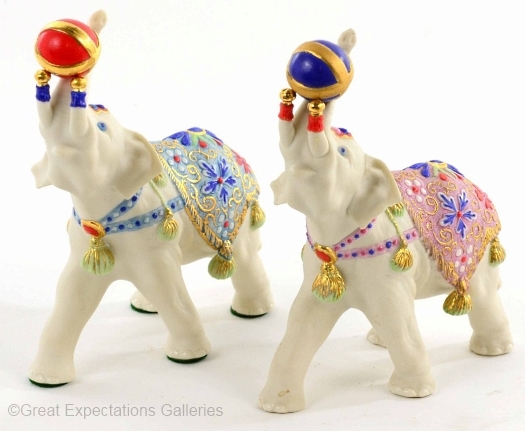
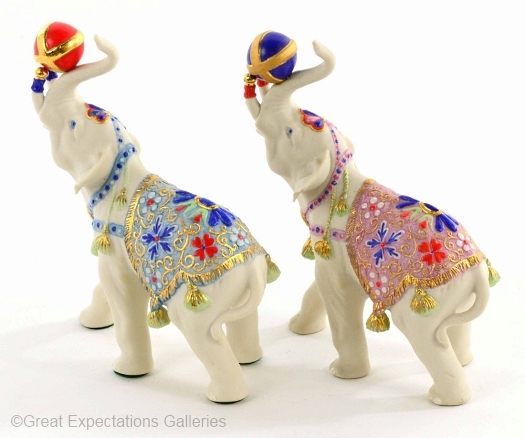 Another example is the circus elephant Alexander, He’s the Greatest! which is also an open (non-limited) edition standing 7.5” high and introduced in 1975 at $195. The normal edition coloration, shown on the left in both photos, has blue trappings and a red ball. But as you can see, Cybis produced a special edition color variant with pink/red trappings and a blue ball – although I have no idea who it was done for or why. It may have been another of the event editions.
In a similar but more rarified category are the OOAK (one of a kind) special editions that were occasionally produced. The most extensive example of this was the group of 50 different special sculptures created for a Children’s Cultural Fund benefit auction in May 1978 at the Garden State Arts Center in New Jersey. There seems to be no surviving complete list of this unique group of OOAK sculptures.
Same Retail Named Sculpture in Two Different Retail Colors
Cybis once made the same sculpture deliberately in two different colorways, both of them for retail release, but kept the sculpture name the same or almost so. This was the circus bear called Barnaby.
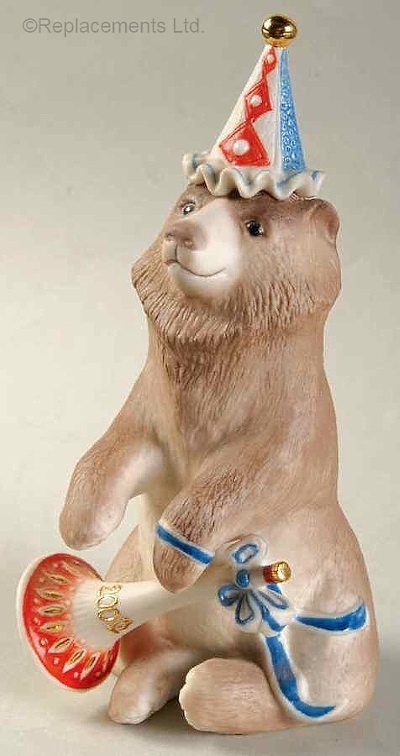 In 1975 this circus bear was introduced with the name Circus Bear, Barnaby as an open edition (7” tall) at a retail price of $125. Notice that his trumpet bears the legend “200th”.
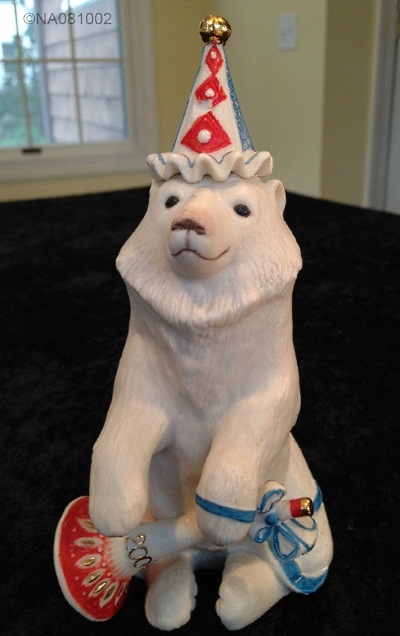 In the Spring 1976 introduction brochure Cybis offered this white version with the name Bicentennial Circus Bear, Barnaby which would be made in this colorway only during 1976 as part of the Bicentennial Collection. He is identical to the prior year’s Barnaby in every way (and now the 200th on the trumpet makes sense!) except for his fur color, and the two bears were priced the same. In 1977 the edition reverted back to only the original brown Barnaby (still with same trumpet) after which year the piece was retired; the closing price was $145. Significantly, the 1979 Cybis catalog does not list these as two separate sculpture names, but only as Bear, Barnaby having been made from 1975-1977.
So which of these two colors should be more valuable? Both were advertised and available to the general public and both versions were priced identically at retail; if someone went to a Cybis retailer in 1976 and wanted the brown Barnaby, they’d have paid the same price as for the white version. Both pieces have the Bicentennial-related 200th on the trumpet; there were no different marks or signatures on the white version. We have no way of knowing how many sculptures were made in each colorway. The only real difference was in length of production run for the colors: the brown Barnaby was available at retailers for three years (1975, 1976 and 1977) while the white version was supposedly only available for a single year (assuming no left-over white ones in retailer stock during 1977). This may give the white bear an edge value-wise but it probably is not a very large one. Personally I think the white Barnaby is more attractive but that’s just me. I do recall it being referred to colloquially by retailers and collectors as the “Bicentennial Polar Bear” at the time but Cybis never officially gave it that name.
Same Retail Sculpture in Two Different Colors and with Different Names
We have at least two examples of situations where the identical sculpture was made in two different colors and each one was given a different retail name. One is a limited edition and the other is not.

 The first example is from 1976, when Cybis introduced the same turkey in two different colorways under different names. The brown version was listed and sold as American Wild Turkey, and the white bird as American White Turkey. This is a different situation than being in “white bisque” and “color” because it is only the bird’s plumage that is done in the differing white. The edition size was 150 for each name; the sculpture is 12.5” high and 13” long. The retail price depended on the color: the Wild Turkey was $1950 and the White Turkey $1450. These were sold as two differently-named sculptures, not as white and color versions of a single design name. Information about the white turkey’s incorrect title can be found in the Later Birds post.
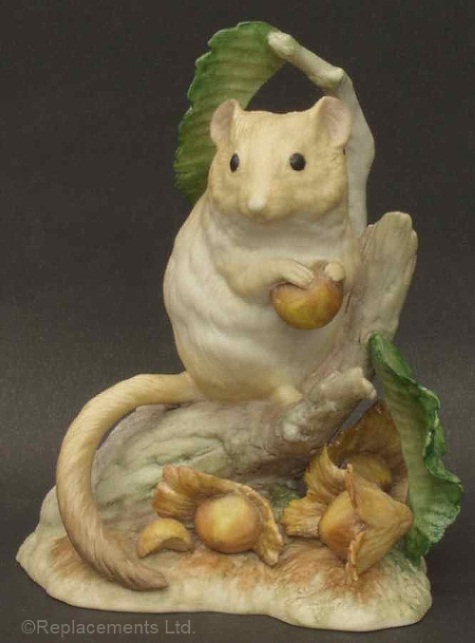

The same situation applies to Cybis’ dormice sculptures. In 1977 the 5.75” open edition Dormouse ‘Maximilian’ was introduced at $250; the following year (1978) his white counterpart Dormouse ‘Maxine’ appeared. She is identical to Maximilian except for fur color. As with the turkeys a couple of years earlier, Maxine’s white-fur version was slightly less expensive ($195).
Limited Edition in a Different Colorway, But is Not Marked as an AP
What about a limited edition that definitely differs from the normal color version of the sculpture but is not marked as an Artist’s Proof?
 This is the usual color version of the Folk Singer, a numbered limited edition introduced in 1967 and made only until 1974. The original declared edition was 500 but the edition was closed after only 283 were made. At introduction it retailed for $300 but when closed in 1974 this had risen to $650 – a significant increase.
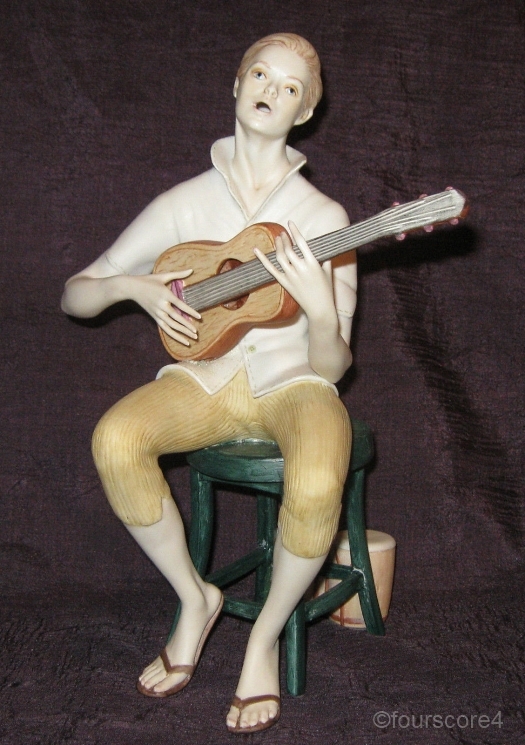
Some of these figures were produced with blue pants and others with yellow. The yellow ones are not a gallery event edition, because Cybis never used limited editions for that purpose. It’s possible that the sculpture was originally intended to have these yellow pants but for some reason after introduction the color was changed to blue. Cybis publications were not printed in color during the 1960s and so a color change would have gone unnoticed as far as advertising was concerned.
Limited Edition Piece in a Different Color, and Marked as an AP
This category is straightforward: a limited edition piece done in a non-standard colorway and marked as an artist’s proof.
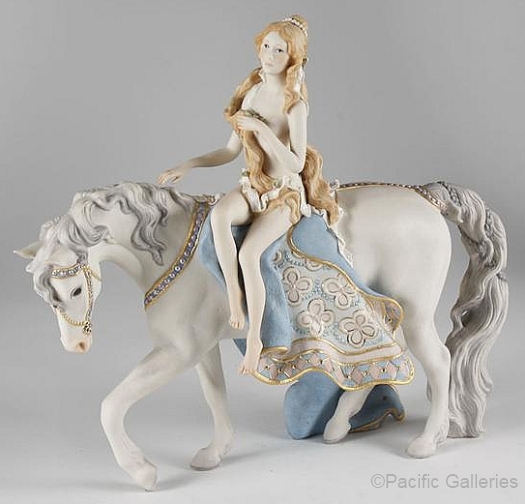 This is the normal color of Lady Godiva, a limited edition of only 200 sculptures, 13.5” tall, introduced in 1982 at a price of $1875.
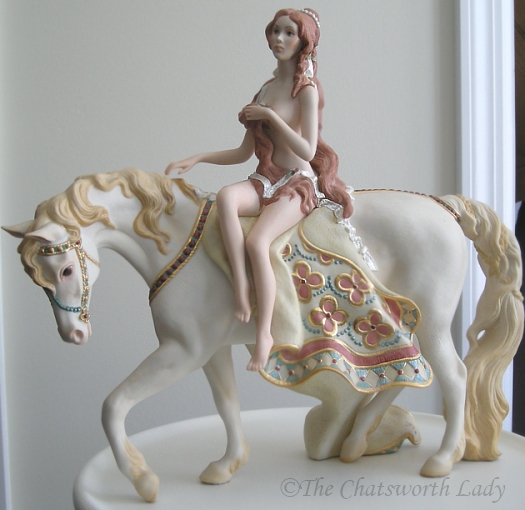 This is an artist’s proof of the same sculpture, done in a different colorway and marked as an AP. It is one of a kind.
As discussed in detail in the Market Values post, nowadays a difference in colorway does not really affect the piece’s value but is instead measured by personal preference.
Name Index of Cybis Sculptures
Visual Index (for human figures/busts only)
About the Cybis Reference Archive
What is Cybis?
Images of Cybis porcelain sculptures are provided for informational and educational purposes only. All photographs are copyrighted by their owner as indicated via watermark. Please see the copyright notice in the footer and sidebar for important information regarding the text that appears within this website.
The Cybis Archive provides the most comprehensive range of information about Cybis within a single source. It is not and never has been part of the Cybis Porcelain studio, which is no longer in business.
 THE CYBIS ARCHIVE