
Angels and cherubs emerged from the Cybis studio ever since its earliest days in 1940s New York where Boleslaw and Marja Cybis created their frescoes and sculptures. The angels below are listed chronologically. None of them were limited editions.
An intriguing group of six angels produced between 1940 and 1942 in “papka” composition was the Angelic Orchestra, which is so unusual that it has been given its own separate post.
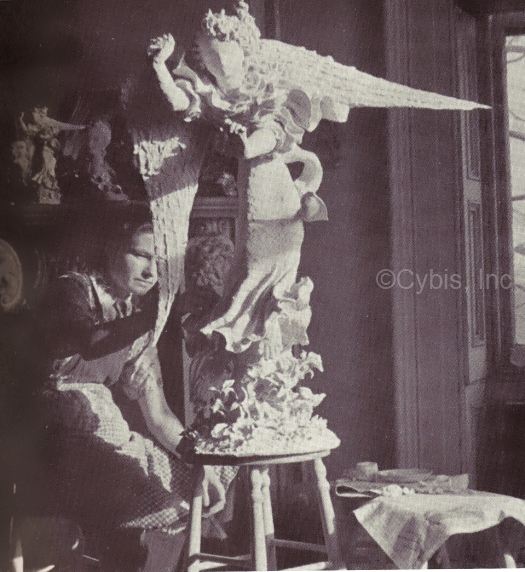 This photograph of Marja Cybis sculpting a large papka angel was taken at their first atelier within the Steinway Mansion in Astoria (Queens), NY. Judging from the photo, the angel must have been between two and three feet tall! However, on a background shelf appearing at the upper left of Marja’s head there appears to be a smaller version which is probably about a foot high.
That angel may well be the same one cited, but not illustrated, in the same catalog as Angel which is described as having a “pastel fresco decoration of soft pink, blue, mauve and yellow” – perhaps the same colors as the Angelic Orchestra – and being 11” high.
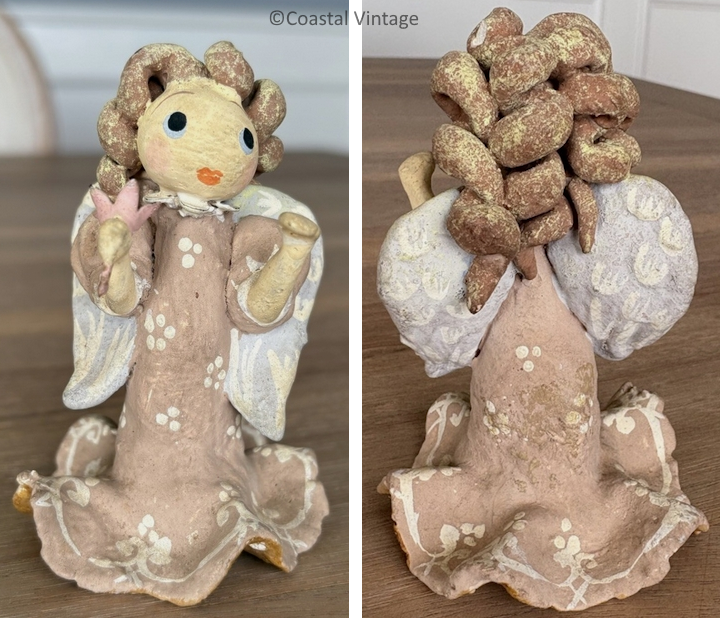
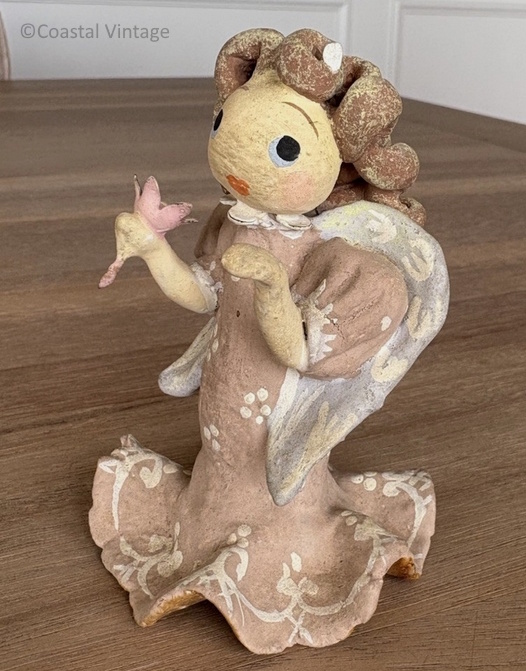
 A much smaller example is this Marja Cybis papka angel with flower who is only 3 5/8″ tall. She looks a bit distressed at having a chip out of her hair, don’t you think?


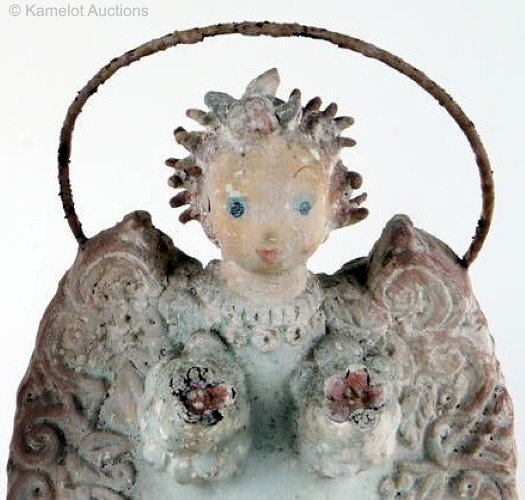
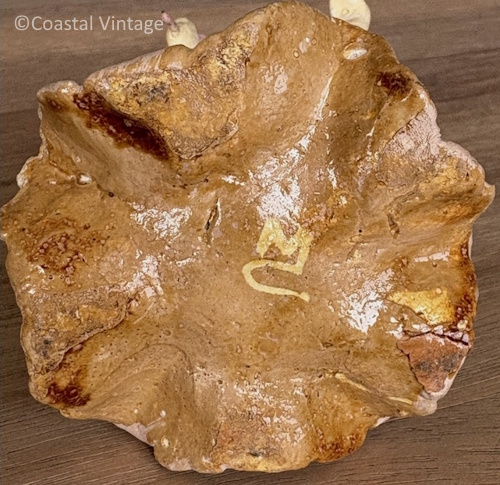
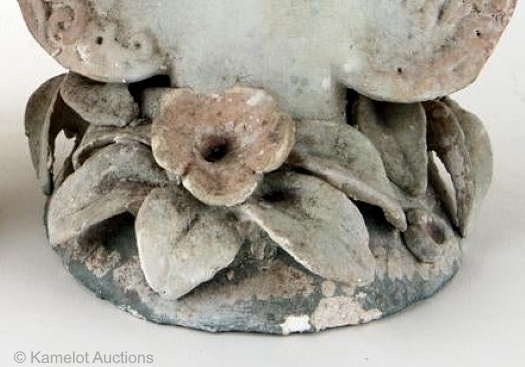 This may well be the piece that was cited as a papka Angel with Halo made in two sizes: 6″ and 8″. The style is very typical of many of the pieces made by Marja Cybis at that time. The signature on the back is a modern one that was added by the studio during a later decade.


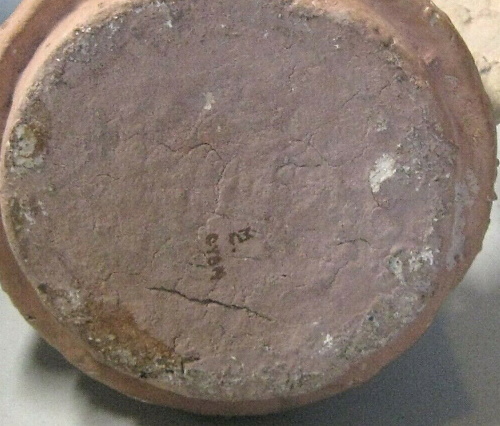 A decidedly larger angel bust with flowers and halo, also in papka, is signed MC (for Marja Cybis) on the underside. She, too, dates from the 1940s and is slightly more than 11″ high. Her wings make her 7.25″ wide.
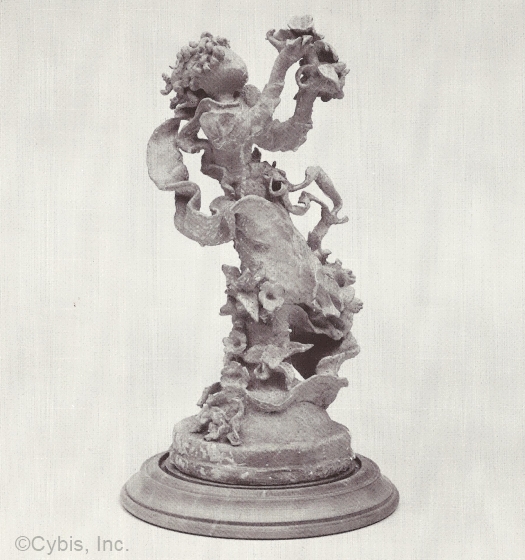
 This one is Angel with Flowers and stands 11”-12” high. The black-and-white photo is from the Cybis in Retrospect; the other is of the same piece during the 2000s and show that part of her ribbon sash was broken off in the years after the ca. 1971 Retrospect photo was taken. The papka pieces are very fragile and prone to breakage.
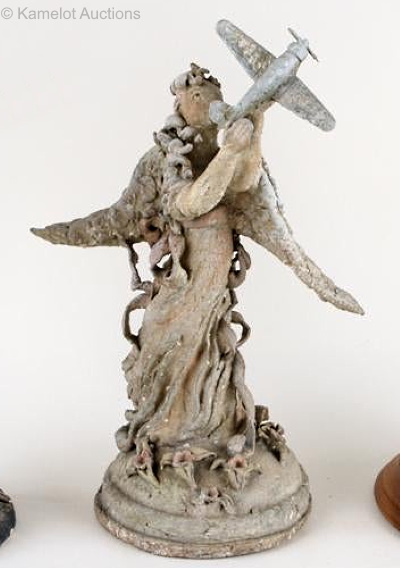

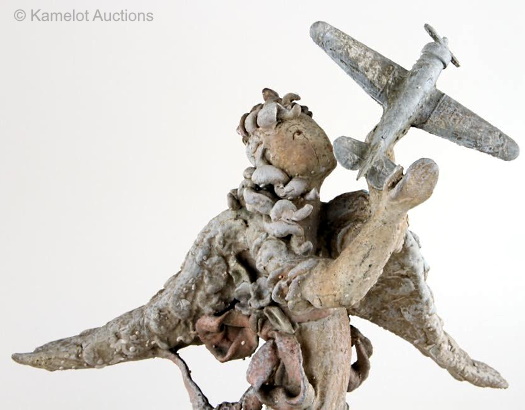 A somewhat bizarre papka angel with airplane was among the 1940s items in the studio’s final liquidation. It would be logical to assume that its inspiration may have been the outbreak of World War II. Notice, in the second photo, the modern Cybis signature and date that the studio later added to this piece which never originally had either. They began this practice during the 1990s when they began selling directly to the public instead of only through retailers.
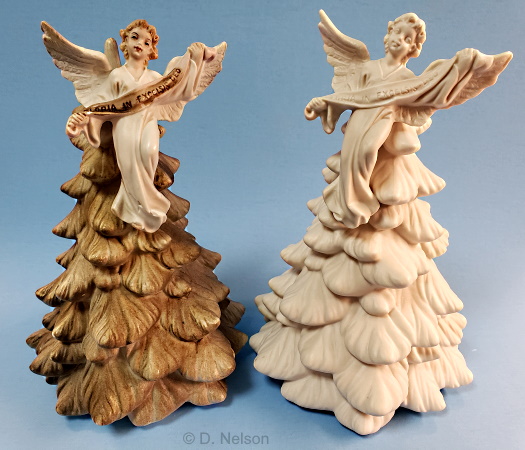 Moving into the 1950s, there is the Herald Angel that was part of the first Cybis nativity set from that decade and was attached to the upper part of a tree. The piece is 9″ high overall (angel + tree) and was made in color and in plain white bisque as shown. Both pieces are from molds that Cybis purchased from the Atlantic Mold Company. The angel by itself is about 5″ high.
 This pair of cherub heads was made to be hung on the wall and originally dates from the first half of the 1950s. They are signed with the “Cybis” and “fine china” stamps, both of which marks are typical of the studio at that time. The heads are 4.5″ and 4.75″ high, and 4.5″ wide. This was not a Cybis original design but was one of several that they purchased from local mold-making companies. Each head was given its own design number (233 and 234.) Some examples have the letter R appended to the design number; it is possible (although not certain) that this may have meant “with roses” – because some of these pairs have a rose added and some do not.

Another angel item for wall mounting was this pair of rococo cherub plaques. They are 6.75″ and have two holes/openings in the back for secure hanging and are stamped Cybis Fine China. The cherub holding ribbons (?) is design #266, while the cherub with the wreath is #267.
A recently discovered 1963 Cybis price list includes, under the Decorative Accessories heading, Cherub Heads, [size] 4″, $10/pair. This should be a slam-dunk identification for the above heads except for the fact that they are indicated as being available in plain white bisque only. Now, it may well be that the color version had been discontinued by that time; no cherubs survived into the 1967 price list which is the next one that I have. The design code for that pair is given as #735.
A one-page text/name only list of verified sculptures in a 1974 Cybis catalog mentions these cherub heads but also lists Angel Heads as a separate item. These could conceivably have been either wall mounted heads, like the cherubs, or perhaps busts. The fact that they are listed as plural (“heads”) indicates they were sold as a pair. It is possible that “Angel Heads” could refer to another pair of cherubs sold as plaques (according to Cybis in Retrospect, anyway) from 1954-1962. According to the 1979 catalog appendix they measured 5.5” x 7” (larger than the cherub heads pictured) and were sold as a pair either in white bisque at $30, or in color (whose price went from $42.50 to $50). The production run years were the same for both.
The Spring 1963 price list also shows, under the “Objects d’ Art” heading, Cherubs, [size] 8“, sold as a pair and assigned design codes 425 and 426. They were available in white bisque for $75/pair and in color for $100/pair. The price and size suggest that these were probably full figures rather than heads or busts.
It’s unclear whether the “Cherubs (pair)” mentioned in Cybis in Retrospect as being 5” high and circa 1954 refers to any of the cherub designs mentioned above; if so, they were available in both white and ‘stained glass’ color decoration.
The Cybis 1974 catalog name-only text list also includes a Seated Angels (pair) which I have never seen.

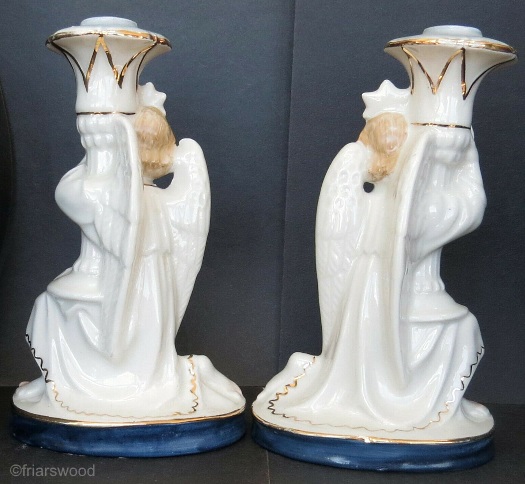 In the 1950s-giftware/decor category is this pair of angel candlesticks. Note the unusual star-shaped headgear and also that the candle cups they support have a definite tilt! The blue-painted base section is also rather uncommon. These are 8.75″ tall, with the footprint being 5″ x 3.5″. Their design numbers are 239 and 240 because they were considered to be religious items.
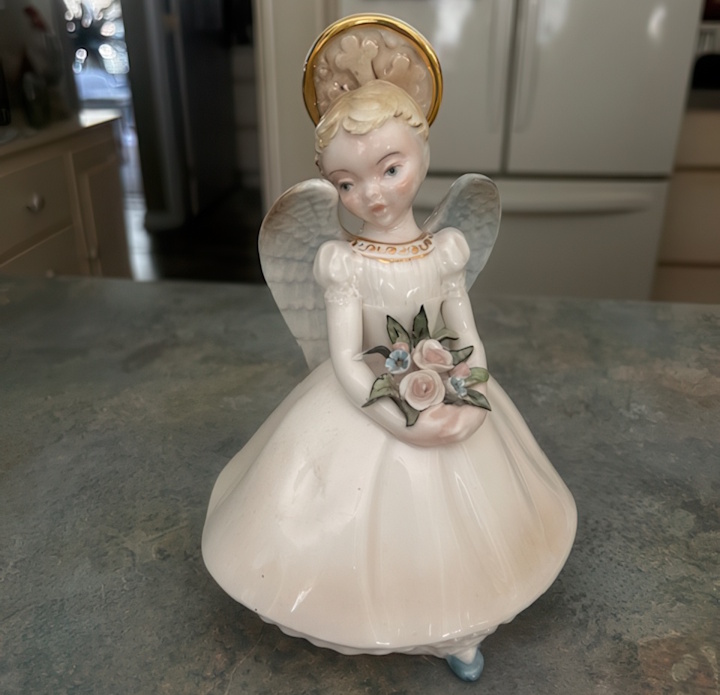
 This charming little lady also exists, sans wings and halo, in the Children to Cherish post because she was cast from a Holland Mold that was sold as “Shirley” (second photo.) We have no idea what Cybis called her (if she did have a name instead of just a description), but what the heck: I’m calling her Angel Shirley. This particular example has the back-to-back double-C mold impression instead of a stamped or painted Cybis signature.

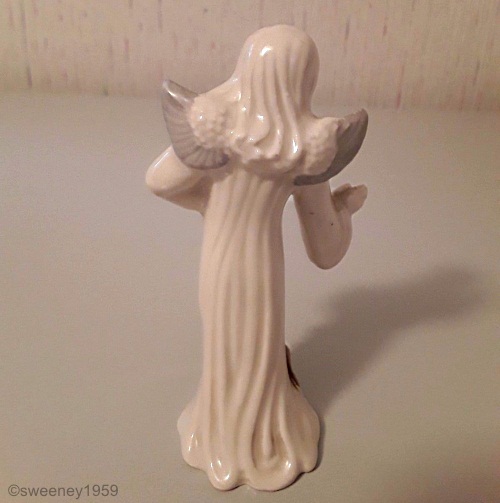 Update, April 2025: I recently discovered that what I have been interpreting/naming as the “Dancing Angel” was originally created during the mid to late 1940s by Ceramic Arts Studio as “Blessing Angel”. Cybis produced it from a slightly-downsized mold they were buying from the Holland Mold Company, who either bought it or copied it from Ceramic Arts (CAS) during the 1950s.
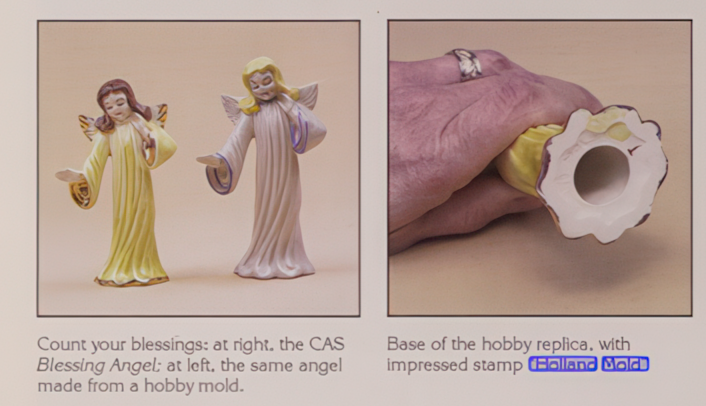
 As shown in the second photo, the CAS “Blessing Angel” had a companion piece. It’s not known whether either Holland or Cybis produced that one, but I wouldn’t be surprised if they did.
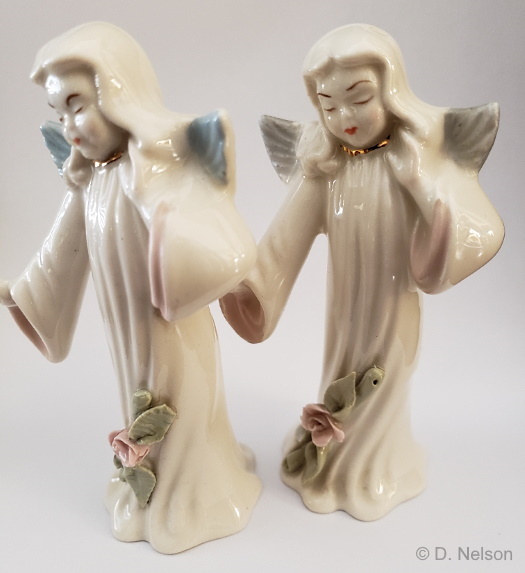
This example shows how the wing shading could vary between individual Cybis pieces.
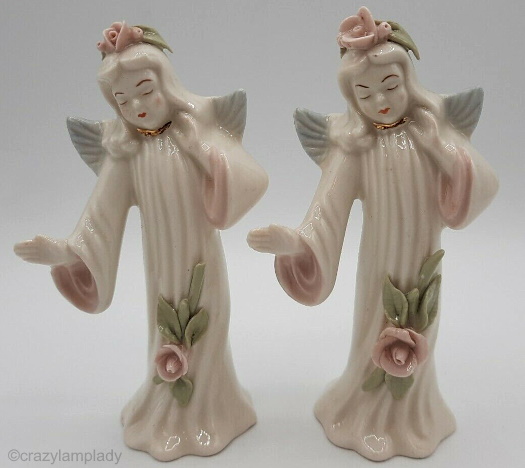 And here’s a slight variation on the theme: These both sport an added “hat” of pink roses!

 Another sweet circa-1950s celestial denizen is this angel with halo and rose bouquet, who has been found in two colorways thus far. The one on the left is done in the ‘Cypia’ tonation, whereas the right-hand angel is a standard glazed color. An unusual attribute is that she has ‘background foliage’ painted onto her gown front immediately behind the bouquet she holds. This somewhat pensive little lady is 7.5″ high.
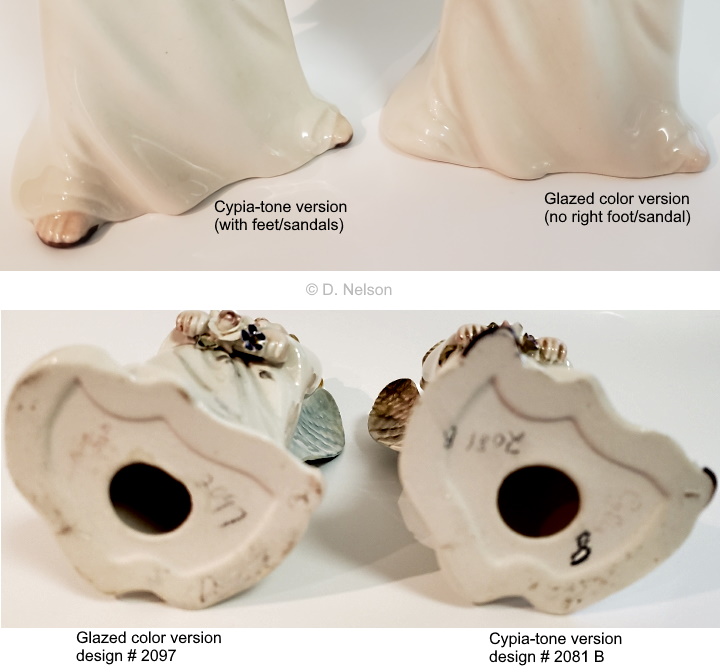 There are other differences between these as well. The Cypia example has sandaled feet peeking out from under her dress, but the forward foot has been eliminated in the color example – an indication that the Cypia one is of earlier date. This is borne out by an unexpected difference in design code as well! The Cypia angel is marked 2081 B, while the other is 2097. I have a hunch that the B suffix may have stood for brown, because we don’t know exactly when the term Cypia actually came into use by the studio. It may well be that Marylin Chorlton coined it after taking over the studio in 1957.

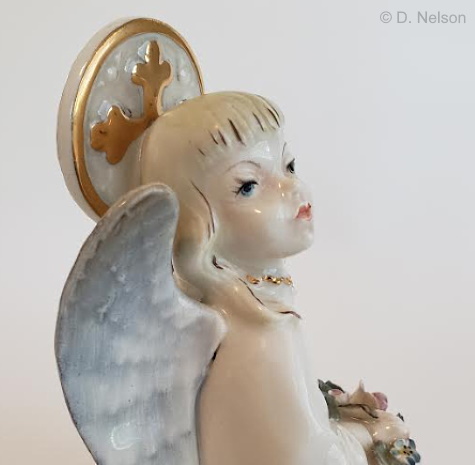 Very similar in design is this sitting angel with halo and flower bouquet; it is likely that she and the foregoing angel were originally sold as companion molds. There is something about her expression that reminds me of the actress Agnes Moorehead; anyone else see it? And she exhibits something else very unusual: She has eyelashes!! This is the first time I have seen them painted onto any Cybis piece, of any age. It remains to be seen whether other 1950s examples turn up with them as well, but for right now, “Agnes” is unique in this regard. She also has the rarely-seen raised-double-C mark on the underside. She is 5″ high with a 3″ wingspan, and is not marked with a design number.
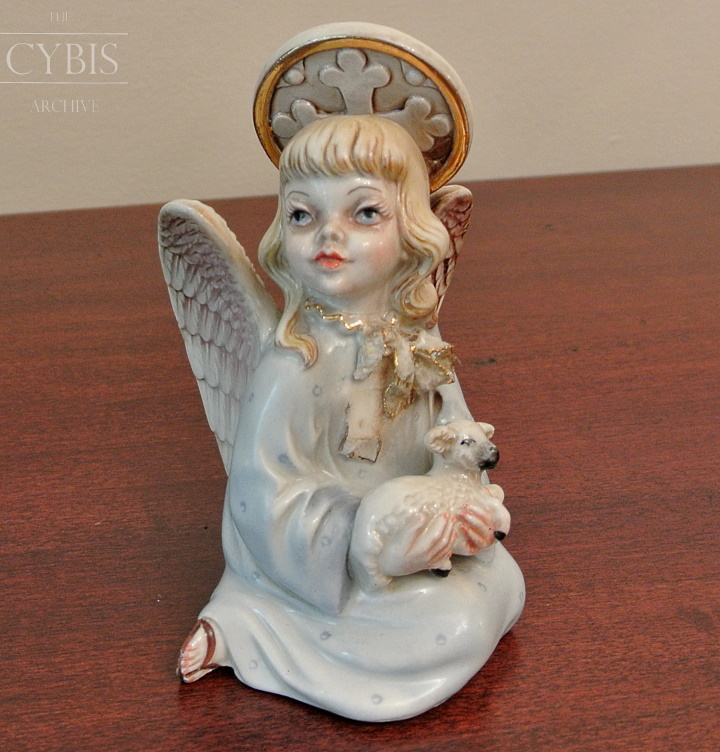
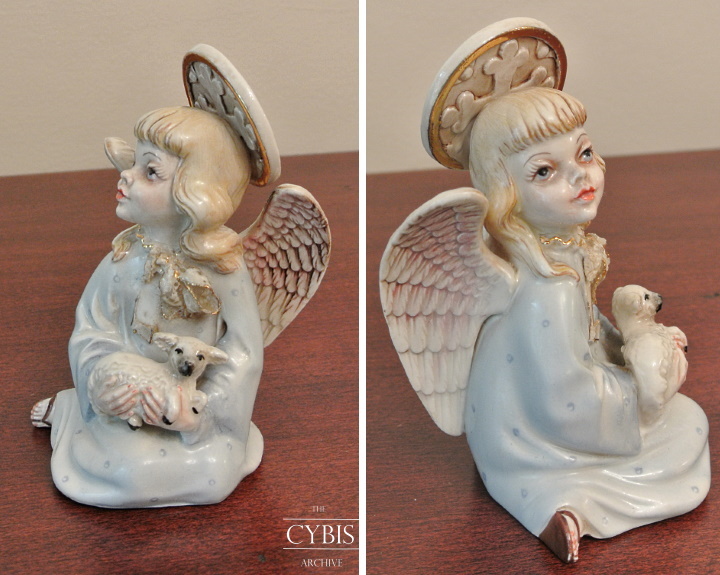 This recently-discovered sitting angel with lamb is unique in several respects. She, too, is marked only with the back-to-back double-C mold impression. This suggests that of the two companion molds (sitting and standing), the studio may have offered the sitting version first – or at least, the two shown here were among the earlier production runs, before they began using the Cybis paint-stamp instead. Unlike “Agnes”, this angel has a dipped-lace bow (partially broken off) which is something not found on any other Cybis angel discovered so far. She’s also the only angel holding a lamb, and the only one of the 1950s small glazed angels whose robe is a color other than white. The inside of her wings is tinted pink, which is also unusual. This particular angel was given by Marylin Chorlton during the late 1960s to one of the Cybis artists shortly after his return from the Vietnam War.
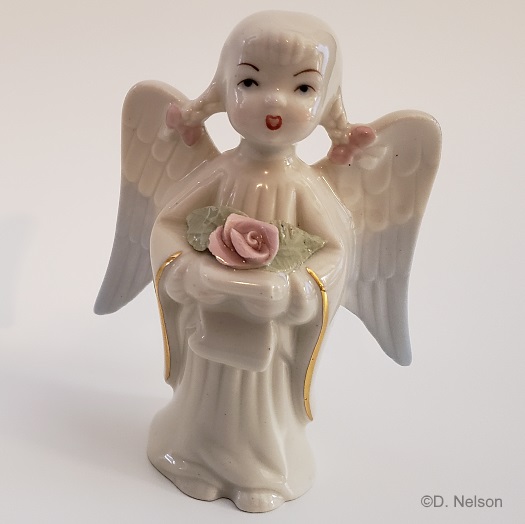
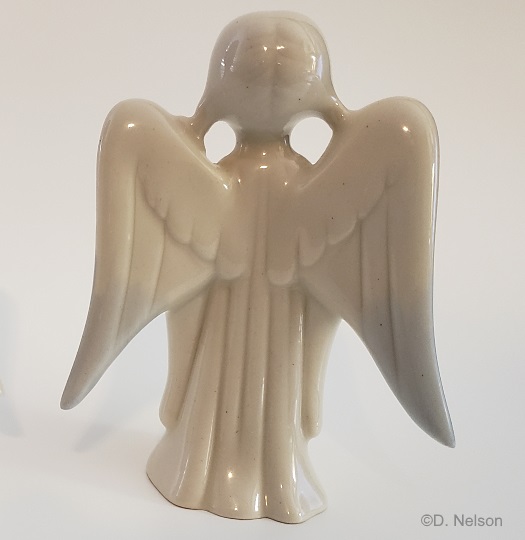 Another 1950s angel with the “decade-signature” pink rose decoration is this 4.5″ high singing angel with pigtails.
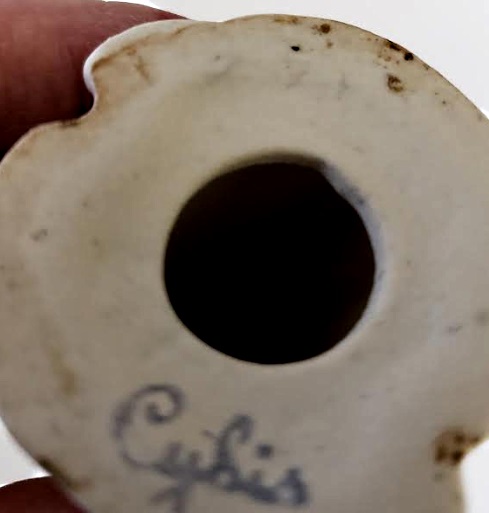 This is definitely cast from a Holland mold and even bears extremely faint traces of their name impression on the underside. This mold was used by at least two other studios as well as countless hobby potters. Another barely-visible mark is the design code in faded grease pencil; located at the 12 o’clock position in this photo, it is either 221 or 271.

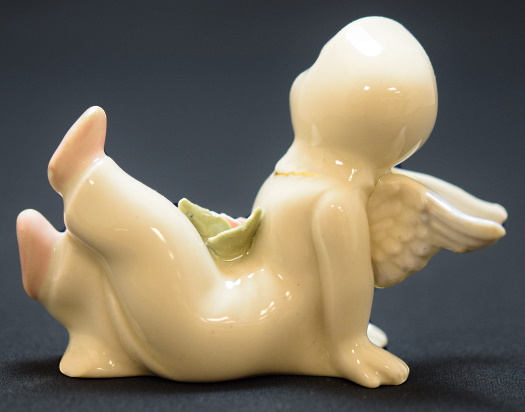 This little cutie is part of a set of Holland Molds that represented babies/toddlers dressed in an angel costume. This caused me to dither a bit over whether to put them into the Angels or the Miscellaneous Children post; the deciding factor was their age (1950s). I am differentiating them a bit by dubbing them “angel babies” rather than “baby angels.” By any title, this reclining angel baby is certainly something different! She is 3.5” high, 3” long, and was design #265.
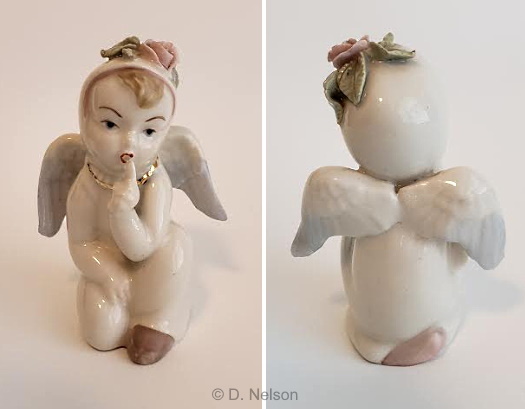 Seriously…how cute is this angel baby with finger to mouth?!? I’m not sure whether she is plotting mischief or simply saying “Ssshhh!”, but it doesn’t matter, because she is simply adorable. She does pose a mystery, though, because she has a penciled #363 on the underside… which does not correspond to Cybis’ numbering system for religious items. They reserved their 300 series design number for birds. I realize that the angel costume does have wings, but….!!

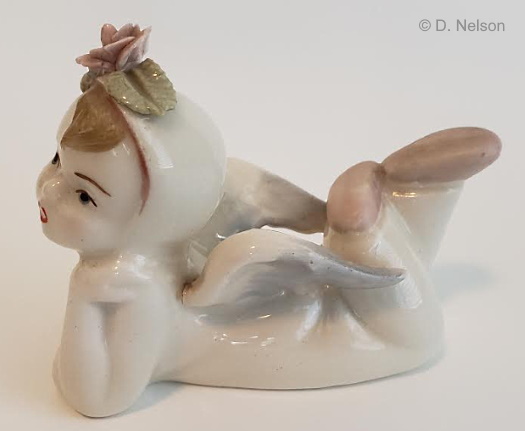 To round out the trio (assuming there was not a fourth!) we have an angel baby lying on stomach, at 3″ high and 3.5″ long. This angel bears design #264.
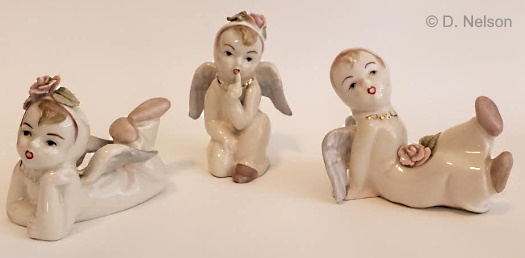 The three angel babies/babies in angel costume together.
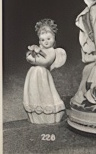 Apologies for the miniscule image, which I actually have upscaled as much as I could without hopelessly distorting it! An old Cybis list describes her as Angel with Halo and Floral Bouquet. She is 7” high, was design #228, and wholesaled for $2.50 during the mid to late 1950s.

 This praying angel kneeling is 4.5″ high and has the relatively rare raised Cybis signature and design number (which in her case is 2000, making her the first design of the four-digit 200 series; instead of going from 299 to 300, Cybis went from 299 to 2000 so as to keep all the religious items with design numbers starting with two, no matter how high it went.) Notice the subtle detail on the end of her sleeves. This angel, along with her companion immediately below, was cast from a Holland Mold Company mold.


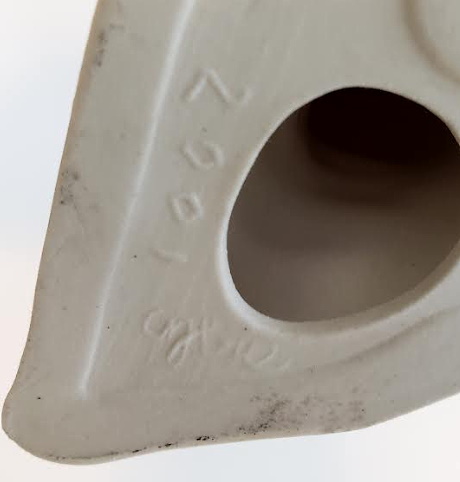 Her companion’s pose reminds me of “The Little Mermaid” (complete with long flowing hair) but I resisted the lure of literary license and am instead calling her the wistful kneeling angel. She is a little bit taller than her friend, being 4.75″ high. She too has the raised signature and her design number is 2001.
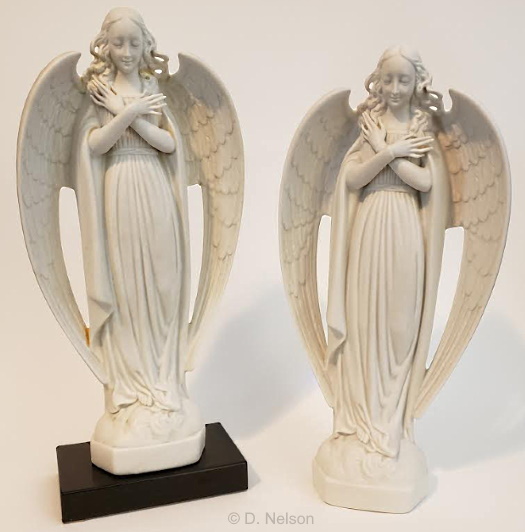
 The Angels in Adoration were sold only as a pair, from 1953–1965. The Cybis 1979 catalog says that they were offered in white bisque only, but Cybis in Retrospect claims they were also offered in stained glass (color). I have never seen a color version but would like to; if any reader has one and would like to share a photo, there is a contact form link at the bottom of this page. This angel is 14” high. They originally sold for $100/pair and are done in what we think of as the classic Cybis style although it’s not known if this was an original Cybis studio design.

 Many thanks to the Archive reader who sent these excellent photos of their pair of Angels in Adoration — the first time I have seen them together as they were originally sold! These are white bisque (unglazed.)
 Despite what the 1979 Cybis catalog claims (it has been shown to be wrong in a few other instances as well), at least one of these angels was made in glazed white bisque!
 The signature on some of these angels can provide clues as to when they were made. The glazed angel pictured also has the “eagle stamp” in the mold, as well as a model number which oddly does not correspond to the number given in the 1979 Cybis catalog for this piece! According to that publication the model number was 2507 but this angel is clearly marked 2006. And another mystery: Is the other marking an underlined W (for “white”, suggesting that there must have been color versions), or is it the number 31??? In any case these marks clearly date this particular angel to the early 1950s.
 This is how the pair of bisque angels are signed. The hand-signing with a brush in brown paint is consistent with pieces produced in the 1960s, so these can be dated to 1960-1965. Notice, also, that the studio has begun applying felt to the base; the 1950s glazed angel does not have this. Given the presence of the eagle impression it’s possible that the earliest Angels in Adoration may have been glazed but switched to bisque fairly soon afterward.
The Guardian Angel is 12.5” high and was produced from 1954 to 1963. She was made in several colorways which leads me to think that the Angels in Adoration were probably done likewise, despite the Cybis catalog info. It is clear from Cybis’ Spring 1963 price list that the Guardian Angels were sold as a pair. The white bisque pair was $50 and the stained glass/color pair was $75 in that final year.


A red-and-gold stained-glass Guardian Angel.


 This blue-and-green version is beautiful also; the fine detail of her hair is particularly enhanced.
 This example of a color Guardian Angel is wearing a different halo and is in a slightly different colorway: gold, blue, and red.
Notice that the color angels have a halo, but the white bisque one does not. I’d be curious to know whether there were any white bisque ones also made with a halo or whether it was only put onto the color versions. (It’s important to note that this is not the same sculpture as the identically-named but completely different Guardian Angel that was introduced by Cybis during the 1990s.)


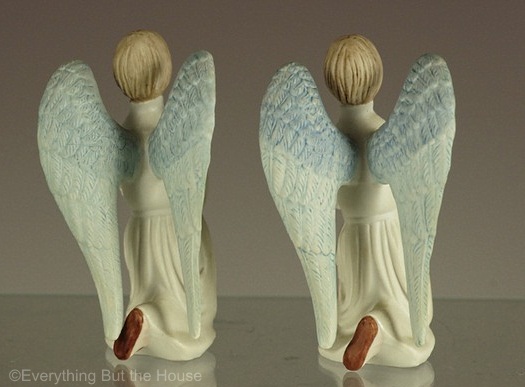 The Kneeling Angels were made from 1958 to 1965, in three different colorways. She is approximately 5.5” high. These were sold as a pair and appear in the very first (1964) Cybis print catalog. However, the photo of the blue-winged version is the only one I’ve discovered of an original pair that has survived together through the decades. The 1963 price list shows the white pair at $10 and the color version at $15. This angel mold was design #2553. See below for a rather unfortunate 1990s ‘resurrection’ of this piece by the studio.
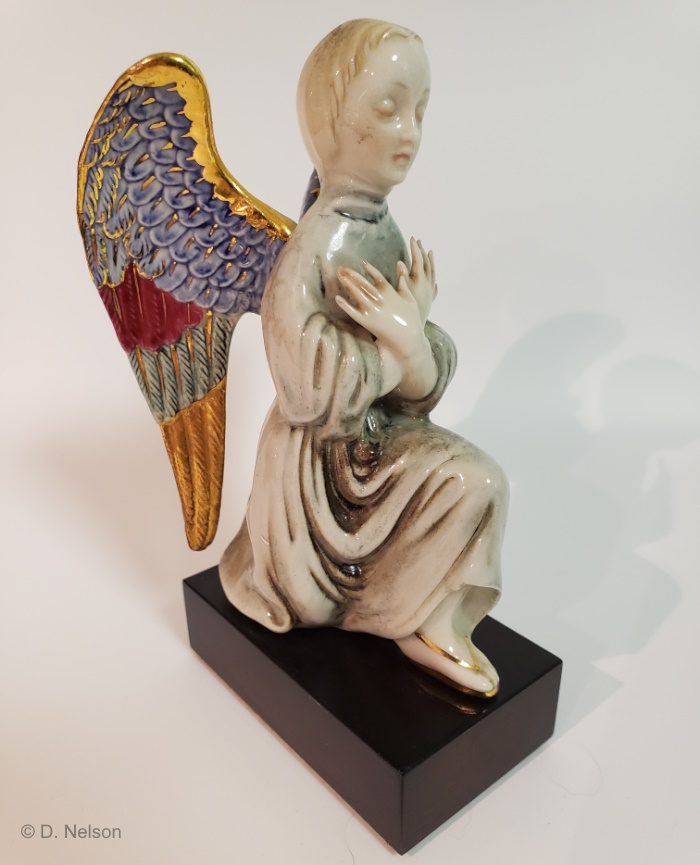 And here is a third colorway of the Kneeling Angel: a veritable feast of every decorative style that Cybis used during the 1950s! Here we see a dark Cypia tonation in the angel’s robe, the ‘stained glass’ glazed color decoration throughout but especially in the wings, and gold paint on the wings as well. This is very close in decoration to the red-and-gold Guardian Angel shown earlier. On the 1963 price list, this colorway is listed at $20 (five dollars higher than the bisque color.) Even more surprising is the fact that this Kneeling Angel is mounted on a base.
 Yet another surprise is a newly discovered Cybis sticker. It is similar to the one shown in this post in color, but is an entirely different shape. The Cybis design number can still be seen in pencil.
 The three known colorways of the Kneeling Angel: white bisque, stained glass with gold (on base), and bisque color (what the studio called “bisque decorated” in the 1971 museum exhibit catalog.)

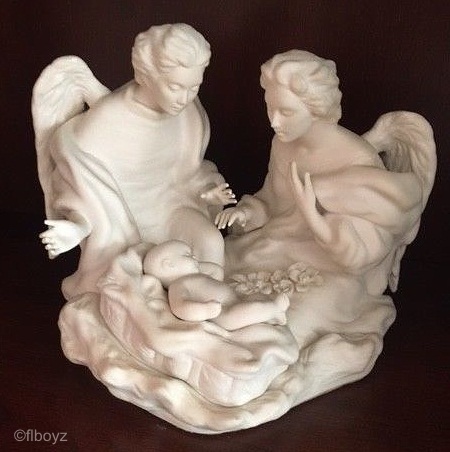 There followed a 15-year gap in Cybis angel introductions until Adoration appeared in 1981. Designed by Gertrude Fass, it is 6” high and was made in white bisque for $325 and color for $375; by now all the color pieces had long since switched to the bisque (matte) finish rather than the high fired glaze. The baby is a separate mold which was also used for a separate Baby in Cradle giftware piece. This sculpture was retired before 1988.


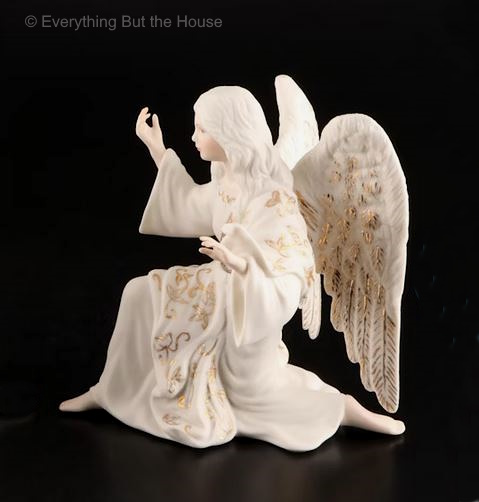
Although Cybis began their second Nativity series in 1982, an angel was not added until 1984. This is the Nativity Angel, kneeling and is 6.5” high. The introduction price was $275 for white bisque (not shown) and $395 for the color version (uppermost photo). This angel was later re-named Nativity Angel I after the studio began adding more angels to the Nativity series. In 1989 Cybis added the white-with-gold version which was introduced at $525.
 Little Angel appeared in 1986 at $125 in color as shown. She is 7.5” high and was designed by William Pae.
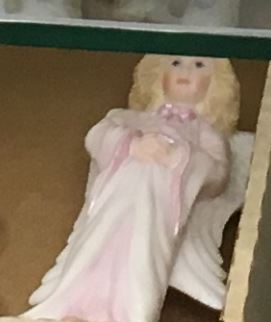 At least two examples of a pink colorway are known to exist. This one was among a collection of items offered for sale in 2020, and has glazed highlights on her bow and sleeve edges. This colorway doesn’t appear in any price lists and so might have been either a retailer event piece during the 1980s, or a 1990s colorway that was sold at the studio only.
 In late 1982 Cybis also released Angel ‘Annunciation’ in both white bisque ($245) and color ($285). She is 9.5” high and was retired before 1989. She was designed by Gertrude Fass.
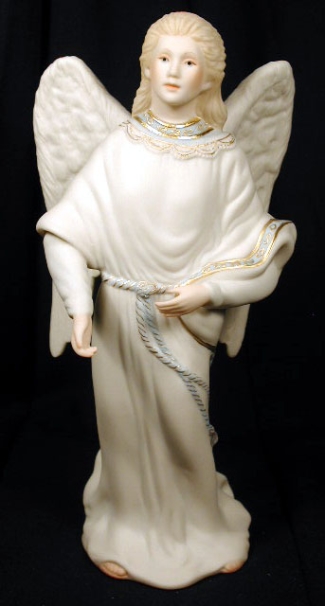
The Nativity Angel II (standing) was added to the Nativity series in 1989 for $525. She is 9.75” high and is cast from the same body mold as the Angel ‘Annunciation’ shown above. Her hair, collar and upper part of her robe have all been reworked, but the worst change is the awkward new position of her right arm. See the Second Nativity Series post for photos of all three color options: white bisque, color (shown here), and white-with-gold.
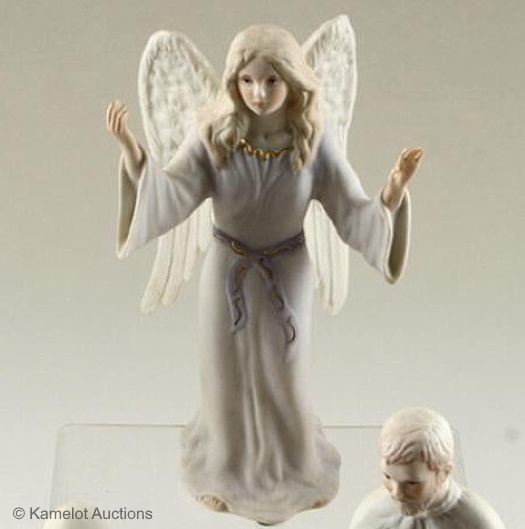
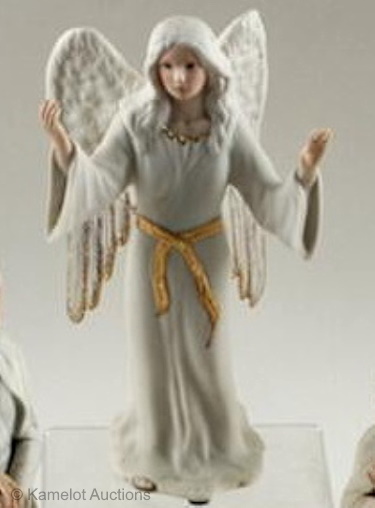 By the year 2000 and later, the studio was relying almost exclusively on re-issues, resurrections, or cobbled-together versions of existing and retired pieces because they no longer employed any full-time artists. Such was the case for the Nativity Angel III which is the upper half of the Nativity Angel Kneeling simply plopped on top of the bottom half of the Nativity Angel II. She is about 10″ high and sold for $1195 in both colorways.
 This version of the circa-1950s Kneeling Angel was made during the 1990s. Although it does not appear on any 1990s price lists, the studio did make pieces that were meant to be sold on-site to visitors during that decade, and especially to the factory-tour-bus trade. Because they used the original (supposedly retired and never to be used again!) mold from the 1950s, this one must be dubbed the 1990s white/gold replica of the 1950s Kneeling Angel. Unlike yet another replica shown next, this one was never made part of the second Nativity Series.

 This ca-2000s white-with-gold replica of the 1986 Little Angel appeared when she was added to the 1980s Nativity Set sometime in the early 2000s. Oddly, in the second photo the back of her wings appears to be a very pale blue but perhaps that is a reflection from the surroundings. This piece was never originally intended to be part of the Nativity set, but by the 2000s the studio was desperate for ‘new’ items and simply drafted her in.
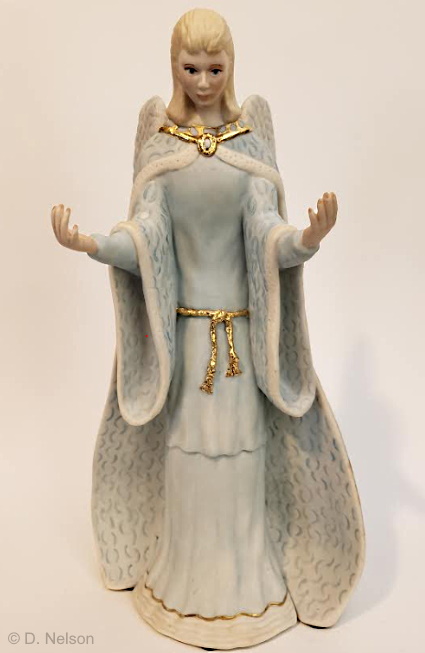

 Supposedly part of the second nativity set even though stylistically she bears no resemblance whatever to the other angels is the Guardian Angel who was introduced in the early 2000s. I’m surprised that Cybis decided to name this piece exactly the same as a (different) sculpture that they had produced 40 years earlier, especially as it’s not even a Hall of Fame replica – all of which also have the designation “II” or “III” added to their name. The name is not the only puzzlement; the style is markedly different from what we typically see from Cybis. It was either a recently-acquired design or a much older one that had been sitting on a shelf for decades without being used. In order to differentiate her from the 1950s piece, let’s call her the millennial Guardian Angel, shall we?


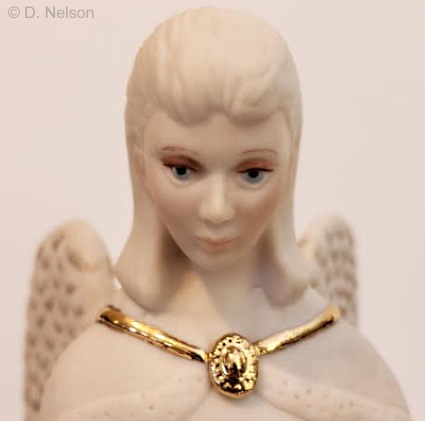 In any event, this millennial Guardian Angel was added to the nativity set in both color and white-with-gold at $895. She is also noticeably taller than the other two standing angels, at 12.75” high.
 For some reason, this piece bears two different mold-impression years: The underside of her skirt/gown/feet (upper photo) has a copyright year of 2001, while the back of her cape mold says 2002. I have absolutely no explanation for this.
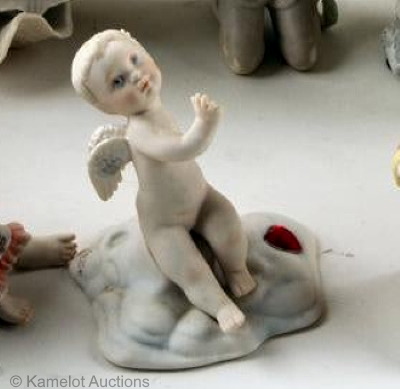

 This cherub on a cloud was disposed of during the 2019 liquidation of the studio’s back-stock. [second photo courtesy of the Museum of American Porcelain Art] This was “designed” in 2002; the quotes are deliberate because it is simply the Baby Jesus mold taken from the 1950s Walking Madonna/House of Gold, a pair of wings put onto his back, and plopped on a rather gloppy-looking ‘cloud’ with a heart (and is that glass?!? If so, it’s a ‘first’!) stuck into it:
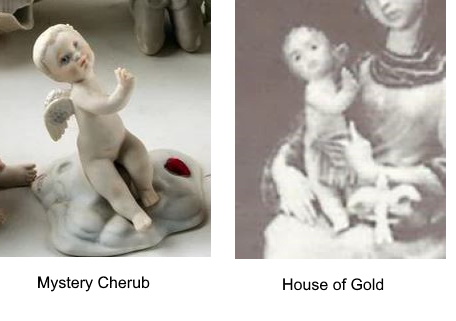 This has, of course, earned a spot in the Body Snatching post! It’s not known whether this was ever offered as a retail piece. Perhaps, like Sabrina, it appeared only during their short-lived foray onto eBay.
 I’m embarrassed to admit that despite decades of looking at Cybis pieces, I only recently noticed the tiny angel that forms part of one of their ballet sculptures! This is The Enamoured Prince Florimund (from the Sleeping Beauty ballet) who was a circa-1970s limited edition.
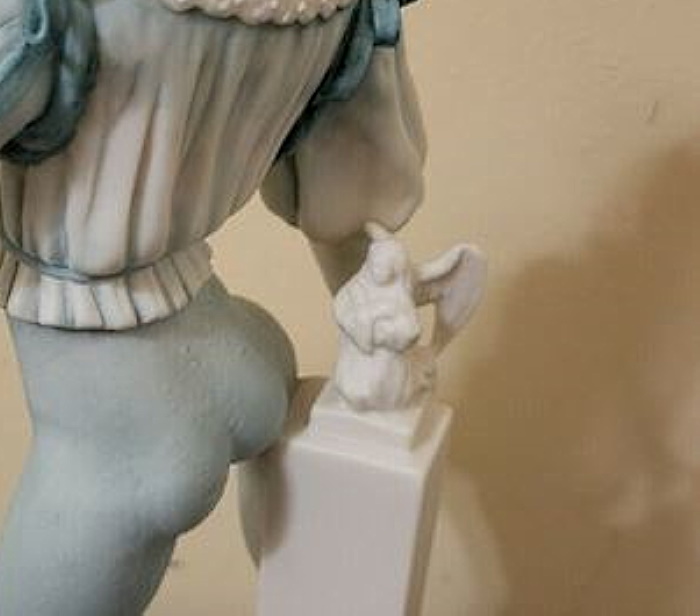 Florimund is only 12” high overall, which means that this tiny kneeling angel must be no more than one inch tall.
Angel Ornaments
Cybis also issued a number of angel holiday ornaments during the 1980s and 1990s. The first was an annual series of four, starting in 1985; all were designed by Lynn Klockner Brown. These four were sold in a specially designed satin-lined gift box and were only available during their individual issue year.
 This was the first (1985) Angel Ornament which was priced at $75. She is 4” high. These annual ornaments have a flat base so that they can be displayed standing as well.
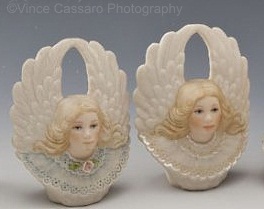 These are two artist’s proof colorways of this ornament; the one on the right differs from the production version via the pearlized glaze on the lace trim.
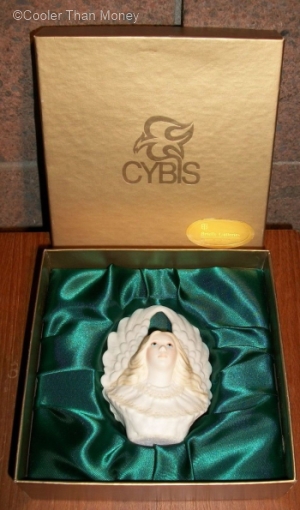 The presentation boxes were contoured to fit the specific ornament.
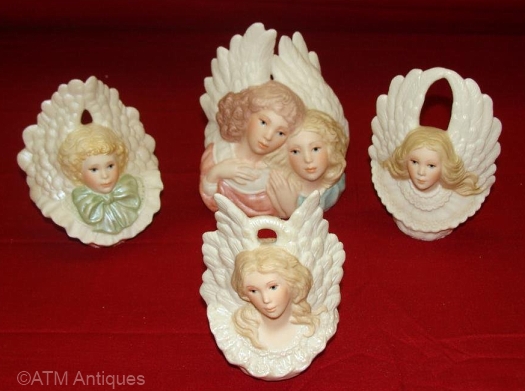 The complete set of four is shown. At the center front is the 1988 Angel Ornament which is 3.75” high. From left to right along the back row: 1986 Angel Ornament at 4” high, 1987 Angel(s) Ornament which at 4.75” is the tallest; and the aforesaid 1985 Angel Ornament. The 1987 Ornament was given the name Heavenly Angels and sold for $125.
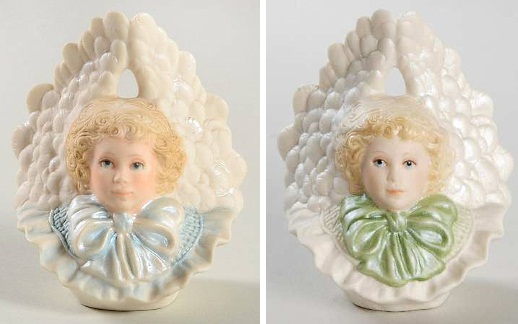 Two colorways of the 1986 Angel Ornament are known: green (which may have been the standard retail version) and blue. The angel’s eye color matches the bow. At least one Cybis list titled this piece as 1986 Cherub Ornament instead of ‘Angel Ornament.’ It certainly is a very young angel, which may have been the rationale for referring to it as a cherub.
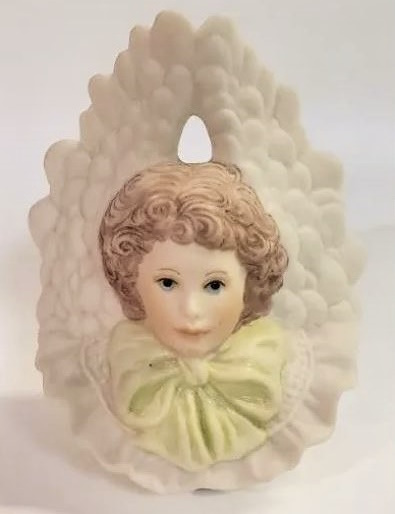
 This example has brown hair instead of blonde. It is one of only two known Cybis-original angel editions to be seen as a brunette angel. Shown in the second photo is a 1987 Heavenly Angels example with darker brown hair than the one shown in the group photo above, who looks more like a redhead/auburn to me.
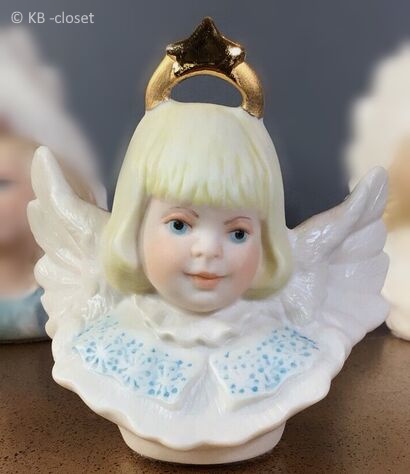 The 1991 Christmas Angel Ornament was the first of two colorways. She is 3.5″ high and sold for $150; her collar area is painted blue.
 The studio used the same mold for their 1992 Christmas Angel Ornament but this time painted the collar area pink. The March 1993 price list has this as 1992 Christmas Angel Ornament (pink) for $150.
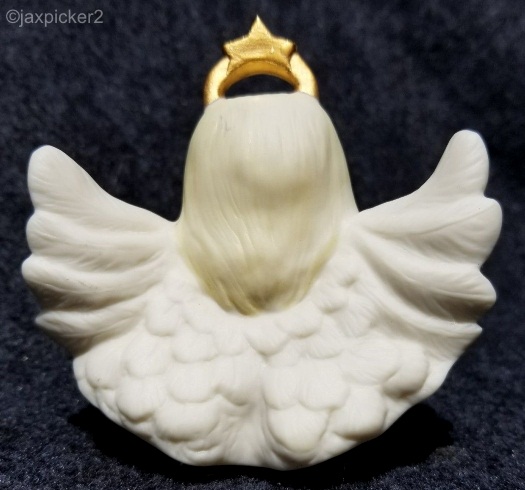 The back of both ornaments is identical because the only difference between the 1991 and 1992 versions is the color of the collar section. Although we see both on the Spring 1993 price list as 1991 Christmas Angel Xmas Ornament and 1992 Christmas Angel Xmas Orn. (pink), their Fall 1993 price list shows this same item (same design number) under a new name: Angel Child (pink/blue). This name change indicated that this ornament could now be had in either colorway and was no longer connected to any specific introduction year.
 An ad placed by the studio in the classified section of November/December 1991 issue of Collector Editions Quarterly described this as the 1991 Cherub and “price approximately $175.” It is five inches high. The only other representation of this piece was on their early-2000s website that had only this extremely tiny thumbnail:
 It was titled there in two colorways: Blue Boy Cherub, First Edition and Pink Girl Cherub, Second Edition. I assume they were issued a year apart, because Cybis switched from assigning specific years to many of their items and instead titles them as ‘editions’ instead. From this we can assume that the pink version was added to the lineup in 1992 or later.
 I suddenly realized that this is actually the baby Jesus mold taken from the early-1950s Walking Madonna/House of Gold but with the addition of a ribbon or sash (indicated by the arrow) that was painted either pink or blue. Here is an enlarged version of the tiny Cybis site thumbnail of it as the cherub ornament. Although this item was not offered as a retail piece until 1991, it was actually created 40 years earlier!
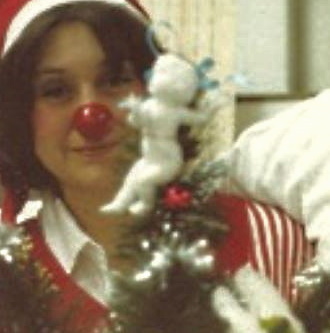 But wait, there’s more (as they say on tv): This photo was taken inside the Cybis studio during their 1982 holiday party. This baby-Jesus-turned-into-a-winged-cherub can clearly be seen top a small artificial Christmas tree in one of the workrooms, almost a decade before it emerged as a retail price list item.
A bit of mystery closes out this Angel Ornaments survey: On the May 1999 Cybis price list is an ornament listed as Angel Ornament with Harp. It was described as being only 3” high and available in two color options: plain white bisque for $75, and ‘embellished with gold’ for $125 (that would have meant white bisque with gold accents.) It also appeared on their circa-2000s website but with no accompanying photograph. Never having seen an example matching these descriptions, I have a hunch that PERHAPS it might have been a downsized version of the mold shown above, but with a tiny harp added (and did they paint the harp gold on the more expensive one?). If anyone has one of these, I’d love a photo to either confirm or disprove my guess!
Name Index of Cybis Sculptures
Visual Index (for human figures/busts only)
About the Cybis Reference Archive
What is Cybis?
Images of Cybis porcelain sculptures are provided for informational and educational purposes only. All photographs are copyrighted by their owner as indicated via watermark. Please see the copyright notice in the footer and sidebar for important information regarding the text that appears within this website.
The Cybis Archive provides the most comprehensive range of information about Cybis within a single source. It is not and never has been part of the Cybis Porcelain studio, which is no longer in business.
 THE CYBIS ARCHIVE