
Almost all of the Cybis ‘Portraits in Porcelain’ are readily identifiable characters from Shakespeare, mythology, literature, or history. However, there are two that defy specific identification; one is from the 1980s and the other is a millennial.
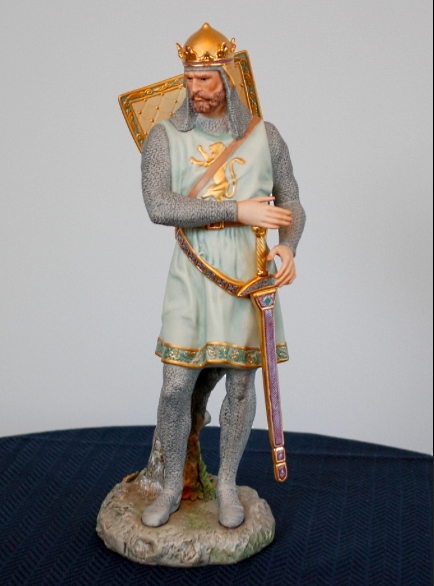

 Sir Henry, the Knight was introduced in 1986 at $1500 as a limited edition of 350 sculptures. He is 16″ high and his final edition quantity size is unknown, because the studio was still offering him for sale on their circa-2000s website.
 There’s a small colorway-quirk about one element of this sculpture:
 On some of the earliest pieces, the front of Henry’s scabbard is painted gold; on others, it is a rose color.
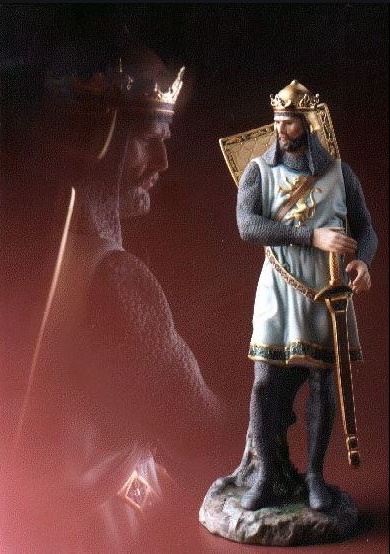 The official/designated advertising image from Cybis shows an even darker color on the scabbard and sword hilt. (I personally think that the gold scabbard looks better.) Thus far, as of late summer 2024, the color-count of pieces sold online has been evenly split: #59, #112, #114 and #125 have the burgundy scabbard; #1, #11, #100 and an un-numbered example have the gold scabbard. There were two that were unable to be determined: the sword is missing from #137, and a Henry that may be #124 was photographed at an angle that didn’t show the sword face or the number clearly. So the scabbard color doesn’t appear to have any connection to the sculpture-number range.
The question of whom this sculpture was originally intended to represent is a rather thorny one. The studio’s chosen retail title (Sir Henry, the Knight) is contradicted by the fact that he wears a crown – a mere knight would certainly not wear one. It appears as if nobody noticed or questioned this obvious fact, either before or after the piece was introduced! However, being a hopeless nerd and history buff, the question of his identity has always nagged at me. The rampant lion on his shield and tunic identify him as English; if he was a French knight, he’d wear the fleur-de-lys. He wears a crown; therefore, he must be either a prince or a king. But which English prince or king?
There are two possibilities. One, based on his red beard (and, presumably, hair although that is hidden), is that he is meant to be Henry VIII as a young man – perhaps history’s most famous bearded redhead. Henry loved to joust, and during his marriage to Katherine of Aragon would often disguise himself in the lists as “Sir Loyal Heart”. However, the Cybis knight isn’t wearing jousting armor nor carrying a lance. Alternatively, perhaps this represents Henry during his first campaign in France, probably the Battle of the Spurs in August 1513. He would have been 22 years old at that time.
The other scenario – and the one that I think more likely – is that the sculpture represents Henry V at the Battle of Agincourt. The way he is dressed is certainly more in keeping with that century than with Henry VIII’s. Particularly noteworthy is the conical helmet with the chainmail drape, because that is definitely a medieval style that was used during the late 1300s into the 1400s. This pointed-top helmet style is called a bacinet. The Battle of Agincourt took place in 1415, so chronologically both the helmet and the chainmail are a match for that time. Another strong indicator is the presence of acorns and colorful oak leaves at the base of the tree stump. Agincourt was fought on St. Crispin’s Day, which is October 25th. Acorns and fallen oak leaves would have been there in abundance!
Does the appearance of Sir Henry approximate what the real King Henry V looked like? As far as age, yes: Henry V was born in 1386 which means he was 29 at the time of Agincourt. This is a better fit for the Cybis piece than the 22-year-old Henry VIII would be.
 The only remaining sticky wicket is Sir Henry’s red hair/beard, because the most well-known portrait of King Henry V depicts his hair as dark brown. However, the miniature above dates from 1412 and shows a definite reddish tint to his hair – quite similar to Sir Henry‘s beard, in fact. The ‘familar’ portrait with the bowl-cut dark hair wasn’t painted until 100 years later (during the Tudor era, in fact!) So, of the two, this miniature – painted while Henry V was alive – is likely to be more accurate. The fact that Henry’s mother, Blanche of Lancaster, is depicted in a number of contemporary portraits of her with either auburn or strawberry-blonde hair also raises the possibility that her son’s may have been a similar color. (The beard on Sir Henry is an anomaly because the real Henry V would have been clean-shaven in accordance with the style of the time.)
Update, April 2025: I have now learned that this sculpture was adapted from an existing figure or statuette that was brought into the studio. This means that its original designer is unknown. If the original figure was meant to be either Henry V, or Henry VIII as a young man, that would certainly explain a lot! I now believe that whoever created the original figure did intend it to be one of those two King Henrys. It does not make sense otherwise. During the adaptation process that Cybis did, part of his clothing was converted to a chain-mail surface. The chain-mail was done by Jolan Palmai, who was the studio’s Art Director at that time.
The Buccaneer
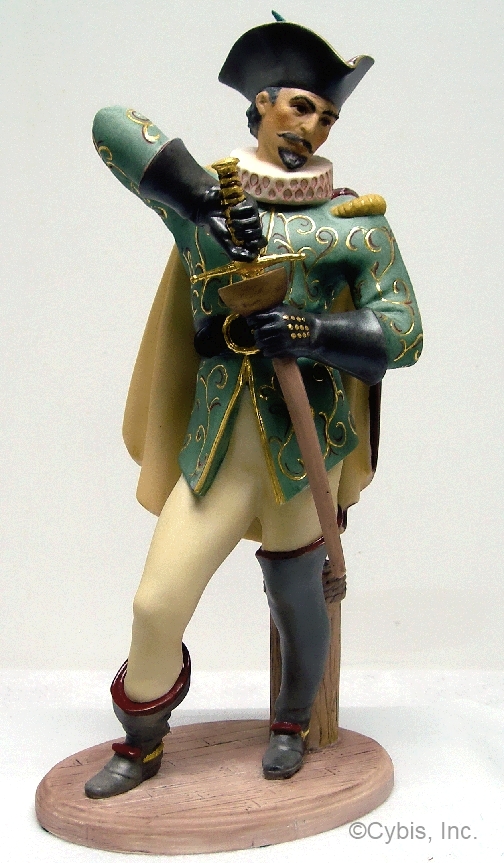 The other mystery portrait is The Buccaneer, whose only appearance was on the early-2000s Cybis website. He was cited as being 15″ high. It’s certain that the intended edition (size not specified) was never completed, if indeed more than just this one sample(?) was created or sold. I have never seen one for sale online anywhere, nor was one included in the studio’s 2019-2020 liquidation auction sales.
There are a few clues as to who he might be, or at least ‘when.’ His clothing suggests the Elizabethan era (note the ruff, in a style popular during the 1560s) and was possibly inspired by Sir John Hawkins or his sometimes-partner in piracy, Sir Francis Drake. From the sole photo above, he does more resemble Hawkins’ facial features as seen in contemporary portraits. Unfortunately, the historical accuracy fails when it comes to his weapon because in real life it would have been a cutlass rather than the longsword shown here, which is not the type of sword that would ever serve the user well for shipboard fighting!
Also, the word buccaneer didn’t really come into usage until almost 100 years after the time of Hawkins and Drake. The buccaneers were Caribbean pirates who made a habit of attacking Spanish merchant ships during the mid to late 1600s. The most famous of the English buccaneers (also known as ‘privateers’) was Sir Henry Morgan who also happened to be an admiral in the Royal Navy. So, was the Cybis sculpture modeled after him? Nope, not in that costume or with that hair and beard, he isn’t….if the artist did their historical homework.
So it appears that The Buccaneer, at least, will simply have to remain a Cybis ‘mystery man’!
Name Index of Cybis Sculptures
Visual Index (for human figures/busts only)
About the Cybis Reference Archive
What is Cybis?
Images of Cybis porcelain sculptures are provided for informational and educational purposes only. All photographs are copyrighted by their owner as indicated via watermark. Please see the copyright notice in the footer and sidebar for important information regarding the text that appears within this website.
The Cybis Archive is a continually-updated website that provides the most comprehensive range of information about Cybis within a single source. It is not and never has been part of the Cybis Porcelain studio, which is no longer in business.
 THE CYBIS ARCHIVE