
One of the special commissions that is never found in any of the Cybis literature is the Spirit of Ecstasy that they produced in 1979. This was a very unusual piece in that it not only had a restricted distribution but also had numbered artist proofs.
“Spirit of Ecstasy” is the actual name of the Rolls-Royce mascot (hood ornament) that most people call simply the Flying Lady.
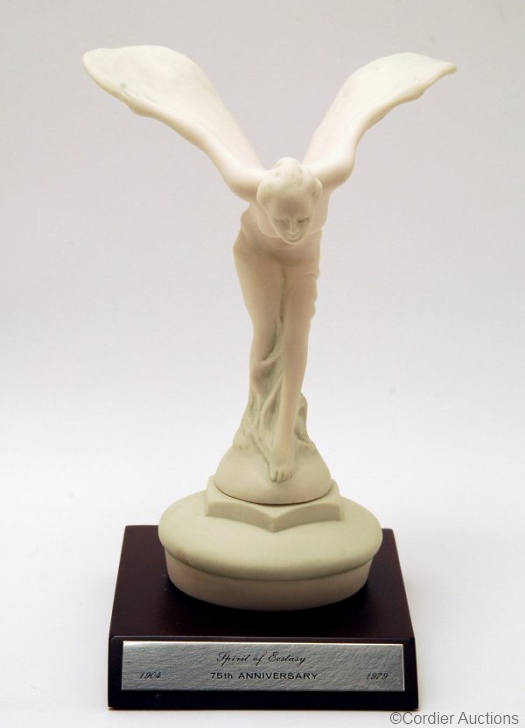
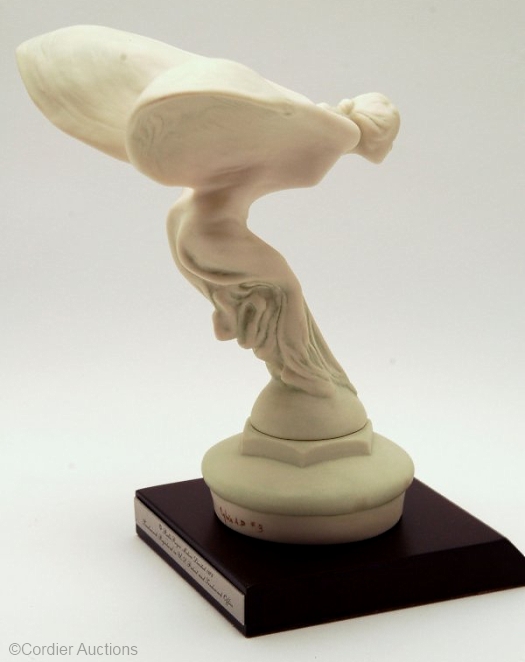
The Cybis sculpture is 9.25” high and has a wingspan of about six inches. She is mounted onto a walnut base that has a brushed stainless-steel plaque on both the front and back. Although the sculpture is white bisque it has very subtle pale greenish highlights that are best seen in the second photograph. It is almost certain that this particular color “wash” was developed and applied by Ginny McCotter who was the studio’s most veteran painter.
I’m very fortunate to have had the fascinating history of this Cybis piece related to me by one of the principals involved in it from start to finish: Mr. David Berndt, who had the original idea to have a licensed rendition of ‘the Lady’ created in porcelain as a special-interest item. However, the Cybis studio was not his first choice of vendor. The Burgues studio was approached, but Dr. Burgues declined on the basis of not being much focused on human figures. On the other hand, Laszlo Ispanky was more than willing, and in fact created a prototype from his own interpretation which was – shall we say – not exactly what Mr. Berndt or Rolls-Royce had in mind.
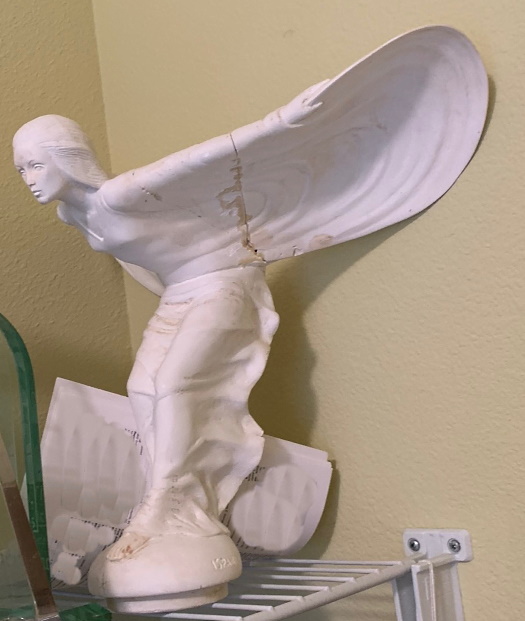
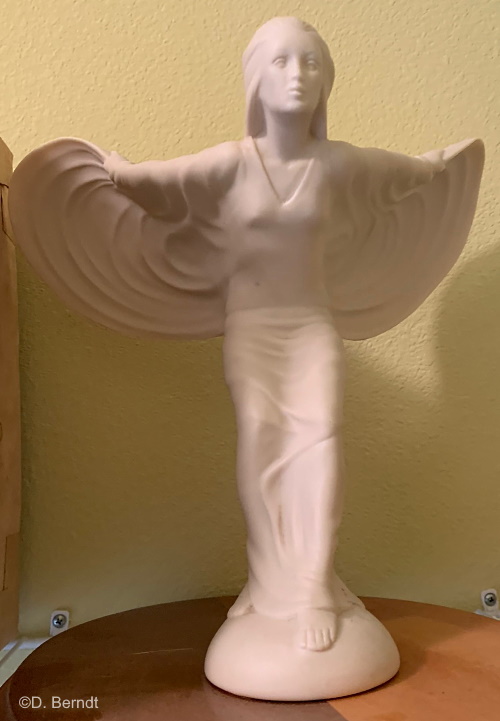
Many thanks to Mr. Berndt for supplying these photos of the Ispanky piece. The top photo is the plaster model (with a repaired wing/arm; an inevitability, because his design made it fatally top-heavy) and the lower one is the same piece in white bisque. There was also a color model (blue dress, blonde hair) which was, after it was determined that the Ispanky version would not be used, sold to a retail jeweler.
 This, too, is a painted version. It has also been reported that a color version was sold during the liquidation of Ispanky’s home-studio items after his death in 2010.
With both Burgues and Ispanky being non-starters, and the Boehm studio having refused the commission outright, Mr. Berndt then approached Cybis. Because the mascot has exhibited some subtle changes from time to time, three examples were given to the studio but Frank Bader, who was the Cybis point man for this particular commission, retained only one. It so happened that this particular mascot still had the radiator cap attached to the bottom, whereas the other two samples did not.
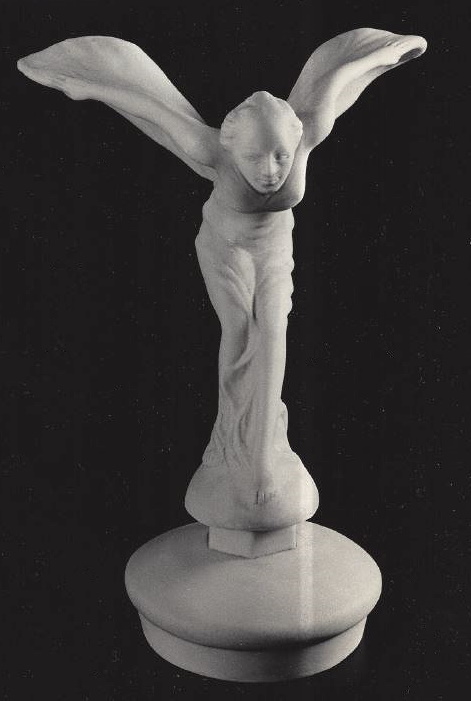 For some reason, what Mr. Bader did was to tell the mold shop to simply create a direct casting of the actual 6” high mascot – radiator cap and all! – and this is what was actually offered by Cybis as the proposed piece. As far as I know, this is the only photograph of that first iteration in existence.
This was clearly not what had been asked for, and so a corrected piece was then created from scratch (as it should have been the first time.) And yet another. That third rendition became the piece that Cybis actually went on to produce. By the way, the height of the actual hood mascot ranges from four to six inches; the Cybis model can thus be as much as twice the size of a “real” one, depending on which mascot is being compared to it.
The studio had to walk a fine line between ‘adaptation’ and ‘accuracy’ when sculpting this. (The Ispanky design completely failed in this regard, obviously.) Being a licensed item, it had to be – in Mr. Berndt’s words – “very close to the original examples and nearly exact.” His license to produce a porcelain reproduction was for only three years, and the inevitable red tape of the “process” ate up almost two of them. After the final Cybis model was approved by Rolls-Royce, things moved rather more quickly.
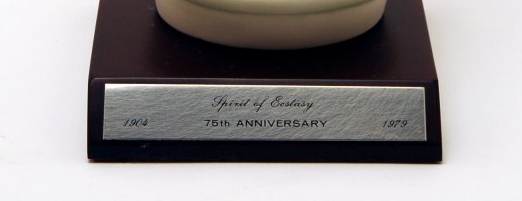
Even after the design was finalized, this commission was not 100% smooth sailing because there were two other elements involved: The wood base (which Cybis obtained elsewhere) and also the stainless-steel plaques which were ordered from the Massillon Plaque Company in Ohio. The front plaques all look like this:
However, there are two slightly different versions of the rear plaque!
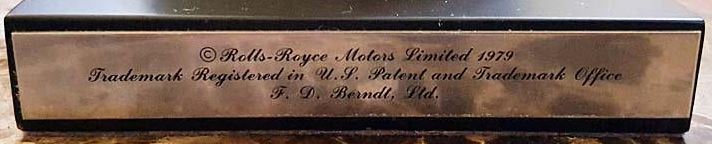 The “three-line” rear plaque includes the name of Mr. Berndt’s company as the licensee. (The gold tint here is a photography artifact; the actual plaque is typical stainless-steel color.)
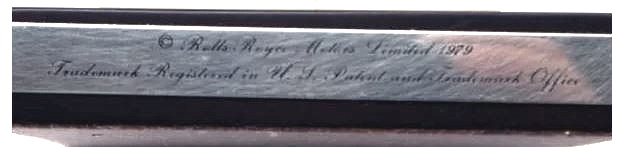
However, the “two-line” rear plaque does not. Neither Mr. Berndt nor Rolls Royce ever caught this omission at the time, and nobody at Cybis was paying attention to it either. The person who ultimately received one of these sculptures would have no way of knowing that there was supposed to be a third line on the rear plaque. If any reader happens to have a Spirit with a two-line rear plaque, I’d love to know what sculpture number (or A.P. number) it is. It might help solve the mystery!
Mr. Berndt advertised the Cybis piece in several print venues: the official Rolls-Royce Owners’ Club magazine, The Flying Lady; several car magazines such as Motor Trend; and a press release in the popular Collector Editions magazine as well. But Cybis themselves never advertised it nor included any mention of it in their own literature, although they could have added it to the Appendix in the 1979 edition of their catalog, had they chosen to.
This piece was never sold by any of the Cybis retailers; Mr. Berndt’s company performed that function. Indeed, he personally picked up the ordered and boxed-up sculptures from the studio and then sent them to their purchaser(s.) At that time, a business associate of someone in my family happened to own a Rolls Royce and, knowing that we collected Cybis, offered to purchase this piece on our behalf. To be honest, I wasn’t privy to the financial end of the sale and thus do not know what its price was (other than that it was definitely in the four-figure category.) I believe, though am not 100% positive, that a Certificate of Authenticity came with it. Our piece was sold along with the bulk of the collection several decades later, and I did not keep a photo or any note of what sculpture number our Spirit was.
The Story Behind the Mascot
Thanks to Mr. Berndt, I can offer a bit of background on the actual mascot. His excellent article about the original female model for the mascot appeared as the cover story in the Spring 2021 issue of The Florida Lady publication for the Florida Region Rolls-Royce Owners Club.
 The original model for the mascot was Eleanor Velasco Thornton, secretary to and mistress of John, 2nd Baron Montague of Beaulieu who had originally requested a custom mascot for a vehicle in his private collection. Charles Sykes was the sculptor. However, the first rendering of the mascot was quite different from the one we know today.
 This first mascot, of which very few castings were made, was named ‘Whisper’, a tribute to both the speed and the silence of the Rolls-Royce motorcars. When the managing director of the company saw ‘Whisper’, he asked Sykes for a new design that would grace all future vehicles produced. The result was the mascot we now know and which Cybis and Ispanky (among others, including Lalique crystal) depicted. It has been known variously through the years as the Spirit of Speed, Emily, Silver Lady, Flying Lady, Kneeling Lady, and ultimately, the Spirit of Ecstasy.
The Cybis Production Run
The production run of the Cybis Spirit of Ecstasy was originally intended to be several hundred pieces, but only 103 of them went out of the studio’s door: 10 numbered artist’s proofs, 90 numbered limited editions, and at least three un-numbered pieces, one of which was given to Soviet Premier Leonid Brezhnev. The highest-numbered piece that I have seen offered for sale online has been #84, and also Artist’s Proof numbers 1, 3, 4 and 5. One of the three un-numbered ones (obviously not Brezhnev’s!) was sold a few years ago by a Pennsylvania auction house for $50.
A very unusual aspect of this commission is the inclusion of a series of numbered Artist’s Proofs. Certainly, this was never done in connection with any of the known Cybis retail production designs. Whether Cybis issued any numbered A.P.s in connection with any other private commissions is a question that can never be answered. Although the studio was known to play ‘fast and loose’ with the A.P. designation, the creation of a numbered series of them is something I have never seen on anything else but these.
Either the original or the current owner of all but 12 of the 100 numbered Cybis pieces is known; of that dozen, three are APs (numbers 2, 3, and 7) and other nine are #s 54, 57, 59, 60, 61, 62, 74, 87 and 88. If anyone reading this is the original purchaser of those twelve or knows what ultimately happened to them, could you let me know? There is a contact form link at the bottom of this post.
That said, at least several of the pieces whose original recipient is currently known have since been re-sold at auction venues either in the USA or UK. It would also be interesting to determine which pieces have the originally-specified three-line plaques and which do not. Several of the higher-numbered examples (#67, #79, and #84) have the ‘full’ plaque, but A.P. #3, which was re-sold at a Pennsylvania auction house in 2007, has the shortened version. Perhaps the two-line plaques were reserved only for the artist proofs??
The Rolls-Royce Ltd. company received nine Spirits which went to various Directors. The Rolls Royce Enthusiasts Club in England originally was given #16 but it was damaged in transit and was replaced by #90. The Rolls-Royce Owners Club in Pennsylvania received #15. Two of the APs were bought by a collector in Spain. An anecdotal report once claimed that a Spirit went to the Sultan of Brunei, but whether that actually happened is not known.
Name Index of Cybis Sculptures
Visual Index (for human figures/busts only)
About the Cybis Reference Archive
What is Cybis?
Images of Cybis porcelain sculptures are provided for informational and educational purposes only. All photographs are copyrighted by their owner as indicated via watermark. Please see the copyright notice in the footer and sidebar for important information regarding the text that appears within this website.
The Cybis Archive is a continually-updated website that provides the most comprehensive range of information about Cybis within a single source. It is not and never has been part of the Cybis Porcelain studio, which is no longer in business.
 THE CYBIS ARCHIVE