
The only non-porcelain retail offering from the Cybis studio was a 1970s art issue called the Folio One. This was a limited edition reproduction series taken from nine conté drawings of Native Americans made by Boleslaw Cybis in 1939. Conté is the name of a type of crayon made of compressed charcoal or graphite mixed with wax or clay. The artist Georges Seurat was particularly fond of using conté for his drawings.
Boleslaw Cybis was fascinated by the Native American (then typically referred to as American Indian) culture and peoples. This may seem odd when you consider that much of his ceramic-based works were distinctly Rococo and/or Old World European in style….a pretty stark contrast, I’d say! But Cybis was nothing if not eclectic in his tastes.
The originals were reproduced as color lithographs, in an edition of 1000, in 1970. This meant “1000 of each individual print.” At present its original issue pricing is unknown, but a Spring 1972 dealer price list shows the full set of nine at $500. Individual prints could also be purchased at either $50 (for Comanche, Shoshone, or Apache) or $65 (for any of the other six)… representing a $40 savings when buying the entire folio at once versus singly. The Spring 1981 price list is the final one that shows the Folio One set for sale, still at the same price ($500) as it was a decade earlier. Individual prints are not available on that list.
According to the 1979 Cybis catalog text “Each of the 12″ x 20″ prints is hand-numbered on heavy Beckett rag-content paper, with a specially designed validating hallmark in the lower right-hand corner, and carries an accompanying page with a brief tribal history.” The hallmark is blind-embossed, not surface printed.
However, the Spring 1972 dealer price list cited above described the prints as being 17″ x 23″ in size. Checking past auction listings for the set, the actual prints are indeed 17″ x 23″, which means that the 12″ x 20″ size probably refers to the image area. The overall size of the set’s burlap-covered box is 18.5″ x 24.5″.
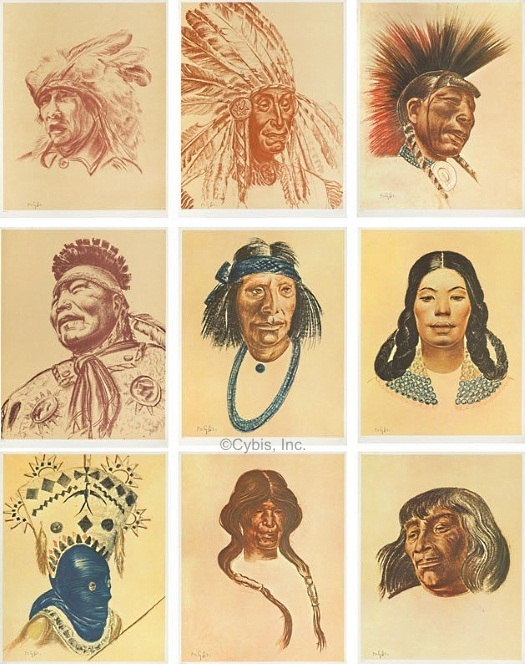
These nine portraits represent seven different tribes: the Comanche, Shoshone, Taos, Apache, Hopi, Mohave, and Yuma. A bit of trivia is that only two of those tribes (Apache and Shoshone) were featured within the modern studio’s North American Indians porcelain series. The images below are identified exactly as they are within the set.
 Comanche ‘Indomitable Spirit’ was also used as the design for the porcelain medallion that adorns the set’s cover page.
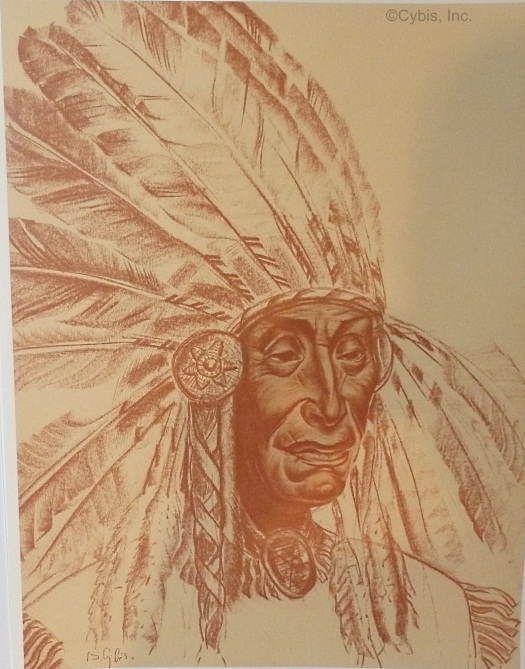 This chieftain is Shoshone ‘Silent Thoughts’ whose expression reflects the heavy burden of responsibility than always accompanies being a true leader.
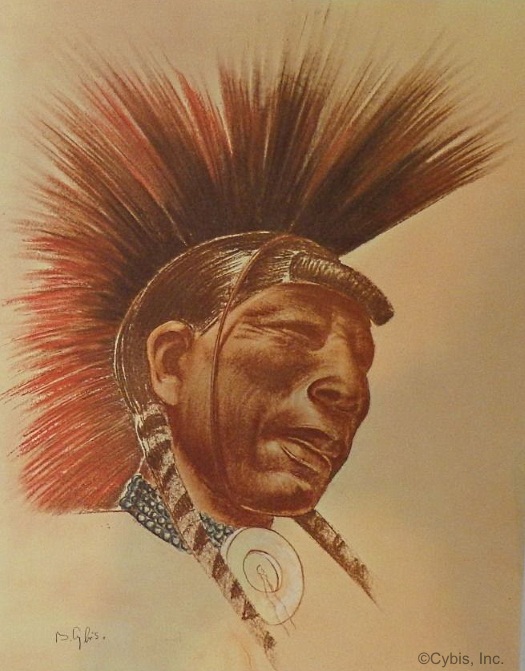 Taos ‘Timeless Ritual’ displays a traditional “roach” headdress.
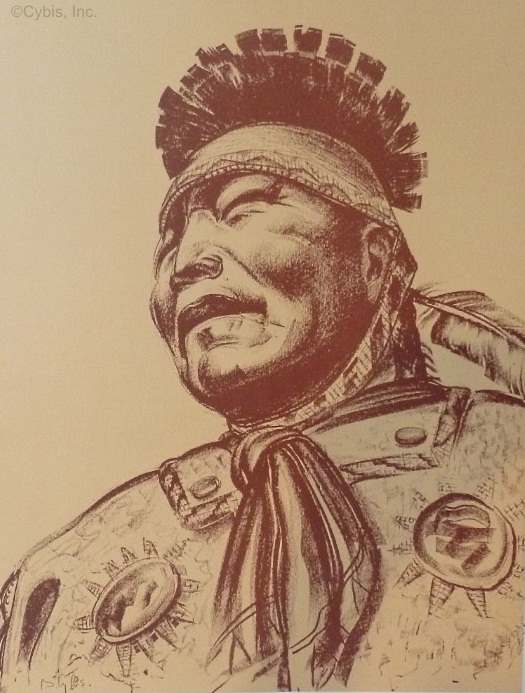 Apache ‘Pride Runs Deep’ exhibits the strength and dignity of this famous tribe.
 Hopi ‘The Farewell’ has an aura of ineffable sadness. The Hopi are one of the oldest surviving cultures anywhere in the world.
 Mojave ‘Eyes of Amber’ is sometimes altered to ‘Amber Eyes’ by resellers, but the copyrighted Cybis title is as given here.
 This very unusual portrait is titled Apache ‘Image Makers’ and depicts the ritual Devil Dancer or Spirit Dancer headdress and fully-swathed face. In Apache culture and legend, the Devil Dancer is a somewhat mischievous although benevolent spirit.
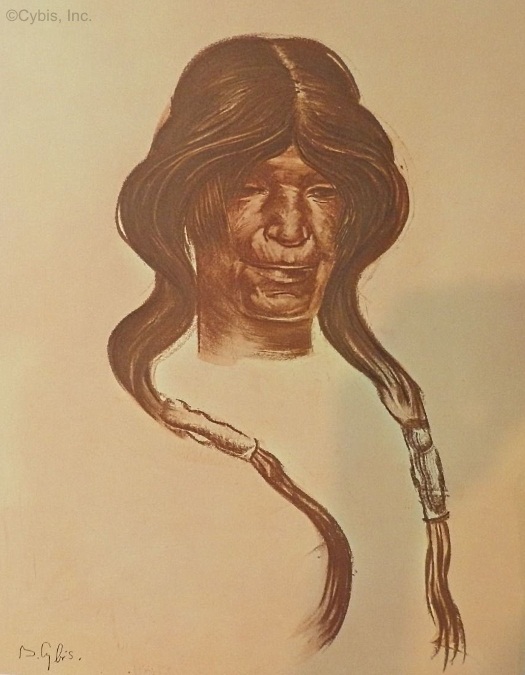 Hopi ‘Old Woman’ evokes the calmness, wisdom and acceptance of old age.
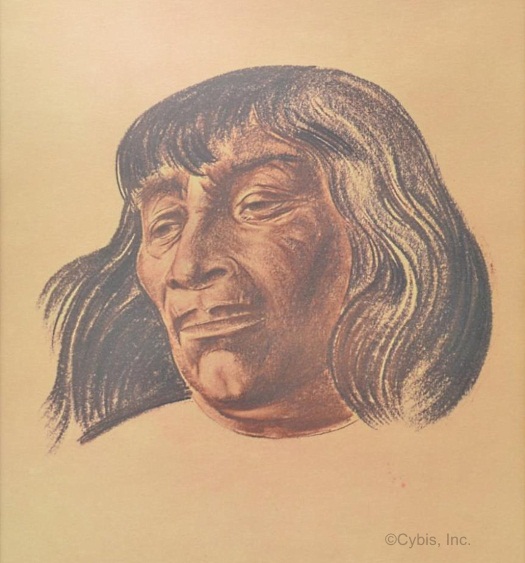 Yuma ‘Vanished Dreams’ reflects the history of this West Coast tribe which suffered 100 years of almost continual warfare from various sources starting in 1775.
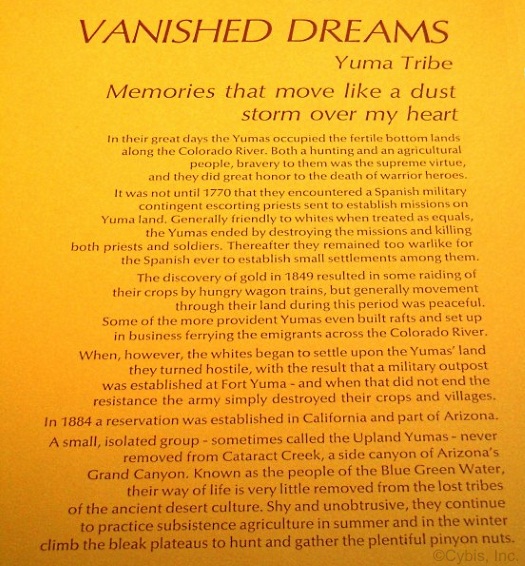 Each portrait was accompanied by an information text page similar to the one shown above.
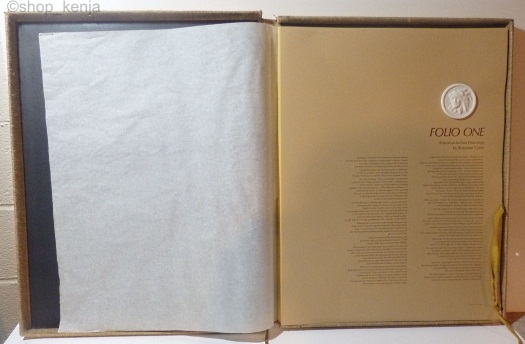
 The facing page of each Folio One set was printed on extra-heavy stock, upon which was mounted a plain white bisque medallion modeled after the Indomitable Spirit portrait. The mold includes the designation CYBIS 1970 on the front. The other later iterations of the medallion are shown in the next post.
Each Folio One image came with a certificate of authenticity from the Cybis Studio, which is something that they rarely did for any issue. The COA had the name of the print, followed by “1 of a set of 9 colored drawings, comprising Folio One of American Indian drawings by Boleslaw Cybis. In limited edition of 1000 on rag-content stock. Authenticated: CYBIS by [signature] Marylin Chorlton, Art Director. Underneath is an area in which the actual individual print’s number was handwritten in a #/1000 format. Thus there are nine separate COAs accompanying a full set.
 It’s not known whether the logo above (with the words Limited Edition added in an arc above) is the same as the one that is blind-embossed on the actual prints. This logo may have been used only for print material or maybe even only for this particular series.

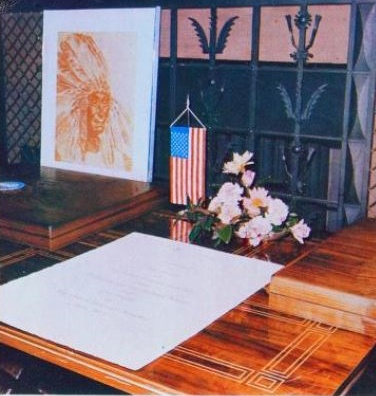 During President Richard Nixon’s trip to the Moscow Summit in May 1972 during which the Cybis Chess Set was presented as a Gift of State, he also brought additional gifts for the other legs of his trip. Upon visiting Poland after the Summit, the Nixons presented two of the original Folio One drawings to the People of Poland; the Cybis brochure that describes the 1972 Chess Set also contains this information about the drawings:
Each is beautifully framed in a velvet lined, hand hewn walnut case with the full color Presidential Seal in porcelain set into the cover, and carries the inscription “Presented to the People of the Polish People’s Republic from President and Mrs. Richard Nixon and the People of the United States.”
The photos above show the actual Shoshone ‘Silent Thoughts’ drawing that was presented. I assume that it is shown there as matted, because an original drawing would not have had such sharply delineated corners.
According to a news article in the Spokane Daily Chronicle on April 11, 1973, “All original plates for Folio One have been destroyed in the presence of James Mitchell, assistant curator of Americana at the New Jersey State Museum in Trenton.” The purpose of the newspaper article (entitled, rather awkwardly, “Prints Party Gifts”) was to publicize the presence of a Folio One set in an upcoming local auction: “North American Indian prints – Folio One — …have been presented to the Wampum auction May 13 by Cybis Graphics of Trenton, NJ.” Another full Folio set was donated, along with nine Cybis sculptures, by Joseph Chorlton to Alfred University (NY State College of Ceramics) in June 1980 for their permanent study collection.

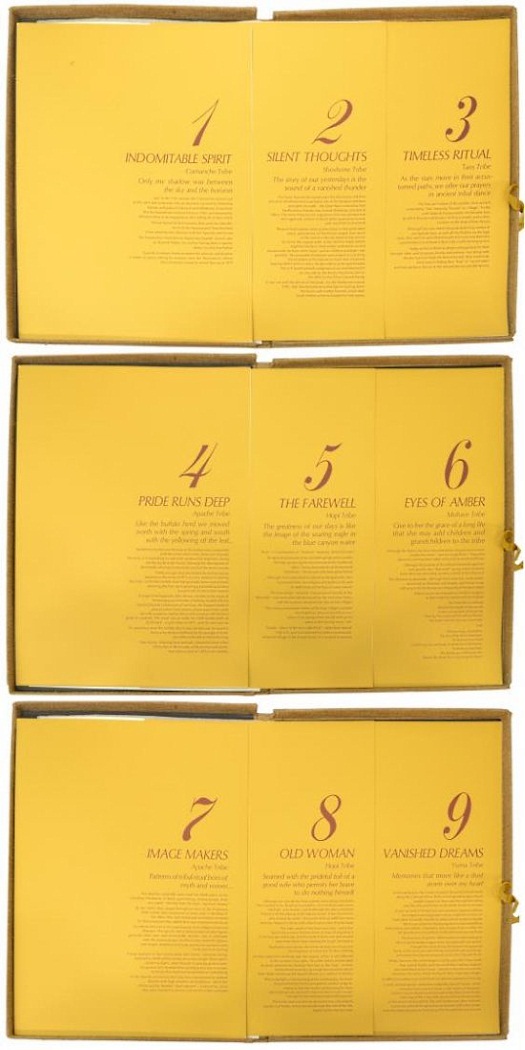 The complete Folio One set was enclosed within a presentation box covered in burlap, with what appears to be a heavy gold foil paper sticker.
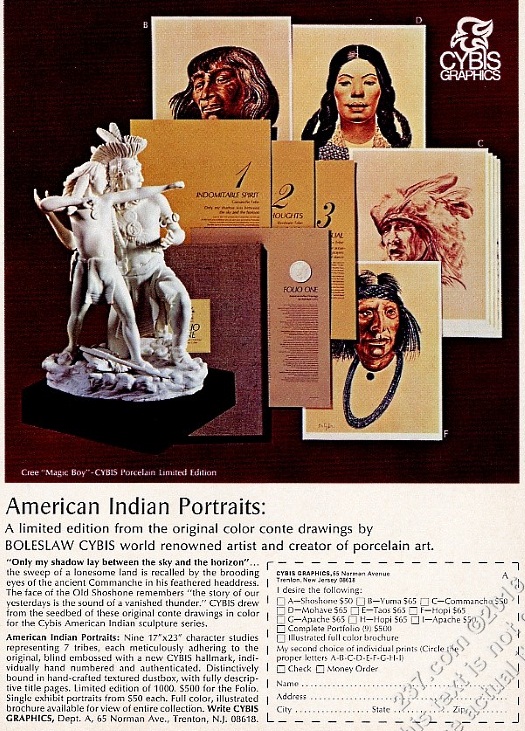 This magazine advertisement from 1971 shows the Folio One as well as the limited edition porcelain Cree ‘Magic Boy’. Notice that the studio is identified here as “Cybis Graphics” rather than the Cybis Studio or simply Cybis. Were they planning to release additional graphic arts items in the future, but never did?
The sixteen different Native American sculptures issued by the Cybis studio from 1969 onward are shown in North American Indians.
Name Index of Cybis Sculptures
Visual Index (for human figures/busts only)
About the Cybis Reference Archive
What is Cybis?
Images of Cybis porcelain sculptures are provided for informational and educational purposes only. All photographs are copyrighted by their owner as indicated via watermark. Please see the copyright notice in the footer and sidebar for important information regarding the text that appears within this website.
The Cybis Archive is a continually-updated website that provides the most comprehensive range of information about Cybis within a single source. It is not and never has been part of the Cybis Porcelain studio, which is no longer in business.
 THE CYBIS ARCHIVE