
The two Boleslaw Cybis porcelain lines (Cordey and Cybis) both utilized a number system for their production but approached them in different ways. A working knowledge of both can be helpful when trying to identify the 1950s output of the Cybis branded items in particular.
The Cordey Numbering System
Cordey items often contain an embarrassment of riches when it comes to numbers but an examination of a large number of pieces offered for sale in recent years shows a general breakdown of mold-number categories:
Numbers in the 200s are almost always teapots, coffeepots, sugar bowls, creamers, etc. Birds (other than the ubiquitous bird-in-a-tree) were in the 300s. The flat-backed wall-mounted ‘lady faces’ have numbers in the 900s. “People” molds – busts, torsos, and full figures – are numbered in the 3000, 4000, and 5000 range with the majority falling into the 4000-5000s category. This makes sense because the majority of Cordey molds were of this type.
The 6000 range is split between the various iterations of the bird-in-tree mold, and lidded boxes. The 7000 and 8000 ranges include a wide array of home décor items such as vases, centerpiece bowls, candlesticks, trinket dishes and lidded boxes, perfume bottles, dresser trays, and wall sconces/pockets/shelves. Cordey had very few animal figures but those that do exist have been numbered either in the 6000s or the 8000s.
 It’s common for Cordey pieces to have not one but several numbers on it and unlike the Cybis items being produced at the same time, the Cordey numbers were not removed. Often it’s impossible to winkle out exactly what mysterious code all the numbers conveyed. Did the painted numbers on this piece refer to additional mold pieces that needed to be attached to the main mold casting? Or to the type of decoration used? Or to the general color scheme/theme? Obviously these numbers meant something to the Cordey artists; but what?
 Cordey items received a gold foil sticker. Cordey lamps had a cardstock hangtag as well.
Please note that I do not/cannot provide information (identification, current market value, etc.) about individual Cordey-marked pieces that are not ALSO signed either Cybis or M.B. Cybis.
This separate post examines the numbers that appear on some (but not all) 1940s items that are signed M.B. Cybis. Those numbers are separate from the ones discussed here.
The Cybis Numbering System
(Update, Sept. 2019: A list of all currently known Cybis design numbers has been added to the Archive.)
Unlike the Cordey pieces, the Cybis mold/design numbers were applied in pencil and then subsequently removed during the actual decorating process. However, some did slip through with their mold numbers intact and these are sometimes the only clue to what name a 1950s piece may have been originally given. The 1979 Cybis catalog contains an Appendix that lists some – but not all – of the 1950s pieces, the vast majority of which belonged to the religious genre (in contrast to the almost entire lack of them in the Cordey line.)
Also in contrast to Cordey, the Cybis design number system is, for the most part, fairly logical and goes like this: Religious design numbers always began with 2; bird numbers with 3; people (other than the Indians) with 4; flowers with 5; and animals with 6.
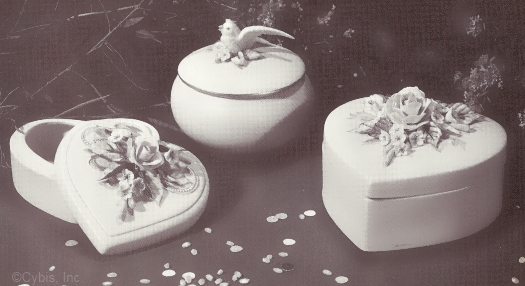 The “7” series of numbers can be confusing because it was used for the North American Indians during the 1970s and then for various home decor items during the 1970s. The confusion arises because when Cybis assembled their late-1970s Appendix they assigned 700 numbers to some home décor items that were produced during the 1950s. For example, the two 1950s Heart Boxes shown above were given numbers 730 and 731 which makes no sense considering that the first Indian design, Hiawatha, was #701 in 1969! Clearly, the Heart Boxes were arbitrarily assigned a mold number in the 1970s catalog that they never possessed during their actual 1950s production.
Eventually the home décor items were assigned design numbers starting with 8. These varied from the Bonbonniere/Baptismal Shell (#818) to Turtle ‘The Baron’ (#820) to the Thinking of You heart box (#817.) During the 1980s the number range was expanded into the 9s for the giftware and home décor items.
One would normally assume that a lower number would mean an earlier piece chronologically, and in general that is true for Cybis except when it comes to the religious pieces, the vast majority of which originated in the 1950s and were assigned three- or four-digit mold numbers. However, the 1950s-era numbers shown in the catalog reference cannot always be relied upon, as is shown below.
 Every so often a 1950s piece will surface with its handwritten mold number still visible, as on this pair of companion Jesus and Mary busts, being marked 2004 and 2005 respectively. If you were curious as to what these may have been named, you could look in the 1979 catalog Appendix for those numbers, and indeed 2005 is there… but it’s assigned to Mater Dolorosa, an entirely different sculpture from the same period which is illustrated in the catalog! Ooops. What’s worse, #2005 is there also but it’s assigned to Ecce Homo (also illustrated) which was the companion piece to the Mater Dolorosa. Because the mold numbers on the actual pieces themselves must be the correct ones, that means the Appendix that was compiled almost 25 years later must be wrong in this instance. Hmmmm.
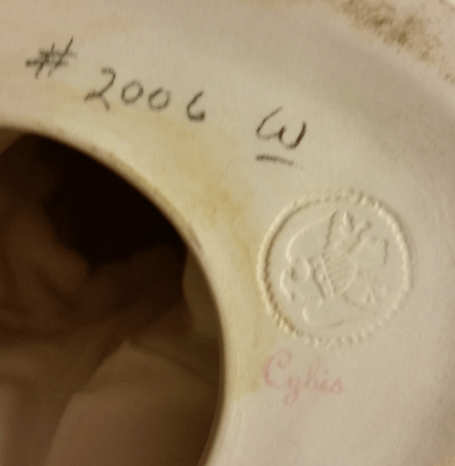 Here’s the underside of an actual Angel in Adoration which is a treasure trove of markings: the reddish Cybis stamp, the rarely seen Eagle stamp, and a mold number of 2006 followed by a W. This piece is illustrated in the 1979 catalog and is listed in the Appendix pages as….#2507! Hmmmm again. The addition of a W normally indicates that the piece was made in two color versions: undecorated (plain white) bisque, and painted. The presence of a W notation was to notify the artist that she shouldn’t paint this one. What’s odd is that the 1979 catalog doesn’t indicate that these particular angels were made in any color other than plain white (although several different Cybis angels were.) As far as the number discrepancy goes, the Appendix doesn’t include any piece supposedly being mold #2006 but again it seems that we must take our cue from what’s on the actual piece instead – unless the studio did a complete mold-number change mid-production from #2006 to #2507 which seems completely illogical.
Keeping in mind that the 1950s Cybis religious pieces were almost all cast from commercially purchased molds, the mold number assignments may have reflected that; for example, the molds they bought from Holland Mold may have been given #20** while the ones from Atlantic Mold Co (such as the Nativity Set) may have been #21**. This actually would make sense because it would immediately indicate what company they needed to order a new supply of molds from.
That said, when it comes to the post-1960 pieces the design numbers do follow a very generalized timeline within the different genres. Beatrice, introduced in 1965, was design #445; Pollyanna, from 1971, was design #465; and Queen Titania in 1977 was design #499. At that point the “people numbers” jump to four digits, with the 1978 introduction Little Boy Blue getting mold #4000.
However, during the 1990s the studio completely revamped their design-number system by changing them to a five-digit format by adding either two or three new numbers as needed in order to accomplish that. Unfortunately, instead of simply adding zeroes at the end, they added the new number(s) at the beginning, thus destroying the original “first-digit corresponds to genre” modality.
Because the majority of post-1960 Cybis pieces do not bear a penciled design number, the usefulness of design number is mostly limited to the identification of the 1950s pieces. This topic is discussed in more detail in the List of Cybis Design Numbers.
Name Index of Cybis Sculptures
Visual Index (for human figures/busts only; no Cordey)
About the Cybis Reference Archive
What is Cybis?
Images of Cybis porcelain sculptures are provided for informational and educational purposes only. All photographs are copyrighted by their owner as indicated via watermark. Please see the copyright notice in the footer and sidebar for important information regarding the text that appears within this website.
The Cybis Archive is a continually-updated website that provides the most comprehensive range of information about Cybis within a single source. It is not and never has been part of the Cybis Porcelain studio, which is no longer in business.
 THE CYBIS ARCHIVE