
Let’s play Twenty Questions with a potpourri of Q and A about Cybis porcelains. :-)
How do you pronounce CYBIS?
It is pronounced see-biss. There is a software company by the same name but their name is pronounced sigh-biss, as in “cyber.”
Will sunlight fade the colors of a Cybis porcelain?
No, the colors will not fade. The firing process makes the paint pigments UV-colorfast, unlike the dyes in fabric, oil or watercolor art, or wall paint pigments which do react to UV exposure. Cybis colors will also not change via oxidation, as paint and fabric colors can do.
Can a very hot or very cold environment damage my Cybis?
A consistently hot or cold room will not cause damage but a sudden and significant change in temperature (thermal shock) can indeed do so. This is true of any ceramic and of many other materials as well. Extreme temperature changes, such as bringing an item that was stored or shipped in very cold conditions directly into a hot room (or vice versa) can cause ceramics to crack, and can cause or exacerbate ‘crazing’ on the surface of glazed pieces.
That said, also keep in mind that some decorative elements were only glued, rather than fired, in place; examples are the swords held by King Arthur and Sir Henry. The glue that was originally applied decades ago has inevitably dried somewhat over time, and if the piece is stored in a hot attic or cold garage the ongoing extreme ambient temperature will accelerate the glue’s deterioration and diminish its holding power. So although consistent high or low temperatures won’t damage the porcelain itself, it can definitely affect any glue that may have been used on the piece.
I have a Cybis that is mounted on a wood base and the base is damaged. Can I remove or replace the base, and how much will it reduce the value if I do?
The busts and other pieces that were permanently mounted onto a wood base are attached with a toggle bolt, accessible via a hole in the underside of the base which was then covered with glued-on felt. After removing the felt and carefully loosening the toggle bolt, you should be able to remove the piece. Replacement of the base is only practical for the busts atop simple square bases and even then you would need to find one with the appropriate size hole.
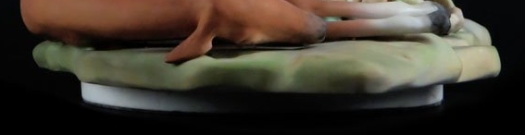 Pieces such as some of the the North American Indians have custom bases with recesses designed to fit the bottom part of the porcelain mold (and vice versa) like a puzzle. Unless you are (or know) a woodworker you will not be able to replace one of those bases. A entirely missing base, especially one of the ‘custom’ ones, should reduce the value of a limited edition although in this market it’s hard to say how much. This post shows all of the different bases that Cybis used, and has lists of which sculptures originally came with or on each kind of base.
I broke my Cybis! Where can I get it professionally repaired? Can I try to fix it myself, and if so, how?
This post addresses this very subject.
The piece I have isn’t pictured on your site or in any of the catalogs. Does that mean it’s a fake?
Not necessarily. It could have been be a part of a special production run for a retail gallery event, or part of a private commission done for a company, charitable organization, or local church. Also, many more 1950s pieces were made than were ever listed or pictured in any Cybis literature, and as they appear for sale nowadays online I continue to add those to the Archive. If it’s a human bust or figure, be sure to check the Visual Index page. If you still cannot find it, contact me via the link at the bottom of this post. I will respond via email to which you can then send photos of your piece and I will try my best to identify your Mystery Cybis for you.
Which museums display Cybis where I can see some other examples in person?
That’s a good question! Although the 1978 and 1979 catalogs include a page titled “Cybis Porcelains are in the Following Collections” listing more than 100 locations worldwide (about 2/3 of which are museums of some sort) that was 40 years ago. This 2022 post updates that list (hint: it’s much shorter now).
What does the year on my Cybis piece refer to?
The year (if any) appearing on a Cybis piece is almost always the year of its copyright registration. This post explains how and why a year appears on some Cybis pieces, and also shows the few exceptions to this “copyright-year rule.”
Does the glaze on the old 1950s Cybis and Cordey pieces contain lead? If so, is it a health hazard?
The short answer is that yes, the glaze on 1940s and 1950s items probably does contain some percentage of lead. Many antique and vintage ceramic glazes used lead oxide as an ingredient, which is why many people keep grandma’s old teacups only for display rather than drinking tea from them. But a glazed porcelain figurine, including any from Cybis, poses no health risk – I’m assuming that you’ve taught your toddler not to put that 1950s figure of Saint Patrick into his mouth, right? That said, I would not use any of the 1940s Cybis spatterware and other tableware for actual food service. Better safe than sorry.
How can I be sure a piece I am considering purchasing is MINT or has not been damaged and repaired?
The gold standard is to check it with a black-light. Obviously that’s not possible if you’re buying online or if a local seller balks at the idea (in which case you should probably walk away.) A careful examination of all available photographs can go a long way. Look for any irregularities or inconsistencies in the surface. Compare their photos of the piece with as many others as you can find online. Definitely check out my post about the most-often/easily-damaged Cybis pieces! And finally, make sure you understand the seller’s return policy before buying. Ask him “If I find any evidence of damage or repairs after examining this under a black-light, will you accept a return?” and make sure you keep their email reply if they say Yes.
I have a piece of old Cybis; was it designed or made by Boleslaw Cybis himself?
How old is “old”? If it’s from the 1940s the answer is “possibly.” If it’s from the 1950s and is marked Cybis, the answer is “probably not.” If it’s from 1960 or later, the answer is “definitely not.”
Be aware that in the 1990s the Cybis studio began selling some one-of-a-kind late 1930s/early 1940s pieces that were indeed designed and made by Boleslaw and/or Marja Cybis. Unfortunately the studio added “modern markings” in paint to these pieces, I guess in an effort to establish authenticity. The typical addition was the copyright symbol and the letters AP – and in some cases the Cybis signature was added as well, if it wasn’t originally there. This gave rise to much confusion when I first saw these being resold by a Pennsylvania auction house several years ago, because during the 1940s the designation AP and the copyright symbol were NEVER used. At first I assumed the pieces were 1960s or later reproductions of the originals (a la the Hall of Fame replicas) but later learned that the 1990s studio had newly-marked the original legacy pieces before offering them for sale.
Was Boleslaw Cybis related to the Polish painter Jan Cybis?
No; although they were roughly the same age (Jan was born in 1897 in Poland, Boleslaw in 1895 in Lithuania) they were from different families.
Why didn’t Cybis put the sculpture’s name on their pieces? Their competition (Boehm, Ispanky, Royal Worcester, etc.) did, and it makes identification much easier!
It appears to have been purely an arbitrary decision on the part of Boleslaw Cybis to not physically identify any of the pieces by name and that tradition was continued after the Chorltons took over the studio. There’s also a cost factor: The sculpture names on those other brands were all applied as decals before firing – just like the studio logo, the edition of (however many), and other information on the underside. A decal’s backing burns away in the firing. The Cybis studio saved some money by using only impression-stamps and hand-painted signatures and numbers, thereby avoiding the decal-expense completely. Yes, they could have handwritten the sculpture name as well (like the Kazmar studio did) but chose not to. Cybis appears to have been one of only two American studios that did not use back-stamp decals, the other being Kazmar.
Some pieces of Cybis have a sculpture number but also AP meaning artist proof. Shouldn’t it be one or the other?
Theoretically yes, it should be either one or the other. This 2023 Archive post explains all of the different situations that an AP on a Cybis piece might represent.
Why didn’t Cybis make sculptures of any “real people” other than Katharine Hepburn and Pope John Paul II? How did they choose their subject matter?
Making representations of real people requires legal procedures and permissions that the studio wasn’t willing to undertake except in those two cases. I’m assuming that the Vatican did give permission for the Pope busts. The Katherine Hepburn piece was done at the request of AVCO Embassy Pictures, who owned the rights to any depiction of Miss Hepburn as Eleanor of Aquitaine; reportedly, Miss Hepburn was unaware of it until she was presented with one of the sculptures by the president of AVCO.
Subject matter choice, ah well, thereby hangs a tale. While Marylin Chorlton ran the studio (1957-1977) many subject inspirations came from her, as well as from various items that she found and brought into the studio to be adapted into porcelain. Inspiration also came from the sculptor/designers themselves who would create models and present them to Marylin. In those days the studio was a very collaborative place. But with the arrival of the “new management crew” to run the show after Marylin’s death, this all changed. By the mid-1980s the marketing department was dictating much of what the studio would produce. This is why you often see such a marked difference in design and quality between the Golden Age (1960s and 1970s) pieces and the ones produced from the mid 1980s onward.
Sometimes sellers say “no original box”; would the piece be worth more nowadays if it still had its box? What did the Cybis boxes look like?
With one exception, the boxes that Cybis used were generic and, except for the Cybis name and logo stamped on them, were unremarkable. They were simply white cardboard with gold-colored printing as shown below.

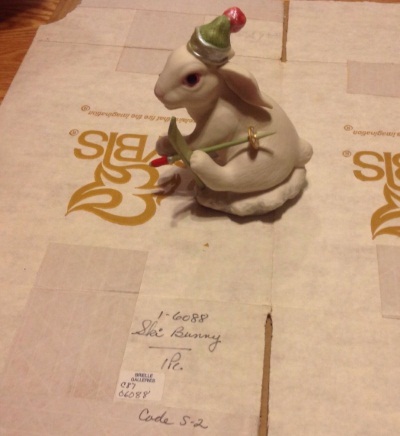 The sculpture name and design number was simply written on the box with a pen. The second photo shows a Cybis box from Brielle Galleries’ stock. The 6088 represents the Cybis design number (all the animal pieces began with 6) although I have no idea what “Code S-2” meant.
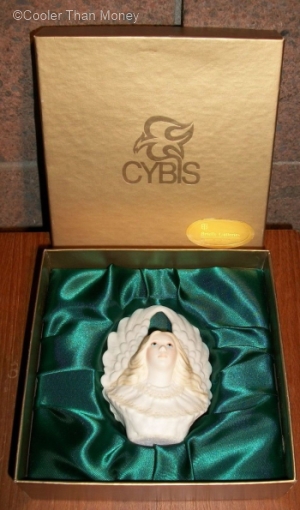 The exception to the generic boxes are the ones that were supplied with the annual Angel Ornaments for the four years they were made (1985-1988). The inside of the fabric-lined gold box was contoured to cradle the ornament. As far as I know, these were the only ‘custom’ boxes that Cybis used.
Why are Cybis and Boehm figurines selling for so much less today than they were when they were originally sold? I thought art was supposed to be a good investment!
The Archive post about the history of the art porcelain industry answers that question in detail.
Great-aunt Tilly died and left us a big houseful of stuff including a collection of Cybis. If I send you a list and pictures, can you furnish an appraisal for estate or insurance purposes?
Because I am not a certified appraiser, a probate court or insurance company would not accept my estimate of current market value even though the basic method (searching for documented recent sales of the same or a sufficiently comparable item) used is identical. Depending on what your estate attorney says is standard for your local court system, the lookback period for “recent sales” can range from only six months to as much as two years. Also be aware that even the various types of professional appraisals differ; the IRS and state courts will not accept an appraisal that was done for insurance purposes, for example.
The Recent Sales page will give you the best available idea of what limited-edition Cybis have been actually selling for.
Has Cybis stopped making porcelains and if so, when? What was the very last piece they issued?
As more fully related in The End of the Cybis Studio, their entire full-time production staff was let go at the end of 1989. During the 1990s and early 2000s, individual new-hire artists were brought in on an on-call basis for a day or two when needed to make an occasional piece if an order was received. Some of the pieces that were introduced during the 1990s and early 2000s had actually been created during the 1980s but not released then. Quite a few previously-retired pieces were brought back into the retail line even though they were never supposed to be made again. In 2019 the building was cleaned out and put up for sale; the leftover stock was liquidated by a Philadelphia auction house.
Their final new design introduction was the Carousel Reindeer, because the last time that the Cybis website was ever updated (December 2008), it was described as being “our newest introduction.” I have only ever seen one of these come up for sale online. It sold on eBay in September 2020, and was sculpture #20.
Name Index of Cybis Sculptures
Visual Index (for human figures/busts only)
About the Cybis Reference Archive
What is Cybis?
Images of Cybis porcelain sculptures are provided for informational and educational purposes only. All photographs are copyrighted by their owner as indicated via watermark. Please see the copyright notice in the footer and sidebar for important information regarding the text that appears within this website.
The Cybis Archive is a continually-updated website that provides the most comprehensive range of information about Cybis within a single source. It is not and never has been part of the Cybis Porcelain studio, which is no longer in business.
 THE CYBIS ARCHIVE