
Although the studio always emphasized Boleslaw as its founder, his wife Marja Cybis was a talented artist in her own right and no doubt contributed just as much to its success as he did. Unfortunately she has gotten short shrift in Cybis studio literature, relegated to a brief mention or a description in a timeline. Today, on the 60th anniversary of her death, it’s time to remedy that omission.
Boleslaw Cybis was a forceful and erratic personality and so it’s not surprising that most of the attention (then and now) focused upon him. We know little about Marja’s early life; she was born on October 13, 1905 in the town of Uman which was then part of Russia but is now Ukraine.
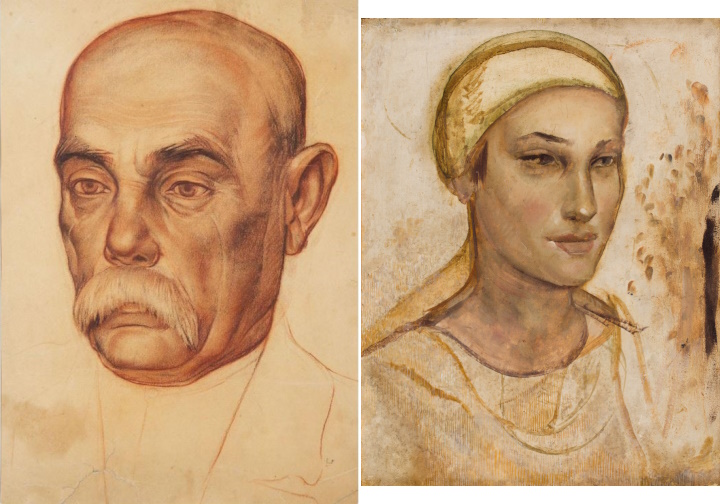 These two recently-discovered portrait drawings by Boleslaw Cybis are of Marja’s father Jan, and her sister Alicja (Alicia) Tym. Her mother’s name was Klementyna.
Marja had an older brother, Casimir (also spelled Cazimir and Kazimier) who in 1950 emigrated to the US with his wife and settled in the Trenton area. Her sister Alicja remained in Poland. It’s possible that Marja had other siblings as well.
A quick note about her name: it was originally Marja but when the couple decided to remain in America and become citizens, she altered the spelling to ‘Maria’.
The first Cybis-literature mention of Marja is in Cybis in Retrospect which states that Boleslaw Cybis “married Marja Tym, a talented fellow artist and student at the Academy.”
A transcript of their marriage certificate translates to:
1925Rz.-cat. Parish of St. TROJCY in Warsaw
Marriage Certificate
This is to certify that Bolesław Jarosław Cybis, 29 years old, son of Franciszek Kacper and Marianna Stanisława
and
Maria Fon-Tymm, 19 years old, daughter of Jan and Klementyna, entered into marriage on March 11, 1925
Fon is likely derived from the German von which means ‘from”‘; this is same usage as the Latin nee, meaning ‘born of’.
Marja accompanied her husband to Italy (Rome and Florence) and then to North Africa (Libya) in 1928 and 1929. The timeline in Cybis in Retrospect is slightly off, because it claims they were in Libya in 1932; this is incorrect, as will be explained below.
Stone Garden Sculptures (1930-1939)
According to research done by the Xawery Dunikowski Museum of Sculpture in Warsaw, upon their return to Warsaw in 1930 the couple established a home and garden in the Placówka neighborhood which abuts a large cemetery and is close to the Vistula River. The artists decorated their garden with more than twenty stone sculptures and decorations of various types, three of which were attributed directly to Marja in a 2016 exhibit at that museum.

 This frieze topped an entranceway and shows a group of eight children in various poses. One boy lifts a girl who is frightened by the approach of a friendly dog, another girl stands with hands on hips in a challenging attitude, and a shy girl covers her face and genitals with her hands.
 The ancient-Babylonian style of this female sculpture is heightened by the flat back section making the outline appear very geometric. Depending on how tall that garden wall was, this may have been a very large sculpture indeed!
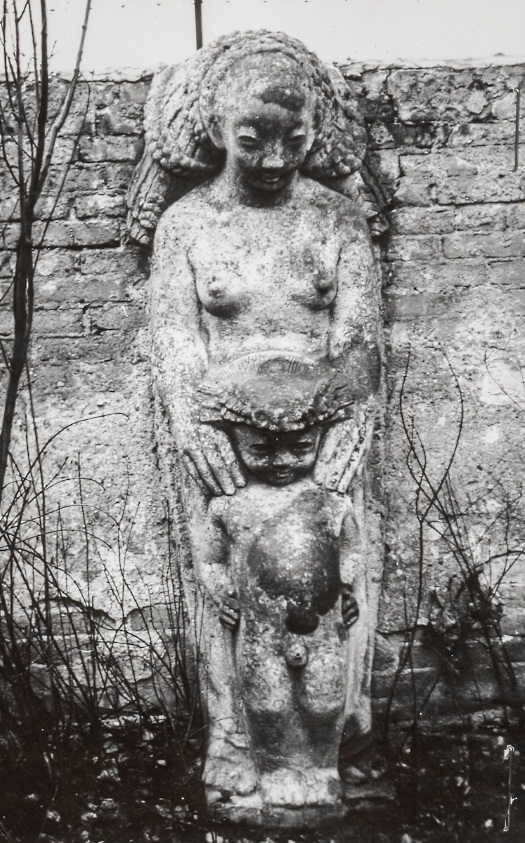 This large figure of a woman and male child includes elaborate hair braids that strongly evoke the Cybis works from their African travels. The story of the garden is told in this post.
In 1937, the couple worked together on the entrance ceiling titled Abundance for the Polish Pavilion at the 1937 Paris Exposition.
In early 1939, Marja and Boleslaw left their home and garden to travel to New York to work on the commissioned Worlds Fair Polish Pavilion murals. The house and garden were left in the care of family members during their absence. The couple would never see it again.
After finishing their Worlds Fair commission, the Cybises took an extended trip through the American West and Southwest; it is during this time that Boleslaw created the Folio One drawings and became fascinated by the Native American people and culture. The couple failed to return to New York in time to make their scheduled boat departure for Poland, and by the time they arrived in Europe the Germans had invaded Poland. They returned to New York from England in late 1939 and found rental quarters in Astoria, Queens County, not far from the Worlds Fair site.
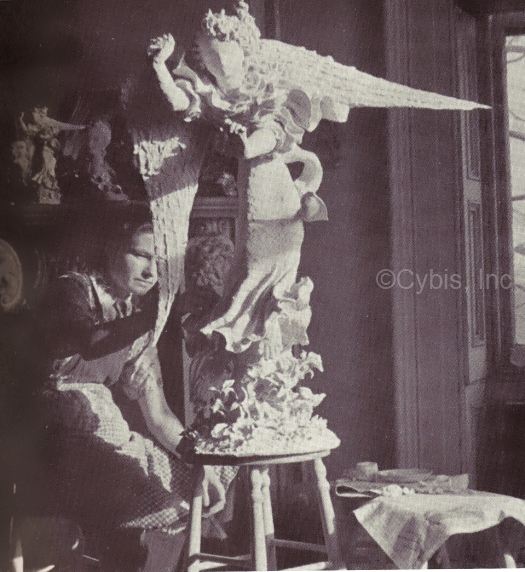 It was in this first USA studio, within the Steinway Mansion, that Marja created papka angels in various sizes. She is shown here sculpting a nearly-life-size model in either clay or papka; notice the small version on an upper shelf in the background.
 Marja created all the members of the Angelic Orchestra; examples of three of the six styles are shown here. A half-dozen other papka angels are mentioned in Cybis in Retrospect and there were probably more.
Two charming little Marja Cybis fairies are profiled in a separate Archive post.
 This photograph of Marja at a window in the Steinway Mansion studio shows her displaying nine assorted ‘lady busts’ of the type shown in the 1940s Papka and Porcelain post. The photo appeared in a 2002 auction catalog in Poland, which cited its source as being the National Museum in Warsaw.
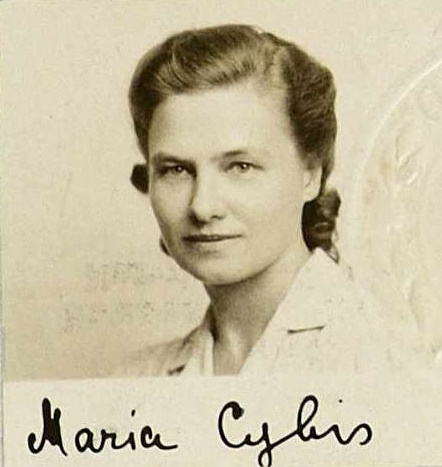 A photograph of Marja in 1942, attached to some of her Naturalization paperwork. She has changed the spelling of her name from the Polish Marja to Maria.
Sculptures and Art at the Cybis Home
Marja continued to be a partner in the retail operations (Cybis Art Productions and Cordey Fine China) on Church Street, as well as Boleslaw’s pet projects including costumes and makeup for the private theatricals staged at their newly built home/studio in Princeton.
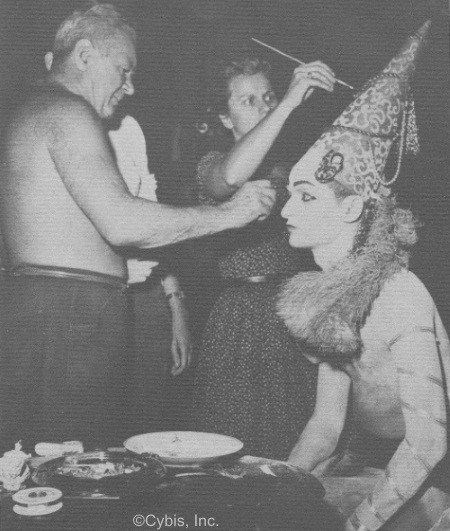 Here Marja assists Boleslaw with a clown character’s costume and makeup. This photo probably dates from the late 1940s.
An article in The Polish Review (a local New York newspaper) in 1946 reported on the 23rd Annual Womens International Exposition of Arts and Industries which ran from November 4th through 10th at the 71st Armory in New York City. It cites
On exhibition in the Polish booth were the works of a number of Polish women artists. The sculptures of Maryla Lednicka, the sculptures and ceramics of Marja Cybis, …
This shows that Marja was not limiting the dissemination of her pieces to only the Trenton area.
Maria Cybis Signatures
Two kinds of Marja/Maria Cybis marks on 1940s and 1950s pieces are straightforward and easy to identify; the third is a bit murky. Keep in mind that some pieces may also have either a Cordey or a Cybis mark/stamp on them as well. None of the papka pieces will have a Cordey or Cybis mark.


 The basic mark is a simple MC, for Maria Cybis, as shown on the bottoms of these papka figures.
 This dual mark on an Angelic Orchestra French Horn Player leaves no doubt as to who created her! The “Maria Cybis” can also appear as a stand-alone, without the accompanying MC signature. See this post for a gallery of all the MC-signed pieces discovered to date.
Speaking of signatures, I recently discovered that the very first Cybis paint-stamp (used in the early 1950s) was based on Marja’s signature!
 The sample signature is from her application for U.S. citizenship; by this time she is using the Americanized form of her first name, ‘Maria’. It is clear from this comparison that the first Cybis porcelain signature stamps are based on how she actually signed her surname. Boleslaw’s signature was very different.
Porcelain Retail Items (1940s-1950s)
Maria’s hand-painted signature can be found on 1940s and 1950s retail pieces bearing the Cordey and/or Cybis imprint but also on items with no other designation on them. These were all glazed and decorated; I have never seen an all-white item with Maria’s mark on it.
 Here is a lady-bust lamp in lavishly decorated, gilded and glazed porcelain that has many attributes of a typical Cordey piece… but instead of being marked Cordey, it is only signed M. B. Cybis. This reminds me of one of the 1940s papka sculptures and so if pressed I would say it could be either a Boleslaw OR a Marja design. But if I hadn’t seen a photo of the signature I’d have said “it’s a Cordey.”
 Here’s a non-lamp lady bust that is also signed M. B. Cybis no Cordey mark.
 This elderly Asian gentleman is extremely interesting because it was cited as having two marks: MC and and also 5094 which is a Cordey-format design number…..but there’s no Cordey name anywhere. MC always means Maria specifically. I love the ‘Cheerios necklace”‘ and this wise old fellow’s expression; too bad I only discovered the listing after it had been sold.
 Here’s another case of Marja not being credited at all in Cybis literature. This Mosaic Head of Christ is physically noted as “M. Cybis – 1946” on the reverse, and is listed in Cybis in Retrospect as a verified item and yet it is not disclosed in the book as having been by Marja…. merely as being a product of the studio. A matching companion plaque, Mosaic Head of Virgin Mary, was also cited but I have not found a photo of one. Both items were listed as being the property of the Cybis studio at the time of the 1971 exhibit and so apparently this was one of the legacy items that the studio sold off during the 1990s. One wonders where the companion plaque is!
I am certain that many of the 1940s items listed in that museum catalog had MC or Maria Cybis signatures on them even though credit was never given to her in their descriptions.
Death of Marja Cybis
Marja / Maria Cybis died on June 14th (Flag Day) 1958 at her home. She was 53 years old. This notice appeared in the June 22-28 issue of the local Princeton weekly paper, Town Topics:

Although the wording of the article describing the event as having occurred “last Saturday” may be confusing, it would have been typeset on the 21st (the Saturday following her death.) It is not known why she chose that date, although Boleslaw had also died on an American patriotic holiday (Memorial Day) the previous year. The circumstances of the discovery of her body are not known, nor the date of the service or initial interment. Boleslaw had been cremated and so it is very likely that the same was done for Maria.
A recent find in online back issues of Town Topics is this ad for an auction sale of the contents of the Cybis home. It is unusual because the sales were not conducted until almost a full year after Marja’s death.
 The first session took plate on May 19th and 20th, 1959 and is odd because the sale was not held at the Cybis estate at #38 Greenhouse, but rather a bit down the road, at #46. This may be been due to delays in emptying and selling the Cybis house. The reason for all of the Americana items is explained in this Archive post!
 The second part of the sale occurred the following month, on June 16th; almost exactly a year after Marja’s death. I found no other notices, and so whatever may not have sold that day probably went back into the Chorltons’ keeping; some of them may have remained to decorate the walls of the Church Street studio and later been removed to the new studio on Norman Avenue.
 Marja and Boleslaw were interred together at Princeton Cemetery on June 29, 1959, shortly after the second estate sale. It’s not known whether either were previously interred but if both were cremated that would not have been immediately necessary. This historic and very large cemetery is on Greenview Avenue; the Cybis plot is in Section 3, Block 09, Lot 019C. Marja’s brother Casimir died in 1990 and was interred in the same plot. (Notice that on the marker, Marja’s birth year is given as 1906.)
It is sad that Marja ended her life so soon; perhaps she would have eventually become a more recognized artist in her own right. I wish that we could know more about her, as a person and as an artist, than we do.
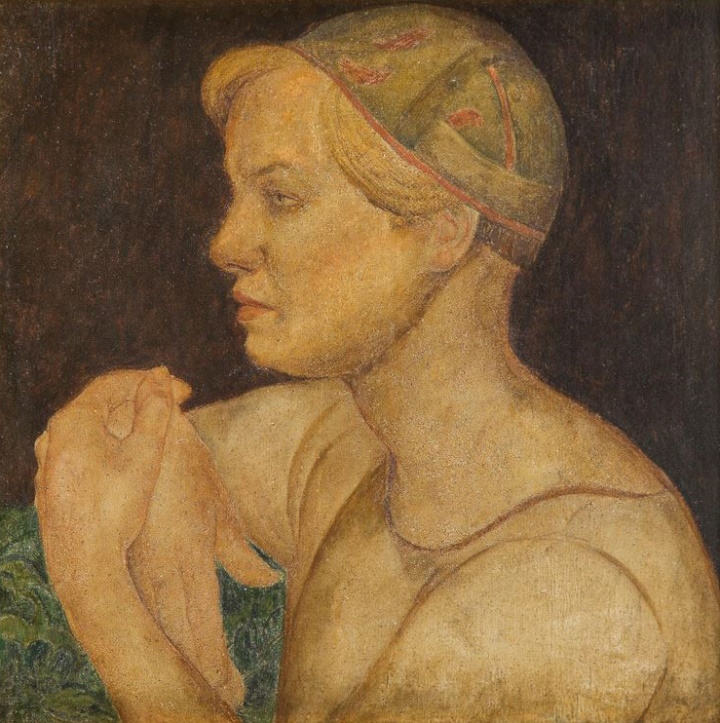 This portrait of Marja, painted by her husband and titled The Artist’s Wife, came up for auction in Poland. It is approximately 15″ square, and was done in oils on plywood. One source says that it is from 1925, shortly after their marriage; another source cites it as being from the early 1930s.
[If you have any information about Marja Cybis (nee Marja Tym) that you would like to share, or signed examples of her work, there is a contact form at the link below. I would be happy to add your information or photos to this page.]
Name Index of Cybis Sculptures
Visual Index (for human figures/busts only)
About the Cybis Reference Archive
What is Cybis?
Images of Cybis porcelain sculptures are provided for informational and educational purposes only. All photographs are copyrighted by their owner as indicated via watermark. Please see the copyright notice in the footer and sidebar for important information regarding the text that appears within this website.
The Cybis Archive is a continually-updated website that provides the most comprehensive range of information about Cybis within a single source. It is not and never has been part of the Cybis Porcelain studio, which is no longer in business.
 THE CYBIS ARCHIVE