
No, I’m really not pairing the chorus of Eminem’s The Real Slim Shady with a Cybis sculpture… even though there certainly were sufficient iterations to warrant it! Although the studio was never shy about borrowing pieces from one sculpture to help create another (see Body Snatching), this particular madonna bust not only kept popping up in one size/form or another but under different names as well. Her genealogy is guaranteed to keep confusing eBay sellers and buyers for many years to come – unless, of course, they read this!
Version #1: Cordey(?)/Cybis, Name Unknown
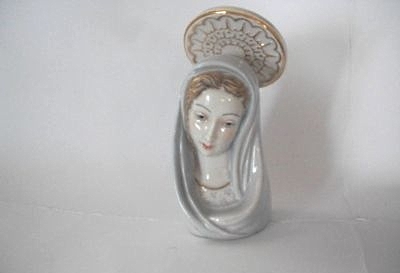 I am following a pure hunch and slotting this bust as the first in this design line. Unfortunately there was only this one photo from a very old eBay listing but it’s the listing description that makes it the possible “first.” The seller described it as “vintage 7 ½” Cybis signed porcelain madonna, made by Cordey China Co” which suggests to me that it was either marked Cordey or was marked both Cordey AND Cybis. If she is marked Cordey she’d be one of only two Cordey-marked religious pieces that I have seen so far. I have no idea whether this piece was given a retail ‘name’, in either case. It’s also the only item cast from this mold that I’ve seen wearing a halo.
Production years: possibly 1940s, definitely 1950s
Cybis design number: unknown
Overall height: 7.5” which I assume includes the rather large halo; probably 5.5″ for the bust alone
No base
Version #2: Cybis ‘Mother Most Admirable’

 This and all later iterations are marked Cybis. She has now acquired a retail name (apparently Mother Most Admirable) and also a porcelain base. She – meaning the bust portion only – may be a bit smaller than Version #1, depending on whether the added height from #1’s halo is close to the height of #2’s base section. The second picture shows three of the bisque (matte) finish colorways; it was also produced in a glazed finish and several of those are shown in the Madonna Busts from the 1950s post. This madonna bust was created by freelance sculptor Patricia Eakin for the Holland Mold Company.
Production years: 1950s only
Cybis design number: 2020
Overall height: 8” including base; bust section alone is 5.5” high
Distinguishing characteristics: Incorporates a porcelain base section; some are bisque, some are glazed.
Like almost all of the Cybis studio’s 1950s items this was not an original design; the mold was produced by the Holland Mold Company.
 This is the actual mold as sold by Holland. As discussed in When Is a Cybis Not a Cybis, it is common to find hobbyist examples of the same molds Cybis bought from them, and even some that were used by other ceramics companies. However, I have never seen a hobbyist or alternate-company example of this particular mold.
Version #3: original size Queen of Angels

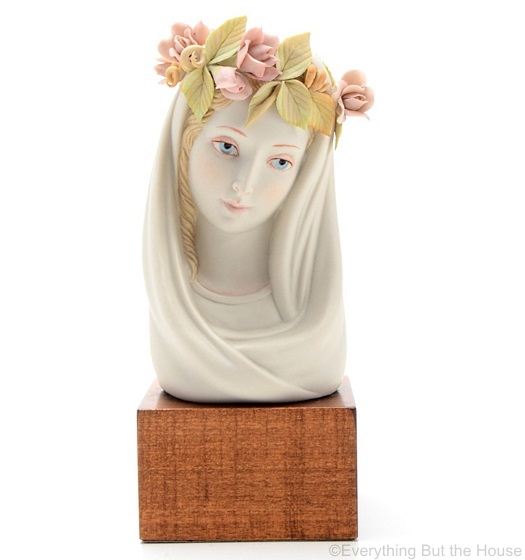 Queen of Angels first appeared in the 1950s and was offered in plain white bisque and in color. Her overall height including the wood base is approximately 11”. The color version was retired in 1970 but the white one continued to be produced. Thanks to a helpful reader I am now aware that in 1981 or 1982 Cybis changed the original brown wood base to a slightly shorter black composite-material one. The resulted in a real-world height reduction from 11″ to around 10″; unfortunately the Cybis price lists and catalogs were not edited to reflect this and continued to give the size as 11″ even though the piece was now actually shorter. The final year that Cybis produced this first version of the white Queen of Angels mold was 1986. A 1962 advertisement placed by the studio specifically identifies this as having been “sculptured by Patricia Eakin.”
Stating an actual size for the porcelain alone is tricky because of the floral crown and individual differences in taking measurements. Does one measure the height to the top of her head, or to the tip of the highest leaf? I’ve seen it done both ways. Combine that with the normal range of possible in-kiln shrinkage (1/2″ or more) and the final fired position of the leaves and flower petals, and you’ve got a recipe for a possible difference of 1″ or more from example to example. So, for the original Queen of Angels versions it is better to not fixate on the height of the porcelain bust itself.
Production years: color 1950s-1970; white bisque 1950s-1986 (from this mold)
Cybis design number: 2093
Overall height: 11” when on an original wood base but closer to 10″ when on a black base
Distinguishing characteristics: Wears a crown of roses; shirt front below collar is plain; is mounted onto its base via a toggle bolt
Version #4: original Madonna Angelica
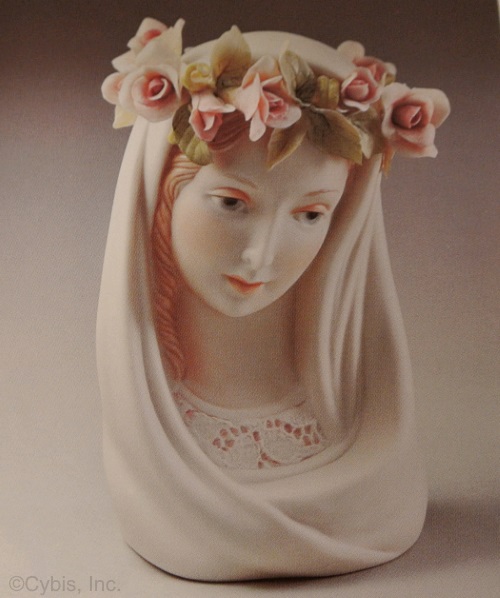
The typical confusion of this piece, Madonna Angelica, with the Queen of Angels begins here. She was introduced in 1981 in a color version only and never came with a base. At 5.5” high she is smaller than the Queen of Angels (which was still being sold in the white colorway) which might lead one to think that she was cast from the same mold as the 1950s pieces. This photo appears in their 1982 catalog and gives her height as 5.5” in the caption and index.
Production years: 1981 – 1983 or 1984 probably
Cybis design number: 2059
Overall height: 5.5” high
Distinguishing characteristics: Wears a crown of roses; shirt front below collar has a lacy surface; is not mounted on a base
Version #5: upsized Madonna Angelica
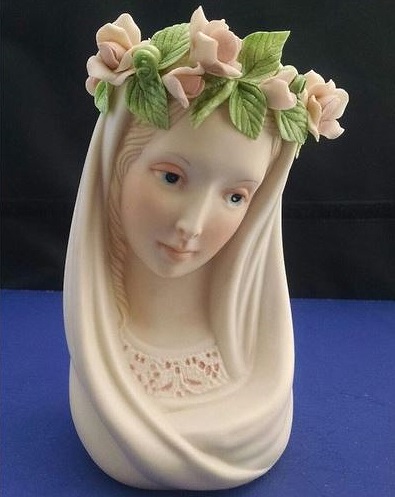 For some reason the studio decided to upsize their Madonna Angelica bust to ‘match’ that of the Queen of Angels. The 1986 Cybis catalog shows her as being 6.75” (still without a base, of course) as the photo caption. Their 1988 price list – unfortunately I don’t have any price lists between late 1982 and early 1988 – shows her offered in color and now also white bisque for $80 less. However, I have never seen a white bisque Angelica. Her design number has also been changed. This 6.75” – 7” size is the one commonly seen for sale on eBay which supports the theory that the smaller Version #4 was produced for only a couple of years.
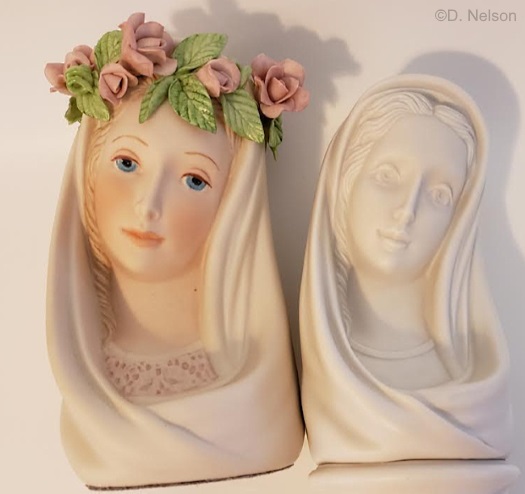 Here is the 6.75″ Madonna Angelica next to a Mother Most Admirable whose base section has been cropped out of the photo to better illustrate the similarities and differences.
 Here is the same Angelica next to an original Queen of Angels.
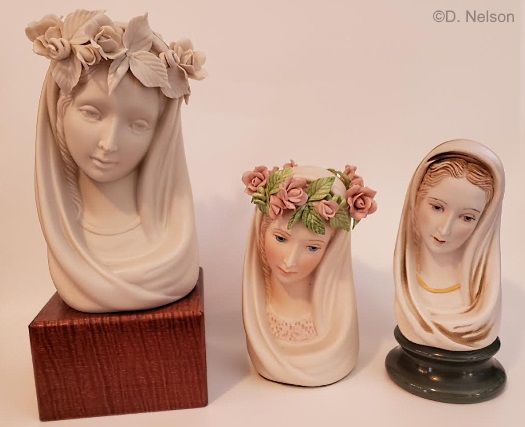 From left to right: original Queen of Angels, 6.75″ Madonna Angelica, and Mother Most Admirable.
Sometimes this size Angelica is seen with her dress front in pale pink lace, as in the example above, rather than white. This may have been meant to coordinate with the somewhat darker and more solid pink roses in her crown.
Production years: 1988 onward
Cybis design numbers: 10059 for color; 20059 for white bisque
Overall height: 6.75” high
Distinguishing characteristics: The color version is indistinguishable from the first Angelica except for height.
Version #6: upsized white bisque ‘Queen of Angels’

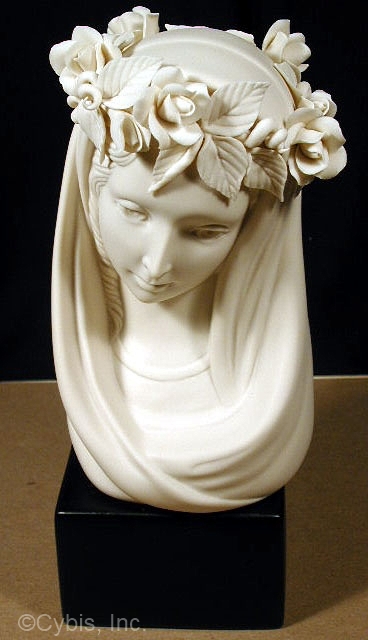 At the same time that Cybis tweaked their offerings of Madonna Angelica they also made some changes to their longstanding white bisque Queen of Angels. By all indications this change took place in 1987 and was definitely part of the line in 1988. The price list from that year also shows design number changes to this piece reflecting the larger size. The bust mold is now significantly upsized to 11” tall … almost double what it had been for decades… and for the first time this piece was offered both with or without a base. (The rationale for this totally escapes me.) However, this base is half the height of the one the original Queen of Angels sits upon: it is only two inches. Thus we now have an 11” high Queen of Angels if without a base and a 13” high Queen of Angels if on a base. These bases are the black composite material (not real wood) that Cybis switched to using during the early 1980s.
The photos above are the ones that appeared on the Cybis web site during the 2000s associated with their Queen of Angels listing. I have not yet seen any of these larger versions come up for sale.
Production years: 1988 onward
Cybis design numbers: 13093 for the on-base version; 23093 for the no-base version
Overall height: 11” high without base; 13” high on a base
Distinguishing characteristics: bust mold is about 4″ taller than the original Queen of Angels; black base base is only around 2” high (if the Cybis price list is correct.)
Diagnostic List for the Queen of Angels family
Because we have at least six versions of this particular madonna, spanning at least five decades, it is helpful to have a way to determine exactly which piece one has by using this list of characteristics.
** Sculptures that do not wear a crown of roses are definitely from the 1950s, and are either Version #1 or Version #2: i.e., they are Mother Most Admirable. However, I do not entirely discount the possibility that the studio may have experimented with adding a crown of roses to a few of these, because several of their other 1950s madonna pieces wear such crowns. Should you find one of these that has a porcelain base as well as wearing a crown of roses, she is from the 1950s – especially if she is glazed. This may never have happened but I am mentioning it for completeness.
** Sculptures that have a crown of roses and a plain shirt front beneath her round collar are one of the Queen of Angels versions, as follows:
– If she is attached to a brown wood base, she is the first Queen of Angels . If in color, she was made before 1971. If plain white, on a brown wood base and 11″ high overall, she was made before 1983; if on a black base but closer to 10″ high overall, she also the first Queen of Angels but was made between 1983 and 1986.
– If the porcelain bust is between 7″ and 8″ high and not attached to a base, she is a first-version Queen of Angels that has been removed from her wood base. This is possible because the attachment is only via a toggle bolt. In this case the determining identity factor is that her shirt front is plain (no lace.)
– If the porcelain bust itself is 11” high, and is all white, she is the upsized Queen of Angels from 1987 onward. Some are on a 2” high black base but some are not; it was the buyer’s choice.
** Sculptures that have a crown of roses and a lace pattern shirt front, and are not attached to a base, are one of the two Madonna Angelica versions. Madonna Angelica always has a lace-pattern shirt front.
– If she is 5.5” high she is the first Madonna Angelica, from 1981 to possibly 1983 or 1984. These were only made in color.
– If she is 6.75” high she is the second Angelica that was made from 1985 or 1986 onward. These can be either color or plain white (I have never seen one of those but would like a photo).
So there we have it: One Holland Mold Company item that managed to survive in one form or another for the entire production history of the Cybis studio, from the early 1950s onward. That’s a pretty impressive accomplishment when one thinks about it. What puzzles me is that although I’ve seen plenty of hobby and other-manufacturer examples of the same Holland molds that the Cybis studio bought during the 1950s, I’ve never seen any of this particular one made by anyone else. Did Cybis commission it (but if so, where did the mold for sale on eBay come from)? Or did they immediately buy the rights to this mold from Holland Mold Company? It would be interesting to one day find a non-Cybis example of this madonna bust but that has not happened yet!
Update: Three Queen of Angels/Angelica Oddities
Three oddly-crowned versions appeared in late 2019 during the liquidation of the studio’s backstock. Unfortunately the auction house did not supply the measurements, or more than one photo view, for any of them and so it is impossible to determine (as of this writing) positively which of the above seven versions these are. I will update this section if and when that information becomes available.

 This color Queen of Angels has a crown of yellow roses instead of the usual pink ones. It’s likely that this was simply a color test. Notice that her eyes are brown instead of the more usual blue. My hunch is that this is probably a Version #3 piece but without knowing its height I cannot be certain.

 This Queen of Angels wears a crown of dogwood flowers and daffodils instead of roses. It is on a short black composite base from the late 1980s/early 1990s. The dogwood flowers are the same ones seen in the Colonial and Majesty flower baskets from the late 1970s, and the daffodils are probably taken from the 1982 Spring Bouquet flowers piece. Her eyes are different from any other of these I have seen — they are so dark brown that they are almost black! [lower photo courtesy of the Museum of American Porcelain Art]
 The third oddity is definitely an original Queen of Angels that is probably from the 1950s and may possibly be the Queen of the Universe instead. The crown she wears is the same one that was used for the original Holy Child of Prague made between 1956 and 1973. Cybis in Retrospect cites “Queen of the Universe” as being 13″ high from the early 1950s. The “Cypia” coloration certainly matches that timeframe. Unfortunately, Retrospect did not specify whether sculptures were busts or full figures but there was one in the 1971 museum exhibit and this piece as seen here would definitely be 13″ high overall. So for the moment I will classify this as a Queen of Angels with Crown and Cherubs (possibly Queen of the Universe) pending further information on its dimensions and possible markings. If this is indeed Queen of the Universe, then it was a 1950s retail piece.
Name Index of Cybis Sculptures
Visual Index (for human figures/busts only)
About the Cybis Reference Archive
What is Cybis?
Images of Cybis porcelain sculptures are provided for informational and educational purposes only. All photographs are copyrighted by their owner as indicated via watermark. Please see the copyright notice in the footer and sidebar for important information regarding the text that appears within this web site.
The Cybis Archive is a continually-updated website that provides the most comprehensive range of information about Cybis within a single source. It is not and never has been part of the Cybis Porcelain studio, which is no longer in business.
 THE CYBIS ARCHIVE