
Any biographical sketch of Boleslaw Cybis will mention his membership in the ‘Brotherhood of Saint Luke’ – but what exactly was that? It was the name of a guild of artists and painters, formed in 1925 in Warsaw, Poland. The founder was Tadeusz Pruszkowski who was a professor at the Academy of Fine Arts in that city. He gathered some of his best pupils and created a group based on the structure of the artist’s guilds of medieval times. It was common for such guilds to be named in honor of Saint Luke who was the patron saint of artists. In Polish, Pruszkowski’s group was called Bractwa Swietego Lukasza (bractwa = brothers or brotherhood.)
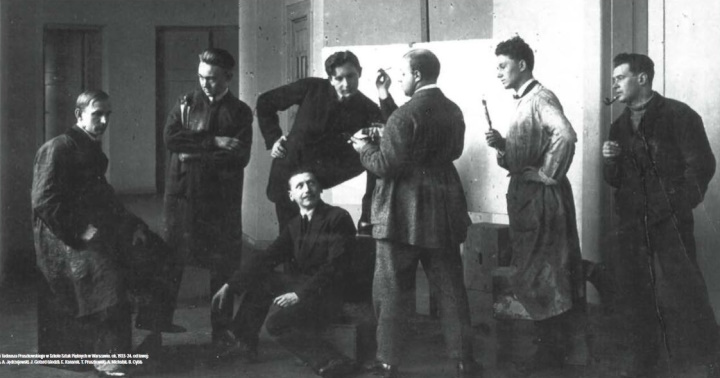 The initial roster of members was Boleslaw Cybis (at far right in this 1925 photo, smoking a pipe), Jan Gotard, Aleksander Jedrzejewski, Eliasz Kanarek, Edward Kokoszko, Antoni Michalak, Czeslaw Wdowiszewski, Jan Wydra, and Jan Zamoyski.
 This undated photo shows the Brotherhood members with name tags applied above them. The four members shown separately to the right of the original photo are later members.
 The cover of the first exhibit catalog of the work of the members of the Brotherhood, in 1928.
 This is the cover of the catalog that was printed in conjunction with the 1929 exhibition. Translated, it says Catalog [of the] Second Exhibition [by the] Brotherhood [of] Saint Luke.
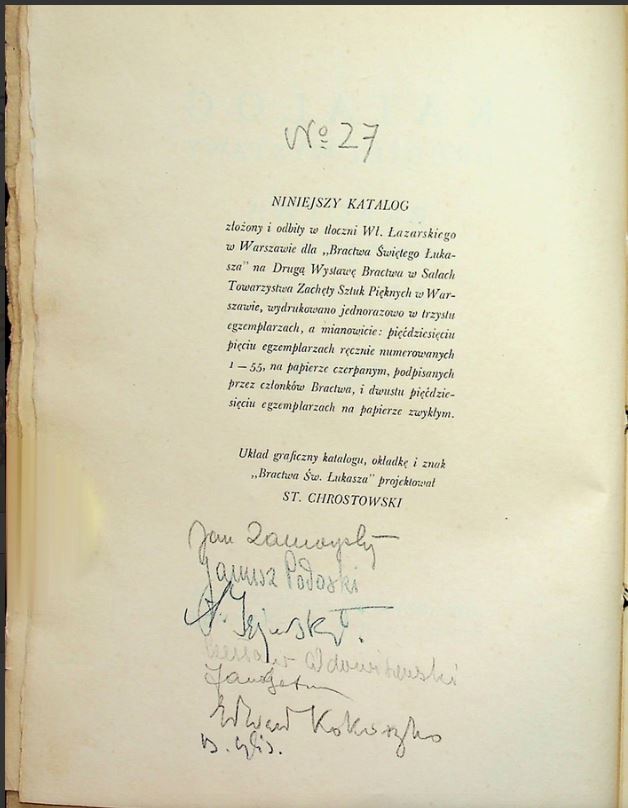 The frontispiece has been autographed by seven of the artists, including B. Cybis as the bottom signature on this page. The text reads:
THIS CATALOG was bound and printed at W. Lazarski’s printing company in Warsaw for The Brotherhood of Saint Luke for the second exhibition in the rooms of the Society for the Encouragement of Fine Arts in Warsaw, printed in three hundred copies, namely: fifty-five copies hand numbered 1-55, on handmade paper, signed by members of the Brotherhood, and two hundred fifty copies on plain paper.
Graphic layout of the catalog, cover, and “Brotherhood of Saint Luke” logo designer,
ST[ephen] CHROSTOWSKI
Handwritten above the printed text is No. 27, indicating that this was #27 of the 55. The catalog contained 28 numbered pages.
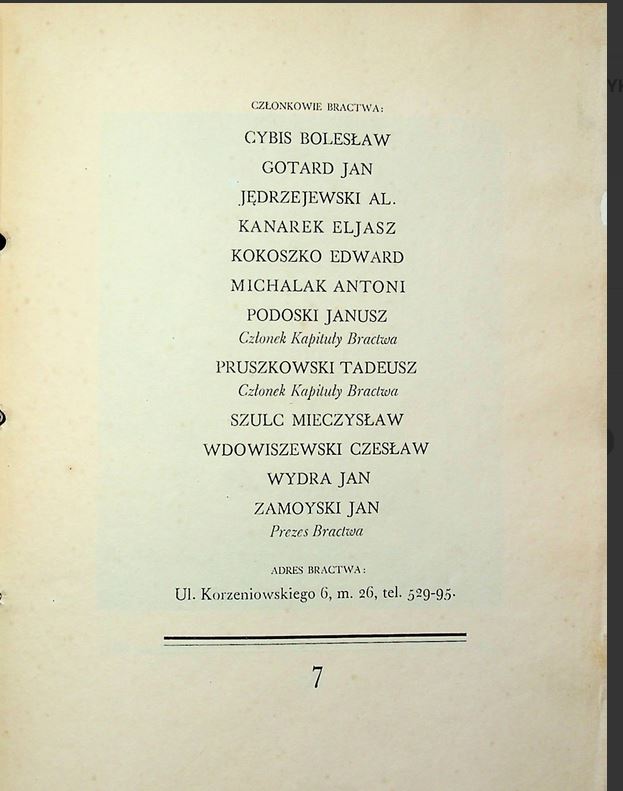 This page lists the members in alphabetical order. Pruszkowski and Podowski are captioned as “(Founding) Member of the Chapter Brotherhood”, and Jan Zamoyski as President of the Brotherhood.
Sadly, the seller of this item did not choose Boleslaw Cybis’ index page as an example of the format, but Jan Zamoyski’s indicates what these were like.
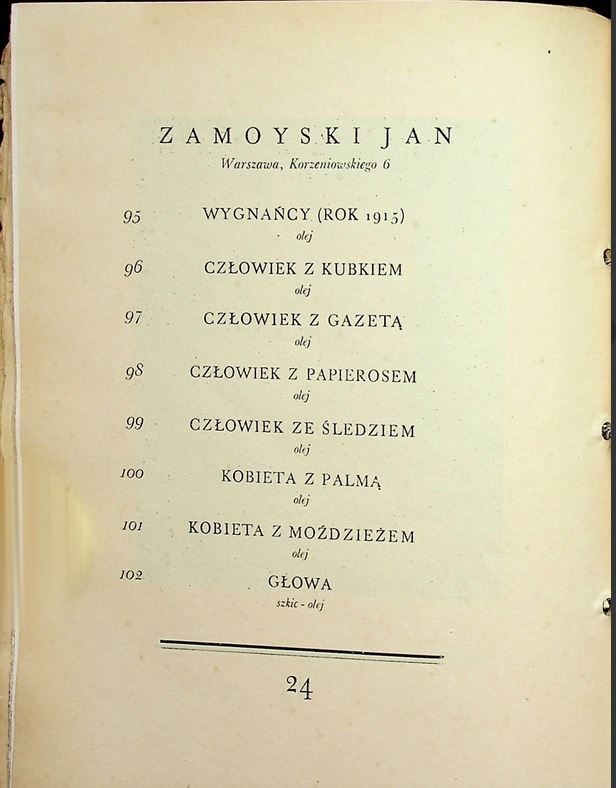 Each illustration of the works in the exhibit was numbered; Zamoyski had numbers 95 – 102. It simply gives the title of the work, and the medium. For instance, #96 is titled Man With a Mug (or perhaps Man Holding a Mug) and the medium is oil. Number 102, titled simply Glowa (Head), is described as sketch-oil.
 This is a photograph of Zamoyski’s Man With a Mug, which appeared on the page immediately after the artist index. This photo appears to show some tints of color in the background, which is somewhat surprising given the cost of color printing vs black-and-white.
This 1929 exhibit was not the only one mounted by the Brotherhood of Saint Luke. Records show that they also exhibited at that location in 1928, 1932 and 1938. Exhibits at the Palace of Art in Krakow were mounted in 1930 and 1938.
 This group photo was taken circa 1932. Cybis is the second from left, holding a framed portrait of an African woman done during his 1930 sojourn in Libya.
The 1939 World’s Fair Project
The Brotherhood of Saint Luke was commissioned to create a series of seven historical scenes to decorate the walls of the Polish Pavilion at the 1939 World’s Fair in New York. The paintings were accompanied by tapestries showing the history of King Jan III Sobieski’s reign. The intent was to reinforce the fact that Poland had a long and rich history as a nation, and was not some Johnny-come-lately (or rather, Jan-come-lately?) actor on the European stage.
Each artist in the Brotherhood was assigned to work on a particular element of the paintings, focusing on their strongest individual talents (faces, clothing, horses, structures, or whatever) and only worked on those parts of each mural. When they were finished with their ‘specialty’, they would go to the next mural and make room for the next specialist-artist to do his or her thing. Unfortunately, there is no record of what Boleslaw’s specific assignments were.
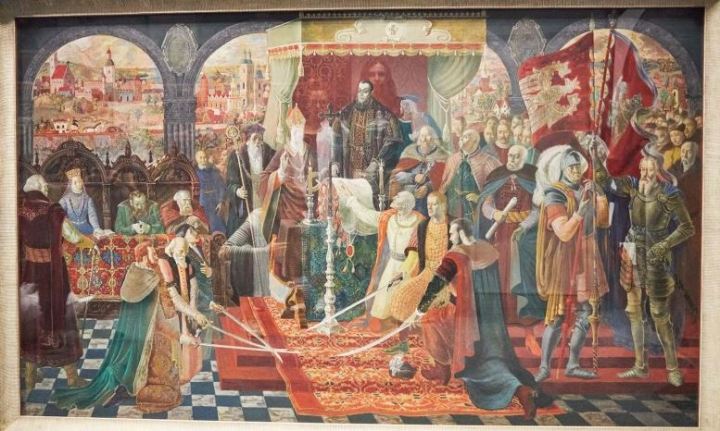 When completed, each of the seven paintings were signed by all eleven Brotherhood artists because all of them had contributed to it in some way. The murals were painted in tempera on canvas and are fully examined in their own Archive post. The example shown here is the Union of Lublin.
Name Index of Cybis Sculptures
Visual Index (for human figures/busts only)
About the Cybis Reference Archive
What is Cybis?
Images of Cybis porcelain sculptures are provided for informational and educational purposes only. All photographs are copyrighted by their owner as indicated via watermark and are used here only as reference material. Please see the copyright notice in the footer and sidebar for important information regarding the text that appears within this website.
The Cybis Archive is a continually-updated website that provides the most comprehensive range of information about Cybis within a single source. It is not and never has been part of the Cybis Porcelain studio, which is no longer in business.
 THE CYBIS ARCHIVE