
(This is a re-posting of my original 2018 post about the Christmas trees made by the Cordey China Company, which I had removed earlier this year along with my other Cordey-only posts. In retrospect, I should have left this one up because I now know, thanks to a very helpful reader, that there is a community of collectors who focus solely on these trees rather than on Cordey in general. And so, with my sincere apologies, here is the resurrected Cordey Christmas Trees post!)
Although the Cybis studio never produced a porcelain Christmas tree, their ‘sister company’, Cordey, made two styles. At least one of the trees was produced during the years when the Cybis and Cordey lines co-existed (1940s to mid-1950s.) Because one of the main Cordey lines was lamps, it made sense for them to offer a lighted ceramic tree; such items were a staple of holiday home decor during the 1940s and 1950s.
The tree molds are noticeably different from each other when compared. Both were given design/mold numbers in the 100 series which is a bit unusual because the few codes that began with 1 were vases and bowls and had four digits, not three. It’s also possible that these correspond to an outside mold company’s item number.
Both tree designs were produced in green and in white, and were lit from within by a 25-watt bulb. Extra multicolored tree “bulb” inserts were included. Both trees were also produced in two sizes: Small and Large. The small trees are between 12” and 13” high overall (including the base) while the large trees are between 18” and 19” and weigh approximately 6 lbs.
Cordey Tree #126
 The #126 Cordey tree has “plump” looking branches with fat rounded tips, and sits on a base that is similarly rounded in style. Even the corners of the square base bottom are rounded.
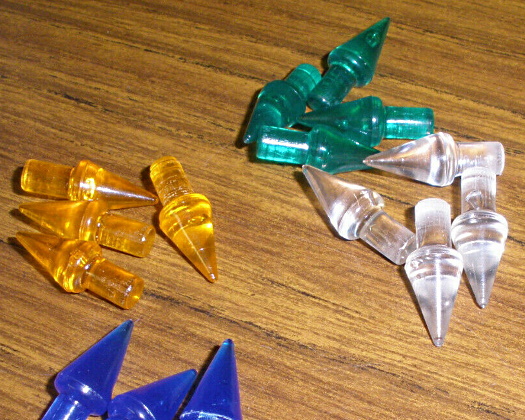 The plastic inserts in primary colors have sharply pointed tips which contrast well with the soft pillowy style of the tree.
Both of the trees illustrated above are the Small version. If I eventually locate a photo of the Large model, I will add it here.
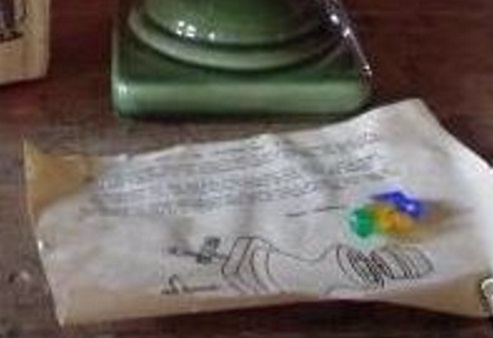
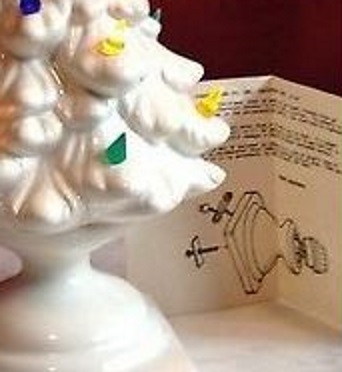 Cordey trees came with instructions for assembly and use. The company may have switched from printing them on normal paper (top photo) to a heaver cardstock (bottom.)
Cordey Tree #131
 The #131 Cordey tree reverses the rounded/pointed ratio seen in #126: The branch sections are slimmer, more defined, and come to a point at the end; the base is likewise angular and with sharply defined edges. The small multicolor bulbs, however, are round … rather like gumdrops. This tree is the Large (16″) size version.
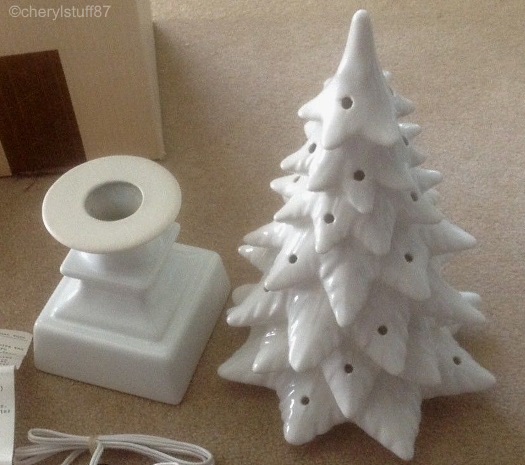
 Here are more views of the Small #131, again in the white version.
 There is the green version #131, in the Large size. The Cordey tree boxes were hand-marked as to the model and color, e.g., 131-W and 131-G.
 The instruction sheet provided is clearly detailed.
 And now for something completely different (as the saying goes): a #131 Cordey tree that has no “bulbs”! Instead, the internal light shines through slits beneath some (not all) of the branches.

 Put a colored bulb inside the tree and voila! one gets these dramatic effects. The #126 style tree, with its fat rounded branches, would not have been amenable to this treatment but for the #131 tree it works perfectly. I had no idea that this style of Cordey tree existed nor how many of them Cordey produced. I’m not sure what to call this style: “slit-lit” perhaps? By any name, it’s quite clever and unusual.
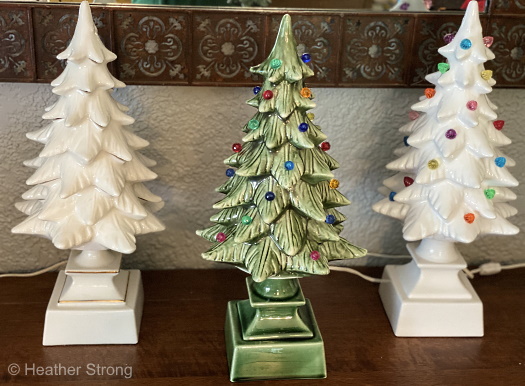 Here are the three Cordey #131 styles together; all are 16” high. Many thanks again for the heads-up and the lovely photographs, Heather!
When Were These Trees Made?
Online sellers have dated these vintage trees to various decades, so it’s useful to pinpoint their production time a bit better.
The Cybis-owned Cordey operation existed from 1942 until the mid-1950s. Because the instruction sheets are not dated, one clue to their production years comes from the original Cordey box.
The logo on the bottom of the #126 tree’s box is that of the Seaboard company in Newark, NJ. A bit of research shows that the Seaboard Paper Company already existed in 1947 but then changed its name to Seaboard Container Corporation by 1949; it remained as that name until 1954, at which time it was acquired by the National Container Corporation. Assuming that the Cordey operation was ordering their tree-box stock as needed (with the custom stamping of Small Xmas Tree and Large Xmas Tree) would seem to establish a mid-1940s to mid-1950s production window for this tree.

 However, the recent discovery of these two 1960s newspaper ads for what is clearly the #126 tree shows that they were being sold even after the Cordey operation passed out of the Cybis-partnership’s hands. This being a seasonal item, it’s possible that they were actually made during the 1950s but it took until the early 1960s for all of the backstock to be sold.
 The #131 tree’s box shows the box company as MannKraft. This company existed in New Jersey during the 1960s and the first part of the 1970s. However….
 A recent eBay listing for this vintage matchbook cover shows that Seaboard Container Corp and MannKraft Container were part of the same company. Boxes with both logos were being used during the 1960s and 1970s.
 This November 1969 ad was placed in the New York Times by the Lord & Taylor department store. By this time Cordey had become a secondary subsidiary of a large corporation who retained the name and operations location of “Schiller-Cordey” for production and marketing purposes. The original (Cybis-owned) Cordey company had gone bankrupt in 1959 and all its assets were sold to Norman Schiller of Schiller Brothers.
Similar Trees That Are Probably Not Cordey
The #131 tree model is occasionally seen for sale described as a Cordey item based only on the mold. However, I suspect that other companies may have utilized this mold as well as hobbyists. Here are a couple of examples of trees that in my opinion were not made by any of the Cordey operations.

 Although the tree mold and base mold look the same at first glance, it is slightly different – especially in the way the cord exits. In this tree the cord has been already brought through the base mold’s hole by the manufacturer, which in this case was almost certainly the Raymond Lamp Company of California. They typically added the ‘drizzle’ of white paint to their green tree models. The Cordey #131 tree base’s cord exit manner is different and was assembled by the purchaser.
 Here are two identical tree molds on different bases and with different mini lights. The tree on the left has pointed bulbs while the “matching” tree on the right has a mixture of round bulbs and pointed ones.
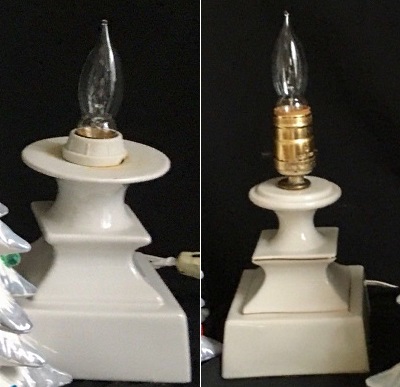 The two bases are clearly different. The one at left in this picture (on the right in the first photo) does match the Cordey #131 although I wish a photo had been provided of the cord exit area.
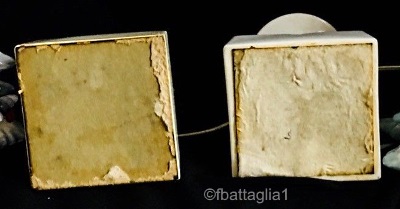 What throws me off the Cordey train re: these trees is the underside. Neither of the actual Cordey trees look like this underneath. It is possible that when Schiller-Cordey stopped making these trees, or ceased to exist as a company (probably during the late 1970s) they sold their molds/stock to someone else who put trees and bases together willy-nilly … or these both could be hobbyist productions. The rather odd paint job (gray branch tips??) also does not seem like anything that a lamp manufacturer would choose.
When and Where
Thus, the round-based #126 tree is a product of the original Cordey China Company and dates from the mid-1940s to mid-1950s only. It is not known whether the trees were produced at the Cordey location in Philadelphia, at the Cordey location on Enterprise Avenue in Trenton, or at both locations.
The square-based #131 tree dates from the 1960s and early 1970s and was made by Schiller-Cordey in one of its later corporate incarnations. These may have been made at the Cordey plant on Enterprise Avenue in Trenton, if Schiller took over the lease on that building, or at some other plant entirely.
I have received several inquiries asking where to find OEM replacement parts, such as a base section or replacement ‘lights’, for any of the Cordey trees. The likelihood is that one would need to purchase an entire second tree in order to obtain the part(s) needed. In addition to eBay, Etsy, and Everything but the House, it may be helpful to check smaller fixed-price sites such as Mercari and Poshmark. Smaller auction or estate-sale compilation sites such as MaxSold, K-bid, CTbids and HiBid are worth a look as well.
Please note that I do not/cannot provide information (identification, current market value, etc.) about any other individual Cordey pieces that are not ALSO signed either M.B. Cybis or Cybis. This post, and the one about the history of the Cordey China Company, are the only two that discuss Cordey specifically.
Name Index of Cybis Sculptures
Visual Index (for human figures/busts only)
About the Cybis Reference Archive
What is Cybis?
Images of Cybis porcelain sculptures are provided for informational and educational purposes only. All photographs are copyrighted by their owner as indicated via watermark and are used here only as reference material. Please see the copyright notice in the footer and sidebar for important information regarding the text that appears within this website.
The Cybis Archive is a continually-updated website that provides the most comprehensive range of information about Cybis within a single source. It is not and never has been part of the Cybis Porcelain studio, which is no longer in business.
 THE CYBIS ARCHIVE