
This post will take us back a half century, to attend a state dinner at the White House in April 1975. The Cybis North American Indians sculptures served as the table centerpieces for this event. So, step into your friendly neighborhood time machine and let’s go…
Back to the 1970s
A recent mail delivery contained something special, postmarked Washington, D.C. Opening the envelope, you found:
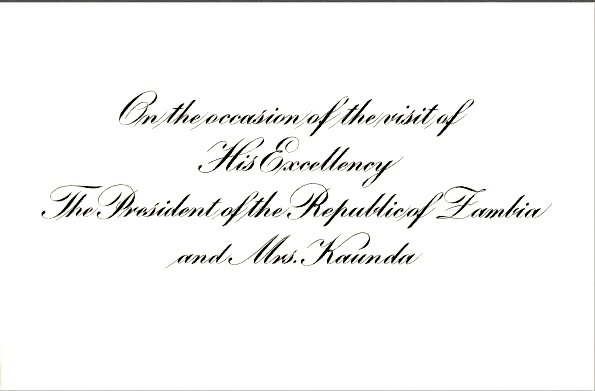
 You quickly filled out the RSVP card and dropped it into the nearest mailbox on your way to do some serious clothes shopping (because, after all, it’s a Black Tie affair.)
 On the evening of the event, you’re relieved that the off-and-on rain afternoon rain showers have ceased and the temperature is a very comfortable 60 degrees as you drive to the White House. The sun has just set, allowing you to appreciate the illuminated North Portico facade behind the fountain that was installed by President Ulysses S. Grant in 1874. The planting bed surrounding the white marble basin blooms with 4000 red tulips and 8000 blue grape hyacinths every spring.
 As you walk into the Entrance Hall,
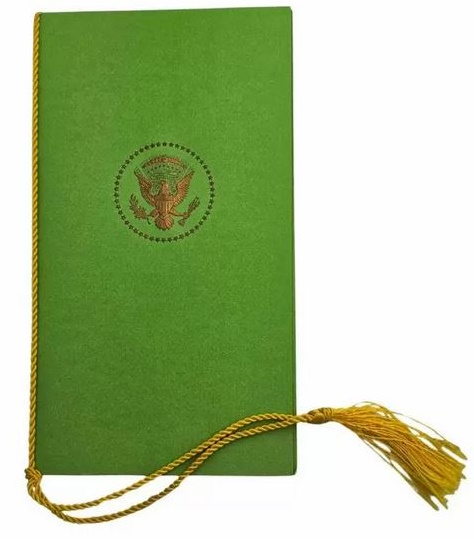 an usher hands you the official program for the evening,
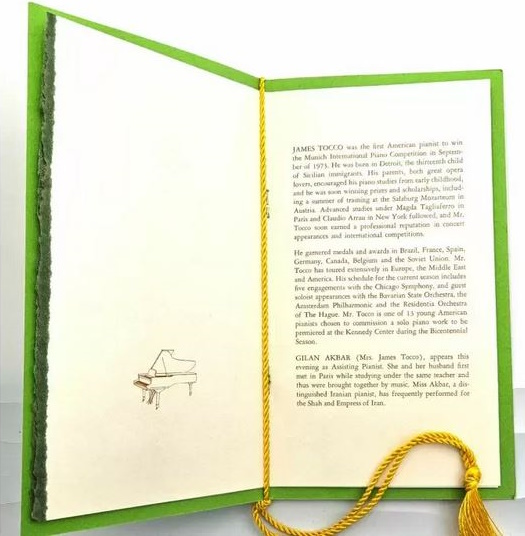 from which you learn that there will be an after-dinner performance by noted young pianist James Tocco who will play selections from Chopin. The usher tells you to proceed through the columns and into the Cross Hall, and then walk down the red carpet to the East Room.
(A Quick Orientation)
It is helpful to step out of the time machine for a moment in order to get an idea of where everything is.
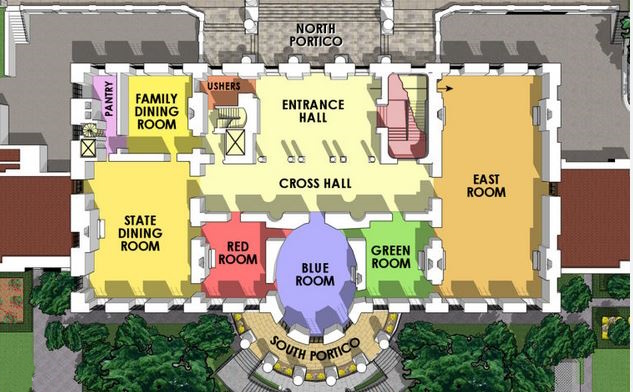 You entered the White House through the North Portico entrance (top center on this map) and walked through the Entrance Hall into the Cross Hall, which has the East Room at one end and the State Dining Room at the other.
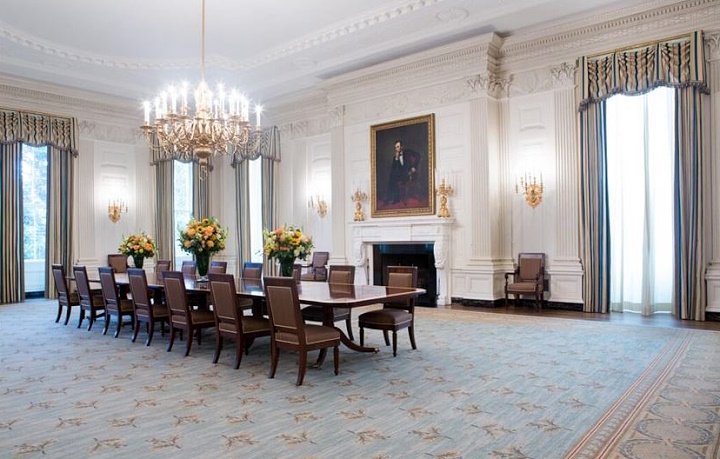 The large dining room, which is 36′ x 48′, has an 1869 Healy portrait of Abraham Lincoln over the fireplace. There is space for up to 140 guests; when not being used for a state dinner, it looks like this.
When set up for a large dinner, the tables are usually round so that nobody will sit at the ‘head’ of any table. Events like these are a huge undertaking; according to the Protocol Unit,
When the White House holds a state dinner, it’s all hands on deck. Staff from several agencies handle everything from selecting flowers to planning transportation. Every decision is made keeping the social customs of a visiting leader in mind. On the evening of the dinner, military social aides escort invited guests and answer their questions.
The sculptures used for this particular event were borrowed from the collection that was then on display at Blair House (see this post for a deep dive into those circumstances), with the possible exception of the pair of child busts noted later in this post. If the State Department did not already have those in their holdings to use as eventual gifts of state, they would have requested a loan of them from the Cybis studio.
Okay, let’s re-enter the time machine and go back to Saturday evening, April 19, 1975.
The State Dinner
Although you arrived promptly at 8 p.m., it isn’t until 8:12 that the President and First Lady, along with President and Mrs. Kaunda, descend the Grand Staircase. The Color Guard plays ‘Hail to the Chief’ as they form a receiving line to greet each guest exiting the East Room to proceed to the dining room.
 At the entrance to the dining room, an aide escorts you to your assigned table, Number 6, which has the 1971 white bisque Cree ‘Magic Boy’ as the centerpiece. At 8:46 pm, the President and First Lady enter the dining room and the dinner service begins.
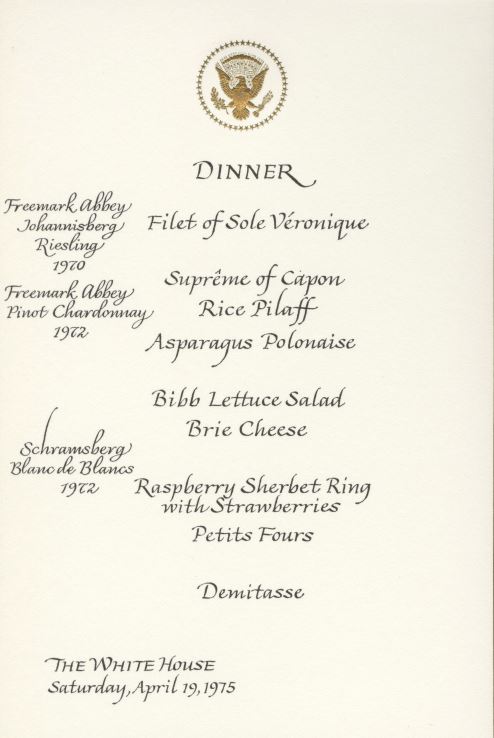 You peruse the menu and try to decide whether you’d rather have the fish or the chicken.
While wondering where Joe and Marylin Chorlton are seated, you make the acquaintance of the very interesting other guests at your table.
 L-R: Secretary of State Henry Kissinger; Lady Nancy Keith, socialite; Lew Wasserman, president of MCA/Universal Studios; Robert Cochran, Olympic skier; Clare Crawford, editor of People magazine.
Table Six guests not pictured: Mari Anderson, wife of the chairman of Continental National Bank; Carl Gerstacker, chairman of Dow Chemical; William Keating, owner of the Cincinnati Enquirer; and Aminda Wilkins, wife of Roy Wilkins, the head of the NAACP. (Joette Shouse, a bigtime donor to the Wolf Trap Foundation for the Performing Arts, must have been bumped in order to make a seat available for you.)
After giving your waiter a surreptitious gratuity, you learn that Joseph Chorlton is seated at Table 11 and Marylin is at Table 12. Both tables are immediately to the left of the fireplace, viewed from where you are sitting.
 Eventually, between courses, you make your way to Table 11 to say hello to Joe Chorlton and the other notables at that table. The Cybis centerpiece here is the pair of child busts, Indian Boy ‘Little Eagle’ and Indian Girl ‘Running Deer.‘
 L-R: First Lady Betty Ford; Kenneth Kaunda, President of Zambia; Lovida Coleman, wife of the Sec. of Transportation; Jerome Robbins, choreographer; Frank Blair, former Today show host; Georgie Packwood, wife of Senator Robert Packwood of Oregon; Joe Chorlton.
Table Eleven guests not pictured: Gloria Sachs, fashion designer; Nellie Van Andel, wife of the founder of Amway; and T.H. Mulemba, Zambian politician and freedom fighter.
You then pay your respects to Marylin Chorlton at the adjacent Table 12. You can’t help thinking that Joe Chorlton definitely got the ‘better’ table assignment at this event!
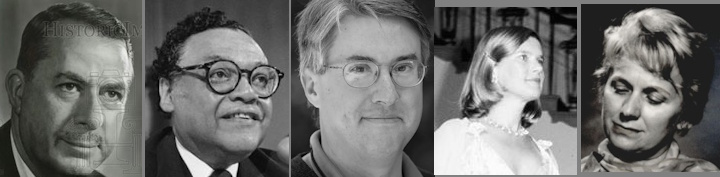 (L-R) Ian MacGregor, chairman of American Metal Climax; William Coleman, US Secretary of Transportation; David Owen, former Senator and Lt Governor from Kansas and advisor to Bob Dole; Jessica Catto, wife of Chief of Protocol Henry Catto; Marylin Chorlton.
Table Twelve guests not pictured: Josephine Powell, wife of Associate Supreme Court Justice Lewis Powell; Mr. Mwale, the Zambian ambassador to the UN; Hans Reis, chairman of Continental Ore; and Dabney Holloway, wife of Admiral James Holloway III.
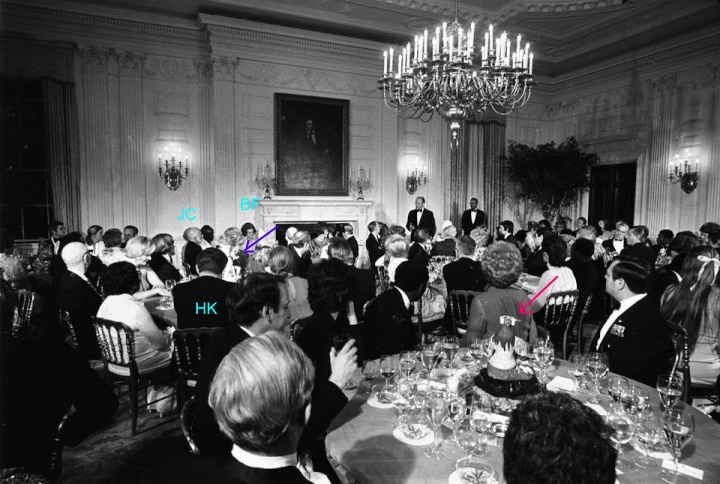 (Photo notes in blue: HK = Henry Kissinger, JC = Joe Chorlton, BF = Betty Ford. Purple arrow = your table’s Magic Boy centerpiece. Pink arrow = Beaverhead Medicine Man centerpiece)
Dessert and coffee end the dinner service, and at 10:10 pm President Ford rises to begin his toast to the guests of honor:
Mr. President, Mrs. Kaunda, Kaweche Kaunda, distinguished guests:
Let me say that Mrs. Ford and I are extremely delighted to have you, Mr. President, your family, and your distinguished guests with us here this evening. It has been a great pleasure for me to talk to your lovely wife and to know of your delightful family. And on behalf of Mrs. Ford and myself, we extend and wish to you our very, very best. Your visit to Washington is a mark of friendship that has existed between our two nations since Zambia gained her independence in 1964.
 (Photo notes in blue: LK = Lady Keith, HK = Henry Kissinger, LW = Lew Wasserman, JC = Joe Chorlton, BF = Betty Ford, PF = President Ford. Pink circle = Indian Boy Head centerpiece. Green arrow points toward Magic Boy, just above HK’s head)
President Kaunda then rises to give his response, which begins cordially:
Mr. President, Mrs. Ford, brothers and sisters:
I first want to express my deep appreciation and gratitude for inviting me to visit Washington, D.C. I also thank you, the Government, and the people of the United States for their warm welcome and the kind hospitality given to my wife and I and the entire Zambian delegation. Mr. President, we are happy to be in Washington, D.C. It is a very brief visit, but since we come for specific objectives, it is not the duration that matters, but the results.
His speech then takes an unexpected turn.
What gives Zambia and Africa great cause for concern is, Mr. President, America’s policy towards Africa–or is it the lack of it, which, of course, can mean the same thing. […] We have, in recent years, been most anxious, Mr. President, about the nature and degree of the United States participation in building conditions for genuine peace, based on human equality, human dignity, freedom and justice for all–for all, particularly in southern Africa. You will forgive us, Mr. President, for our candor if we reaffirmed on this occasion our dismay at the fact that America has not fulfilled our expectations.
You can hear the proverbial pin drop in the dining room at that point. UPI (United Press International) reports afterward that
Throughout the speech, Ford was impassive. Some observers said he went out of his way to mask a reaction. Neither the President nor Secretary of State Henry Kissinger had any comment on Kaunda’s remarks.
At 10:35 p.m., given the awkwardness of the previous moments, everyone is quite happy to be ushered into a nearby parlor for after-dinner drinks and nibbles, and of course some armchair dissection of President Kaunda’s speech. Somehow you have wangled your way onto the separate After-Dinner Entertainment guest-list as well, so that in a short while you are able to proceed to the East Room and
 listen to the piano performance by Mr. Tocco accompanied by his wife, Gilan Akbar, from 11 to 11:40, after which
 guitar-aficionado President Kenneth Kaunda and his wife Betty give an impromptu song or two. Afterward, you make a beeline for the Grand Hall where there is dancing for another half-hour. The after-dinner guests are an entirely different group (the B-list, so to speak) but you are able to identify
 veteran actors James Whitmore and Hugh O’Brien, as well as the famous mime Marcel Marceau, busting some pretty decent moves on the dance floor. When the POTUS and FLOTUS retire to the Residence at 12:35 a.m., this ‘State Dinner with Cybis’ comes to an official close and we will, in the parlance of the 1970s, “See ya on the flipside” … which in our case is 2025!
Nerd Notes:
- All of the data, and most of the photographs, in connection with this state dinner are available via the Gerald Ford Presidential Library and/or Google.
- Frank Blair’s final Today show episode aired in March 1975.
- Transcripts of the toasts given by President Ford and President Kaunda can be read here.
- A mid-1970s performance of Chopin by Mr. Tocco can be heard on YouTube.
Name Index of Cybis Sculptures
Visual Index (for human figures/busts only)
About the Cybis Reference Archive
What is Cybis?
Images of Cybis porcelains are provided for informational and educational purposes only. All photographs are copyrighted by their owner as indicated via watermark and are used here only as reference material. Please see the Copyright Notice in the footer and sidebar for important information regarding the text that appears within this website.
The Cybis Archive is a continually-updated website that provides the most comprehensive range of information about Cybis within a single source. It is not and never has been part of the Cybis Porcelain studio, which is no longer in business.
 THE CYBIS ARCHIVE