
Even though it opened less than seven years ago, the Museum of American Porcelain Art (MAPA) currently has more pieces of Cybis porcelain in its holdings than any other museum in the world. It leads the other two of the Top Three public Cybis collections by a wide margin in terms of quantity. How did the MAPA become so successful so quickly? I’ve traced its history in the form of a timeline.
The MAPA Timeline
 1960s: During the 1960s Richard Barone, a principal in two management-consulting firms, examines the investment potential of art porcelain which was a fledgling but burgeoning collecting trend among high-income earners. His interest is soon piqued, and he begins to slowly build a collection of his own.
1970s: Richard Barone continues to build a personal collection of American art porcelain.
1980s and 1990s: External market forces exert mounting pressure on the art porcelain industry, especially during the 1990s; see this post for a more in-depth look at what happened.
2006: Richard Barone has assembled a significant collection of American art porcelain. Helen Boehm sells the Boehm studio to Dallas-based direct-sales company Home Interiors & Gifts.
2008: Home Interiors files for bankruptcy, and the future of its Boehm division becomes extremely uncertain. The introduction of the final ‘original’ Cybis design edition occurs in November; their website is never updated after that point.
2009: Sharon Parker, a New Jersey native, happens to visit the Boehm studio location in Trenton and ends up buying the company with the intention of revitalizing it.
2013: Richard Barone buys the historic Telling Mansion near Cleveland, Ohio, with the intention of restoring it and turning it into a museum dedicated to five major American art porcelain studios: Boehm, Cybis, Ispanky, Burgues and Bronn.
2014: The Parker-owned Boehm porcelain studio is evicted from its longtime location on Princess Diana Drive in Trenton, and ceases all physical operations.
2015: Richard Barone buys all of the surviving physical assets of the Boehm porcelain studio and uses them, in combination with his own personal porcelain collection, as the basis of his nascent museum.
2016-2017: The restoration of the Telling Mansion and its conversion to a museum continues.
January 2019: The Museum of American Porcelain Art opens to the public for the first time.
April 2019: The Cybis studio building in Trenton is listed for sale.
late 2019 into 2020: The remaining physical stock of the Cybis studio is offered in a series of online auctions by a Philadelphia auctioneer. MAPA acquires about 300 pieces of Cybis in this way.
March 2020: MAPA is closed during the COVID-19 pandemic and remains so for more than two years.
2021: The Cybis studio building in Trenton is finally sold.
May 18, 2022: The Museum of American Porcelain Art re-opens to the public.
The Telling Mansion
A very comprehensive and fascinating history of the mansion that houses the MAPA, and the of man who commissioned it in 1928, can be found here (an outside link that opens in a new tab). The mansion has been painstakingly restored, and it’s interesting to see how the original rooms have been transformed into the Museum of today.
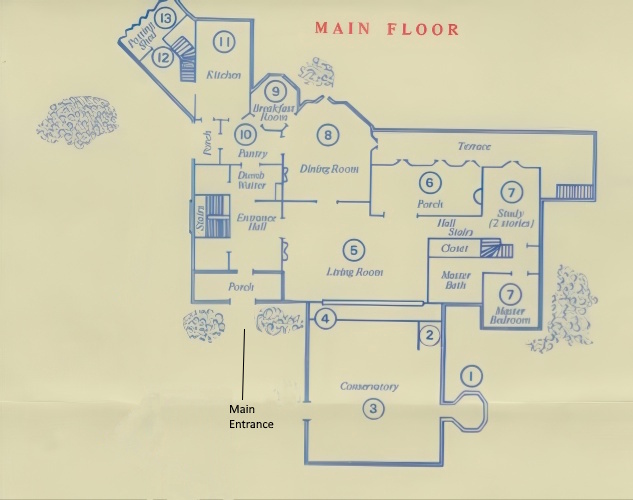 This is the ground-floor plan of the original Telling Mansion. I am very grateful to MAPA for giving me a room-by-room list of what each of those rooms now contain! We’ll start on the Porch, which is the Museum’s front entrance door.
- The entrance hall is the museum’s Greeting/Reception Area.
- The area with the dumbwaiter now contains small lockers because handbags, backpacks, etc. are not allowed within the galleries.
- Room #5 (former Living Room) is now the Presentation Room which is used for larger tours. A cabinet inside this room holds an exhibit that changes throughout the year.
- Room #8 (former Dining Room) is now the Legacy Room; everything displayed inside it was a gift to a POTUS, a royal, or the Vatican. The entrance to this room is seen in one of the photos in my Womens’ History Month post.
- The hallway leading off the Presentation room contains the American Belleek Display, and the original Closet can be used as a cabinet.
- The #7 room (former Study) is the MAPA Theatre, where visitors watch two videos. One is about the mansion and its builder, and the other about the making of the Boehm Sugarbirds sculpture.
- The other #7 room (former Master Bedroom) contains the MAPA Library as well as a major donated collection. The adjacent master bath has been converted into a small Kitchenette.
- Room #6 (the original porch and its terrace) will eventually be the MAPA Cafe after some additional restoration work. It is currently being used as a temporary buffet-and-bar area during museum events.
- Walking back through rooms #5 and #8, we come to room #10 (the original pantry) which now contains the MAPA Archives of articles and photographs about Boehm.
- The original breakfast room (#9) is now the permanent home of the Circuses and Carousels exhibit which is primarily Cybis.
- The Museum Store is in room #11 which was previously the kitchen.
- The permanent Hidden Hands exhibit is in the hallway (#12) leading from the Store to the small greenhouse (#13) which was the original potting shed. Today it is used as a meeting place for MAPA events as well as for miscellaneous displays and holdings.
- On the opposite site of the building, the original Conservatory (Room #3) is now the Main Gallery. The walls of windows afford fabulous lighting for the porcelains even on cloudy days. It is the largest single exhibit space in the museum.
- The small circular room (#1) leading off the Main Gallery is called the MAPA Aviary because it contains the large Boehm Snowy Owl as well as a collection of smaller birds by Boehm, Cybis, and Burgues.
- The area labeled #4 on the plan includes an Educational Display of sample molds, a Touching Station where visitors can feel the difference between various types of ceramics, and a small shipping exhibit.
- The Basement (not shown on this plan) houses MAPA’s entire collection of sculptures not currently on display.
- The second floor of the mansion is the living quarters of the museum’s caretaker and is not open to the public.
The total interior square footage of the mansion is typically cited as being between 20,000 and 28,000 square feet, although I don’t know if that includes the basement. The design of the mansion exhibits elements of the English Tudor and French/Normandy architectural styles.
Because the mansion is a designated historic site, no structural changes can ever be made to it although restoration is allowed. However, because it is on a six-acre parcel there is enough room to build a entirely separate, new structure – if desired – that could be used for storage.
MAPA’s Cybis Collection
Although Boehm made-in-Trenton porcelain comprises the majority of MAPA’s holdings (2621 items as of late July 2025), the Cybis items run a respectable second with 1534 individual sculptures. [Those numbers do include multiple examples of the same edition or design.] As with my research into the New Jersey State Museum’s collection, certain percentages break down as follows:
- 3.5% of the holdings are pieces that were made during the 1940s
- 10% are pieces that were made during the 1950s
- 15% are sculptures introduced during the 1960s
- 48% are sculptures introduced during the 1970s
- 44% are sculptures introduced during the 1980s
- 19% are sculptures introduced during the 1990s
- 5% are pieces that were introduced during the 2000s, although almost all of those were decorative variations or portions of sculptures that were introduced earlier.
- An undetermined percentage are pieces for which either the introduction decade or the production year is unknown.
- It is not known what percentage of the above categories are multiple copies of a single sculpture design; for example, how many in the 10%/1950s category are multiple examples of the Baby Owl.
Compared to the total number of all American porcelain examples held by MAPA, Cybis at 34% is second only to Boehm’s 56.5%. Ispanky is a distant third at 7%, followed by Burgues at 1.8% (81 pieces) and Bronn of America at less than 1% with 16 examples. The museum also has 337 pieces of Boehm porcelain that were made in their Malvern, England studio during the 1970s and 1980s; those are not included in the 56.5% cited above. Thus, MAPA has slightly more than 4800 pieces of art porcelain in all.
 The base (in this case, literally) of MAPA’s collection is the Basement storage which is a porcelain-nerd’s version of being a kid in a candy store! Here is museum curator Carey Barone with just a partial view of the trove of sculptures housed here. The unit directly behind her is filled with Boehm, but the taller unit in the next row is nothing but Cybis! Items of particular note in that section include a White-Tail Deer group, the entire surviving stock of the event-edition Roberta (blue version of Young Rose), seven original Lady Macbeth, multiple examples of all three figure skaters miraculously still upright on their ‘ice’, and a Moses Plaque on an adjacent wall. [Click here for a larger version of this photo.]
As I illustrated in my Public Collections post, only 18 institutions still have any pieces of Cybis – a far cry from the 100+ that their 1986 catalog listed – and most of those have fewer than a half-dozen. MAPA is the only museum in America that is actively engaged in building a collection that includes Cybis porcelain, but that does not mean that they have ‘deep pockets’; in fact, the reverse is true because it is a privately-held museum. That is why, when anyone contacts me to ask where they can donate their Cybis collection, I respond by referring them to MAPA.
The fact that there is a museum that focuses entirely on American porcelain art is pretty amazing in itself. There are such institutions in other countries: the Toguri Museum in Tokyo, the Jingdezhen Ceramic Museum in China, the Gustavsberg Porcelain Museum in Sweden, the Museo de Porcellane in Florence, the Porzellanikon in Germany, and the Museum of Czech Porcelain in Klášterec nad Ohří. There are also museums devoted to the products of one specific maker: Royal Worcester (no surprise there!), Coalport, and Royal Crown Derby in England; the Adrien Dubouche Museum in Limoges, France; and in Germany, the Meissen Porcelain Museum and the Royal Porcelain Factory (KPM) Museum. So it was definitely past time for the United States to join that company! However, I must point out that all of the national (not just for a specific studio) porcelain-only museums that I cited are – with the exception of the Toguri – financially supported by their national government. The Museum of American Porcelain Art is not, which makes what they have already been able to accomplish even more impressive.
MAPA has published a digital newsletter at least twice a year since 2022. The most recent issue (Spring 2025) gave a heads-up about the Timeless Tales off-site exhibit that I reported on in this post, a teaser about the upcoming National Indigenous Peoples exhibit in November that will feature Cybis and Bronn, and a behind-the-scenes look at how Curator Carey Barone created the Women’s History Month exhibit (and thanks for the shout-out, Carey! :-) ) The cover of the Spring 2024 Newsletter featured the Polish Bride, Birth at Lowicz, and Cybis artist William Pae. The Summer 2023 cover was a truly awesome photo of the Circus Rider ‘Equestrienne Extraordinaire’, and Apache ‘Chato’ was among the Cybis pieces seen on the Fall 2022 cover page.
The people at the Museum of American Porcelain Art are truly doing yeoman’s work in honoring and preserving the legacy of this country’s porcelain art studios. In addition to the historical aspect, MAPA has also recently partnered with a local guild, the Erie Shores Porcelain Artists. What began as an occasional demonstration of painting on porcelain was so well received that it has expanded into a regularly-scheduled program each Wednesday from 10 am to 2 pm.
Ah, I almost forgot about those technical details. MAPA is located about 10 miles east of Cleveland, in the town of Euclid. It is open every Saturday from 10 am to 1 pm, but Monday through Thursday are for private tours only. However, on the first (only the first!) Wednesday of the month the museum is open free to all visitors during those same 10-1 hours. MAPA is closed on Fridays and Sundays.
General admission on Saturdays is $10, or $7 for seniors, military, college students, first responders and educators. The youth (14-17) admission is $3, and those 13 and under are free with an accompanying adult. There are a number of different levels and types of supporting yearly memberships ranging from $25 to $1000.
Speaking of visitors, Brielle Galleries alumnus David Fitzmaurice visited MAPA this summer and is the subject of the latest Spotlight feature on the museum’s home page! He is also one of my ‘Cybis correspondents’ and contributed a number of vintage photos to my recent Brielle Galleries post; thanks again, David!
Keeping the Cybis Legacy Alive
The Museum of American Porcelain Art is one of only three institutions that have a significant collection of Cybis porcelain. The other two are the New Jersey State Museum and Mercer County Community College; however, Mercer’s collection is in permanent storage and I am told that it will never again be displayed. At the risk of sounding slightly political (the bane of communication these days, it seems) I sincerely hope that someday MAPA will receive the level of governmental support that its dedication to this truly American art form so richly deserves.
Name Index of Cybis Sculptures
Visual Index (for human figures/busts only)
About the Cybis Reference Archive
What is Cybis?
Images of Cybis porcelains are provided for informational and educational purposes only. All photographs are copyrighted by their owner as indicated via watermark and are used here only as reference material. Please see the Copyright Notice in the footer and sidebar for important information regarding the text that appears within this website.
The Cybis Archive provides the most comprehensive range of information about Cybis ever compiled within a single source. It is not and never has been part of the Cybis Porcelain studio, which is no longer in business.
 THE CYBIS ARCHIVE