
The Cybis studio has a long history of bird studies, with a few dating as far back as the 1940s; those are recognizably different from those produced during the 1950s and beyond. The Cybis birds produced during the 1950s show a gradually evolving style mix which coalesced into a permanent and definitive look beginning in 1961.
Papka composition/fresco designs (1940–1942)
Several bird items were created during the earliest years, using papka composition and “fresco” decorations. The best description of “papka” is what most people would probably think of as ‘modeling clay’ appearance: rustic and earthy rather than refined and elegant. The 1971 museum exhibit catalog Cybis in Retrospect lists a number of these papka pieces, some of which were one of a kind prototypes such as the one shown below. All of the pieces in this section date from 1940–1942.
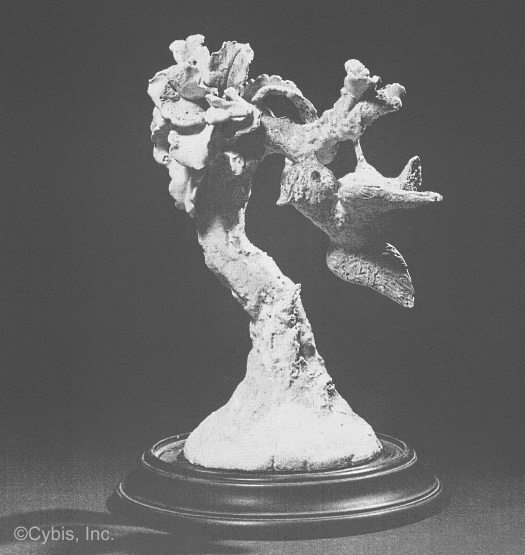 This prototype was called Bird on Rose Tree and is 12” high. Unfortunately the black and white photo gives no idea of the color which was described as “pastel fresco decoration” which typically was shades of pink, yellow and blue.
 In the foreground is Bird on Lilac Tree which is the same height as the Bird on Rose Tree. .
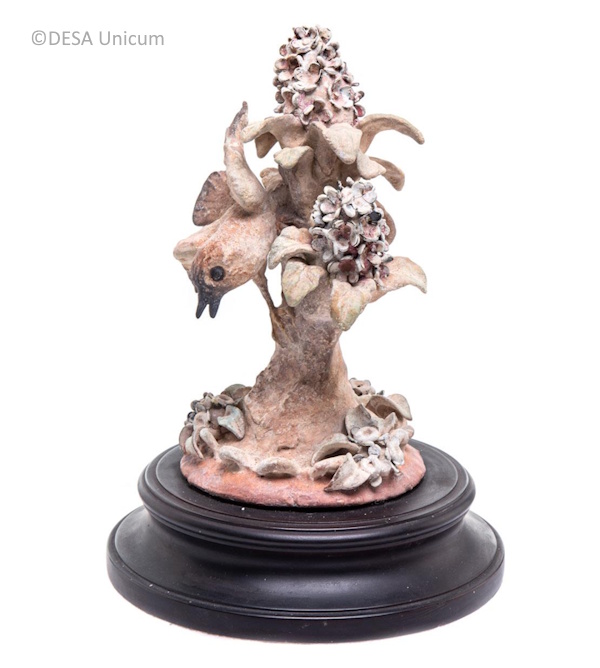 A better photo of the Bird on Lilac Tree. The post-1990 Cybis studio added modern markings and signatures to this piece that were not on it originally..an unfortunate practice.
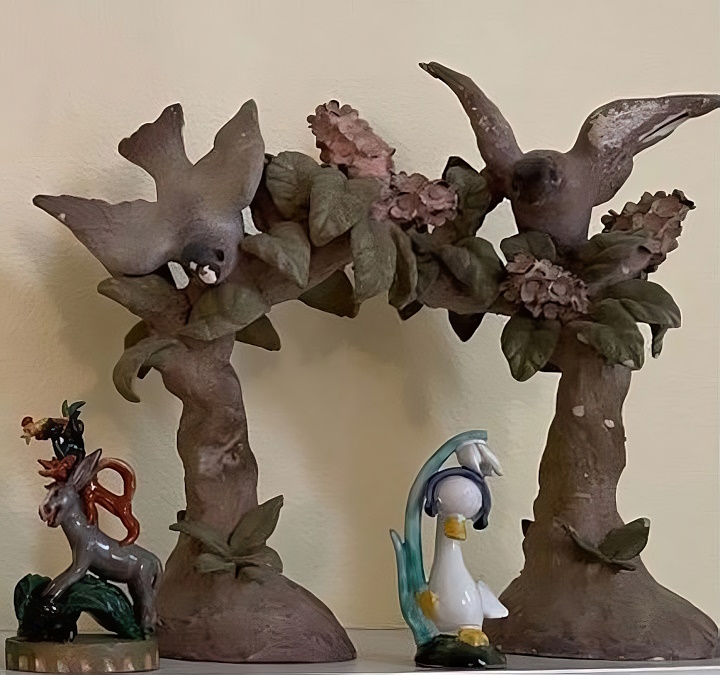 I accidentally stumbled upon this photo of a pair of what may be two Bird on Lilac Tree examples. It was among many nondescript pieces in an estate-sale listing from New Jersey. The sale also included a few, rather common, modern Cybis limited editions. The dark color of these pieces is not the painting technique that one would expect from known examples of the papka pieces; however, the workmanship of the lilac trusses, the leaves, and also the general style is extremely close to what we have seen from similar Cybis pieces. The bright white interior that is visible in the chipped areas would be what’s expected from this material. There were no photos of the back or the underside, unfortunately. I am truly ‘on the fence’ about whether these are indeed early Cybis papka (badly painted as they are!) or are merely a lookalike attempt. Because I am that unsure, I’m including them on this page “just in case”!
 This piece is marked MC which indicates it was done by Marja Cybis; the style of the bird strongly resembles two little fairies that she did. I’m going to go out on a limb – no pun intended! – and call this a baby bird on a melting branch. The bird’s head is tilted upward with a decidedly quizzical look. I’m guessing that the legs are tiny wood dowels painted orange to match his beak.
 I originally assumed that this piece was either a one-off or perhaps even a kiln accident (because of the appearance of the branch), but I was recently made aware of this second example which, although not marked, so closely resembles this one as to guarantee its shared Marja-Cybis origin.
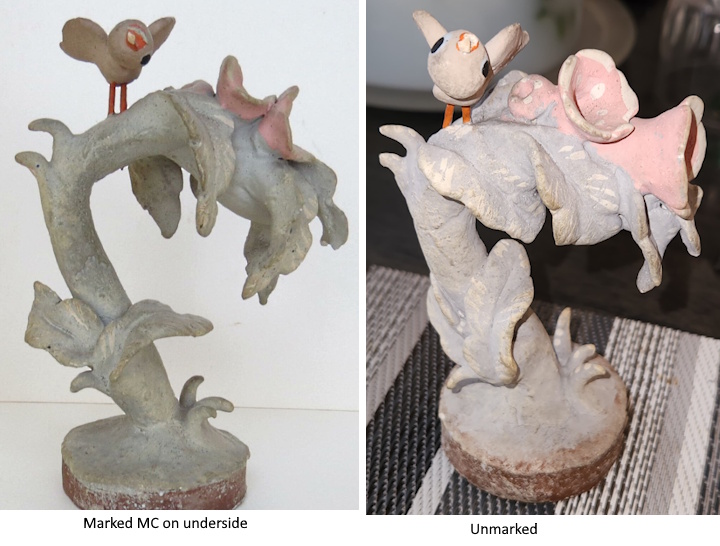 A comparison of the two examples. I wonder how many others of this design have survived.
As for other papka birds, there was supposedly a Robin with Blue Blossom and a Yellow Bird with Pink Blossom, both 5.5” long but no height given; these were probably alternate colorways of the same piece. There were also multiple colorways of the Tree with Bird, measuring 10” x 9”; according to the museum catalog there was a “green with pink blossom”, “mauve with yellow blossom”, pastel blue with pink lilac blossoms (“lilac” probably indicating the plant rather than the color), and “mauve-blue tones with blue lilac blossoms.” Bird on Branch was 6” high and could be had as a mauve bird with yellow flowers or a pink bird with blue flowers. Confusingly a second Bird on Branch is also listed at 5.5” high in three colorways: blue with blue, pink with blue, and blue with pink – the first color perhaps referring to the bird and the second to additional decorative elements. It sounds as if these two were different designs.
An intriguing mention in Retrospect is of an Abstract Bird, from 1942-1944, described as being 8” high in glazed porcelain and a “prototype for future release.” This one was not papka. A bird perched on a tree was a favored subject, such as Bird on Tree (“pastel tones with pink blossoms”, 12.5” h) and the possibly similar Bird on Blossom Tree (“soft pink and blue”, 11” h.)
M.B. Cybis signature (mid-late 1940s to early 1950s?)

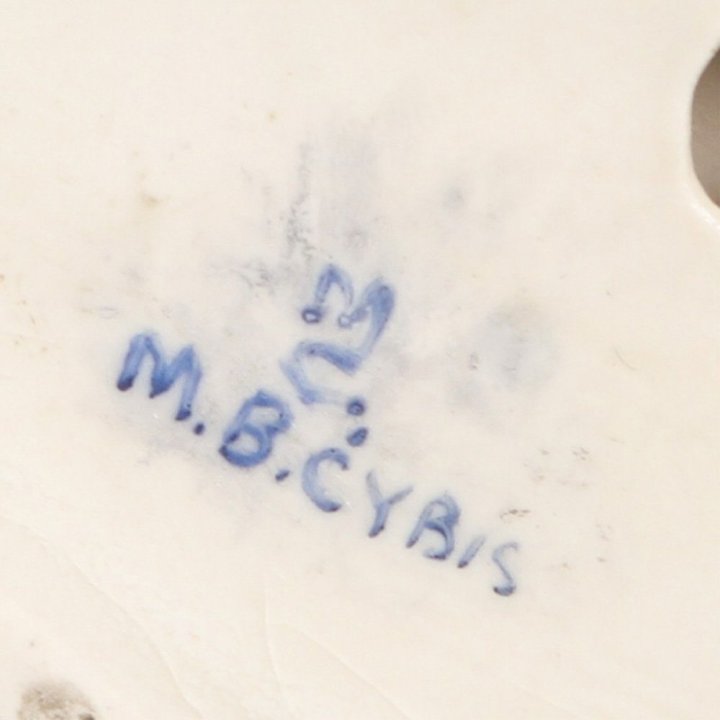 These two fowl may be Cybis’ version of the Golden Pheasant, Chrysolophus pictus. They are signed M.B. Cybis which dates it to the 1940s or early 1950s. The addition of the MC indicates that the piece was either designed or (more likely) painted by Marja Cybis. They are only 7” high, which makes me wonder if this is the “Pheasant, small” that appears on a short Cybis studio list of undated but verified sculptures. The name does not appear in any other Cybis literature. The base of the white colorway is decorated in gold which is slightly reminiscent of some of the Cordey base trims.
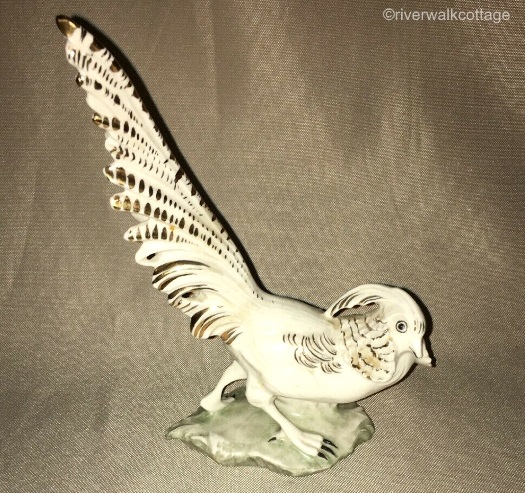
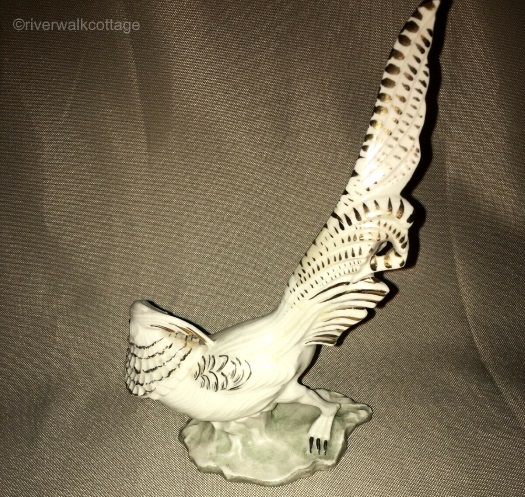
 This almost-entirely white-and-dark-gold version has a very faintly tinted greenish bottom section. It is unusual to see any 1950s retail piece in the white/gold colorway. This one has the same signatures as the color versions.

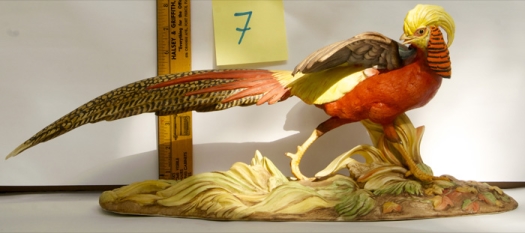 The top image is an artist depiction of an actual Golden Pheasant, followed by Boehm’s porcelain interpretation of that bird. Needless to say, the Cybis version has used more “artistic license” (if this bird was indeed what was meant, rather than an extremely fancy chicken!)
Cybis imprint (1950s)
All of the sculptures below bear the typical Cybis signature (see Signatures and Marks for examples) in paint as a stamp or signature. Some of the birds have been confirmed as being cast from commercially available molds (such as from the Holland Mold Co.), some are suspected but not confirmed as being so, and others were original designs by either in-studio or freelance artists. They are shown in chronological order by introduction year. Sculptures from this decade for which there is some information, but no available photograph, are listed at the end of the section.

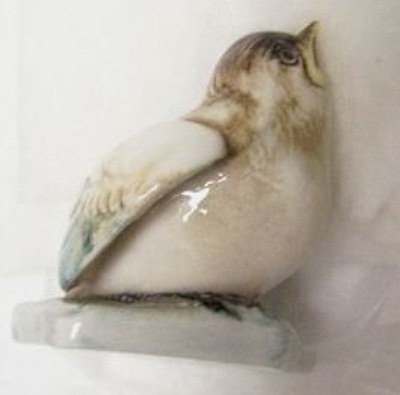
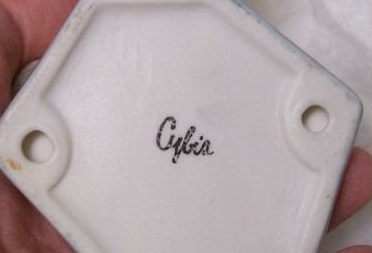 The Baby Bluebird is probably from the early 1950s, based on its style and glazed decoration. It is 3” high and 3” wide; stamped Cybis on underside in the style typical for the period. The bird is cast from a Holland Mold Company set of parent birds and young, this being one of the nestlings.
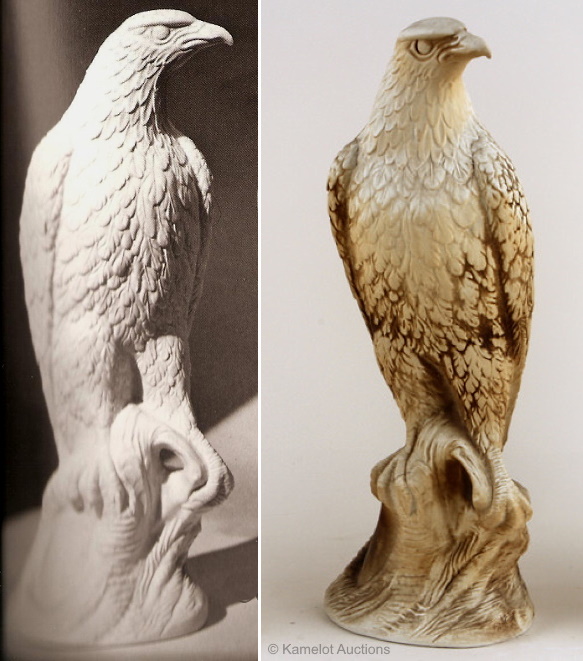 The American Eagle is 14” high and was sold as a pair, available in white bisque and in color. The white was made 1954-1960 and sold for $60; the color, from 1955-1960 for $90. This is the only known Cybis bird that was sold as a pair of two identical sculptures; all of the other bird pairs are two different designs. The right-hand photo above shows a bird in their Cypia tonation, which was probably included in the studio’s definition of a “color” piece. The design number for this mold/pair was #302.
 This example is probably the most typical of the retail painting style for this bird.
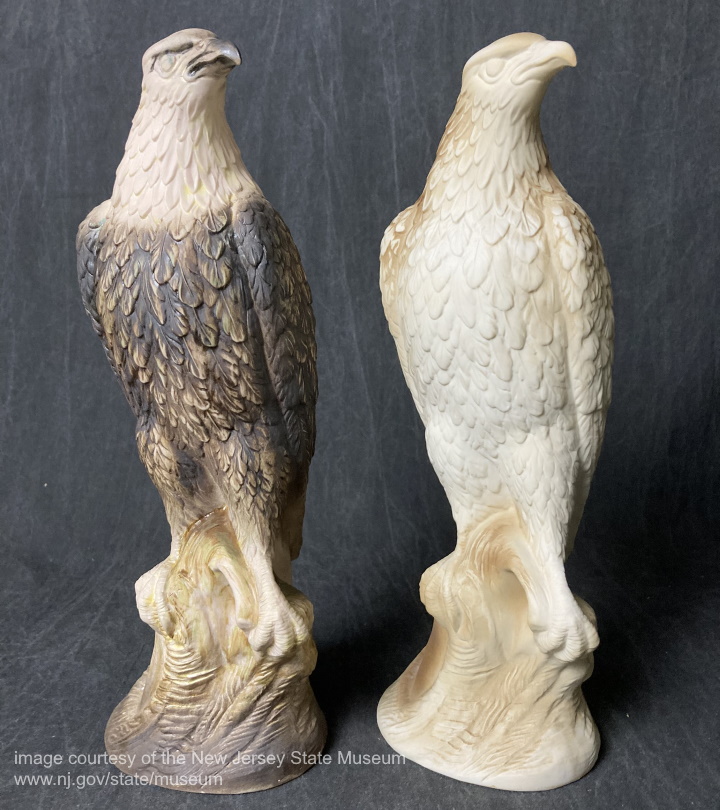 Both of these are in the collection of the New Jersey State Museum, which I thank for providing this and other photos. The eagle on the left is darker than one would expect of a Cypia piece. The bird on the right has only had the very first color applied, so is obviously unfinished. Ironically, the actual American Bald Eagle, Haliaeetus leucocephalus, has much less white on its body than seen on any of the Cybis representations!
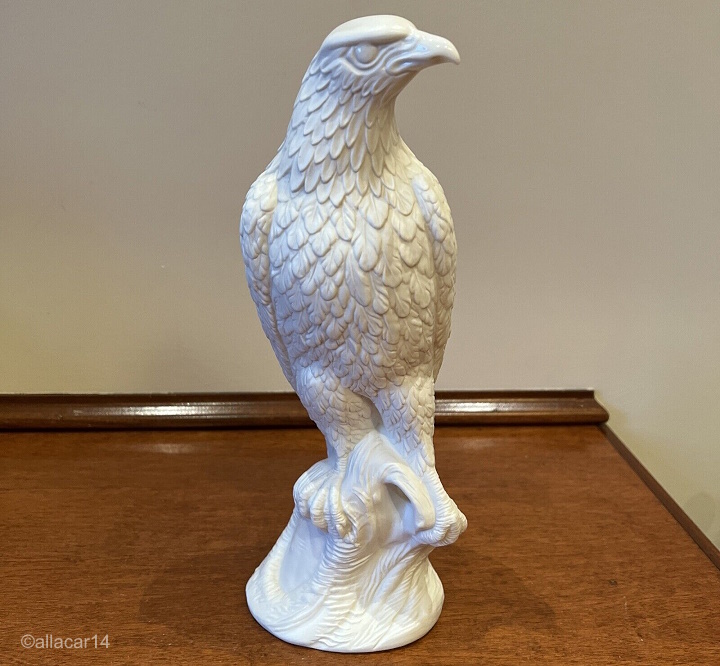
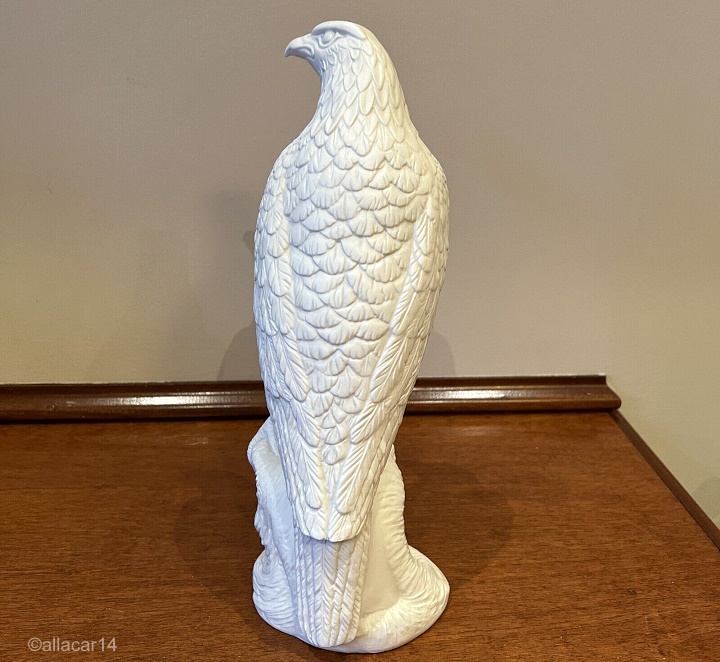
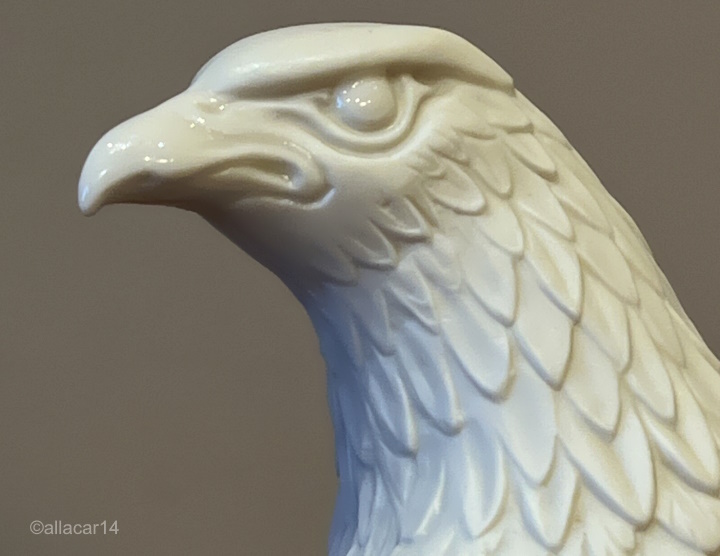 These photos of a white bisque example show that the retail pieces did receive a subtle layer of clear glaze on the eyes and beak.
 This Great Horned Owl was introduced in 1956 and is 19.5″ high. It was offered in plain white bisque for $100 and in color as shown for $150. When it was retired in 1968 the prices were $150 and $200, respectively. The all-white version can be seen in the Cybis Owls post. Although the design number for this piece is #301, it was introduced two years later than the American Eagle which was #302.
 Wild Duck, produced 1957-1962, measures 7″ x 6” with base and was made in in white for $50 and color for $60. This was not an original Cybis design but was produced from a Holland Mold Co. mold. According to the 1978 Cybis catalog appendix, the design number for this piece was 337.
 Here is the same Wild Duck but made on a larger “pond” or “waterside” base. It may have been given a different name because clearly it’s not the same piece as the one identified above as “Wild Duck” in the 1979 Cybis catalog. So I’m going to arbitrarily call this their wild duck at waterside.

 This Canada Goose doesn’t appear on any Cybis list that I have seen, but is unquestionably theirs. The fact that geese mate for life makes me wonder if these were perhaps made as a pair (two different molds.)
 The underside is also interesting, because it has an incised script signature, suggesting a mid-1950s (rather than early decade) production timeframe for this. The penciled design number begins with 959 followed by two characters too faint to read. This is odd for a couple of reasons. First, because Cybis bird design numbers always started with 3; and second, because five-digit design numbers were never used before the late 1980s. The odds are also that this was a Holland Mold Company mold, not only because they were Cybis’ go-to source during the 1950s but because of the cutout area that you see at the lower left. This indicates that the base mold was intended as (or could be used for) a lamp base. The half-moon opening is where the cord would emerge.

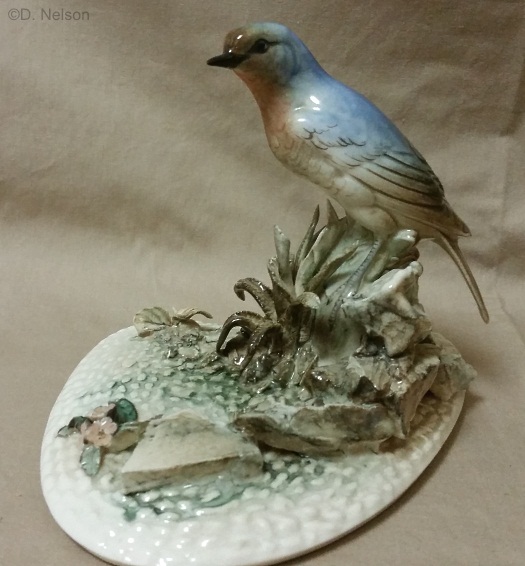
 Bluebird ‘By the Garden Wall’, 6” high, was made from 1952-1962 in color as shown for $37.50; a plain white bisque version sold for $30. Notice the “chunks of rocks” which were also used in the waterside duck sculpture. The bird’s body mold appears to be the same one used for the 1960 Cerulean Warbler shown in in the next section. This retail release was given design #329.

 Here is a pair of two different baby birds, both marked in pencil on the underside with 322 (the design number), indicating that these were intended to be sold as a pair. Because I have no indication of what these may have been called, I’m going to dub them the baby chickadees pair because of their black caps! These clearly came from a purchased mold, although I’ve been unable to find a match among the known Atlantic or Holland ones. Notice that no hand-made leaves or flowers were added to the base, although there would barely be room for any except in the front of the taller nestling. That one is just shy of 3″ tall, whereas his more reserved sibling is only 2.25″ high.

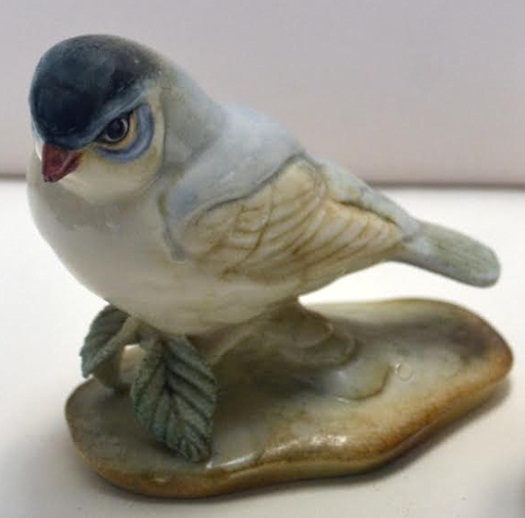 These two small birds, both cast from the same mold but painted differently, are about 3″ high. Although I’ve not been able to identify them by name, the dark-colored one — possibly meant as a baby swift or swallow? — has the design # 325 penciled on the bottom. That 3- series of design numbers is the one Cybis used for all their birds. The closest name/number matchup is the Bluebird ‘By the Garden Wall’ which was #329 in 1952 so it’s likely that this bird mold dates from that year or the one preceding. This was probably a commercial mold.
 This small Pheasant was also cast from a Holland Mold and dates from the (probably early to mid) 1950s. It is 10″ high and about 14″ long and has no relation to the 1960 limited-edition bird which was an original design. Holland did also offer a female pheasant mold but I’ve never seen one of those marked with the Cybis name.

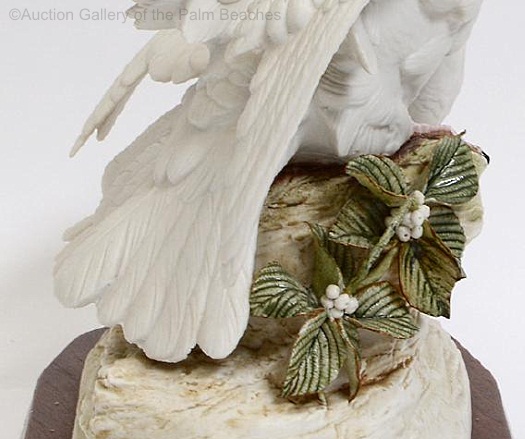 Turtle Doves ‘Doves of Peace’ was a limited edition of 500 selling for $350 between 1957-1970. It is 12”high and was designed by Patricia Eakin and Marylin Chorlton. Originally commissioned during the Eisenhower administration for a planned presentation at peace talks with Russia, that conference was cancelled as a result of the Gary Powers/U2 incident. However, it did eventually end up in Russia anyhow: Although the retail edition was closed in 1970, an artist’s proof of this sculpture was presented as a gift of state in 1979 in connection with the second Strategic Arms Limitation Treaty (SALT II) talks in Russia during that year. The commemorative plaque on the wood base of that sculpture reads “DOVES OF PEACE” Presented to President Leonid Brezhnev from President Jimmy Carter, June 1979. This sculpture and the Baby Owl may well have been the first two introductions, in 1957, showing what we now think of as the ‘modern’ style of Cybis birds. The second photo shows a rear detail section.
Special Note: I now have a list of what retailer originally received each one of these sculptures from Cybis. If you have one and would like to know who and when that was, I will be happy to look that up for you. There is a Contact Form link at the bottom of this page.
Recently, I came upon an old eBay listing for a pair of single (made as separate sculptures) Turtle Doves. I suddenly realized something that had not occurred to me about the single retail piece. I will call these individual pieces Single Turtle Dove A and Single Turtle Dove B.
 Single Turtle Dove A carries a sprig of olive branch in its beak. Notice the square wood base that it is mounted on, and the modification of the standard piece’s porcelain base into a circular shape in order to fit atop it.
 Single Turtle Dove B appears to be in a preening posture. There are pink flowers adorning the lower section, and the wood base is entirely different from the one used for Dove A.
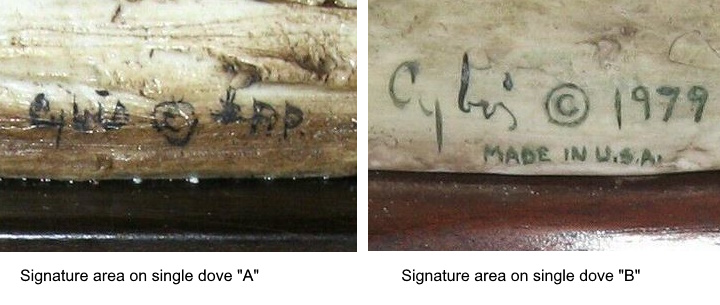 The signature areas of both Single Turtle Doves, compared. Dove A is marked as an A.P. (see this post for the myriad possible reasons for this), but Dove B is not. However, Dove B is dated 1979. The standard retail Turtle Doves edition ended in 1970 but, as mentioned earlier, there was an event in 1979 that occasioned at least one fresh example of the ‘double doves piece’ to be made (connected with the SALT talks.) Whether one or both of these single doves have any connection to that event is impossible to discover.
The thing I had failed to previously notice about the standard Doves of Peace is that both birds are cast from the same mold! They are cleverly positioned on the large base in order to obscure the fact that – just like the 1950s Mallard Ducks shown below! – the retail piece is simply two castings of the same bird mold, mounted on a single base. I feel rather silly for failing to notice that, until now! :-)
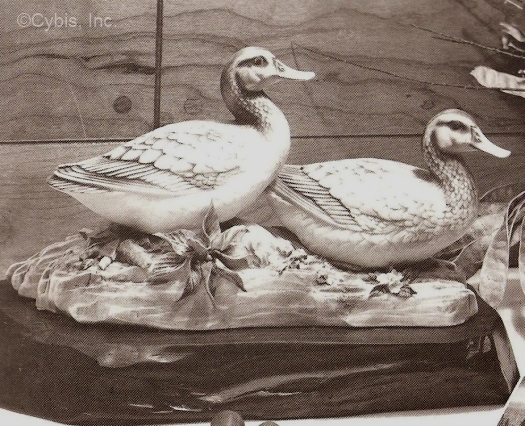
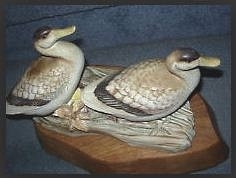 The Golden Mallards were made from 1957-1962, in color only and at $125 throughout which probably reflects the fact that it was on wood base. Both birds are from the same Holland Mold. The actual “golden mallard” is a rare color mutation of the typical mallard duck, Anas platyrynchos but the Cornell Laboratory of Ornithology does not mention a “golden” subspecies.
An alternate colorway of this same mold was also sold by Cybis during the same time period under the name Teal Ducks. According to Cybis in Retrospect that piece is 11″ high. According to the 1979 Cybis catalog it was made in color only at $125, while Cybis in Retrospect says was done in both white and color and was 10” high x 12.5” long. The reason we know that the Golden Mallards and the Teal Ducks were the same sculpture is via the model numbers in the 1979 catalog: The mallards are listed in the Appendix as #303M, while the teal ducks are #303T.

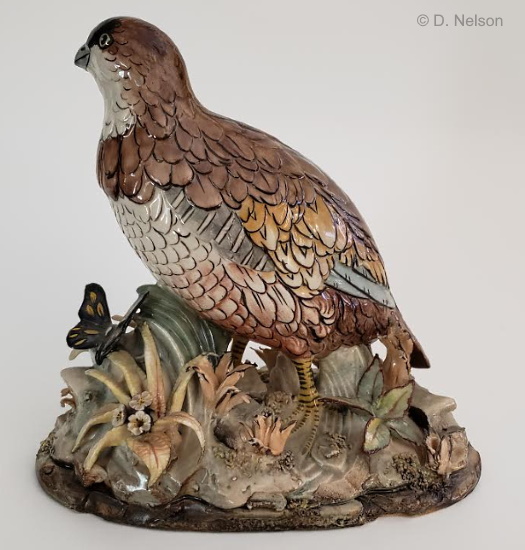
 Valley Quail may have been made in both a male and female version; this one appears to be a female. The December 1, 1957 issue of the local Town Topics (Princeton) newspaper contained this snippet: “This shop [Princeton Decorating Shop] at 35 Palmer Square also has some more conventional pieces of pottery and sculpture. B. Cybis has done a porcelain quail six inches high that looks real enough to shoot at.” The fact that this piece is 7.25” high is what makes me wonder if there was a male piece as well.
 A white bisque version with ‘Cypia’ tonations.
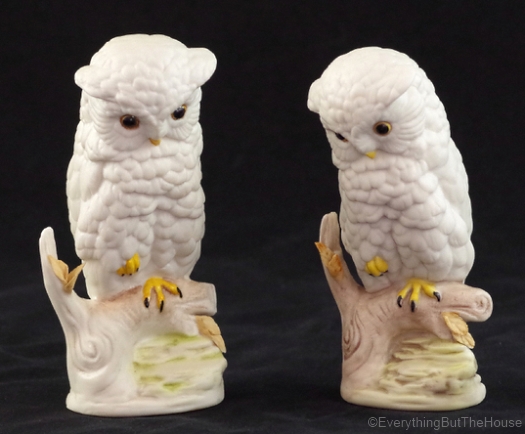 The iconic Baby Owl was produced continuously from 1957 and is 4.5”high. First issued for $18, his final studio pricing was $195. See Cybis Owls for photos of some early Cypia tonation examples, a holiday variation and an artist’s proof colorway.
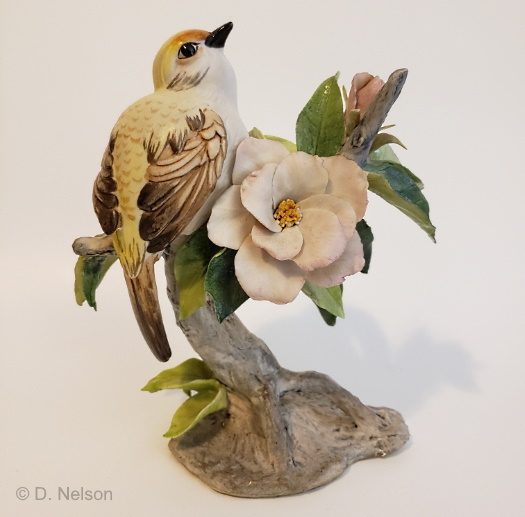
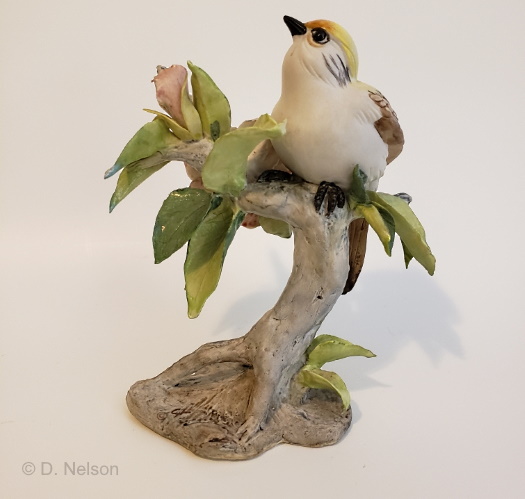
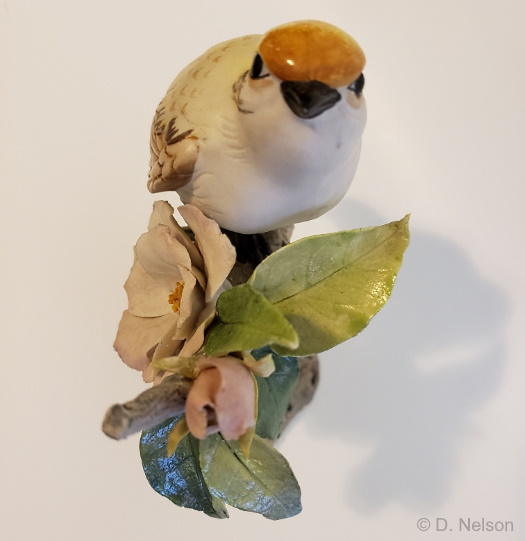 The Palm Warbler was introduced in the same year as the Baby Owl (1957) and was produced until 1962. It is 7” high and sold for $75. The bird mold was a commercially available one (part of a family group) made by the Holland Mold Company. The actual Palm Warbler is Setophaga (formerly Dendroica) palmarum and has a rusty cap and also some yellow on the face.

 The Maryland Yellowthroat dates from 1958-1963, although Cybis in Retrospect says it was retired in 1961. It is 7″ high and was made in white for $65 and color for $85.
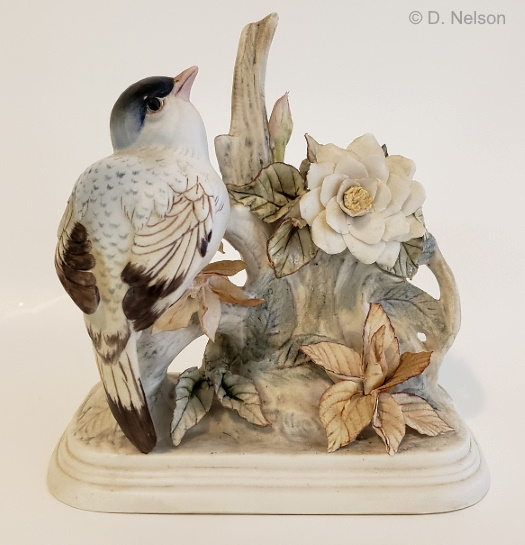
 This 1950s Cybis bird with flowers and foliage is 6.25″ high; its name is unknown at present. If the bird looks somewhat familiar, it should: It’s the same mold that was used for the Palm Warbler in 1957, but there’s no way to know which came first in Cybis’ retail lineup. Any guesses as to this bird’s intended species (based on the painting details) are appreciated! There is a contact-form link at the bottom of this post.
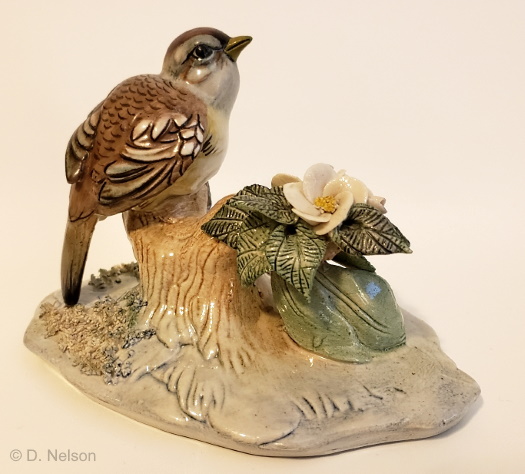
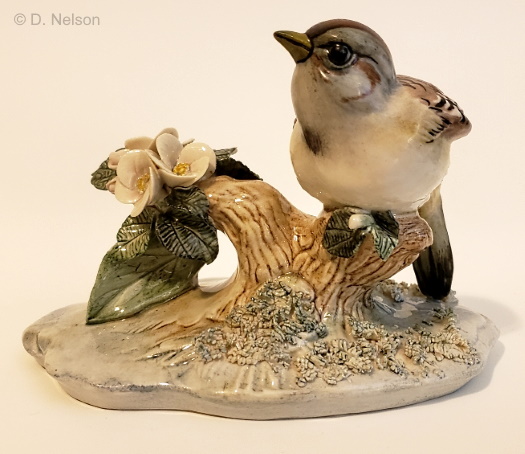 Yet another issue that used this same mold is the Tree Sparrow (identified via field marks) which has two Cybis signatures on the underside: the expected studio signature and also B. Cybis which is very similar to the signature seen on the female Valley Quail pictured above. It is possible that Boleslaw Cybis signed both of those pieces himself.
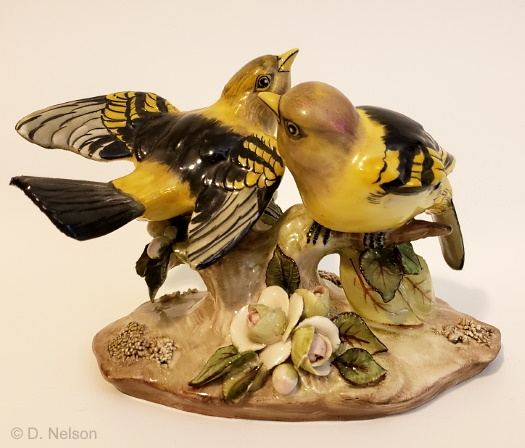

 In the Western Tanagers we have two different Holland Mold Company birds combined: the closed-wing one shown above, and the open-wing one that is seen on a couple of early-1960s pieces. This suggests a late-1950s timeframe for this particular design. A surprising discovery was that this specific one was once attached to a wood base. This would never have been known except for the fact that the ‘wings’ of a toggle bolt was discovered to still be inside the sculpture! This begs the question of whether this piece was mounted similarly to the Golden Mallards which was also a two-birds piece. This design uses the same porcelain base as in the Tree Sparrow, but with a second bird on the longer branch section instead of a group of flowers and foliage.
 See this post for a discussion of (and identification plea for) the pair of painted mystery 1950s birds in this display-cabinet photo. I also have no idea which one the white bisque/unpainted bird and large flower in the center is!

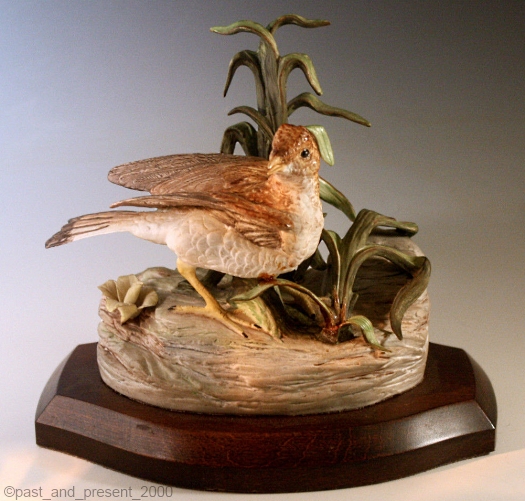 The Skylarks were, like the American Eagles, sold as a pair only, from 1958-1970 and are approximately 8” high. The male is the bird in the more upright posture. Originally a limited issue of 750, the edition size was reduced to 350 before closing. Pricing began at $300 and finished at $500. The bird represented is the Eurasian skylark, Alauda arvensis. These birds continue the new/modern birds ‘look’ first seen the year before in the doves and Baby Owl.
Special Note: I now have a list of what retailer originally received each one of these pairs from Cybis. If you have one or both and would like to know who and when that was, I will be happy to look that up for you. There is a Contact Form link at the bottom of this page.

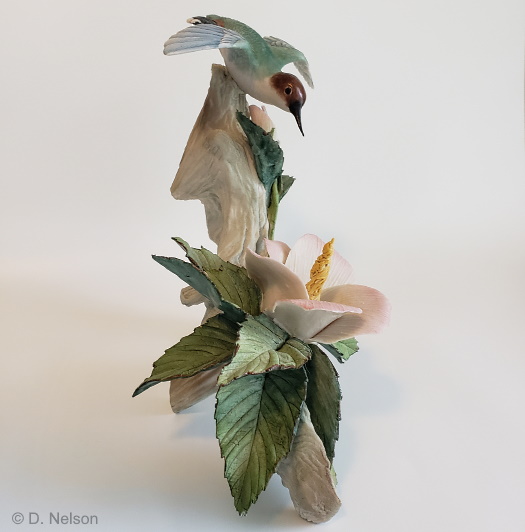 Just squeaking into the 1950s introductions by a hair (or feather?) is the Hummingbird which was produced from 1959 to 1963. It is 9.5″ high and was made in the color version shown here and also in plain white bisque. This is the first photo I have seen of this piece and I admit I was very curious to whether they managed to portray this bird (as Boehm and Connoisseur of Malvern did) in a delicately hovering position….and indeed, as we see, they did not attempt to. During its’ five years of production the white version was priced at $75 and the color one at $95.
This sculpture poses an interesting question: Which way is “up”?? I mean that seriously, because there are arguments for and against which orientation (vertical or horizontal) was originally intended! Clearly it seems a bit awkward to portray a hummingbird zooming down toward a flower, like an avenging drone strike, when everyone knows that their natural position when feeding is to hover. But the vertical orientation shown above does give a good sense of movement. On the other hand, there’s this:
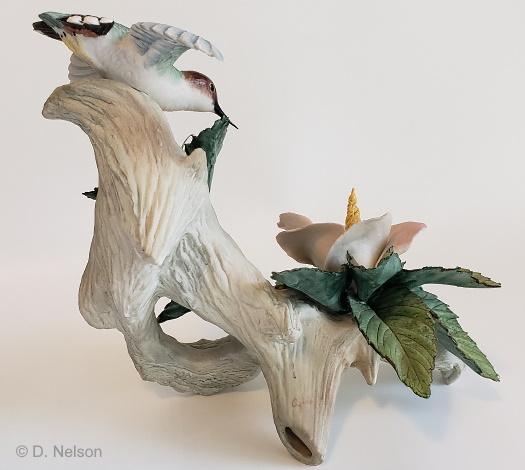 It is unusual (to say the least) to have the firing hole be intentionally visible, as it is when positioned vertically. But if the branch was borrowed from an entirely different piece, that might explain it. And the Cybis signature is on a normal visual plane in this position.
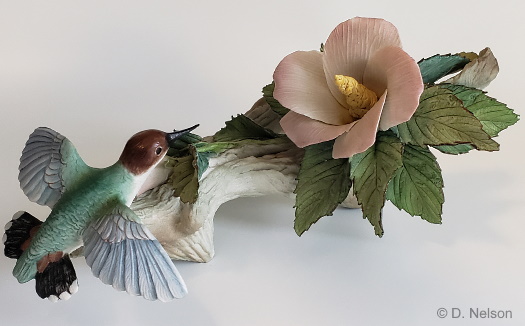 Here is the piece if positioned horizontally. The firing hole is now hidden, and the bird is also approaching the flower in the natural way. Which orientation do you like better? I have to say, it’s kind of nice to be given a choice in the matter!
 Before we leave the Hummingbird, I can’t resist commenting on the center of the flower, which resembles nothing so much as a ‘twist’ of spaghetti that was not cooked in a sufficient amount of water. I’m assuming that this was meant to represent the hardy hibiscus (H. syriacus, a/k/a ‘Rose of Sharon’), an actual bloom of which is shown below:
 Well…I guess they tried. But I may never look at overcooked spaghetti in quite the same way again!
The following circa-1950s birds are known to have been produced although no photo is available. If any reader has one of these and would like to share a photograph, I would be delighted to add it to this post; there is a direct-contact link below.
A limited edition (design #305) titled Fox Sparrows appears on the Spring 1963 price as being “expired”, which perhaps was Cybis’ initial version of either “closed” or “completed.” I’ve never seen that word used in any of their other price lists. Sadly, no dimensions, issue years or prices were given for this particular piece.
Magnolia with Bird, 5.5” high, 1953-1962 or 1963, in white at $30 and color at $37.50. The ambiguity in retirement year is because it still appeared on the Spring 1963 price list. Although titled as a flower piece (Magnolia with, rather than Bird with) it was assigned a design number in the 300s which indicates a bird.
Parula Warblers, height unknown. This was a pair of separate sculptures, but differing only in coloration to differentiate the male from the female.
A Baby Robin and a Baby Sparrow were mentioned in a 1974 Cybis list with no other information given. It is very possible that one or both of these are similar in style and decoration to the Baby Bluebird shown above (circa early to mid 1950s). Could they have been the identical mold but with different painting/decoration to match the species??
Mallard is included on the 1974 list only, with no further information, and may even be the unidentified “duck at waterside” whose photo is shown above.
Pintail Duck has no details other than its’ name appearing on the 1974 list only.
1960 Introductions
Although I was originally intending to split the bird chronology into pre- and post-1960, that year happens to be the last in which the style of the 1950s appeared alongside the recognizably modern pieces. With only one exception, which will be seen in the next post, after 1960 there were no birds introduced that resemble the “old-school 1950s flock”. The next post reviews the birds starting in 1961.
 The Blue (Headed?) Vireo ‘Building Nest’ was an open edition produced 1960-1965 (although Cybis in Retrospect says it was retired in 1963.) It is 8.5″ high and was offered in color for $75 and in white bisque for $60. Some Cybis literature lists this as “Blue Headed Vireo..” while others say “Blue Vireo.”
Although the majority of Blue Headed Vireo pieces are as shown above, I discovered that there was an earlier/initial version that was slightly different in two noticeable respects.
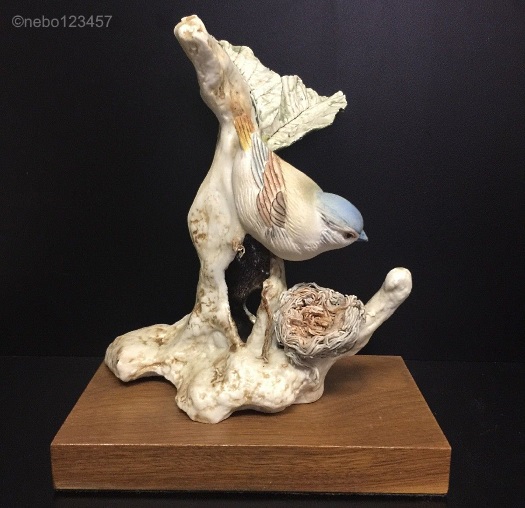 The first/earliest pieces were mounted on a wood base. It’s is possible that this is the same wood base that was used a couple of years later for the Goldfinch and and the Wood Wren with Dogwood. The base was eventually discontinued for both of those, but it seems to have disappeared from the Vireo first.

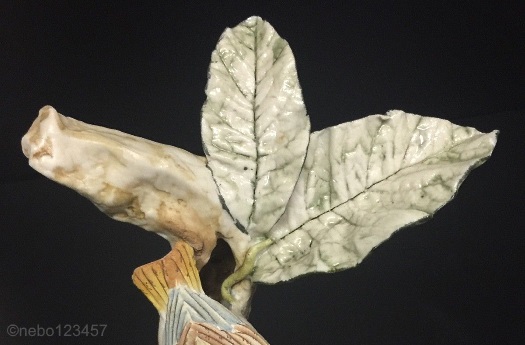 Notice that the foliage element on the vertical branch is completely different. In this first/early version both leaves are pointing outward from the branch in the same direction, and there is no flower present. The leaves are also cast from an entirely different mold than the ones used in the subsequent version, which has the leaves pointing in opposite directions to form a V-shaped ‘cup’ with a flower placed in the center.

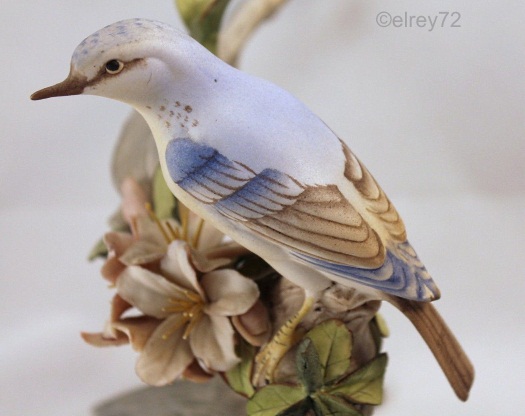 The Cerulean Warbler has a discrepancy in Cybis literature regarding its production year: Retrospect says 1960-1963, while the 1979 catalog Appendix says 1960-1965. It is about 6″ high, 7″ long, and was originally sold with an accompanying wood base.
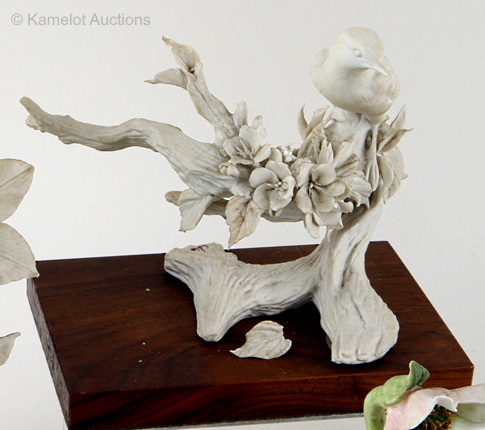

 It too was made in color and in white bisque. Examples of the white one have been found with a base in either the light (above) or dark brown wood. The Cerulean Warbler was assigned design #338 but some of the white bisque pieces may still retain a penciled design number of 338W. The white version sold for $70, and the color for $90, throughout their production runs.

The Little Blue Heron, a limited edition of 500 from 1960-1971, is 19.5” high. Its price went from $425 to $500. This was a Laszlo Ispanky design, as was his Great Blue Heron a few years later. This definitely shows a juvenile Little Blue Heron (Egretta caerulea) because as they get older the white plumage changes to a greyish blue. In fact, the Spring 1963 price list shows the sculpture name as “Little Blue Heron (immature)” although the clarification was dropped from later advertising literature.
 Update, May 2025: A recent eBay listing contained some misleading information about this sculpture. The seller claimed that there “were two different molds”, one having an “upturned beak/head” and the other having “a level beak/head.” That is not true; all of the mold components were the same. The head/neck mold on this piece is separate from the body mold and was joined to the body mold with slip during the pre-firing assembly process (see this post for the steps in creating each figurine).The other separate mold pieces were the wings and the legs. The six pieces, once assembled, were supported with porcelain props to control the amount of movement in the kiln during firing; however, there is always some movement of components and the only difference is how much movement. It also depends on the skill of the mounter (assembler.) The image above shows four variations in head position of the Little Blue Heron as a result of the normal responses of porcelain in the kiln, ranging from horizontal to almost a star-gazing position. All of them were cast from the same six molds. The eBay seller made an assumption/statement without understanding how porcelain sculptures are produced. FYI, the photo that the studio chose for this piece in their 1964 catalog has the neck in the horizontal position. (If it later turned out that they were experiencing too many breakage issues with that position, the mounters may have been told at some point to prop the head mold a little bit higher in the kiln.) But every Little Blue Heron was made from the exact same head/neck mold.
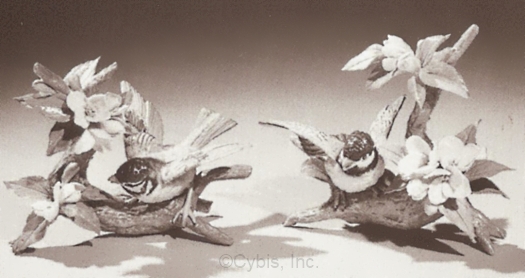 The Bridled Titmouse, Male and Bridled Titmouse, Female were sold separately as open editions at $95 each. Both are 6″ high. There is more of a discrepancy in production dates, with the Cybis catalog claiming 1961–1965 while Cybis in Retrospect says 1960-1963. The wing position of the bird reminds me of the Cordey bird-in-tree pieces shown earlier.
 The Goldfinch is 6” high and was offered in white for $60 and color for $75. The design of the bird is consistent with the Blue Vireo, Baby Sparrow, and others during this same late 1950s/early-1960s period. Again there are slight production-date differences: 1961–1964 in the Cybis catalog versus 1960-1963 in Retrospect. The black and white Cybis catalog photo above shows the decoration as berries, but a November 2021 Archive post about this sculpture shows three decorative variations discovered thus far. Cybis later made an entirely different goldfinch sculpture, Goldfinch with Violets, in the 1980s.

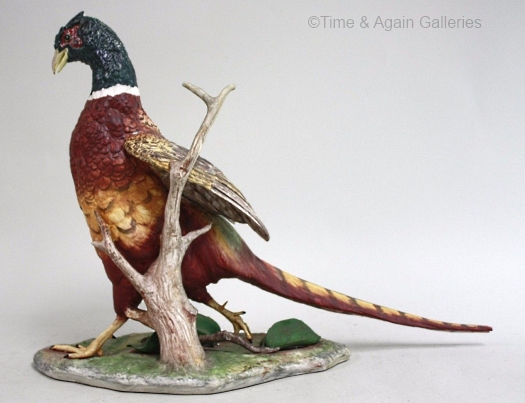
 Pheasant (Ring Necked), made from 1960-1976, is 16″ high x 22″ long. This was a limited edition of 150 which began its retail price at $750 and closed at $2500.
 This unfortunately very blurry photo of a Pheasant in Flight is the only image of what would have been a companion piece to the Ring Necked Pheasant. Depicting a pheasant in the instant of being ‘flushed’, it appears on the top shelf in the background of a photograph taken inside the Cybis studio, hence the blurriness. You can see one of the walking (Ring Necked) pheasants to the right of it which gives an excellent idea of the scale of this piece. After completing this prototype Marylin Chorlton decided to postpone putting it into production for a while, and after her unexpected death in 1977 the idea of making it as a retail issue was abandoned. A great shame, because it would have been a spectacular piece!
 The Golden Crowned Kinglets were a pair made from 1960 to 1962 (or 1963); they supposedly sold in white for $65 and in color for $85. I have only seen this photo of one of them so far. Cybis literature gives a 10″ height but this one is 8.5″ and so perhaps the other piece is taller. (This is not the same sculpture as the 1978 Kinglets on Pyracantha pair, nor the much later single piece called Golden Crown Kinglets with Crab Apple from the 1990s.)
The birds introduced in 1961 and later are shown in the next post.
Name Index of Cybis Sculptures
Visual Index (for human figures/busts only)
About the Cybis Reference Archive
What is Cybis?
Images of Cybis porcelain sculptures are provided for informational and educational purposes only. All photographs are copyrighted by their owner as indicated via watermark. Please see the copyright notice in the footer and sidebar for important information regarding the text that appears within this website.
The Cybis Archive is a continually-updated website that provides the most comprehensive range of information about Cybis within a single source. It is not and never has been part of the Cybis Porcelain studio, which is no longer in business.
 THE CYBIS ARCHIVE