
Helen Granger Young was one of several freelance sculptors who designed for the Cybis studio during the 1970s. Unlike most of their other designers, Mrs. Young’s work for them was limited to a single genre: portraits of Native Americans.
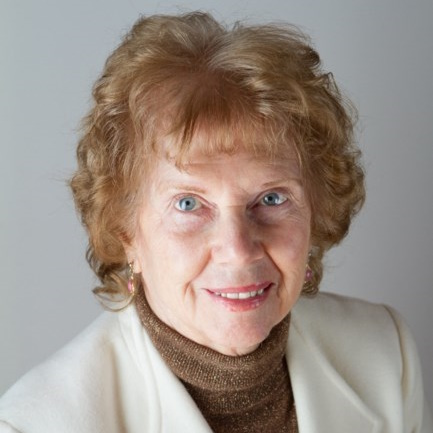 She was born in Mimico, Ontario, Canada on November 1, 1922. A common error found on several art-reference sites on the internet is that she was born in 1944; this is incorrect – and indeed impossible, because she graduated from the Ontario College of Art during the 1930s! She had gone to that institution on a scholarship, where she studied sculpture under Charles Fraser Comfort and Franklin Carmichael. During the 1940s she worked as an art instructor while doing commercial art for two of Canada’s leading retailers, Eaton’s and Hudson’s Bay. After the outbreak of WWII, she helped the war effort by creating technical drawings of military vehicles and aircraft. She was only in her twenties at the time.
In 1947, Helen moved to Winnipeg, Manitoba, where she began to create sculptures in porcelain and in bronze. Her work in porcelain, including the pieces she designed for Cybis, is perhaps less well-known than are her bronze monuments. In the course of my research into her work I discovered a couple of surprising facts about the pieces she designed for Cybis, so let’s look at them first.
Helen Granger Young porcelain designs for Cybis
Freelance artists employed by Cybis rarely worked (physically) inside the Cybis studio; they might make a few visits, and certainly would deliver their final working model renditions of their designs, but once that design was purchased by the studio, their involvement in the process would end. Susan Clark Eaton, being a local resident, was one of the few freelancers who actually spent a great deal of work-time at the Cybis studio. Helen Granger Young, who resided in Canada, obviously did not do that. All but five of Cybis’ North American Indians Collection were designed by Mrs. Young.
It was only recently that I unearthed the real story of how this series came to be created, as related in several 1973 articles in Canadian newspapers. The Cybis studio never allowed any of this information to be disseminated in the USA.
The first three (in the Cybis retail chronology) sculptures had actually been previously created by Ms. Young during the 1960s. According to a March 1973 article published in the Montreal Gazette:
Then there was a telephone call in the fall of 1967 from Marylin Chorlton […] Mrs. Chorlton had seen some of the pieces Mrs. Young had done and wanted her to come to the U.S.
[Mrs. Young:] ‘I said I was too busy with my family. So the Chorltons came to Winnipeg to see me. They saw Hiawatha, Minnehaha and Beaverhead – and said they wanted to do them. So I packed them up and went down.’ The Chorltons met her at Kennedy International Airport and drove her and the three models the 90 miles to the studio where she learned the Cybis technique of mass-producing collectors’ art.
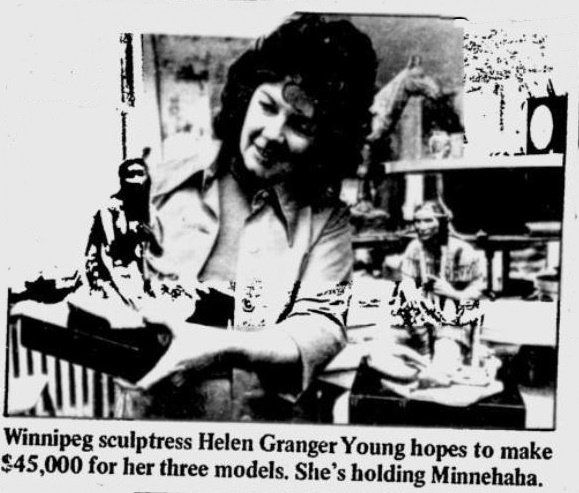 This photograph accompanied that article. And about that caption regarding money, here’s an interesting bit from another 1973 article – this time in the Calgary Herald:
Models of Hiawatha, Minnehaha (in plasticine) rode in first class seat on Air Canada from Winnipeg to NY at half fare. Beaverhead in a box on the floor in front of her seat. Mrs Young didn’t know it then, but […] ultimately her three Indian sculptures, done in her Winnipeg home, would result in gross sales of $2.5 million. Her share? She doesn’t like to discuss it. She gets a royalty on each copy sold. She hopes to receive at least $15,000 per statue.
I decided to look into that math a bit, and the cited $2.5 million is correct if one bases it on the actual retail price (i.e., gross retail sales) for those 1050 sculptures (350 each of Hiawatha, Minnehaha, and the Medicine Man.) Obviously, the studio sold their sculptures to retailers for less than the published retail price. The “$15,000 per statue” must refer to the total amount of royalty payments per sculpture design over the entire production life of that piece.
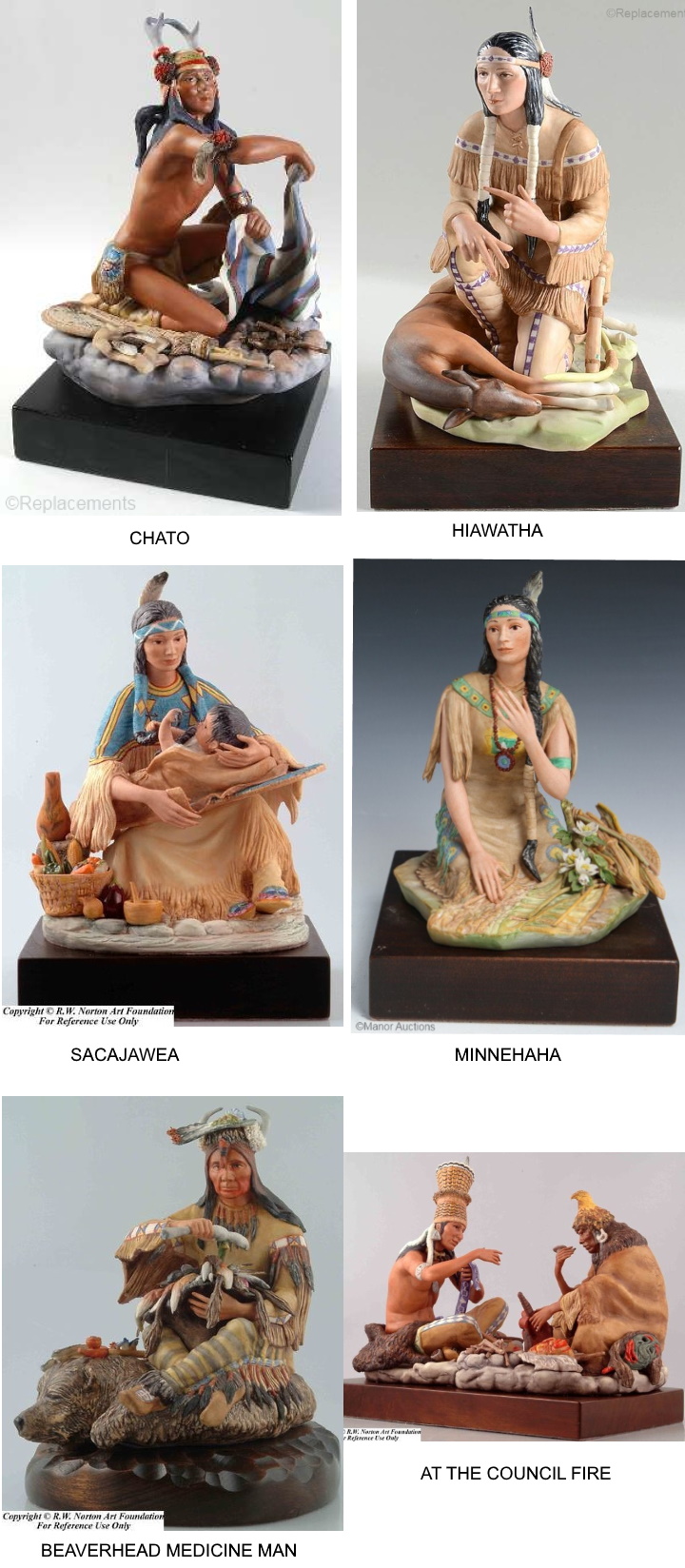
This collage shows the first six of Helen Granger Young’s pieces that were produced as limited editions by Cybis. From the top left, they are: Apache ‘Chato’ (1974); Onandaga ‘Hiawatha’ (1969); Shoshone ‘Sacajawea’ (1971); Dakota ‘Minnehaha’ (1969); Blackfoot ‘Beaverhead Medicine Man’ (1969); and ‘At the Council Fire’ (1973.)
Several of these were chosen by the State Department as official US Gifts of State during the 1970s and early 1980s. Minnehaha was given by President Nixon to Mexico in August 1970, and to Chinese leaders Mao Tse-Tung and Chou En-Lai in 1973. The 1973 Chinese gift also included a Hiawatha, a Beaverhead Medicine Man, and a Sacajawea (who was also sent to Prince Charles and Princess Diana on the birth of Prince William in 1982.) Two dignitaries received a copy of At the Council Fire: Leonid Brezhnev in 1973, and South Korean President Park in 1974.
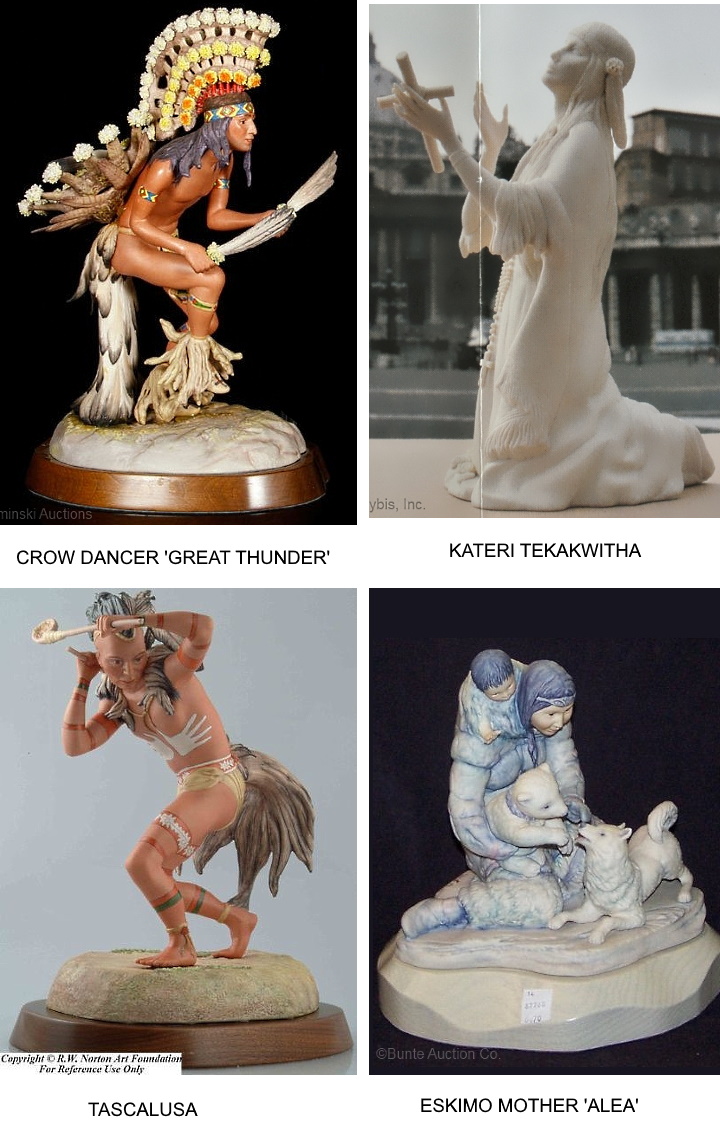 These four sculptures were introduced later. They are Crow Dancer ‘Great Thunder’ (1977), Kateri Tekakwitha ‘Lily of the Mohawks’ (1981), Choctaw ‘Tascalusa’ (1982) and Eskimo Mother ‘Alea’ (1973.) The Cybis studio did not place the Eskimo Mother into the North American Indians Collection initially; they assigned her to other collections for almost a decade, before finally moving her into the North American Indians in 1981. An Eskimo Mother was given by President Gerald Ford to Soviet President Leonid Brezhnev in 1974, and later to Prince Charles and Lady Diana Spencer as a wedding gift in 1981.
 At the time that this photo was taken, Cybis had placed the Eskimo Mother into their North American Indians Collection for the first time. For the previous eight years they had moved her between their ‘Portraits in Porcelain’ and other collection categories.
 At least one of the Cybis pieces was originally created for another manufacturer: Cree ‘Magic Boy.’ As related in its own Archive post, the white bisque version was introduced by Cybis in 1971. However, this entry in the US Copyright Office records
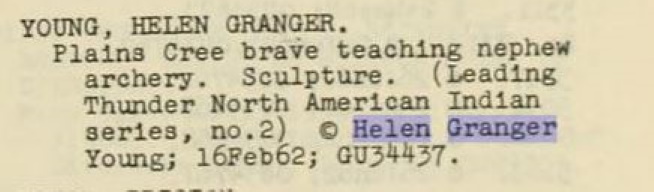 shows that the sculpture had been created and copyrighted nine years earlier (1962) by Helen Granger Young on commission for a company called Leading Thunder, for inclusion in their ‘North American Indian series.’ No search engine has been able to turn up anything about a company by this name, but obviously it did exist at some point during the early 1960s. Perhaps they went out of business before ever producing any goods? In any event, this sculpture ended up being sold to Cybis for use as the ‘Magic Boy’ limited edition in the 1970s and again (in color) in the 1980s. Nowhere in any Cybis advertising literature is Helen Granger Young credited as the designer – but then again, they never credited her for any of the other Cybis pieces either. The difference, of course, is that those other pieces were eventually copyrighted by Cybis, while this one had already been copyrighted by Mrs. Young during the previous decade.
 The other surprising copyright discovery was the Cybis Sioux ‘Wankan Tanka’ The Great Spirit which was introduced in 1979 as an edition of 200. Before finding this entry I did not know who the designer was.
 So, I was really surprised to discover this 1968 copyright registration by Helen Granger Young. This is definitely the same piece that Cybis produced nine years later.
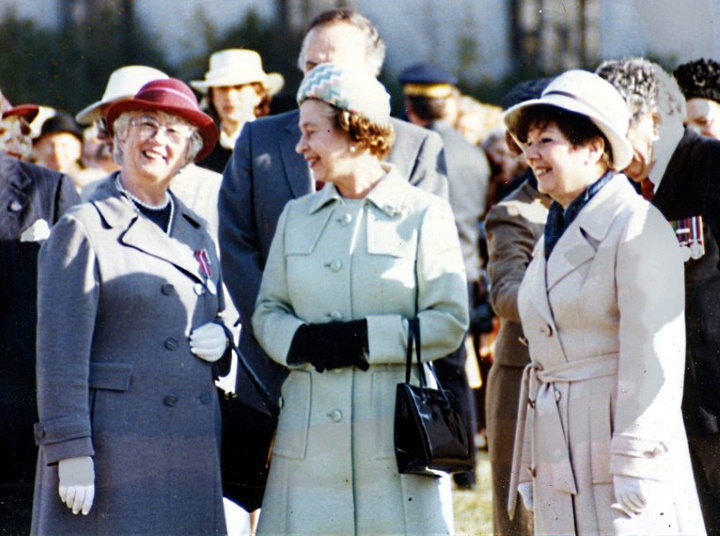 This photo shows Helen Granger Young, at right in the white coat, in Manitoba with Queen Elizabeth II during her Royal Tour of Canada in 1984. It was during this tour that HM was presented with a Wankan Tanka on behalf of the people of Manitoba; I have confirmed with the Royal Collection Trust that the piece is signed Cybis and AP and is also autographed by Helen Granger Young. A Wankan Tanka was also given by Illinois governor James Thompson to the visiting King Carl Gustaf of Sweden in 1988.
Additional information about, and views of, the entire Cybis North American Indians Collection can be found in their dedicated Archive post.
Other Porcelain Designs by Helen Granger Young
I have found evidence of only two other companies for whom Mrs. Young designed porcelain sculptures.
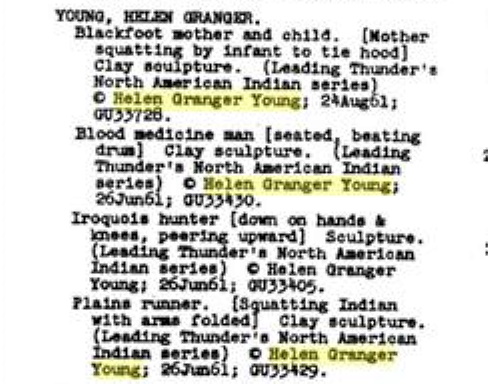 The first is the aforementioned ‘Leading Thunder’ client; all of the search engines draw a complete blank when it comes to relevant results. It’s clear that they intended a series, at the start of the 1960s, on the same theme as Marylin Chorlton proposed later in that decade.
 Notice that the 1962 Cree copyright registration is slightly different, in that it cites ‘Leading Thunder North American Indian series, no. 2’ which suggests that there was more than one series planned, if not actually physically produced. It’s frustrating that absolutely nothing shows up in searches! Should any reader have one or more of these figures, there’s a contact form link at the bottom of this post; I’d love to find at least one photo!
So, there were at least five Helen Granger Young copyrighted porcelain designs in 1961 and 1962, regardless of whether they were ever actually produced for sale.
The next record of Helen Granger Young porcelains doesn’t appear until late 1979, when she signed an exclusive agreement with Goebel to design for them. I have only been able to find items dated 1980 and 1981, so it may be that she ended her association with them after that point. The pieces were produced at the Goebel of North America studio/factory in Pennington, New Jersey.
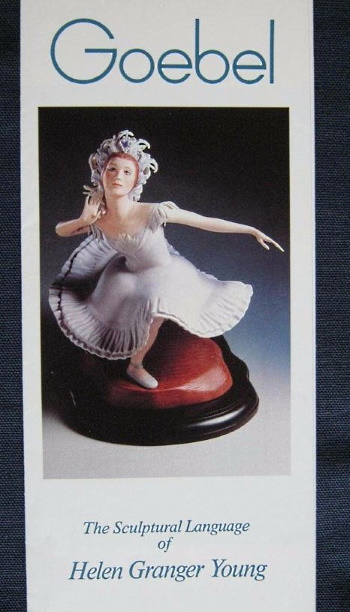
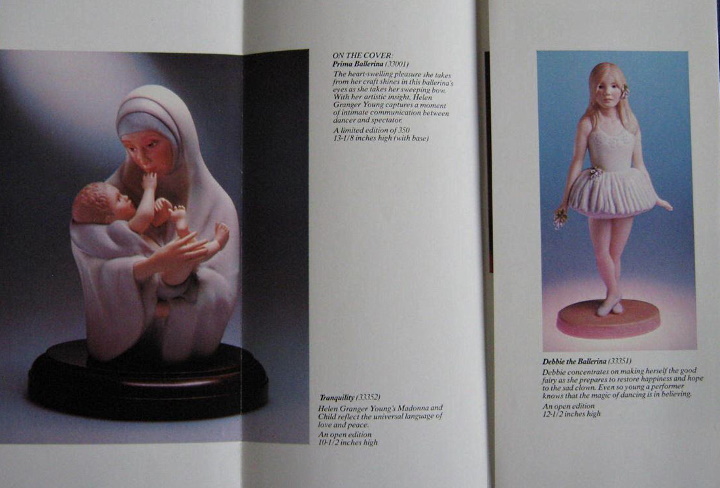
 Goebel produced these brochures in 1980. Their tagline for her branding was “The sculptural language of Helen Granger Young.” Like most porcelain studios of the era, there were both limited and non-limited offerings, and some of the limited editions were available in a choice of either white bisque or color.
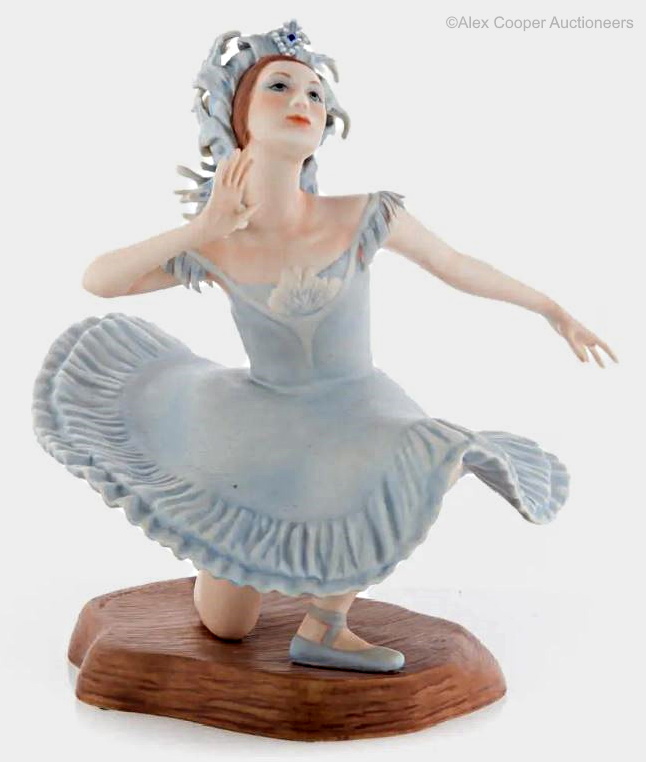
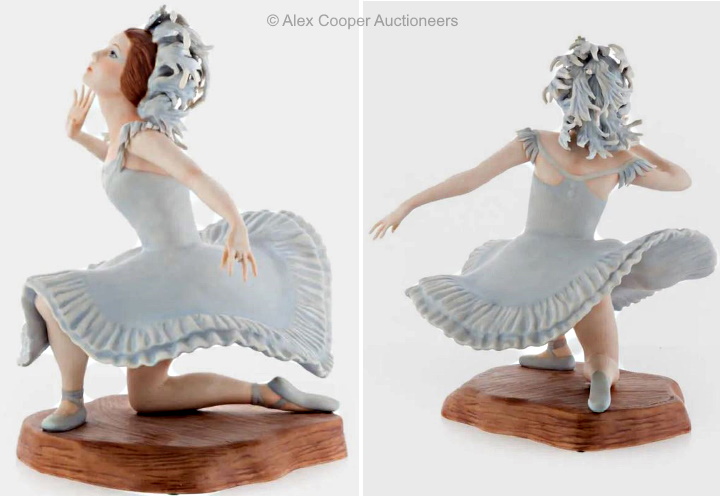 The Prima Ballerina was an edition of 350, and is 13” high on her base.
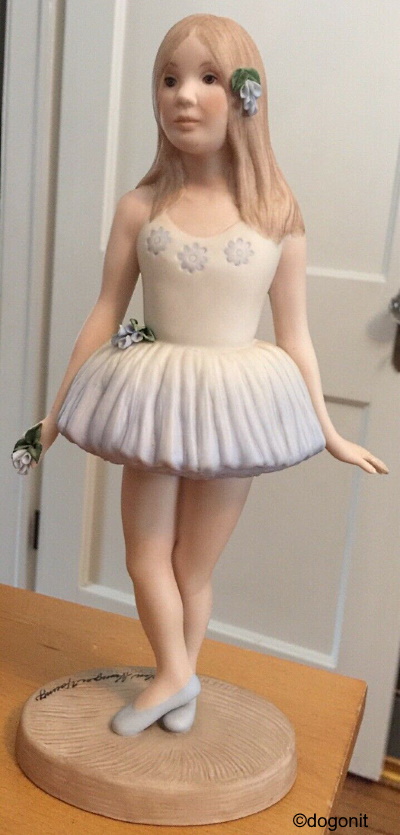
 Debbie was an open-edition ballerina standing 12.5” high. Part of Mrs. Young’s contract with Goebel was that her name would appear in the mold on all her pieces. This was something that the Cybis studio never allowed, regardless of who the designer was.
Another interesting facet is that many of the Goebel pieces appear to have been autographed. These are not decals, which brings up the practical question of when and how that was done. It makes me wonder if some were ‘signatures by proxy’, as the Cybis studio did with two pieces they connected with Michel Cousteau (see the All at Sea post for the backstory.) To make a long story short, although the studio said that the pieces were all signed by Mr. Cousteau, only a small number of them were – the pieces that were sold at a dealer event at which Mr. Cousteau was present. All the others were signed by people who worked at the Cybis studio, and the difference in the signatures is readily apparent to anyone who takes the times to compare them. Did Goebel do the same thing with their Helen Granger Young line? Or did she simply do a very large number of personal appearances at retailer events during 1980 and 1981?

 Kathlyne was one of several “Era of Elegance” female portraits for Goebel. She is similar in name and format to the three shown in the 1980 brochure: Rosalyne, Madelyne, and Charlyne. All are about 12” high on their base and were editions of 500.
The next three figures were non-limited Goebel from 1980.
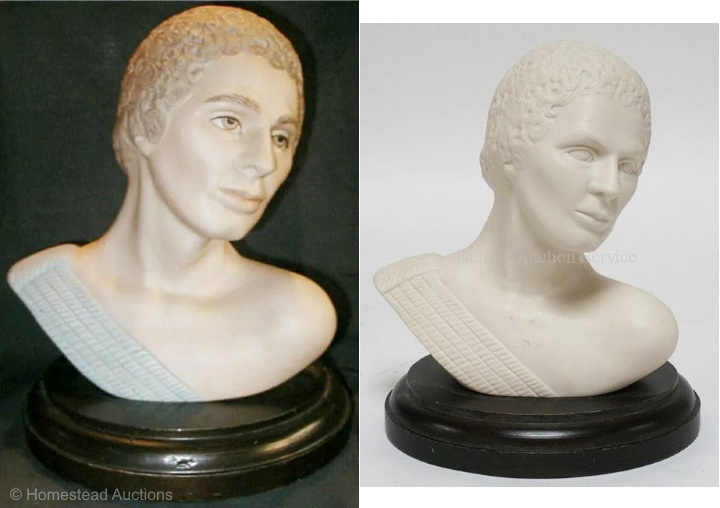
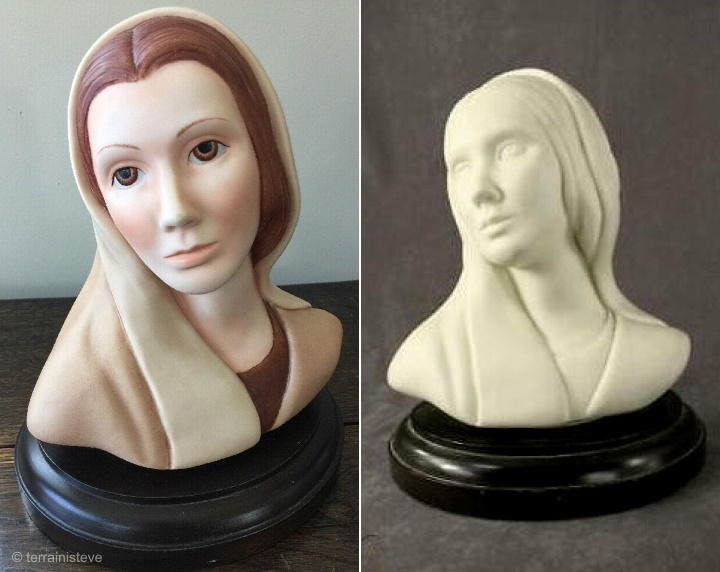
 They are, from top to bottom, John, Mary Magdalene, and Simon Peter and are approximately 10 inches high.
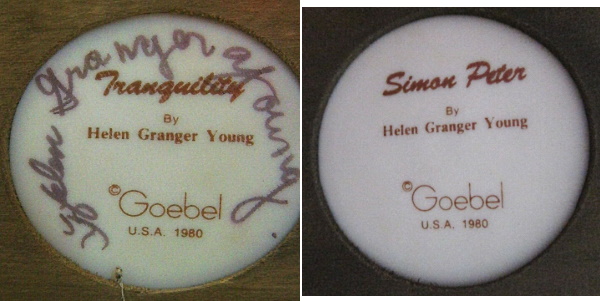 The typical open-edition Goebel backstamp for the Helen Granger Young series, one autographed and one not.
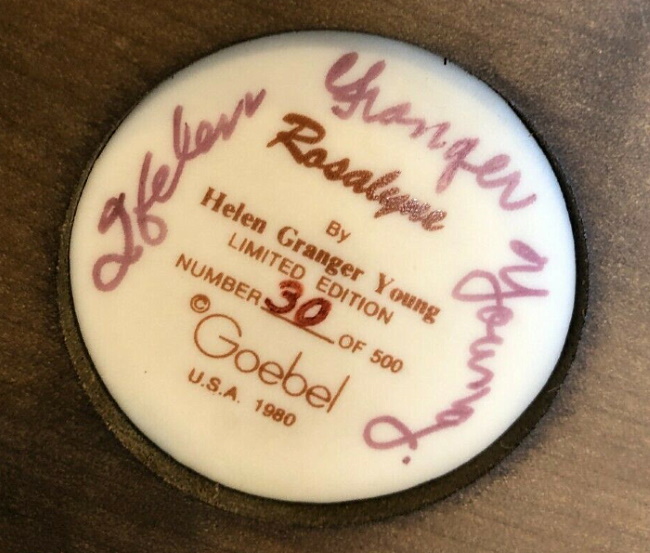 This was their limited-edition backstamp format.
 Two items that accompanied a limited edition: the COA and a folder embossed with the brand’s tagline “the sculptural language of Helen Granger Young.”
Paintings and Drawings by Helen Granger Young
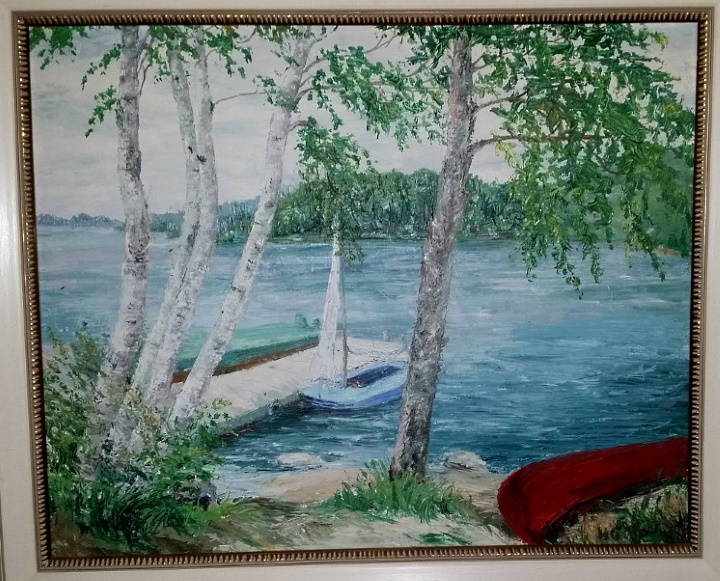 It has been much harder to find examples of paintings or drawings. A helpful Archive reader sent a photo of a painting that Mrs. Young did as a thank-you gift for his family after spending a summer vacation at their lakeside cottage.
 This is an example of her signature (as H G Young) which is at the lower right in this painting.
Helen Granger Young Bronzes
Mrs. Young is widely known in Canada for her bronze monuments, so I am going to show only a few of them.

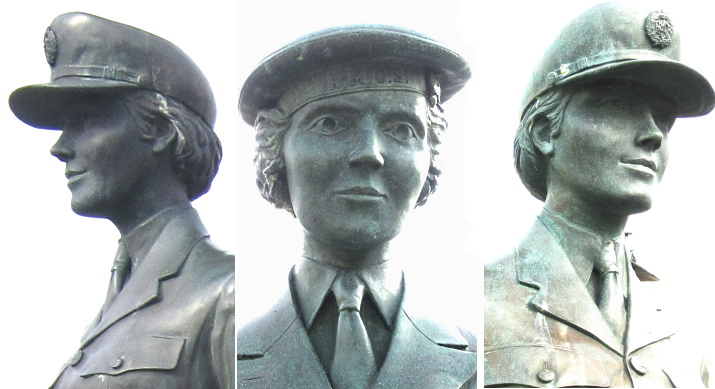 The Tri-Service Memorial, on Memorial Boulevard in Winnipeg, honors the women who served in Canada’s army, navy and air force during both World Wars. The design of the monument came from Beryl Isabel Simpson, then-president of the Women’s Tri-Service Veterans Association, but the actual sculpting was done by Helen Granger Young. The monument was unveiled in July 1976 but Queen Elizabeth’s schedule did not allow her to attend. The monument was re-dedicated during the Queen’s 1984 tour of Canada; she herself had served as a mechanic and military truck driver during World War II.
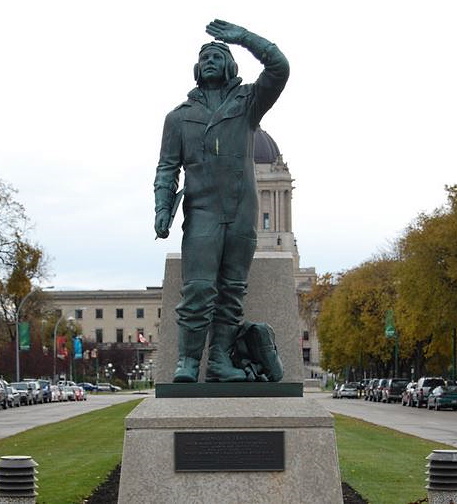 The Airman in Training was installed in Winnipeg Memorial Park in 1984.
 That park also contains a number of bronze busts by Helen Granger Young within its grounds, of which these are a selection. At top left, Donald McDonald (first Chief Commander of the City of Winnipeg in 1971); top right, Duff Roblin (Manitoba premier from 1958-1967); bottom left, Edward Drewry (late-1800s Winnipeg philanthropist); bottom right, Israel Asper (leader of the Liberal Party in Manitoba during the 1970s.)

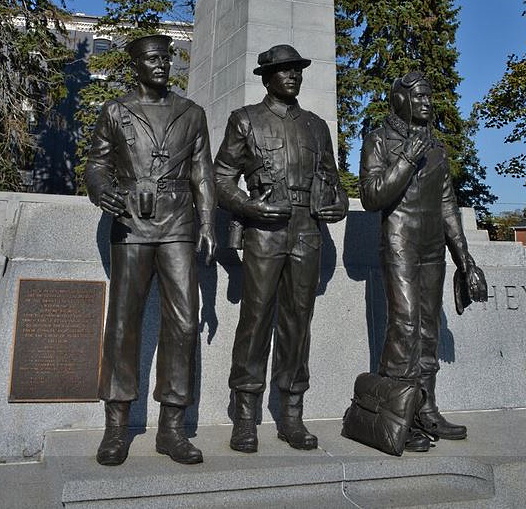
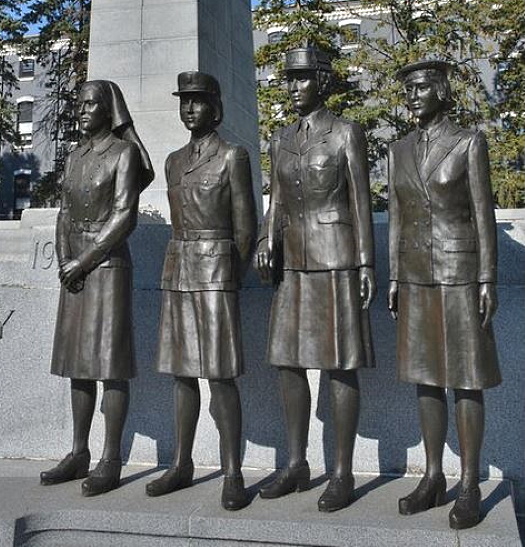 This is the Brant County War Memorial; the marble base reads They gave their lives for humanity. The monument was unveiled in 1992.
 This is one of Helen Granger Young’s late-1980s sketches for the female side of the monument. Her original design called for four figures on each side, but as you can see, there are only three men; the fourth was eliminated due to budget constraints. In 2020 a proposal was floated to relocate the figures and to add a fourth male but, due to issues related to the Covid-19 pandemic, that plan was put on hold.
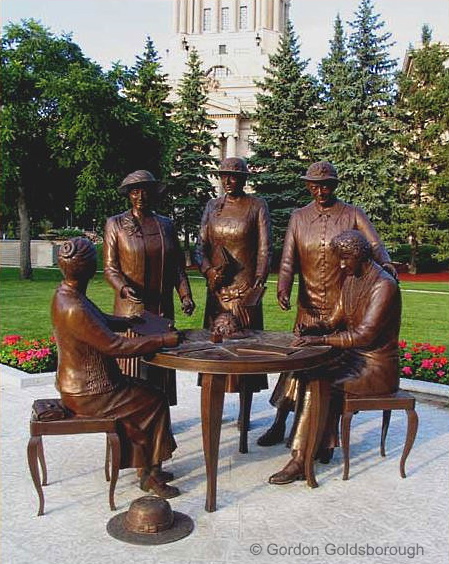 This is the Famous Five Monument on the grounds of the Manitoba Legislative Building. It was commissioned by the Nellie McClung Foundation at a final cost of $750,000 CDN and unveiled in June 2010. The group portrays Judge Emily Murphy, Henrietta Muir Edwards, Irene Parlby, Louise McKinney and Nellie McClung – all of whom brought a case to the Supreme Court of Canada to reverse a 1928 decision that women could not hold a Senatorial office because they were not “persons.” Needless to say, they won the case, and there is an excellent YouTube video showing the creation process of this Famous Five monument.
 The most recent Helen Granger Young bronze monument is probably The Prairie Sailor. This is her original maquette (small clay model) of the project, which was commissioned by the Naval Museum of Manitoba. During the entire history of the Canadian Navy, a large proportion of the men and women who served have come from the prairies – yet there had never been a monument honoring their service specifically. During the “Battle of The Atlantic” from September 1939 to May 1945, the navy lost 24 ships and more than 2000 personnel, the majority of whom had been from the prairies of Canada.
 The finished monument was dedicated in May 2014, on the grounds of the Naval Museum.
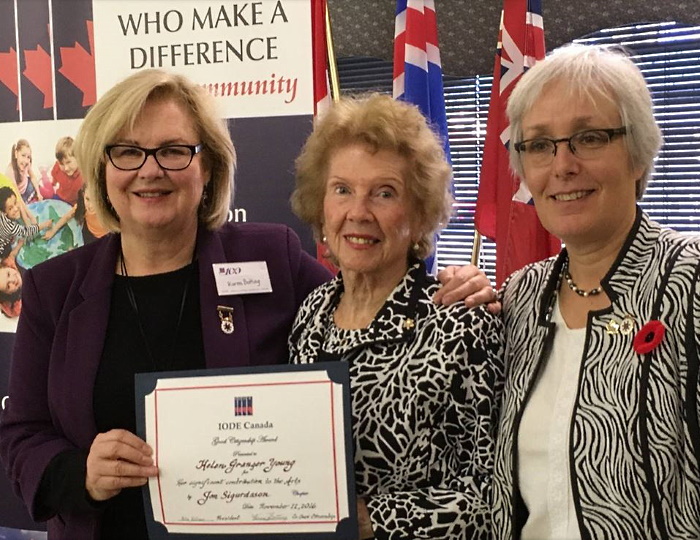 Helen Granger Young has received numerous awards and accolades in Canada, including the Order of Manitoba and the Women of Distinction. This photo was taken in 2016 at the Imperial Order Daughters of the Empire charitable organization in Toronto.
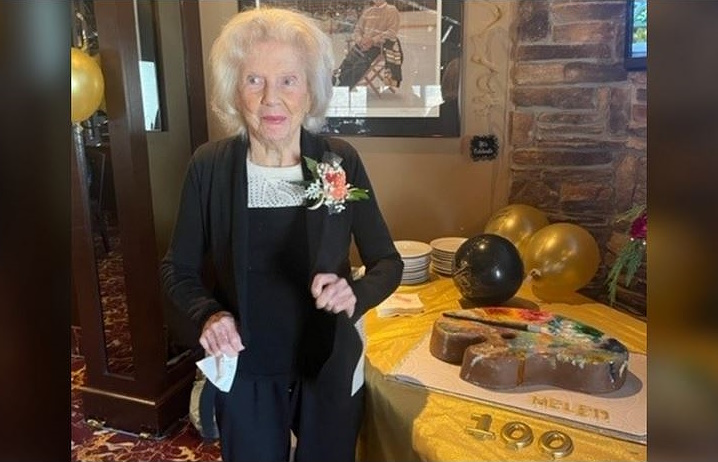 Helen Granger Young passed away on April 7, 2023. This photo was taken on the occasion of her 100th birthday party in November 2022. Photo courtesy of Debra Jonassen-Young.
Name Index of Cybis Sculptures
Visual Index (for human figures/busts only)
About the Cybis Reference Archive
What is Cybis?
Images of Cybis porcelain sculptures are provided for informational and educational purposes only. All photographs are copyrighted by their owner as indicated via watermark and are used here only as reference material. Please see the copyright notice in the footer and sidebar for important information regarding the text that appears within this website.
The Cybis Archive is a continually-updated website that provides the most comprehensive range of information about Cybis within a single source. It is not and never has been part of the Cybis Porcelain studio, which is no longer in business.
 THE CYBIS ARCHIVE