
Some online sellers make a point of mentioning whether a given item is or isn’t being sold with its’ original box/packaging, and/or its COA (certificate of authenticity) if there originally was one. The original Cybis-marked boxes were frankly nothing to write home about, and most buyers didn’t bother to keep them. The COA situation is bit different.
The Cybis studio normally did not provide any sort of COA with their sculptures, even the limited-edition ones. It was just not something that they chose to do. The few instances when they did, was always in connection with something special about that particular issue: Perhaps it was a private commission (such as the Spirit of Ecstasy for the Rolls-Royce Owners Club) or was a retail piece that had a connection/arrangement with a charitable organization – although even those situations were not necessarily any reason to create and supply a COA for it.
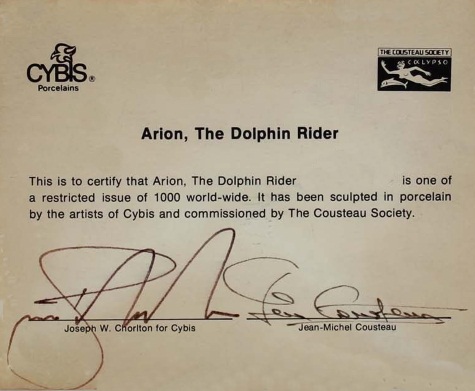 For example, here is the COA that was originally provided with each Humpback Whale and each Arion the Dolphin Rider. Both were limited editions, and a non-specified portion of the selling price was supposedly given to the Cousteau Foundation. (For some reason, this COA does not have the sculpture number filled in, even though it survived along with the #336 Arion and should have had that number written in the designated space for it.)
However, so few Cybis sculptures merited the effort and expense of having a few hundred COAs printed up, that the odds of any surviving along with the matching sculpture throughout the decades are very slim. Most purchasers stuck the COA into a drawer along with the original sales receipt and forgot about them.
I recently came across an online listing that advertised a ‘Cybis Certificate of Registration’ along with the sculpture being offered for sale. The piece was the hippocampus Sea King’s Steed ‘Oceania’, which was a normal retail edition. Knowing that the Cybis studio never established a ‘registry’ of the pieces the produced (other than their own internal production inventory for cost-accounting), I was quite curious!
 This is the inside of the certificate/card. The wording suggests that this document had been issued by the Cybis studio itself, but the number 694 on the “Registry no.” line did not correspond to the sculpture’s actual number, which is
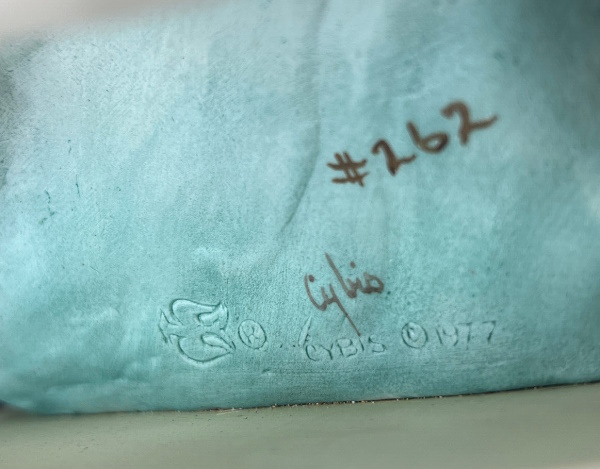 obviously, #262. So, what relevance does 694 have? It turns out that this was the studio’s internal design/mold number for this edition. The 600 series of design numbers was (as seen in the Design Numbers post) used for the various types of animal sculptures. There was, of course, no such thing as a ‘registry’ and that word has no connection to the number that Cybis assigned to each edition’s design.
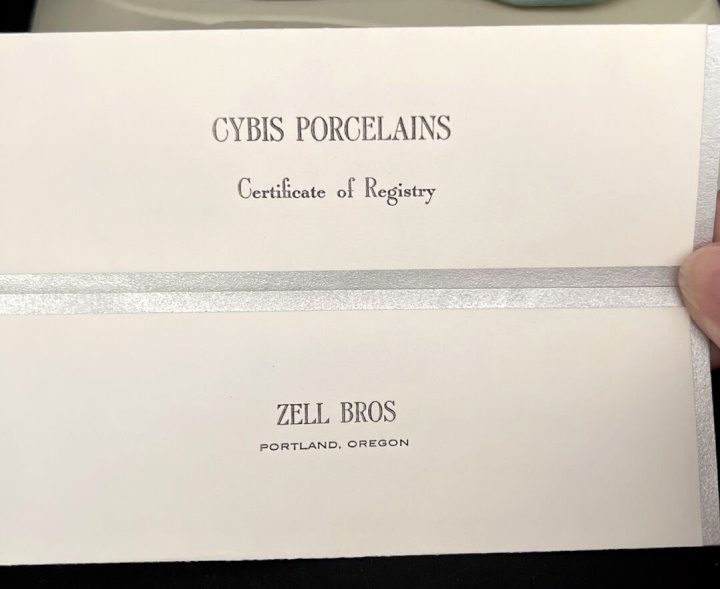 Viewing the certificate in a closed position, we see that the top section says Cybis Porcelains Certificate of Registry (which is a complete fabrication, because there was never any such thing) and on the lower section, Zell Bros. Portland Oregon. Aha!! Mystery solved.
These faux ‘Certificates of Registry’ were invented and supplied by the retailer, not by the Cybis studio. Although they tried to make it look authentic, the effort fails because (a) There was never any ‘sculpture registry’ by either Cybis or Zell’s, and (b) Even if there had been, the ‘registry number’ (which is merely the design number that applied to every example of that sculpture and had no relevance to anyone but the Cybis studio) would be useless. If instead the card would have shown the individual sculpture number (as was done in the real Cybis studio COA for Arion et. al., had it been filled in), it might have served some purpose. But in reality, all of these Zell Bros. ‘Certificates of Registry’ are completely meaningless. The lack of the official Cybis studio logo anywhere on these is another red flag.
This misguided attempt at marketing made me curious about that retailer, so I did some digging. The Zell Bros. store was founded in Portland, Oregon by three brothers in 1912. In addition to fine jewelry, their goldsmiths could create custom designs in precious metals, and custom silver flatware. Zell’s continued to operate as a family-owned business until the 1970s, when the store was sold to Bailey, Banks & Biddle, a well-known upscale chain of jewelry stores mostly based on the East Coast. The deal included the unusual concession that the Zell Bros. operation could continue to retain their original name, instead of being re-named as a Bailey, Banks & Biddle store. Thus, most of Zell’s customers were probably unaware of the corporate ownership change, especially as the three brothers remained active participants in the retail operation and continued to be the public face of the store.
The Cybis ‘Oceania’ was introduced in 1977 and closed in 1981. So, these faux COAs may fall into the timeline of Bailey Banks & Biddle ownership that was locally managed by the Zell brothers. However, the timeline gets a bit murky after this, because at some point – either during the late 1970s or into the 1980s – Bailey Banks & Biddle sold the Zell location to the Zales Jewelry Corporation (with whom we are all familiar via their shopping-mall stores.) The Zell brothers stayed on for a short while after that, but then decided to step away. A local Portland newspaper reported in 2009 that
When [the brothers] left Zell’s it was the beginning of the end. Zales gave staff members I.D. numbers and the great sales staff and goldsmithing employees vacated.
In 2007, Zales sold the Zell’s store to a NY-based management organization, Finley Enterprises, for $200 million. Finley had no experience in the jewelry market business, and made a hopeless botch of things. The store survived for only two years. In April 2007 Finley shuttered it. Zell’s had been in business, under one ownership or another, for 95 years. A local paper reported that four of the employees who turned out the lights for the final time in 2007 had worked there for more than 30 years.
 This undated photo accompanied the 2009 Portland-newspaper snippet about Zell Bros. Their Cybis pieces would likely have been inside the cabinets lining the side walls, or perhaps in a separate small room at the rear. Independent jewelry stores such as this often carried a selection of porcelain art pieces (Boehm, Cybis, Lladro, etc.) during the 1960s and 1970s heydays. Such items would not have been their mainstay (as it was at galleries such as Brielle, Reese Palley, or Armstrong’s, who either did not sell fine jewelry or offered only a very limited selection) but the store would still have been one of the available local sources for collectors. Cybis was also sold by certain higher-end department stores (such as B. Altman in New York) and independent giftware shops (such as Herbert John Gifts & Lamps.) None of those locations had the space for an extensive display, but they had Cybis price lists, brochures, and catalogs and could order whatever current pieces a collector might want.
It is likely that the Cybis studio was completely unaware that Zell Bros. was giving these so-called ‘Certificates of Registry’ to buyers of their sculptures, because once the pieces were shipped to the retailer, the marketing was left up to the stores (other than the pricing, which their contract with the studio tightly controlled.)
Name Index of Cybis Sculptures
Visual Index (for human figures/busts only)
About the Cybis Reference Archive
What is Cybis?
Images of Cybis porcelain sculptures are provided for informational and educational purposes only. All photographs are copyrighted by their owner as indicated via watermark and are used here only as reference material. Please see the copyright notice in the footer and sidebar for important information regarding the text that appears within this website.
The Cybis Archive is a continually-updated website that provides the most comprehensive range of information about Cybis within a single source. It is not and never has been part of the Cybis Porcelain studio, which is no longer in business.
 THE CYBIS ARCHIVE