
After writing my previous post about Boleslaw Cybis and the Brotherhood of Saint Luke, I was inspired to look a bit further into the ‘world stage’ Exhibitions that he was involved in.
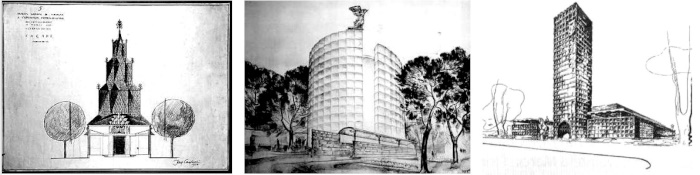 There were three such Exhibitions of note. From left to right in these renderings of the Polish Pavilions within each, they were the 1925 Paris Exhibition, the 1937 Paris Exhibition, and the 1939 World’s Fair in New York.
The 1925 Paris Exhibition
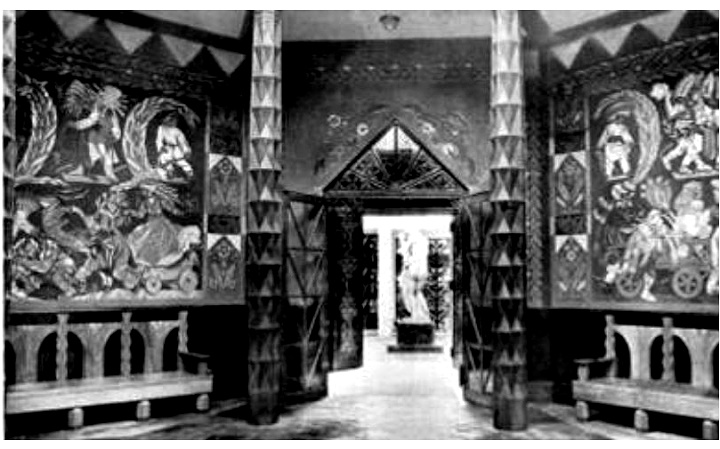
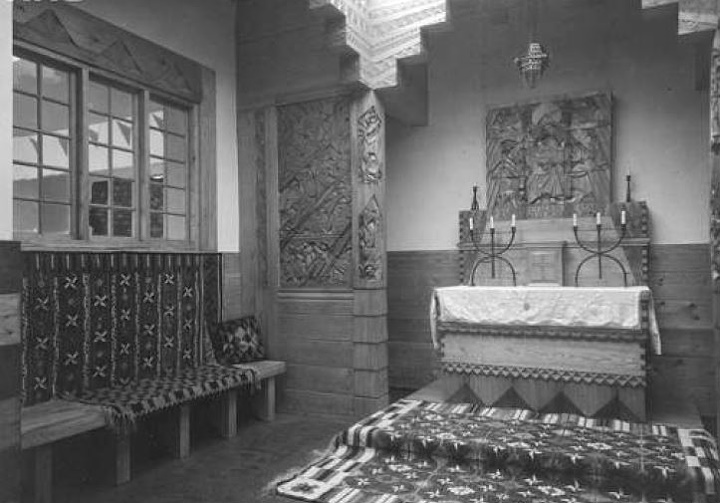 Update, July 2024: I recently discovered these photos of part of the interior of the Polish Pavilion. Although it is known that Boleslaw Cybis did some work within the exhibit space, it is not known exactly what that work was. He would have been 30 years old, and recently (1923) back home from his time in Constantinople.
 Views of the exterior of the Polish Pavilion. The statue in the second photo can be seen through the back door in the first interior photo. A contemporary French critic wrote that “..the Polish Pavilion is the most original and complete of all the foreign pavilions. It exhibits strong unity and as much as possible is Polish without ceasing to be modern at the same time.” This Exhibition was the first that Poland had participated in after gaining its post-war independence; the interior chapel was awarded a Grand Prix.
The 1937 Paris Exhibition
The full name of this was Exposition Internationale des Arts et des Techniques appliqués à la Vie Moderne (The International Exhibition of Arts and Techniques applied to Modern Life.) Poland was one of the 44 nations participating in it.
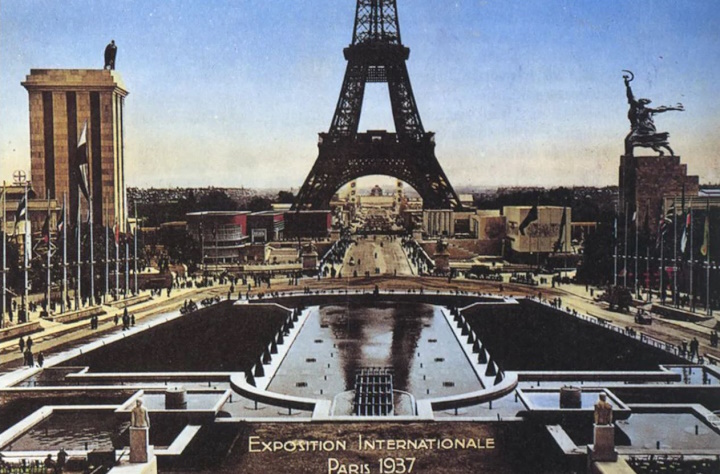 A contemporary souvenir postcard of the Exhibition. The two massive pavilions directly opposite each other are those of Germany (left) and Russia.
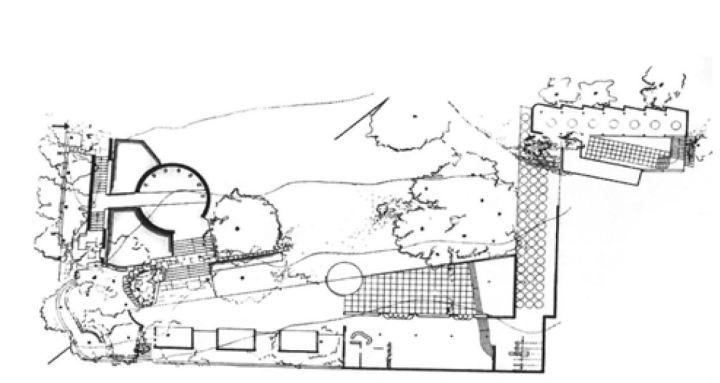 The Polish Pavilion was designed by architect Stanisław Brukalski; the rough floorplan sketch is shown above. As described in the excellent 2016 article Examples of Polish National Pavilions Before World War II by Izabeta Sykta, there was a small chapel at the entrance, in which there was a painting of the Virgin Mary on glass. (This excerpt has been translated into English.) Entering the pavilion,
Behind a stone wall, whose continuity was interrupted by a gate with a simple lattice with elegant stylized design inspired by folk paper cut-outs […] [was] a massive rotunda with a vertical opening serving as the entrance and topped with a statue of Polonia Restituta. Along the wall ran [a] covered arched gallery, opening into the interior patio garden, slightly Mediterranean in character …in front of the entrance to the pavilion. In that area was a pool with stone banks, in which the rotunda was proudly reflected, with a footbridge to the entrance. The stone rotunda was a kind of a monumental transition to [the] proper exhibition pavilion [which] was, [as] opposed to the rotunda, an unpretentious, light, skeletal structure of modernist architecture.
Of course, the interior of the Pavilion intended to (as Ms. Sykta puts it) “expose the power and glory of Polish statehood, to show Poland as a country of great deeds and heroes.” The mention of Boleslaw Cybis in relation to this exhibit is also in her article:
The entrance to the pavilion, covered by leather tent (designed by T. Głogowski), was introduced through a portico with a plafond (creator Boleslaw J. Cybis) [and thence] into the hall with a tapestry “The Succor of Vienna” (creator Mieczysław Szymanski).
‘Plafond’ is defined as “a ceiling of elaborate design that is formed by the underside of the floor above it.” One would think that this restricts a plafond to a flat plane, but another dictionary claims that a plafond “can be flat or arched” – which rather contradicts the definition that it is the underside of a floor (unless said floor happens to be a bridge!)
 This photo shows the entrance described by Ms. Sykta, with its leather canopy.
 This is the barrel-vault walkway ceiling/plafond that was described.
 This is an expanded photo view of the 1937 Polish Pavilion.
 This photo was taken during the work in progress. Boleslaw Cybis is standing and smoking a cigarette. Marja Cybis is seated, with her lands in her lap, and looking directly at the camera. It is possible that the woman sitting behind her may be Zofia Siemasko.
 Update, August 2024: This photograph was captioned “Maria Cybis, Boleslaw Cybis, and Zofia Siemasko [in background] at work on the ceiling decorating the entrance to the Polish Pavilion at the International Exhibition in Paris, 1937“. The design seen in the upper right corner appears to be a seated woman in flowing draperies in front of a brick or tiled wall.
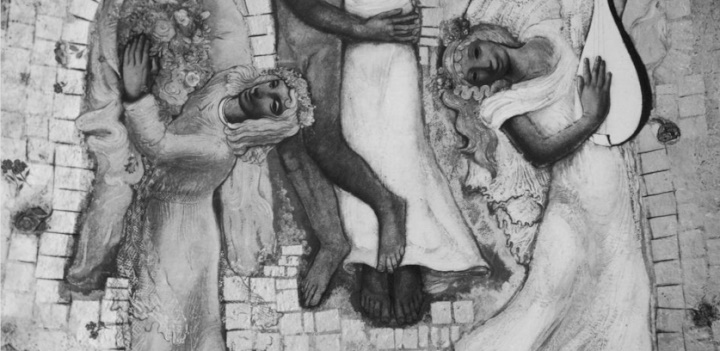
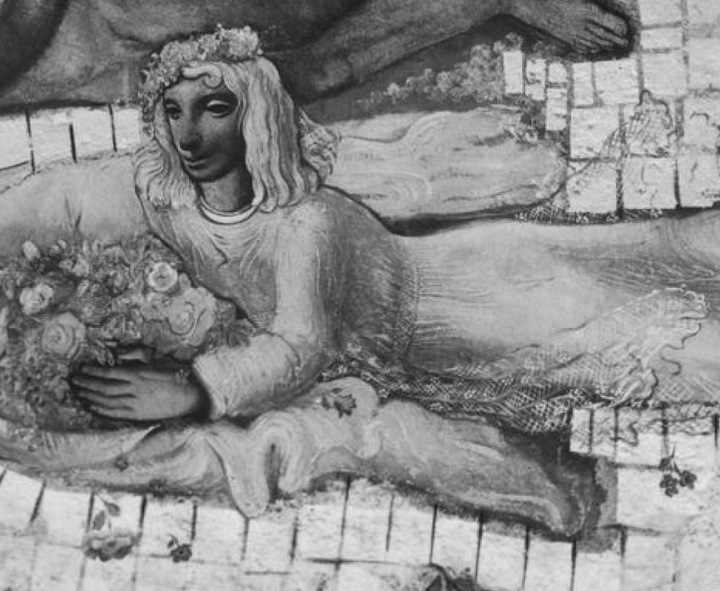
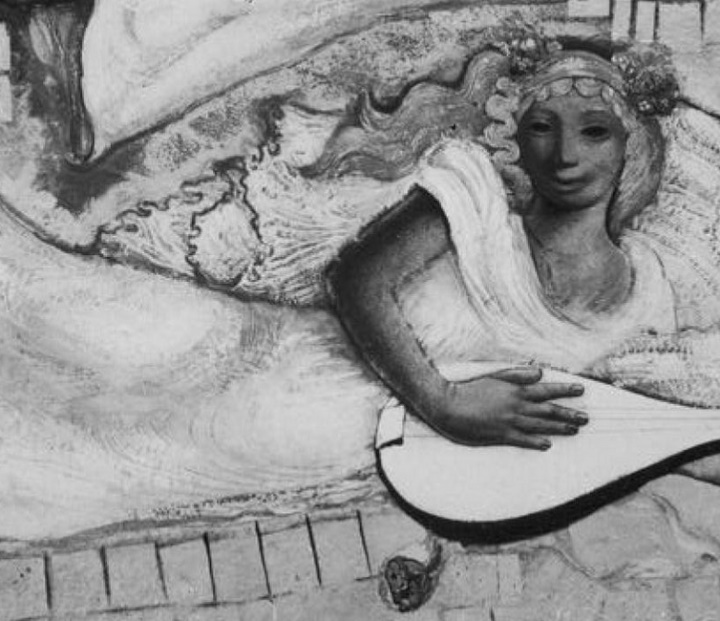 These photographs show part of the actual ceiling. The caption identified the title of the work as Abundance. The ’tile’ effect shown in the previous photograph is clearly visible here!
The Polish Pavilion was given an unfortunate site location, even though it was on one of the main thoroughfares of the exhibit. The building was not particularly large, and was further dwarfed by the surrounding large trees and even more so by the adjacent German Pavilion which was generally acknowledged to be “gigantic” in size. Thus, in the competition for fairgoers’ attention, the Polish Pavilion was doomed to lose out. In fact, even in Poland the structure was denounced as “a shame” and “the ugliest pavilion at the entire exhibition.” Critics likened the stone rotunda to a grave or mausoleum in design and feeling. One Polish writer sneered “What nonsense to build a tomb in Paris!”
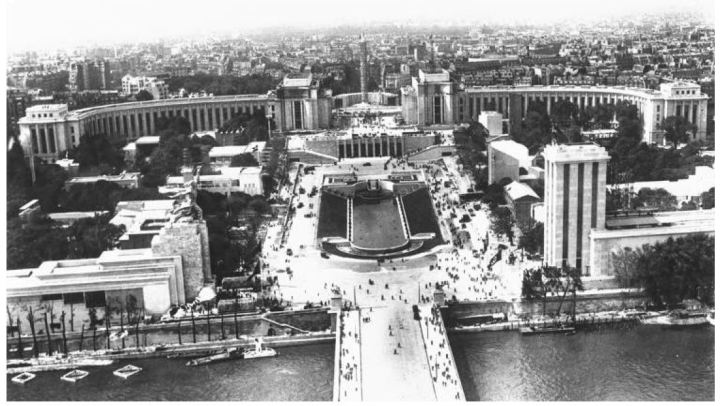 This postcard photo is an aerial view of the ‘nations’ part of the site, demonstrating that the large trees were indeed very much in evidence! A small part of the Polish Pavilion can barely be seen behind (from this vantage point) the German Pavilion at the right front. (From this angle, the Eiffel Tower is behind us.) The Exhibition as a whole was generally acknowledged to be rather a flop, partially due to the recent economic depression.
1939 World’s Fair in New York
Many were determined that the disaster of the 1937 Paris Exhibition would not be repeated two years later in New York. Held at Flushing Meadow Park in Queens (a suburb of New York City) this was billed as “Building the World of Tomorrow, For Peace and Freedom”. Most of the pavilions were designed as single-story and without windows, in order to maximize interior wall display space. The Polish Pavilion was a notable exception, its entrance tower being 120 feet (40 meters) tall, from which a daily bugle call was played. The pavilion itself was a low building, similar to the others on the grounds.
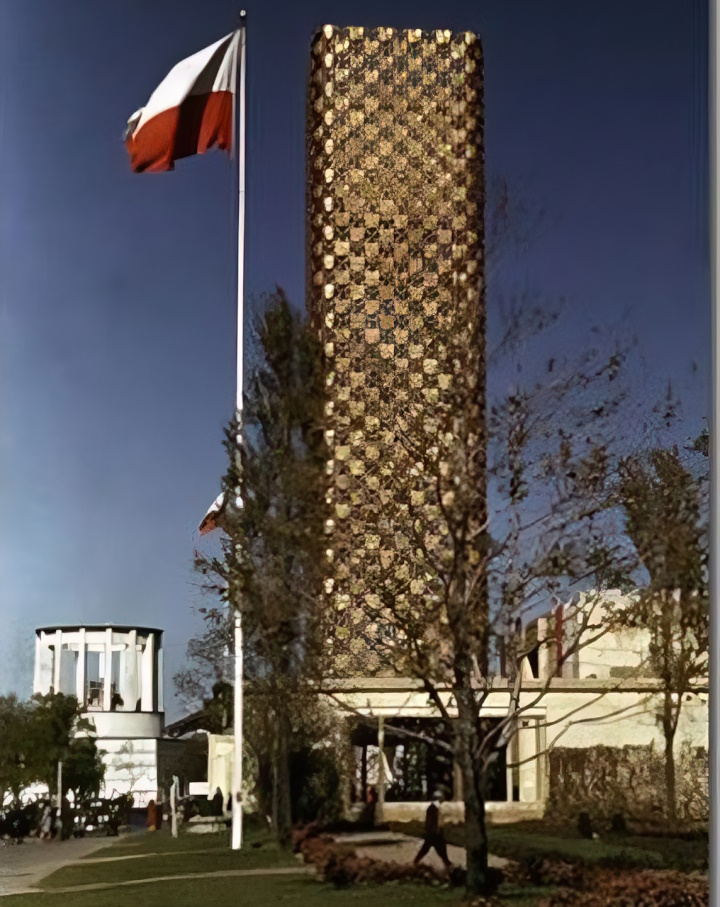 This color postcard shot is courtesy of the World’s Fair Historical Society. The exterior of the tower was clad in new copper, so that it gleamed golden in the sunlight.
 The tower was properly called the Tower Gate, as it was the entrance to the actual pavilion.
 The intricate pattern on the Tower’s surface is shown in this group photograph of the Polish Orchestra.
 An official brochure included a floor plan layout. The murals painted by Boleslaw Cybis and the Brotherhood of Saint Luke were in the area marked as A, called the Hall of Honor. They were mounted on the right-hand side of this area (as seen when walking in.) That side of the Hall represented Poland’s historical past, while the left side represented the future. However, Boleslaw Cybis was represented here also. According to the 2016 article,
[The left wall] was a tribute to the main theme of the exhibition, ‘World of Tomorrow’. Above cartograms there were fresco paintings of the Central Industrial District and Gdynia (created by Boleslaw Cybis) – significant achievements of the young Polish state.
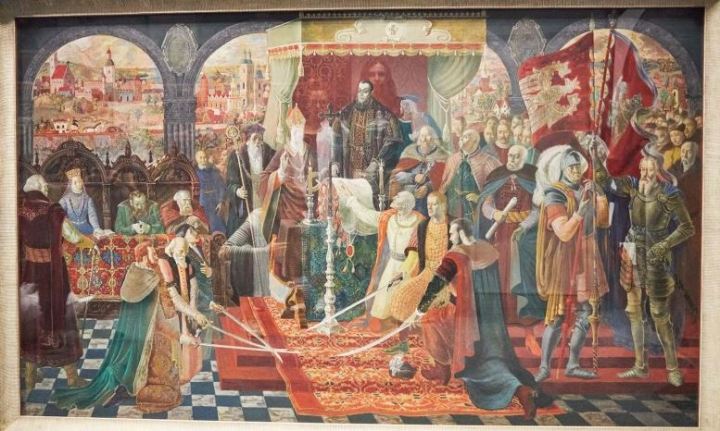 This is the Union of Lublin mural. This, and the others from the exhibit, now reside in the Polish History Museum in Warsaw. All seven of the paintings can be seen and described in their own Archive post.
A naturalistic carpet created by Boleslaw and Marja, and displayed in a different section of the Pavilion, is examined in this post.
Although most World’s Fair buildings are demolished after the exhibit closes, the Polish Pavilion’s tower was considered so unique that the plan was to spare it. The Fair Committee formally offered the golden tower to the City of New York, and indeed a plaque had already been created and installed on the exterior of the Tower:
This tower was built by Poland to commemorate its participation in the Great World’s Fair 1939-1940. Thanks to generosity of those whose names appear here, it was a gift to the city of New York in 1941. Within its area has become a lasting symbol of the Poles, their heroism on the national sample [sic], their unfailing determination of freedom and their eternal spiritual union with the society of the United States.
The gift of the tower is recorded in a document within the holdings of the Polish Embassy in Washington, D.C. Unfortunately, the retention of the building did not come to pass. It was demolished, along with all of the other buildings on the site.
 The only architectural remnant of the 1939 Polish Pavilion is the bronze monument of Wladyslaw Jagiello which originally guarded the entrance; it was installed in Central Park, where it remains to this day.
Name Index of Cybis Sculptures
Visual Index (for human figures/busts only)
About the Cybis Reference Archive
What is Cybis?
Images of Cybis porcelain sculptures are provided for informational and educational purposes only. All photographs are copyrighted by their owner as indicated via watermark and are used here only as reference material. Please see the copyright notice in the footer and sidebar for important information regarding the text that appears within this website.
The Cybis Archive is a continually-updated website that provides the most comprehensive range of information about Cybis within a single source. It is not and never has been part of the Cybis Porcelain studio, which is no longer in business.
 THE CYBIS ARCHIVE