
This oddly-titled post is in response to a perfectly logical question posed to me some time ago, which was: “If you have posts about Cybis sculptures that include crowns, or hats, or other specific elements, why not write about the figures that have weapons?”
To be honest, the thought had never occurred to me but I could see their point; especially because it turns out that there were quite a few Cybis designs that included some sort of weaponry. The studio’s ‘porcelain arsenal’ falls into four categories.
Blades
This category includes daggers and swords of any type. It’s the largest group, with twelve sculptures, nine of which were limited editions. They are shown in chronological order by introduction year.
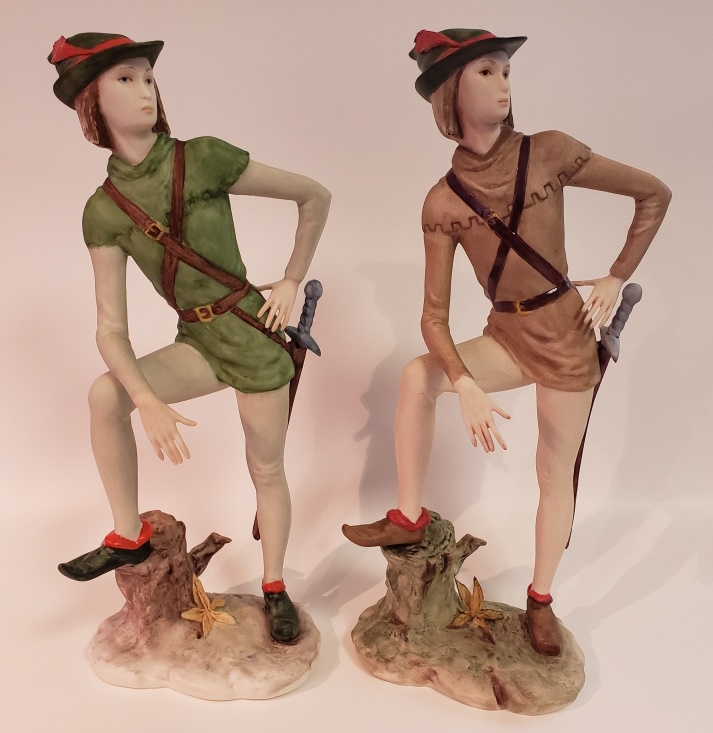 Robin Hood (1964) – The choice of his weapon is puzzling because, after all, the legendary Robin Hood was famed for his archery skill! So the fact that he was portrayed by Cybis with only a sword and a hunting horn is downright strange. Why no bow and arrow?? The photo above also shows the rare brown version; the standard retail one wore green. There was supposedly also a white bisque version that I have never seen. See all of Robin’s particulars in the Portraits from Literature post.
 Hiawatha (1969) – He has a short knife (indicated by red arrow) which is only visible from the back of the sculpture. A side view, which shows a different kind of weapon, is in the next section.
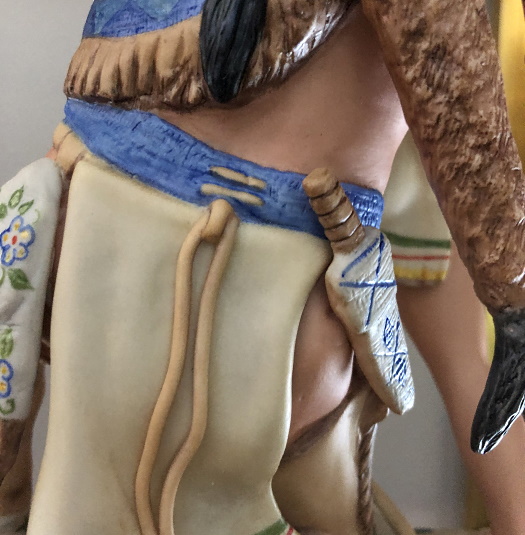 Cree ‘Magic Boy’ (1971) – This detail photo shows a small sheathed knife. More photos of this piece are in the Bow and Arrows section below, and even more can be found in Magic Boy’s own Archive post.
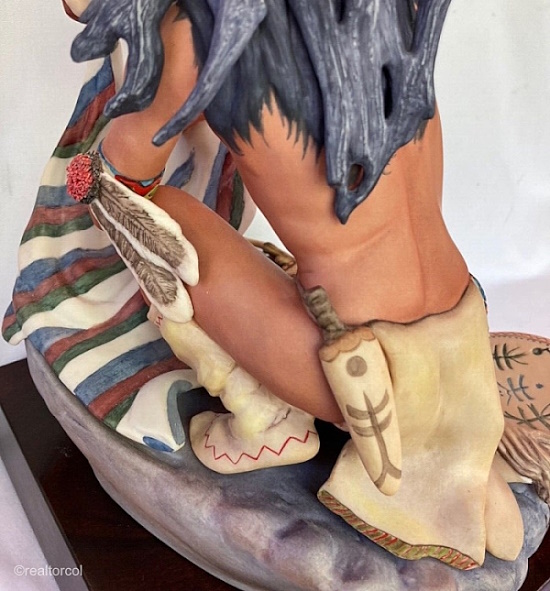 Chato (1974) – Just like Hiawatha and Magic Boy, Chato has a handy short knife. He can be found on either of two styles of original wood bases; see the North American Indians post for more information on him.
 Although Yankee Doodle Dandy‘s weapon is depicted as a homemade wooden toy, it’s still a sword and so it is included here! This open edition was made for only three years (1975-1977) and was created by Marylin Chorlton. Read this piece’s backstory here.
 Chess Set Knight (1980 edition) – There were two versions of the Cybis Chess Set: the original 1970s ‘Presidential gift’ one, and the later 1980 ‘Commemorative’ retail edition. Only the Knight in the Commemorative edition carries a short sword; the 1970s version of him does not.
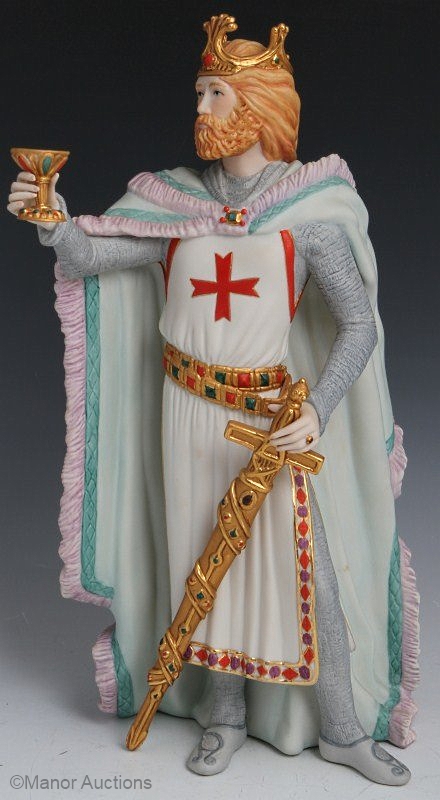 Richard the Lionheart (1982) – Richard carries his trusty sword as he goes off to The Crusades. Unless it comes unglued from his hand, that is! That goblet tends to go missing also, poor guy. See the back of his elaborate robe, and his stats, in the Historical Personages post.
 Othello (1983) – The famous Moor is well-armed with both sword and scimitar. Here in the Archive, his information is found in Shakespeare as Performed by Cybis.
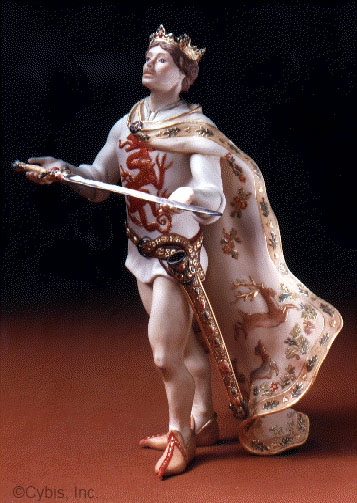 King Arthur (1985) – Here we see Arthur just after he has received Excalibur from The Lady of the Lake. He and his Queen Guinevere are found in the Portraits from Literature post. Arthur is the only Cybis sculpture in which the sword is unsheathed from its scabbard. There were two slightly different molds used for the sword; one mold has a decoration on the up-facing side of the blade, but the other is plain on both sides. See photos of them both here.
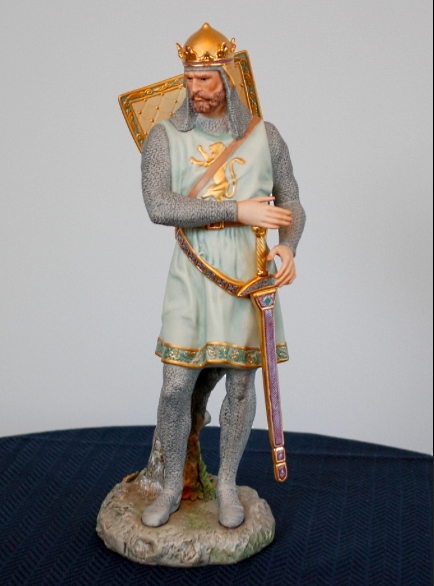 Sir Henry (1986) – This “parfit gentil knyght” has a bit of an identity crisis which is explained in the post that he shares with another piece featured here (The Buccaneer.)
 Knight in Shining Armor (1989) – One of the Cybis studio’s most ambitious (and definitely most expensive) editions, the knight has his sword easily at hand to protect the damsel that he has just rescued. There is a dragon in this sculpture as well, which is shown among the other detail photos in this post.
 Indian Warrior/Proud Warrior (1999) – This was one of the final few new-design pieces that the studio ever released and, in my opinion, one of their worst. There is a woeful lack of detail, and the manner in which the warrior is holding the knife suggests that he is preparing to engage in mortal combat. (However, unless he gets rid of that blanket, he’s bound to lose). I have never seen one of these for sale, and this was the only photo ever put onto the Cybis website, so I have no idea where on his body the knife would be stored when he isn’t wielding it. But, he is holding a blade and so he has a place in this section because of that. Dates and pricing are in the North American Indians post.
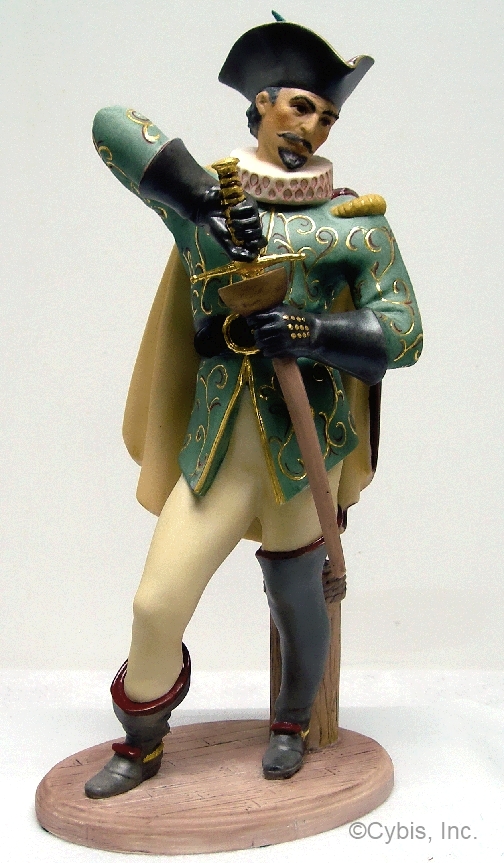 The Buccaneer (2000s) – I have never seen an example of this piece either, other than this one photo on the defunct Cybis website. Shown in the act of drawing his sword, he doesn’t appear to notice that the top of his right boot has fallen down. Another anomaly is that a far more likely blade for a buccaneer/privateer/pirate would be a cutlass, which is a shorter sword with an entirely different hilt. A fascinating discussion on an internet forum (it’s amazing what you find when you are trying to figure out whether something is historically accurate or not) reveals that what this fellow has is actually a saber. Which isn’t really the best thing for a sea-going buccaneer, because
The saber is long and curved because its purpose is to scythe into infantrymen from horseback. The cutlass is short and more or less straight (but single-edged) because it’s designed to be used in close-quarters fighting where the enemy has boarded you or you’ve boarded the enemy. The hand-bell of the cutlass is also designed to double as a bludgeoning weapon similar to brass knuckles.
Bow and Arrows
This category encompasses five designs; all but one were part of the studio’s North American Indians series.
 Hiawatha (1969) – His bow is laid by his side, but he has no loose arrows; they are in his quiver as a one-piece mold, with the flights sticking out of the top. The quiver is attached to his left hip. The rear view in the Blades section above shows it better. More information about Hiawatha, including variations in his wood base, is in the North American Indians post.
 Chess Set Pawn (1972 and 1980 editions) – Unlike the Chess Knight, the Pawn is exactly the same in both Chess Set editions. He holds a bow and has a small quiver of much-too-short arrows attached to his belt. This particular shape of bow is called a ‘monobloc recurve.’
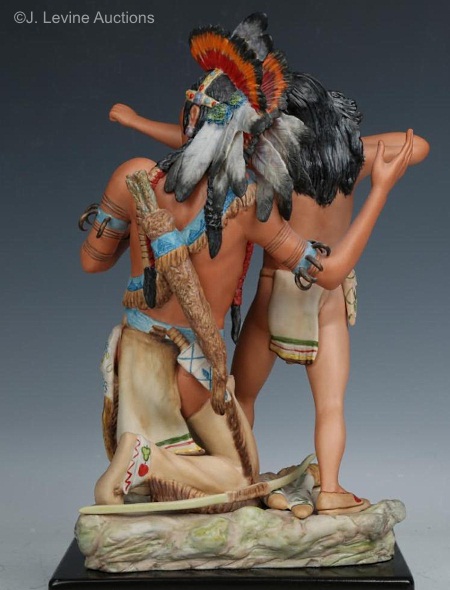
 Magic Boy in white bisque (1971) and color (1984) – This piece, which has its own Archive post, contains a bow, two quivers of arrows, and a sheathed knife. The second photo shows a prototype version in which the man actually holds the bow; the retail production examples always placed it on the ground.
 Chato (1974) – I am honestly unsure whether the quiver(?) holds arrows (but if so, where are the feathers?), or arrows plus a short bow as well, or simply some sticks! I’m including it here because I truly have no idea what’s in there, LOL.
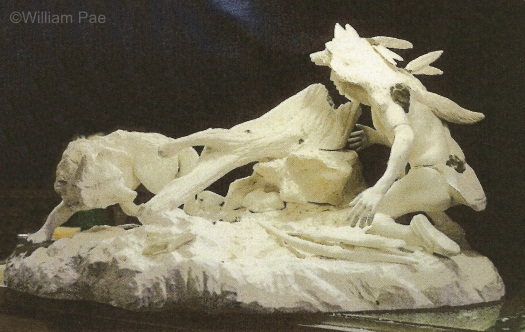 Wolf Hunter (unreleased; created in 1980s) – This would have been among the best of Cybis’ studies of Native Americans, had they ever had the sense to release it. Sculpted during the early 1980s by William Pae, the original maquette shows a bow at the hunter’s feet.
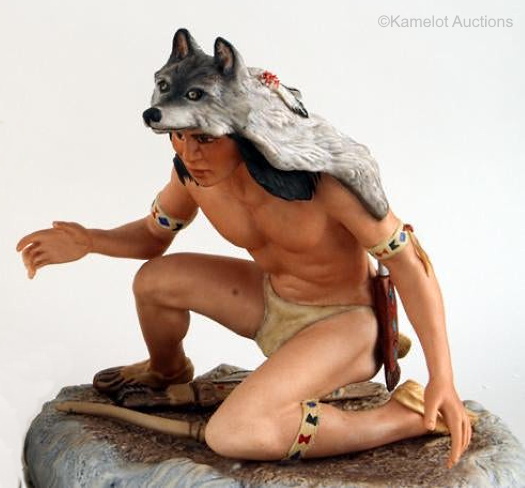 A painted example, probably a prototype or sample, separates the two into the Hunter and the Wolf. On this smaller base, the bow is inside his left leg, and what appears to be a quiver is in this area also. He seems to have a long knife stuck to his left hip (but with no visible belt, which would have been needed in real life.)
Hands and Feet
As any student of martial arts will tell you, hands and feet can definitely be weapons! As expected, the only three Cybis pieces in this category are the T’ang Dynasty series of kung fu stances within their Classical Impressions collection. I think that the stances are from traditional Shaolin Kung Fu but I will be happy to be corrected if my guess is wrong; there is a Contact Form link at the bottom of the post.
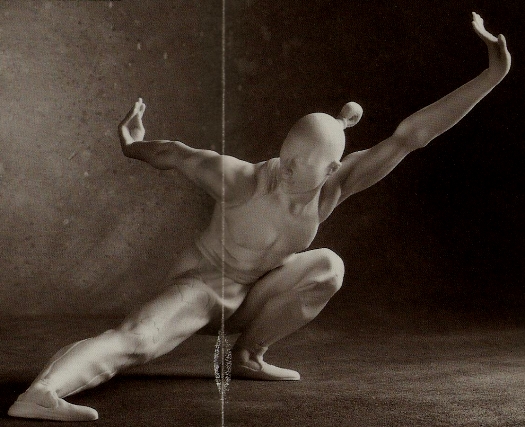 T’ang Dynasty I ‘The Student’ (1986) – This was the first of the series, and was initially made in white bisque only. A color version was supposedly added, but I have never seen one.
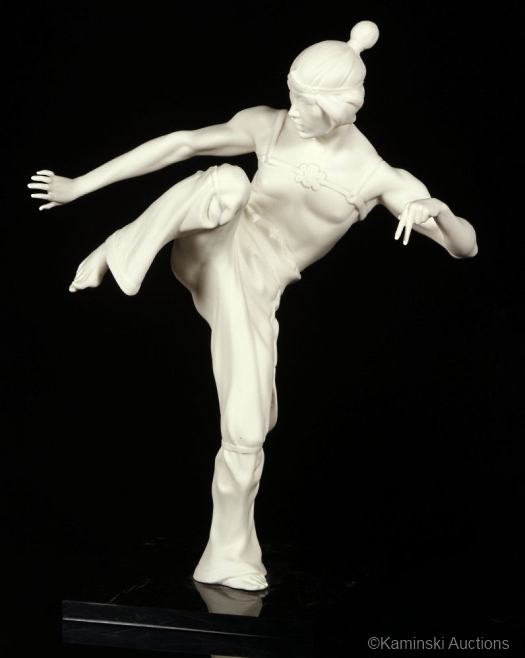 T’ang Dynasty II ‘The Nobleman’ (1987) – This too, supposedly was made in a choice of either white bisque or color. This sculpture represents a roundhouse kick.
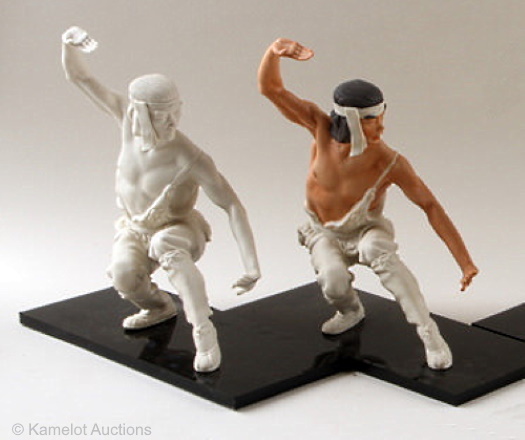 T’ang Dynasty III (2000s or unreleased) – These figures were among the pieces of studio back-stock that were consigned to the 2019/2020 liquidation auctions. It does not appear on any Cybis price list that I currently have; the most recent year that the other two pieces appeared on one, was 1989. These three T’ang designs are unusual in that they are the only Cybis pieces that came on (or with?) a Lucite base rather than wood.
Firearms
This was the small surprise, although I should have expected it because the Cybis studio only produced two figures in which a gun would have been appropriate. The Buccaneer could theoretically have included a musket, but didn’t; this is the other:
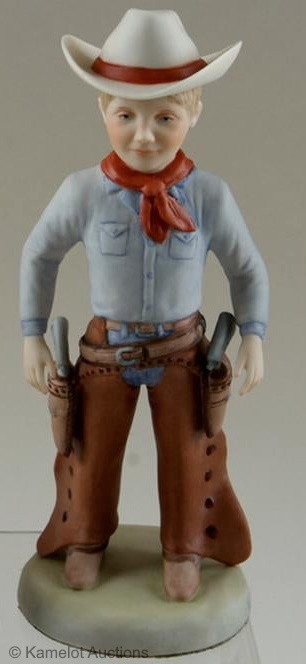 Little Cowboy, whom I personally will always call ‘little John Wayne’ because his facial features are undoubtedly those of The Duke, is an open edition from 1990. He has toy guns in his holsters. On some later price lists, this piece is shown as Cowboy (young boy.) He was part of the studio’s Children to Cherish collection.
So, there we have it: A total of 19 known Cybis designs that incorporated a weapon. Speaking of muskets, I think the studio missed an opportunity in not creating a Musketeer …plumed hat, doublet, musket, rapier, and all. He could have been marvelous!!
Name Index of Cybis Sculptures
Visual Index (for human figures/busts only)
About the Cybis Reference Archive
What is Cybis?
Images of Cybis porcelain sculptures are provided for informational and educational purposes only. All photographs are copyrighted by their owner as indicated via watermark and are used here only as reference material. Please see the copyright notice in the footer and sidebar for important information regarding the text that appears within this website.
The Cybis Archive is a continually-updated website that provides the most comprehensive range of information about Cybis within a single source. It is not and never has been part of the Cybis Porcelain studio, which is no longer in business.
 THE CYBIS ARCHIVE