
Certain Cybis porcelains are known for having alternate decorative retail versions of the originally-issued piece. The bunnies are a prime example, especially Bunny ‘Bon Bon’ who can boast having 13 of them! I have also found seven versions of Bunny ‘Snowflake.’ The creation of variants/spinoffs was less common among the human sculptures, however.
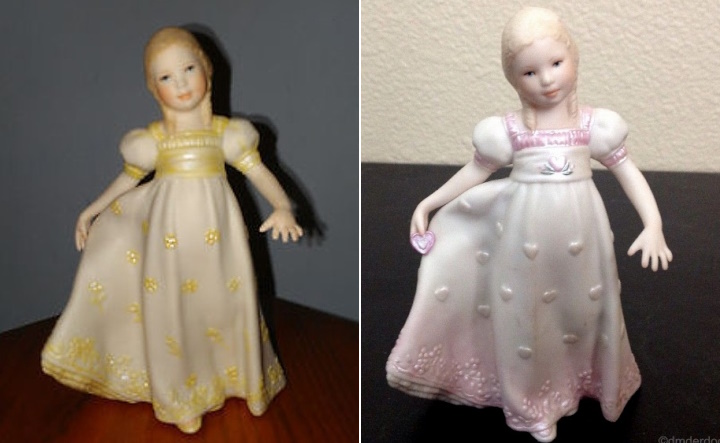 The human variants (not to be confused with those found in the two seasons of Loki on Disney+) were almost always done as retailer-event pieces, although the 1986 introduction Clarissa at left was followed by Little Heart in 1987. Little Heart was part of a new and very short-lived ‘Sweetheart Collection’ that year, which also included a Bunny ‘Heartfelt’ (Snowflake wearing a heart-shaped locket), Unicorn ‘Tender Feelings’ (Sir Bailey with a heart decoration on his collar), Poodle ‘Je T’aime’ (a female version of Pierre with a heart-decorated circus ball), and Rhino ‘Love is Blind’ (Monday wearing a bow-tag saying “love me”.) The Sweetheart Collection only existed for one year, after which these variants were moved into other group headings.
 The two Cybis human figures with the most spin-offs were Wendy and Pandora. The original Wendy was introduced in 1957 for $35 and initially retired in 1982. However, the studio resurrected her in 1995 and brought her back into the retail lineup. Wendy also had three known retailer-event editions and one sample piece. In the lineup above, from left to right, the variations are: early retail Wendy with handmade belt ribbons, standard retail Wendy with painted bow ribbons, Betsy Bobbin event piece, Wendy with Blue and Floral Decoration event piece, and Wendy in Apricot with Flowers event piece. The sample piece wears braids and carries a yellow bird and a basket of eggs.
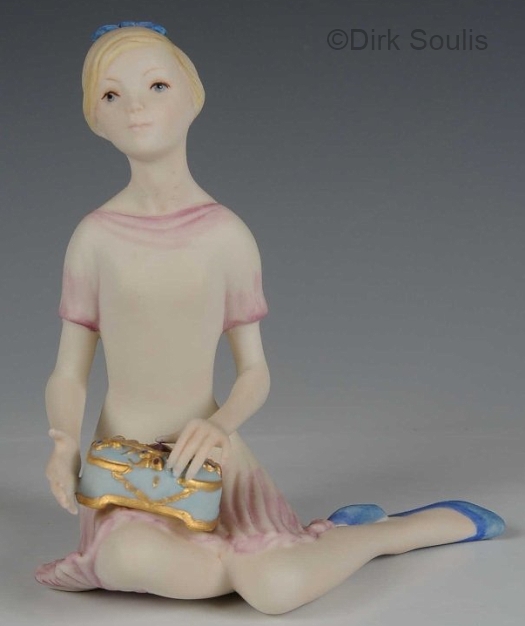 Pandora first appeared as a retail edition in 1967, for $75. At her retail retirement in 1983, she was priced at $265. She is 5” high and although she isn’t dressed as the mythological Pandora, the studio’s advertising tagline for her was
Endowed with every charm save one: the willful urge to pry; Pandora’s name is still invoked whenever maiden questions ‘Why?’
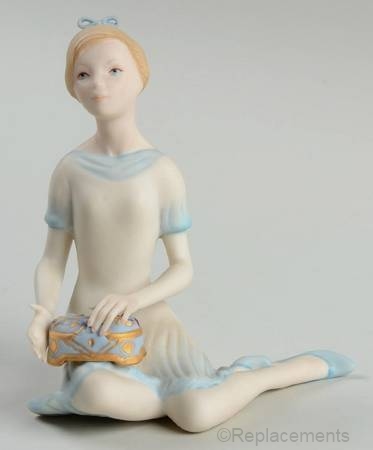 The first retailer-event ‘assignment’ that Pandora received was in the early 1970s (read this post for an explanation of what the retailer-event versions were.) This first spinoff was decorated entirely in a lovely soft pale blue which – in my opinion – is a nicer color than the blue that was used on the standard version. The size of her event version was 200 pieces and she was titled Pandora in Blue. Although the event variations were never on the standard Cybis price lists, they were advertised in advance of the event by the retailers themselves in local newspaper ads and in direct mailings to their customer base. If memory serves, this version sold for slightly less than $200.
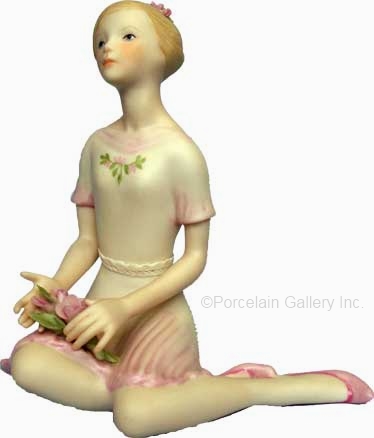 In the spring of 1983, the same year that the original Pandora was retired, the studio again used her for a retailer event piece. This one has more than a simple pink-for-blue-paint switch. The bow in her hair has been replaced by tiny roses, her bodice has a painted floral motif, a lace belt has been added, and she holds a spray of pink roses instead of the jewel casket. She was given her own name (April), a larger production run (400), and sold for $345. Unlike most retailer event pieces, April is physically numbered.
Until recently, I assumed that Pandora in Blue and April were the only alternate versions of the original Pandora; I had never seen any others, not even in the auction lots of the Cybis studio’s liquidation sales in 2019 and 2020.

 Imagine my surprise when this blue glazed Pandora with gold accents turned up for sale online. The glazing on her garment is a treatment that is virtually unknown on post-1950s Cybis items. Not only is this Pandora’s hair very pale– almost white, in fact – but her eyes are light (hazel?) rather than the usual blue. Her entire dress is tinted and has a hand-painted bodice detail in blue and gold. Her hair bow and skirt hem are edged in gold as well. The artist has painted her mouth in a rosebud shape rather than following the mold contours. (The detail photo shows some rubbing of part of the gold decoration, probably from careless handling.) She is marked A.P. which means she was definitely not a retailer-event issue.
As explained in this post, an A.P. on a Cybis piece can mean any of several different things. In the case of this blue-glazed Pandora, she is probably OOAK (one of a kind) but there is also the possibility that during the 1990s and 2000s the studio offered a number of similarly-decorated examples for sale to on-site visitors only. If so, they might all have been decorated like this OR the others could have been done in other colorways: Perhaps glazed lavender with gold, or glazed pink with gold. To be honest, I lean toward this second possibility because the detail on her bodice is not up to the standard that we find on pre-1990 Cybis pieces. None of the original and very experienced Cybis artists remained at the studio during the 1990s and 2000s.
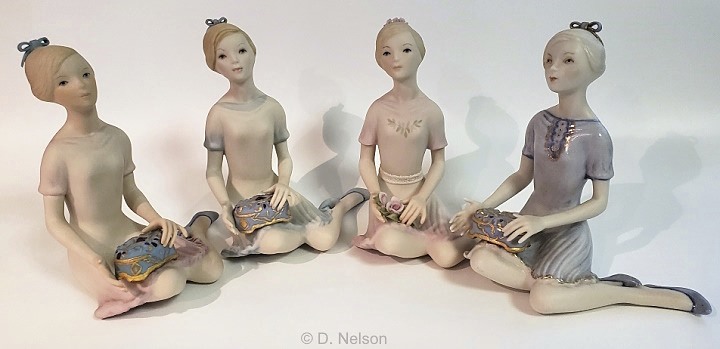
Such alternate-colorway in-house-sales versions of Pandora (if any) would be very interesting to see!
Name Index of Cybis Sculptures
Visual Index (for human figures/busts only)
About the Cybis Reference Archive
What is Cybis?
Images of Cybis porcelains are provided for informational and educational purposes only. All photographs are copyrighted by their owner as indicated via watermark and are used here only as reference material. Please see the Copyright Notice in the footer and sidebar for important information regarding the text that appears within this website.
The Cybis Archive is a continually-updated website that provides the most comprehensive range of information about Cybis within a single source. It is not and never has been part of the Cybis Porcelain studio, which is no longer in business.
 THE CYBIS ARCHIVE