
I am occasionally asked for advice regarding the best venue in which to offer any of the Cybis North American Indians series. My reply always begins with this sentence: “Well, those can be a bit tricky.” The purpose of this post is to explain why.
One reason is that the subject of the series (Native American peoples) is going to appeal to a much smaller market than other Cybis pieces do. No matter what ‘collection’ titles the studio created, their other human sculptures also fit into a larger and more inclusive category.
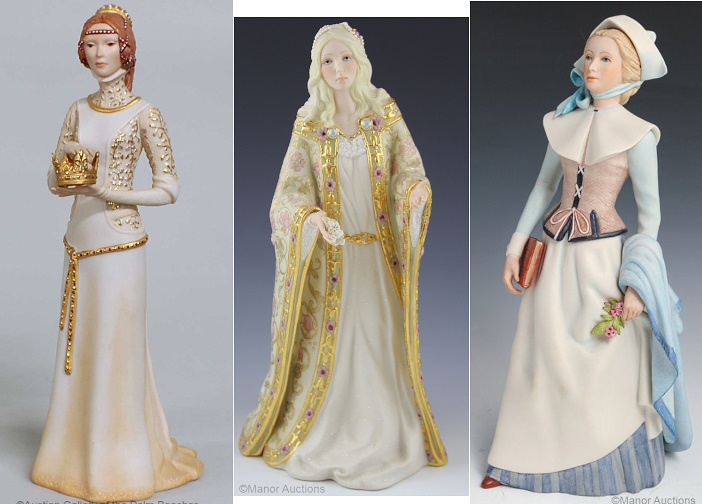 For example, anyone who doesn’t know that these sculptures are titled Lady Macbeth, Desdemona, and Priscilla will assume that they’re ‘a queen’, ‘a Renaissance lady’ and ‘a Colonial lady.’
 Here’s an even better example. Someone unfamiliar with Cybis (or this website!) would likely take all of these three as representations of 19th-century ladies. Good Queen Anne‘s tiara could just as easily be worn by a countess or duchess rather than a queen; and as for Camille versus Jane Eyre? London style versus the country estate, of course. Lacking the retail-name context, these three ladies are on an equal (and very large) marketplace footing.
Not meaning this in a disparaging way, but let’s be honest: Almost all of the Cybis non-religious human figures are generic, meaning that they could represent anyone – and a Caucasian anyone at that, other than the pieces shown in the Ethnic Diversity post. The few easily-recognizable exceptions are Eleanor of Aquitaine (obviously this is Katharine Hepburn in her movie role), Nefertiti and the Nefertiti Bust, Lady Godiva, the George Washington Bust and possibly the full-figure Mr. President also, Hamlet (but only if the skull isn’t missing), Noah, and Moses. Catholics will likely also recognize The Pope bust as John Paul II specifically.
All of the Cybis Native American pieces are instantly recognizable as such, even if the retail (name and tribe) title isn’t known. Just like the Cybis religious pieces, there isn’t another market category for them to fit into but, demographically, the Cybis religious (Judeo-Christian) items have a larger potential customer base. Assuming that a North American Indians piece is described and tagged properly for search algorithms, it should be very easy for interested shoppers to find. That’s true, but they are only a fraction of the overall buying public.
There’s also another potential pitfall. In recent years, there has been a growing opinion that any depiction of Native Americans that was done either in a ‘stereotypical’ manner, or was not created by a Native American artist, is cultural appropriation. I’m not going to debate or even weigh in on the issue, but am merely stating the situation as fact.
Here’s one example. Last year, a photo taken inside one of the state houses of a Canadian province caused a media furor because a Cybis Blackfeet ‘Beaverhead Medicine Man’ was spotted in the background. The sculpture had been on display there for at least 35 years. When it was discovered that the piece had been manufactured by a New Jersey porcelain studio – and despite the fact that the sculptor, Canadian artist Helen Granger Young, had gone to great pains to research and depict everything correctly as it pertains to the Blackfoot culture – it was deemed unacceptable for public display because, among other things, neither the artist nor the Cybis studio had obtained permission from the Blackfoot Confederacy elders to depict a Native American ceremony.
The fact that any Cybis sculpture of a Native American might now be regarded as cultural appropriation or as offensively stereotypical is an additional challenge that any seller of these pieces is going to face.
These factors are why putting a market value estimate on any of these is so tricky. An upside is that interested buyers might be willing to pay more for these than for any of the ‘generic’ Cybis human figures. The downside is that there are far fewer of such buyers. Unlike the six examples I’ve shown above, none of the North American Indians pieces are likely to be an ‘impulse buy.’
What About the Child Busts?
The Native-American child busts were never part of the North American Indians series, but did represent child members of the culture.
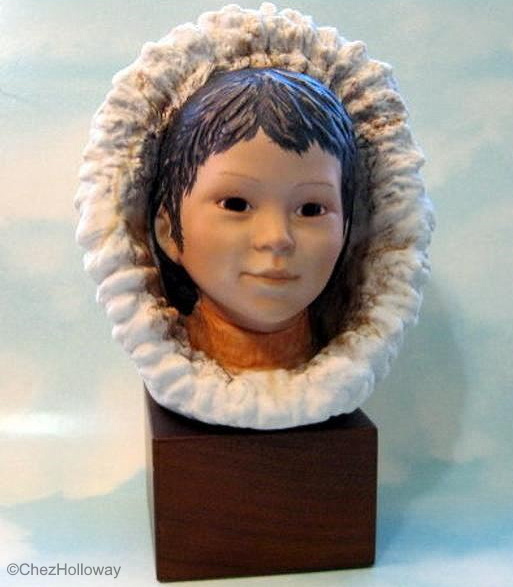 In Spring 1973, Cybis added this bust to their existing Children to Cherish collection series; it was titled Eskimo Child Head ‘Snow Bunting’. The other pieces in that collection were small full figures such as Heidi, Wendy, Pandora, and Pollyanna. The Eskimo child bust remained there until Spring 1975, which is when the studio created a separate category called Children of the World and moved Snow Bunting into it, along with two new pieces:
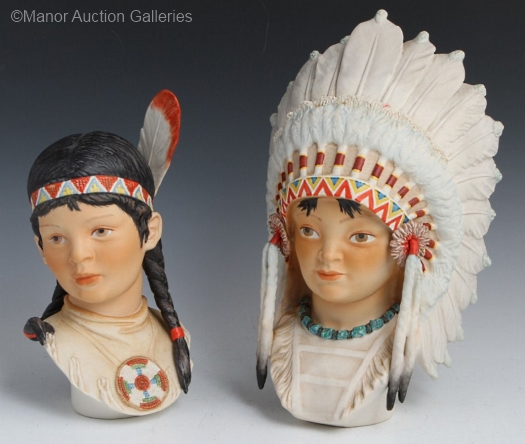 These were introduced as “Running Deer” and “Little Eagle.” In the accompanying new price list and in a 1978 catalog, they are shown as Indian Girl ‘Running Deer’ and Indian Boy ‘Little Eagle’. The studio’s advertising at that time described them as being brother and sister. Those who would argue that these busts are stereotypical representations do have a point, especially when it comes to the boy head because I suspect that a Native American boy of this age would not normally be wearing a headdress such as this. Both sculptures were retired in 1979.
The Children of the World series lasted for only six years. The new additions were the freckled, red-haired siblings Jeremy and Jennifer in 1977 and 1978, the African-American brother and sister Jason and Jessica in 1978 and 1979, and finally the “Oriental” (Cybis’ advertising description) children Lotus Blossom and Cheerful Dragon in 1979 and 1980. In the autumn of 1981, the studio gave up on the series and retired the three survivors – one of which was its original inhabitant, the Eskimo Child. (All of the known Cybis child busts can be seen in this post; there were 30 of them, although some were separate decorative variations.)
In contrast to the open-edition child busts, the North American Indians pieces were conceived as serious depictions of certain tribes; or at least the 1970s and early/mid 1980s ones were. The three circa-1990s ones are, frankly, an embarrassment on multiple levels and I wouldn’t blame anyone for objecting to those on any and all grounds!
These two specific considerations (a limited buyer market and cultural-sensitivity issues) can make the approach to selling any of the limited-edition Native American sculptures more of a challenge than other Cybis pieces may present. The Recent Sales page records the prices that buyers are actually paying nowadays for them. The best advice that I can give to sellers is to choose your venue wisely, your titles/tags/descriptions with care, and above all: Cultivate patience.
Name Index of Cybis Sculptures
Visual Index (for human figures/busts only)
About the Cybis Reference Archive
What is Cybis?
Images of Cybis porcelains are provided for informational and educational purposes only. All photographs are copyrighted by their owner as indicated via watermark and are used here only as reference material. Please see the Copyright Notice in the footer and sidebar for important information regarding the text that appears within this website.
The Cybis Archive is a continually-updated website that provides the most comprehensive range of information about Cybis within a single source. It is not and never has been part of the Cybis Porcelain studio, which is no longer in business.
 THE CYBIS ARCHIVE