
This second part of my profile of George Ivers focuses on the art that he produced either when he was a prisoner of war or afterward, and also his published memoir which goes into great detail about his wartime experiences.
CONTENT ADVISORY: This post contains images and/or descriptions that may be distressing to some readers, which is why I am publishing this material separately from the other George Ivers content. If desired, go directly to Part Three of the George Ivers profile.
I am greatly indebted to the National World War II Museum in New Orleans, Louisiana for their assistance in preparing this part of my Ivers retrospective. In particular I would like to thank Toni Kiser, Senior Registrar and Director of Collections Management, who was able to provide a list of the George Ivers art that is in their holdings. The descriptions and background information are taken from their files. Their George Ivers Collection, donated to them by Iris Ivers, contains 23 items (paintings, drawings, and prints.)
Original Paintings and Drawings
 Bread Crumbs
oil on canvas, 32” x 26” framed
Description: Gray toned painting with seven gaunt figures wrestling in the foreground while six guards watch from behind a fence in the background.
Background information: In one of the POW stalags in which Ivers was imprisoned, the Nazi guards got sadistic pleasure from throwing a loaf of bread over the barbed wire fence that enclosed the prisoners and watching the starved-out men fight each other for every crumb. The guards even brought their cameras to take photographs. The Nazis considered themselves a superior race and Ivers overheard one guard tell another “Look! They behave like animals!”
[Image credit: The National WWII Museum, New Orleans, LA, The George Ivers Collection, 2009.331]
 Bread for Eight
oil on canvas, 32” x 26” framed
Description: Green toned painting with eight men standing around a table with a small loaf of bread and a scale to evenly weigh each piece, a guard stands in the background with a rifle.
Background information: On a good day, a group of starving prisoners were given a loaf of bread to share. Because every crumb was so precious, the men devised a crude scale to weigh each slice. (Additional note: This painting is signed Ivers 1991, along with a small iris flower, in the lower left corner)
[Image credit: The National WWII Museum, New Orleans, LA, The George Ivers Collection, 2009.331]
 Guardia Civil – Spain Dec 1941
pencil drawing, unframed, 6 ¼” x 4”
Description: Two Spanish Nationalist officers of Franco’s Guardia Civil arresting a handcuffed man.
Background information: This sketch depicts Ivers being caught by Franco’s Guardia Civil in December 1941 after he and a small group of Polish soldiers were emerging from their trek over the Pyrenees Mountains into Spain. The group had been smuggled out of Switzerland by the French Underground and were enroute to Gibraltar to rejoin the Allied Forces stationed there. After being incarcerated in four Spanish prisons – Figueras, Gerona, Barcelona and Zaragossa – Ivers was sent to the infamous Spanish concentration camp, Miranda de Ebro, where he spent almost two years.
[Image credit: The National WWII Museum, New Orleans, LA, The George Ivers Collection, 2009.331]
A first-hand account of the perils involved for Jewish refugees during this time appears on the website of the US Holocaust Memorial Museum. An excerpt:
With the fall of France in the spring of 1940, thousands of refugees tried to escape to France’s closest neighbors—Switzerland to the east or Spain to the south. But Spain and Portugal closed the borders to refugees unless they possessed transit visas to another country. Refugees who entered Spain without proper documentation were either returned to France by agreement with the Vichy government or interned at the Miranda de Ebro concentration camp in the province of Burgos.
The camps at Figueras Castle and Miranda del Ebro had originally been forced labor/internment camps during the Spanish Civil War.
 A photograph taken inside Figueras Prison; date unknown.
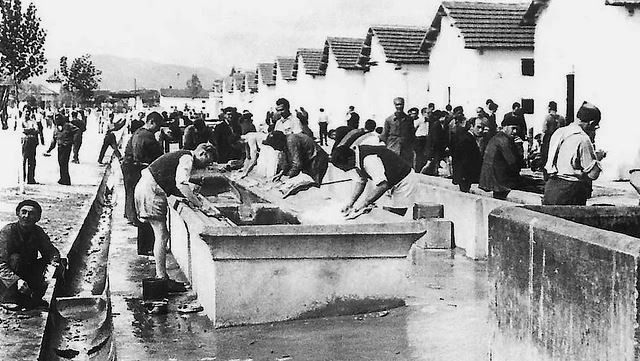 A photograph of prisoners at Miranda del Ebro during WWII.
A description of Miranda del Ebro appears on the WW2escapelines website. An excerpt:
There were almost 200 concentration camps constructed throughout Spain by the Franco regime. […] Miranda was the largest and originally built to incarcerate the remnants of the International Brigade, some 600 – 700 men of many nationalities. Later it was enlarged to accommodate the men caught trying to escape from France via Spain to Gibraltar or Portugal and, by the end of 1942, the number of detainees had risen to over 5000. It was the only camp used to detain non-Spanish nationals who were trying to escape from Occupied Europe. There is little doubt that the Nazi regime was involved in advising the Spanish on how to build and run Miranda.
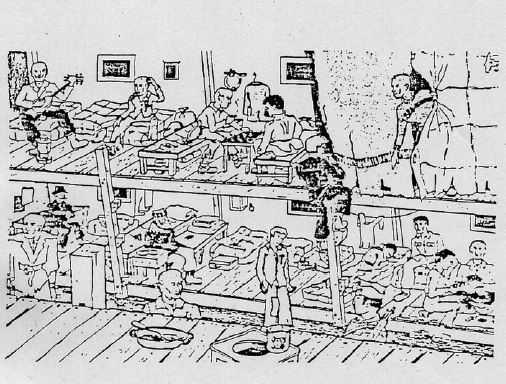 This drawing by fellow-prisoner Maurice Chauvet gives an idea of how the interior of the prisoners’ barracks was constructed.
A published account on the WW2escapelines website, by Polish prisoner Władysław Popiołek who was there for a year and a half, relates
We declared ourselves to be Poles, and were handed over to a ‘Cabo’ (a former prisoner, in charge of a barrack) who allocated us an area of a bare wooden floor about 2m x 2.5m between the three of us. It was very warm in the day, but cold at night and we had no mattress or pillows, just one thin blanket. It was extremely difficult to keep clean and free of lice and fleas. About halfway through my stay the head of the Polish Group, Captain Snarski, negotiated to have our underclothes washed and boiled by an outside laundry, which whilst it did not get rid of the bedbugs, helped somewhat.
Every morning and evening all the inmates had to attend the ‘bandera’ and shout “Aviva Franco, Aviva Espana”. We all had to stand to attention, with arms raised, to honour the Spanish flag going up the mast. We worked at moving stones from the nearby quarry to the river. A bulldozer today would manage it in a few hours, but it took us a back breaking year. Stones were put into baskets and two prisoners would each take a handle. Wood had to be unloaded from the railway wagons, for cooking, and the guards would beat us if this was not done quickly enough. Beatings and whippings were commonplace, and injured prisoners were often thrown into solitary confinement.
The hunger strike that eventually resulted in Ivers’ release is described by Mr. Popiolek:
In an attempt to get the conditions of the Camp improved, the Poles organised a hunger strike. It began on January 6, 1943 when all Poles (about 700 of us) refused lunch. The Czechs and Yugoslavs then followed suit and in the end all the other nationalities joined in, except for the Spanish prisoners. I can remember becoming very weak. A total of around 4000 eventually took part. […] I recall the strike as lasting about a week, after which we were allowed to get some extra rations in the form of tinned food from the Polish Legation in Madrid.
Meanwhile outside the Camp, the fortunes of war were changing. It no longer suited the Franco regime to upset the Allies by keeping their nationals imprisoned. Word came through that we were to be released in the spring of 1943. It was agreed that we were to be released in batches of 100. I was given some clothes from an American charity, and a passport, and on 21st March 1943 I and 99 other Poles marched through the gate and onwards to help in the war effort.
Mr. Popiolek visited the Miranda del Ebro site in 2006:
Very little remains, a small stretch of railway track hidden in an industrial estate. The area has changed beyond recognition, and the mound where prisoners’ bodies were heaped and covered in quicklime has of course disappeared now. An industrial estate has grown up over the space that the Camp occupied. However the local people still remember, as do all of us who had the misfortune to pass through it.
 Stalag, 1941, oil on canvas, 25 ¼” x 13” framed.
Description: Blue toned painting with guard tower lights crossing in the middle with a dove at the intersection. A single guard stands on each side of the towers. Four hut like structures with lights in the windows compose the background.
(Additional note: The signature Ivers, along with an iris flower, appears in white near the lower right edge.)
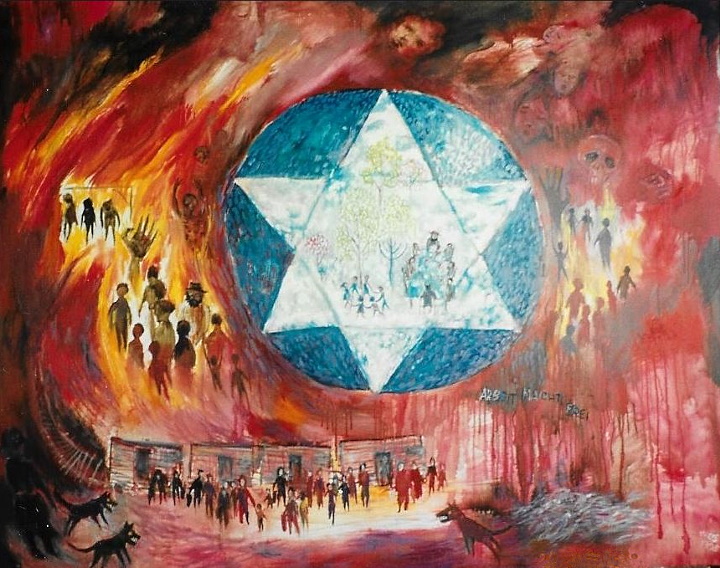 This oil painting, titled Holocaust, was created by George Ivers during the 1980s. The photo source states that it is currently in the ‘New Jersey Holocaust Museum’ but there does not appear to be a museum of that name nowadays.
The following items of original art are in the National WWII Museum’s collection, but no photographs are available. The descriptions and background are from the Museum’s files.
Jesus Himself was Jewish, oil on canvas, 18.25” x 29.25”
Description: Jesus on a crucifix with a Jewish 6-pointed gold star above his head and a violin player in the sky. The death camp Dachau in the background with a crematorium and a train, three guards and a dog are in the foreground of the painting.
Dysentery, watercolor on paper with sketch pencil on paper, framed 22 ¼” x 15 ¼” including frame; watercolor measures 11 1/4” x 10”, sketch measure: 4 ¼” x 5 ½”.
Description: Watercolor shows three men crouched down with pants down and their feet on boards over a trench. In the background, lines of people wait.
Background Information: The only toilet facilities for the prisoners were open trenches, with wooden slats across them. The men had to straddle the slats after standing in long lines waiting their turn.
Killing Lice, watercolor on paper, framed, 15 ¾” x 17”
Description: Blue toned painting of two skinny shirtless men with rocks in their hands and shirts in their laps. In the background are two buildings and many people.
Einsatz Commando at Minsk, pencil on paper, unframed, 10” x 7 ¾”.
Description: Pencil sketch of Einsatzkommando which refers to a sub-group of the five Einsatzgruppen killing squads in charge of murdering Jews. Shows SS officers with machine guns and whips in front of small group of mostly naked women and children near Minsk, in what is now Belarus. Jews in background are digging graves or burying bodies in mass graves.
Jewish Escapees on the S/S Struma, ink drawing, blue ink on scrap calendar paper from 1982, unframed, 5 ½” x 3 ½”
Description: Small group of Jewish men, women and children; an S/S Struma lifesaver in foreground.
Background information: The S/S Struma was a Romanian ship of European Jewish refugees not allowed to enter Istanbul, Turkey or Palestine (then controlled by Great Britain) in early 1942. The ship was eventually towed into the Black Sea where a Soviet submarine mistakenly sunk the vessel February 24, 1942.
(Additional note: There was only one survivor, David Stoliar, of the almost 800 people aboard. Mr. Stoliar died on May 1, 2014, at the age of 91.)
Pencil sketch of a Polish soldier on notebook paper, unframed, 8 ½” x 11”.
Description: Intricately drawn image of Polish soldier facing forward, mirror image facing left is sketch of thinner, less robust soldier.
Two very similar works depict Ivers’ activities after he was released. Both were described by Ivers as Transporting iron ore across the dangerous Atlantic Ocean with the Polish Merchant Marines, circa 1943.
Descriptions: One is a drawing in black ink on white paper, 7.5″ x 3″, and shows an Atlantic convoy travelling by moonlight. The other is a drawing in black pencil on a sheet of interoffice memo paper, 8.5″ x 5.5″, and shows a convoy traveling through overcast weather.
(Additional note: Ivers is known to have first served on the S/S Krosno and then on the S/S Bialystok, during this period.)
Limited-Edition Prints or Lithographs of Ivers’ Wartime Art
 Bread for Eight, Stalag 5D 1941, edition of 50. Gift of the Artist (George Ivers) to Princeton University in 1969. This is a print version of the 1991 oil painting in the previous section.
 Search and Destroy, edition size unknown because this one is marked AP; dimensions unknown. The National WWII Museum has the original drawing of this.
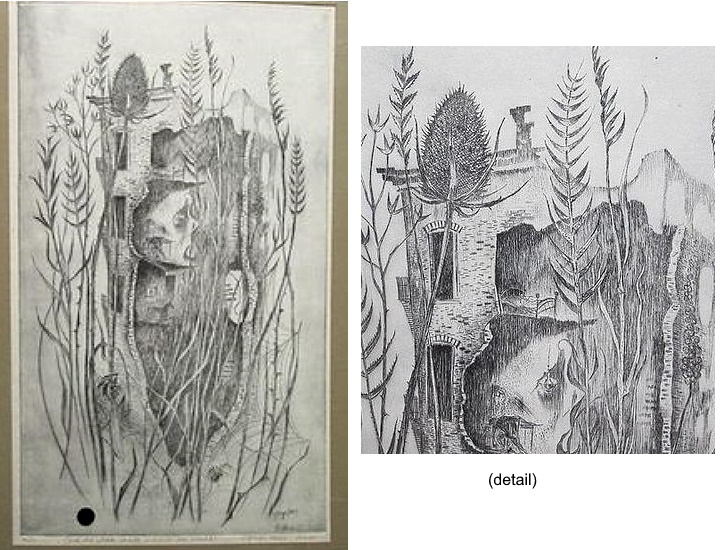 And the Meek Shall Inherit the Earth, edition of 50, approx. 11 1/2″ x 19 3/8″. The National WWII Museum has the #1 print from this edition.
The following items currently do not have a photograph:
Escape, framed etching. The etching itself is 2.5″ x 1.75″; framed dimensions are 8.75″ x 11.25″
Description: Blue toned etching of dog tag with man running and being chased by dogs.
Background Information: George etched himself on his own dog tag fleeing the Nazi guards as German [sic] shepherds chased him, and used this as a plate to produce a print.
Roll Call in a POW Camp, offset lithograph or photocopy, black ink on white paper, unframed 11″ x 5″
Description: German officer in front of prisoners of war. Two German officers near POW line harass victims at one end.
POWs Gathering for Morning Roll Call, photocopy, black on white paper, unframed, 8.5″ x 11″
Description: Prisoners of war in winter overcoats outside of camp barracks, watchtower and barbed wire fences in background.
Book, Escape into Danger
 George Ivers published his memoir, Escape into Danger, in 1993 as a softcover book of 242 pages by Criterion Press. This image shows the front cover.
 Although I do not own a copy and thus cannot quote excerpts, the Contents pages offer an excellent preview.
 The back cover, with reviews. Mary Roebling was an influential banker and philanthropist based in Trenton, who also had numerous connections in Washington D.C. The first woman to ever head a major American bank, she interacted frequently with the Cybis studio.
Part Three takes a brief but comprehensive look at other (non-Cybis) George Ivers artworks.
Name Index of Cybis Sculptures
Visual Index (for human figures/busts only)
About the Cybis Reference Archive
What is Cybis?
Images of Cybis porcelains are provided for informational and educational purposes only. All photographs are copyrighted by their owner as indicated via watermark and are used here only as reference material. Please see the Copyright Notice in the footer and sidebar for important information regarding the text that appears within this website.
The Cybis Archive is a continually-updated website that provides the most comprehensive range of information about Cybis within a single source. It is not and never has been part of the Cybis Porcelain studio, which is no longer in business.
 THE CYBIS ARCHIVE