
Although textiles are far from the first medium that comes to mind when considering the works of Boleslaw and Marja Cybis, they would form a surprisingly notable part of a catalogue raisonné. Boleslaw and Marja were definitely creating textile art in Poland during the 1930s. What did these items look like? In her article Polish Textiles Old and New, published in the October 1944 issue of the bulletin of the Polish Institute of Arts and Sciences in America, Irena Piotrowska wrote [translated into English]:
Along with traditionally knotted and tufted carpets, deep-pile rugs were produced, often with designs raised or carved into the pile and… scattered, isolated motifs predominated. The simplicity of these was strongly influenced by modern ‘abstract’ art. […] They are distinguished by heavier and coarser native wool and more vivid colors, and by the preference given to stylized floral and animal motifs which at times recall the patterns on the old peasant rugs from the Grodno district.
In researching Polish textiles, I often came across the word kilim in reference to those works. Kilim refers to a specific style of weaving that is very flat, which means that the rug has little or no pile. This also means that it is thin, in comparison to other rug weaves. Another term for kilim is slit-woven, a technique that allows for crisp edges between different areas of colors and shapes. Geometric designs are easier to produce via this weave than in a typical knotted or tufted rug or carpet.
At this point you may be thinking “So kilim is like a tapestry?” Yes, it is, because both kilims and tapestries are flat-woven. However, there are differences in how the weaver will handle the two components of warp and weft, based how the finished textile will be used. A kilim rug, which will need to survive being walked on, vacuumed, perhaps occasionally rolled up, etc., will be woven more tightly than a tapestry and will be made of a sturdy wool. A wall-hung or framed tapestry can incorporate a lighter-weight warp and/or a finer weft material such as silk, linen, or a more delicate wool.
Kilim Rug Designs by Cybis
Several years ago, three circa-1930s kilim-rug design pattern drawings by Cybis were sold at the DESA Unicum auction house in Warsaw. Drawn in pencil and gouache on paper, they are smaller than a sheet of letter-size paper but are very detailed.

 Kilim design ‘A’ is about 6” x 4”. Penciled along the lower edge is the word zloty (“golden”) which undoubtedly refers to the color of the background. On the reverse are several stickers which say Projekty kilimow z lat 1930-1935 (“Kilim Project from years 1930-1935”). This design reminds me of those seen on some Native American textiles, even though Boleslaw Cybis had not yet made his 1939 ‘tour’ of the American Southwest.
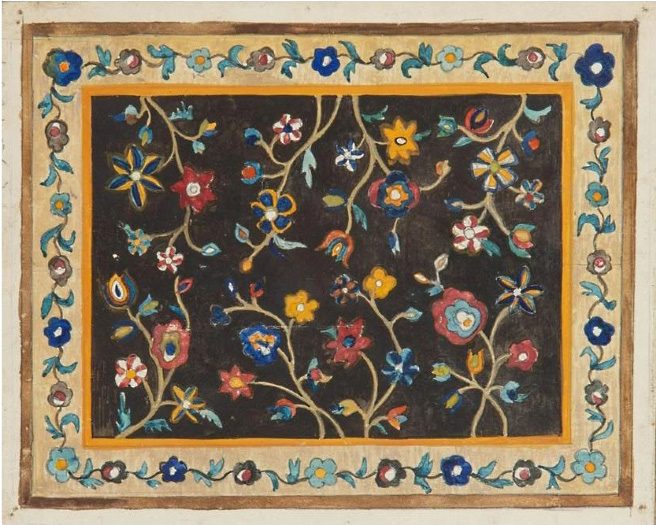
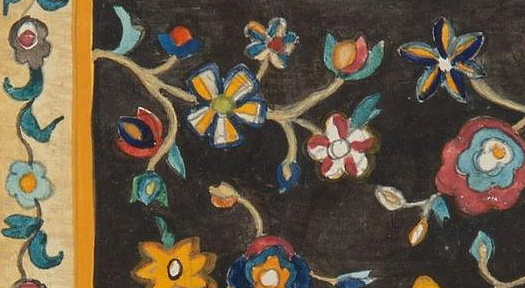 Kilim design ‘B’ is a bit larger, at 8.5” x 6.5”, but has no notations on it. This one is very different in style and resembles a flower garden; not quite millefleurs, however.

I have no details about Kilim design ‘C’ but it is probably the same size as the other two drawings. In style this is almost midway between the previous examples!
 This design for a very geometric Kilim appeared at auction in February 2025 in Warsaw. It is a very small (only 3″ x 6″) pencil and gouache on paper.
The 1939 World’s Fair Carpet: ‘Walking Through a Park’
Ms. Piotrowska’s 1944 article specifically praised a Cybis textile that was on display in the Polish Pavilion at the 1939 Worlds’ Fair.
Of great interest was the carpet on the floor of the Dining Room in the Polish Pavilion at the New York World’s Fair. The American magazine Interior Design and Decoration, in its special issue devoted to the Fair (June 1939) called it “one of the finest carved rugs in the entire Fair; a masterpiece of raised weaving representing a flower garden and a fishpond in natural colors.” It was designed by Barbara Brukalska, architect; Boleslaw Cybis, painter; and Maria Cybis, sculptress; and was woven by Jadwiga Handelsman. The refinements of the most modern carpet-making techniques were here employed to bring out the Polish love of nature and its splendor.
Barbara Brukalska is a name that comes up often when circa-1930s Polish art is cited. Born in 1899, according to Wiki, she was
a Polish architect, an architectural theorist, a prominent exponent of Functionalism, a member of the Praesens group, and a professor at Warsaw Polytechnic. She was also the wife of architect Stanisław Brukalski. From 1927-1938, the Brukalskis worked together designing the interiors of passenger ships. Stanisław Brukalski was interned in a German P.O.W. camp from 1939-1944. After World War II Brukalska and her husband worked more independently, mostly in Warsaw. She died in Warsaw in March 1980.
A 1999 Master’s Thesis by Elizabeth Zimnica, titled Making History: Poland at the 1939 World’s Fair in New York, talks about the art on display at the Polish Pavilion:
The 1930s, however, saw an attempt to incorporate what artists believed were native elements, frequently taken from what had by then become a folk language, into a truly international modernist style. The Regionalists of the late 1930s such as Barbara Brukalska produced designs that demonstrated an attempt to combine native materials and certain vernacular forms into modern utilitarian spaces. They made extensive use of kilims, and used peasant works as their source. A dining room designed by Brukalska featured fur rugs, as well as fur-covered chairs, and a carved wooden corner table executed by Adam Siemaszko.
The 1939 World’s Fair Carpet by Cybis
Thanks to an early-2020 auction sale at DESA Unicum, we now know what the 1939 World’s Fair rug looked like, although not what ultimately happened to it.
 This is the design for the carpet, created by Cybis as a painting, mounted and framed. The auction lot description was:
Design of a kilim for an exhibition in New York, 1938
oil, tempera on plywood, 38.5 x 55.5 cm (about 15” x 22”)
Penciled on the reverse: dywan do wnętrza pano B. Brukalskiej
 The English translation of this line is carpet for the interior Madam B. Brukalskiej. The word pano (or pana) means Sir, Lord, Madam, or Lady… in this case, Barbara Brukalska. This painting of the carpet design sold for 28,000 Polish zloty; at today’s exchange rate, that is a bit less than $7100 USD.
The 1970-71 museum exhibit catalog Cybis in Retrospect includes this in their timeline entry for 1939:
Also shown at the fair was a textured tapestry rug, ‘Walking through a Park’, designed by Cybis and his wife.
 The full carpet design as shown in the oil painting.
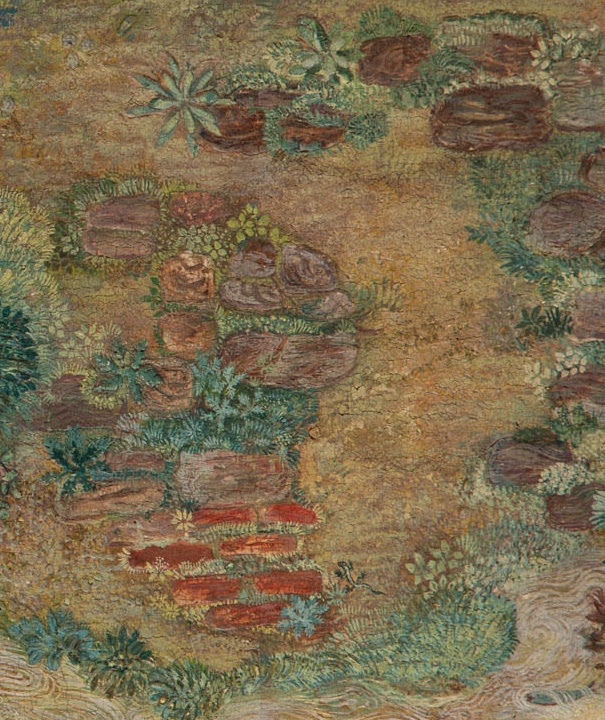 This appears to be a rock garden area. Notice the lizard near the red rocks/steps, and the large fish in the lower right corner.
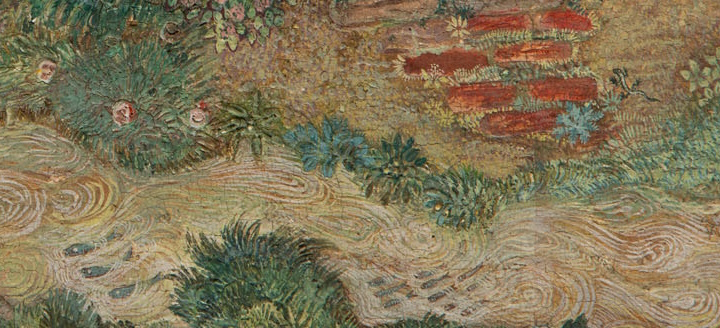 The river or stream contains a central school of fish and also a trio of larger ones, all navigating the swirls and eddies.
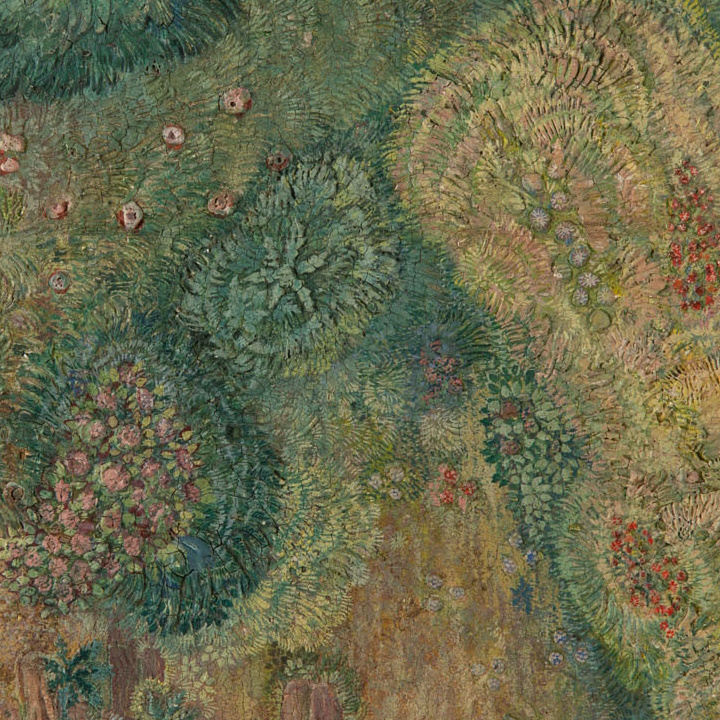 More floral details. Because this was described by Piotrowska as being a “carved rug” and having “raised weaving”, we know that the hillocks of foliage were not simply an optical illusion created by the weaver. The painter of this work was not identified specifically as being either Boleslaw or Marja; perhaps this, too, was a collaborative effort.
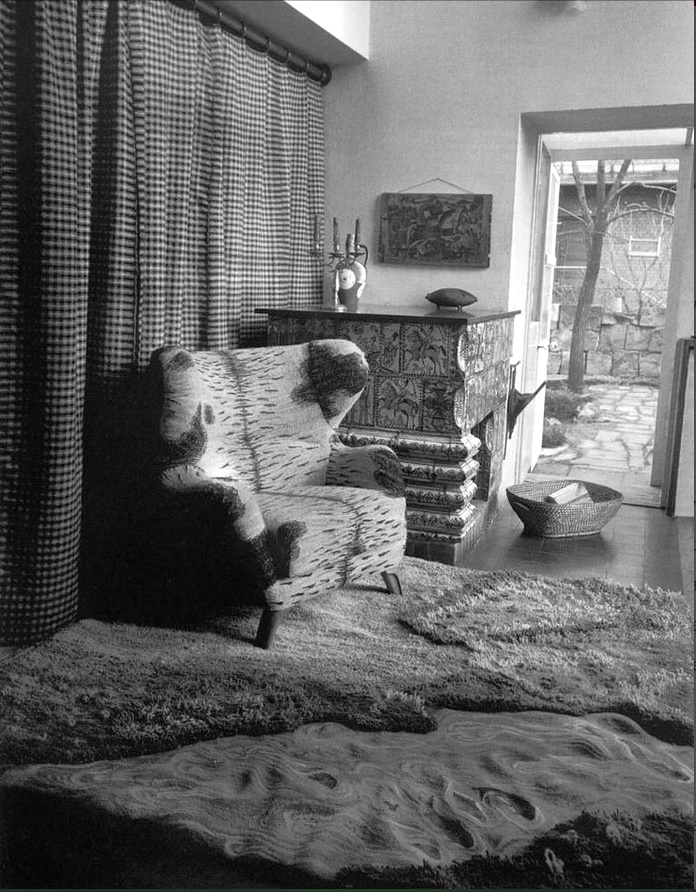 This is the only photograph of the Polish Pavilion’s dining-room display that I could find….and there is (part of) the Cybis carpet, complete with fish in the stream. What a shame that the photo was not taken (or printed) in color!
Cybis Textiles After 1939
We know that Boleslaw and Marja Cybis continued to create textiles for at least a few years after initially settling in America in late 1939. Marylin Chorlton is on record as saying, about the first studio inside the Steinway Mansion in Astoria, New York (bolding mine):
We didn’t start with porcelains. We were a fine arts studio, doing paintings, tapestries, designing furniture.
Another citation in the Cybis in Retrospect catalog, speaking of that studio:
The Mansion also became ‘home’ for uprooted fellow artists as well as a studio where they practiced painting and sculpture and designed tapestries and furniture.
Another mention in that same catalog, this time of the studio within the Cybis home that they built on Greenhouse Drive in Princeton,
The Studio, with its enormous open stone fireplace on one wall, a large tapestry on another and a hand-painted carpet on the floor, was the center of activity.
Was one of these textiles the carpet from the 1939 World’s Fair? If so, what happened to it after Marja Cybis died in 1958? There were indeed two textiles specifically mentioned in the May 1959 tag/estate sale advertisement of the Estate of Maria Cybis at the premises: “2 Verdur [sic] tapestries”. The word verdure is typically used to describe a pastoral design, and the World’s Fair rug certainly fits that description. However, given its history, I would think that this particular item might have instead passed directly into the hands of her brother and sister-in-law, Casimir (who died in 1990) and Helen Tym (who died in 2004.) Unfortunately, there is no way to find out.
If anyone knows where the actual Walking Through a Park carpet is today, I would love to be able to update this post with that information – or better yet, with some color photos! There is a contact-form link below.
Name Index of Cybis Sculptures
Visual Index (for human figures/busts only)
About the Cybis Reference Archive
What is Cybis?
Images of Cybis porcelains are provided for informational and educational purposes only. All photographs are copyrighted by their owner as indicated via watermark and are used here only as reference material. Please see the Copyright Notice in the footer and sidebar for important information regarding the text that appears within this website.
The Cybis Archive is a continually-updated website that provides the most comprehensive range of information about Cybis within a single source. It is not and never has been part of the Cybis Porcelain studio, which is no longer in business.
 THE CYBIS ARCHIVE