
Although the 1939 Polish Pavilion murals have been referenced in numerous bio-snippets about Boleslaw Cybis, I was unable to locate good photographs of them until very recently. There were nine murals, based on three very different themes.
The Seven ‘History of Poland’ Murals
These were commissioned in early 1938 by a committee that was directed by the Polish Ministry of Foreign Affairs to produce seven very large paintings with a historical theme. Professor Oskar Halecki, heading the commission, decided after much debate that the works should (a) focus on specific historical moments and (b) be produced by The Brotherhood of Saint Luke, of which Boleslaw Cybis was a member.
The resulting oil-on-canvas paintings are approximately 3.5’ high and 6.5′ wide, thus providing a true panoramic view of the depicted events. It reportedly took the Brotherhood six months to complete all seven, which are shown below in subject-chronology order with the event year in parentheses. Boleslaw Cybis worked on all of these.
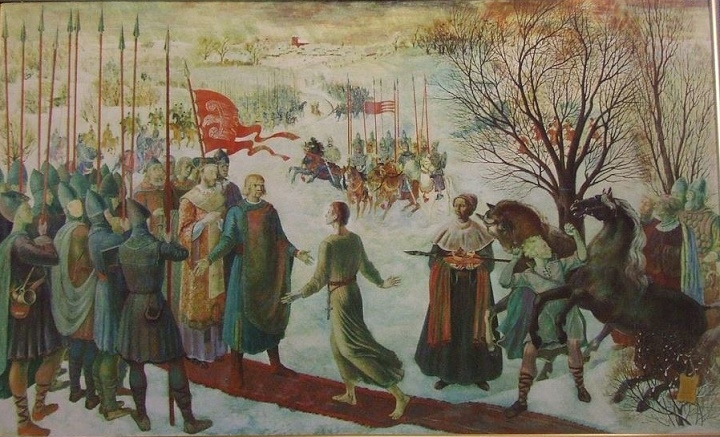 The Meeting of Boleslaw the Brave with Emperor Otto III at the Tomb of Saint Adalbert (1000) Saint Adalbert was a missionary whom Boleslaw (then Duke of Poland) particularly supported. When Adalbert was martyred in 997, Boleslaw ransomed his remains by paying for the corpse’s weight in gold and establishing a fine tomb for him. In gratitude, the Holy Roman Emperor Otto III officially permitted the establishment of a separate Polish church and ceremoniously crowned Boleslaw as a symbol of granting him royal prerogatives. In this painting we see Boleslaw dressed very simply with a crucifix at his waist, but the crown and scepter are held by an unknown woman, who may possibly be his third wife, Emnilda, with whom he had five children.
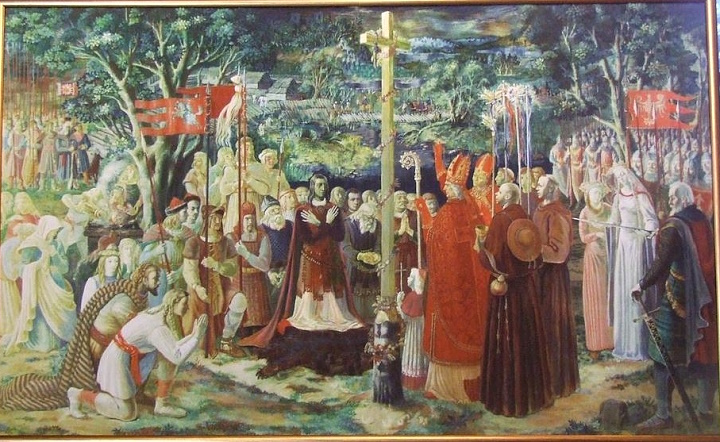 The Adoption of Christianity by Lithuania (1386) was important in more than just a religious sense although Lithuania had been the last remaining pagan state in Europe. The kneeling man is Lithuanian Grand Duke Jogaila being first baptized and then immediately married to Queen Jadwiga of Poland, shown wearing a white gown and holding a sword of state. Upon completion of the marriage ceremony he became King Władysław II Jagiełło of Poland, which was undoubtedly convenient.
 The Granting of the Jedlnia Privilege (1430) shows that same King Jagiello on a dais. In those days, a ‘privilege’ was what we now call a ‘constitutional right’. This particular Privilege was of habeas corpus, stating that no member of the gentry could be imprisoned without a warrant; it took almost 400 years for it to be extended to everyone. The structure in the far background is Wawel Castle which was the king’s residence because Krakow was then the capital of Poland.
 The Union of Lublin (1569) marks the formation of the Polish Commonwealth via the joining of the Kingdom of Poland and the Grand Duchy of Lithuania. This was more of an ‘after-the-fact’ affair, because Poland’s King Sigismund III had already seized more than 1/3 of Lithuania’s territory, mostly what is today known as Ukraine. Lublin is a city that at the time stood very close to the Polish/Lithuanian border.
 The Adoption of the Warsaw Confederation of Religious Freedom (1573) guaranteed religious freedom to all non-Roman-Catholics in Poland. The Polish Commonwealth’s King Sigismund III had died, so a new king had to be chosen. The favorite was Henry of Valois but there were objections because Henry had participated in the infamous St. Bartholomew’s Day Massacre of Protestants the year before. There were fears that something similar might be repeated in Poland; the Warsaw Confederation/Pact was intended to calm those fears. It turned out, though, that Henry was only King of Poland for a year: In 1574 he abdicated in order to return to France to succeed his brother as King Henry III.
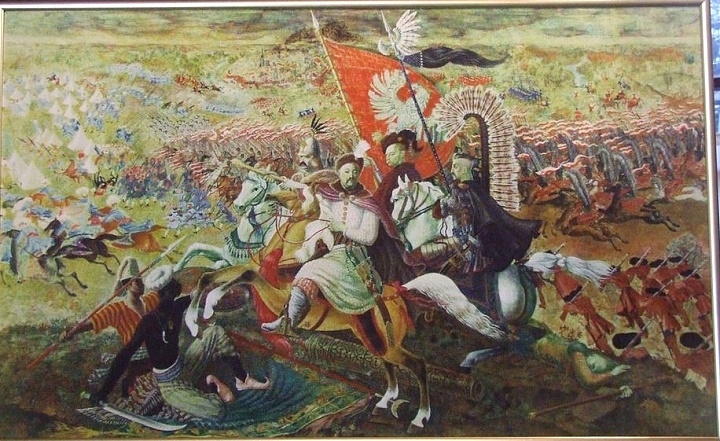 The Battle of Vienna (1683) shows King John III Sobieski defeating the Ottoman Turks who had besieged Vienna for almost two months. A combined force from Poland and from the Holy Roman Empire engaged them on September 12th. The battle included a cavalry charge of 18,000 Polish Hussars which remains the largest cavalry charge in history and is clearly shown in this painting. The presence of Oriental carpets on a battlefield (one flat, one rolled up) seems rather incongruous, though!
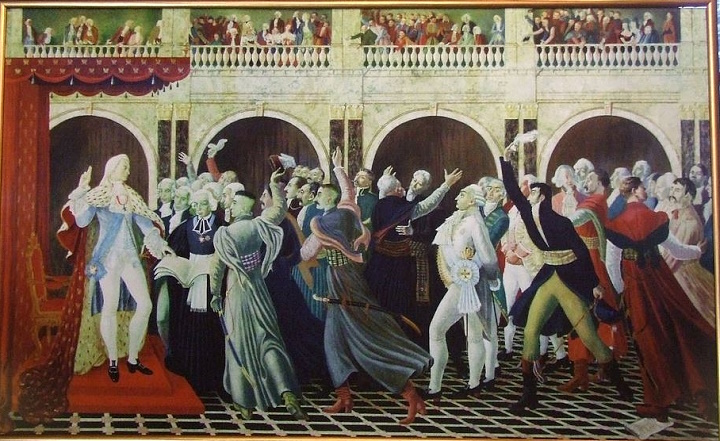 The Adoption of the Constitution of 3 May 1791 is the final painting in the historical series. This document was only the third written constitution in history, those of the USA and San Marino having preceded it. It not only established a constitutional monarchy but ensured equality between the landed gentry and townspeople, and placed the peasants under governmental protection by extending the right of habeas corpus to all persons in Poland regardless of status. Many other reforms were planned. Unfortunately, this laudable document existed in force for barely a year. Empress Catherine of Russia became incensed by it, and her armies invaded Poland and Lithuania in May 1792. With that, the fragmentation of Poland began in earnest.
One of the attractions within the Polish Pavilion was a 35mm film titled Visit Poland! that had been created in 1938. It had no narration, but in 1941 the Polish government commissioned a re-issue of it with added narration by Eve Curie, daughter of Madame Marie Curie who was born in Poland, titled The Land of My Mother. This expanded original 1938 film includes footage of all seven historical murals and is easily found on multiple sites including YouTube. Despite the expected poor video quality, it is interesting to be able to watch the same film that the 1939 World’s Fair visitors would have seen after viewing the actual paintings. Each of the paintings was signed by the members of the Brotherhood of Saint Luke.
‘Poles Fighting for America‘
The other paintings in the 1939 Polish Pavilion were created by Boleslaw and Marja Cybis specifically. Marja, not being a member of the Brotherhood of Saint Luke, would not have worked on the seven historical paintings at all. According to a timeline in the 1971 exhibit catalog Cybis in Retrospect, we learn that Boleslaw was

The title of this mural as shown in Cybis in Retrospect is incorrect. It is shown there as Poles Fighting for American Independence, and this photograph also appears in the catalog:

Given the style of the items that are visible, it appears that the painting could indeed have been titled in that way. (I suspect that this photo was taken while the couple was standing on a scaffold, given the wood structure seen directly behind Marja.) And history certainly shows us two famous Poles from that era.
 Although Poland sent no official assistance to the American colonies during the Revolutionary War, several notable Polish individuals wanted to assist in that effort. The two best-known are Thaddeus Kościuszko and Casimir Pulaski. Kościuszko (above) was a brilliant engineer and tactician. The bridge that connects Brooklyn with Long Island City, which was opened in August 1939, was originally called the Meeker Avenue Bridge. In July 1940, during the Cybises’ first year of residence in the USA, it was renamed in honor of Kościuszko.
 Marylin Chorlton, who lived in Brooklyn at that time, would have crossed the Kościuszko Bridge daily as she commuted to and from the Cybis studio inside the Steinway Mansion! This is how the bridge looked during those years. In 2017 it was demolished and replaced by a completely new bridge of a different design but with the same name.
 Casimir Pulaski, a Polish nobleman and military commander who, after meeting Benjamin Franklin in Paris, came to fight alongside General George Washington who made him the first leader of the United States Cavalry. His particular special regiment became known as Pulaski’s Legion; sent to the southern-states front, he was killed in 1779 during the Battle of Savannah. Various roadways and bridges commemorate him, such as the circa-1930s Pulaski Skyway in Newark, New Jersey.
 Update, August 2024: This newly-discovered sketch, positively identified as being for the Fair mural, is similar to the photograph in the exhibit catalog. However, although the uniforms of the three front-most soldiers correspond to the Revolutionary War era, that of the soldiers farther back in the line do not. Clearly, this mural did not portray Poles that fought here only during the 1770s! The timeline is much longer than that, and the title that the Warsaw auction house (DESA Unicum) gave to this and to another study is far more accurate; according to an online Polish/English translator, it is ‘Military Action of Poles in the History of the United States’ (in the original Polish, Czyn zbrojny Polaków w dziejach Stanów Zjednoczonych). I have refined that translation to Poles Fighting for America. The sketch is done in pencil and measures approximately 31” x 29”.
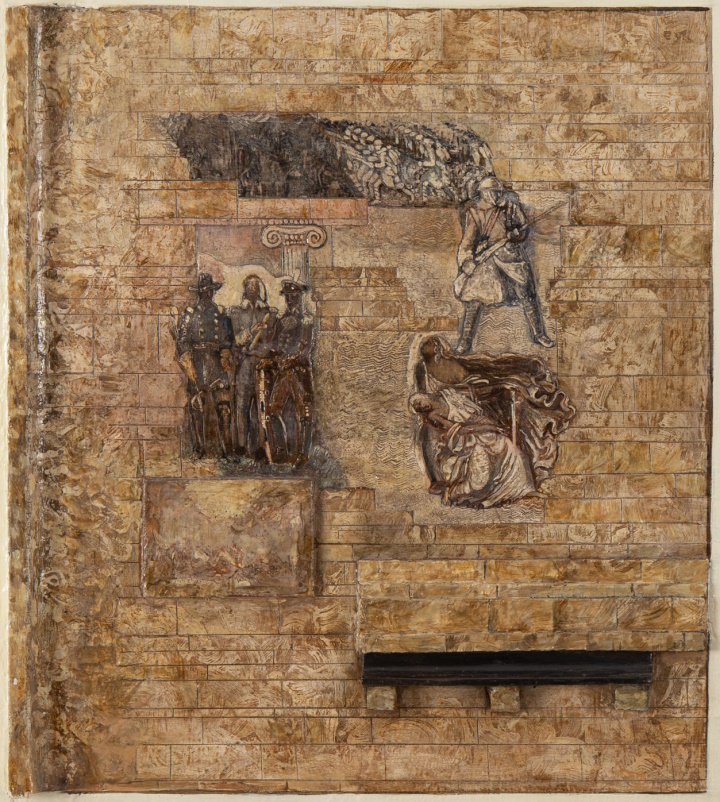 In that same Warsaw auction exhibit was this painted study for the same fresco. This is oil and mixed media on panel that is about 20” x 18”. This is closer to how the actual fresco must have looked when on display at the World’s Fair.


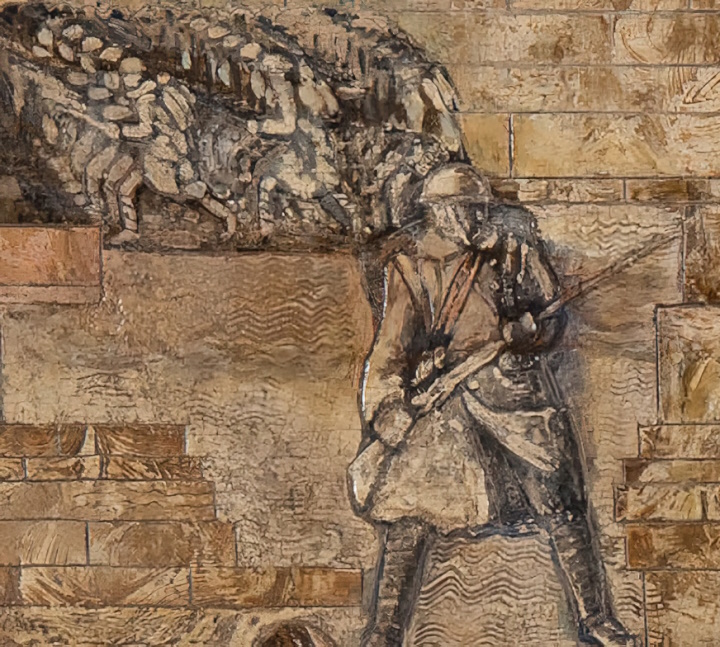 Enlarged details of the three main sections.
Thanks to these two circa-1938/1939 studies by Boleslaw and Marja Cybis for their two frescoes, we not only now have a good idea of what the finished mural looked like, but also can correct the title cited in Cybis in Retrospect to one that represents what the painting actually depicted.
‘Central Industrial District and Gdynia‘
Update, October 2024: I was thrilled to be sent a scan of photograph of what appears to be a concept drawing or representation of the elusive Central Industrial District and Gdynia mural! My sincere thanks to Michal Szark of the DESA Unicum auction house in Warsaw for finding this, because there appears to be no surviving photograph of the finished mural itself. A contemporary account of the pavilion’s interior mentioned that
Above cartograms there were fresco paintings of the Central Industrial District and Gdynia (creator Boleslaw Cybis) – significant achievements of the young Polish state.
A cartogram is a map constructed in a geometric manner so as to easily convey specific information. It sounds as if there were several such informational maps of Poland displayed below the art.
 This is the entire photograph. I do not know the purpose of the blacked-out section or whether that area was part of the completed mural. The river depicted is the Vistula River which is the longest in Poland, running 651 miles south to north, passing through several major cities as well as the village of Kaczimierz where Boleslaw Cybis and the other members of the Brotherhood of Saint Luke spent a formative summer.
 This is the section at the upper left; the incomplete banner bears the name of the city of Sandomierz, which sits at the uppermost part of the Vistula River, near the Baltic Sea.
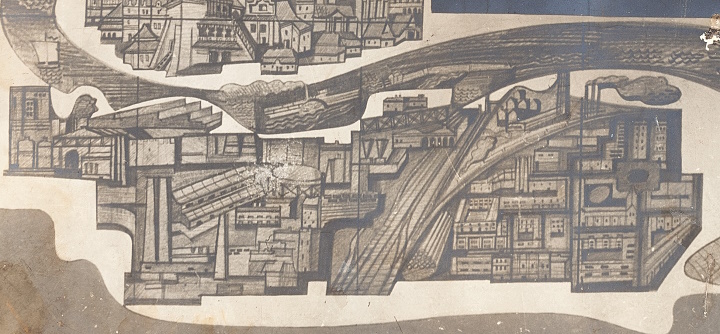 Both of these sections are part of the Central Industrial District. The creation of a ‘Central Industrial District’ was the brainchild of Polish prime minister Kwiatkowski in 1937; the area would cover about 15% of Poland and be divided into sections that specialized in different areas of manufacturing but especially in steel.
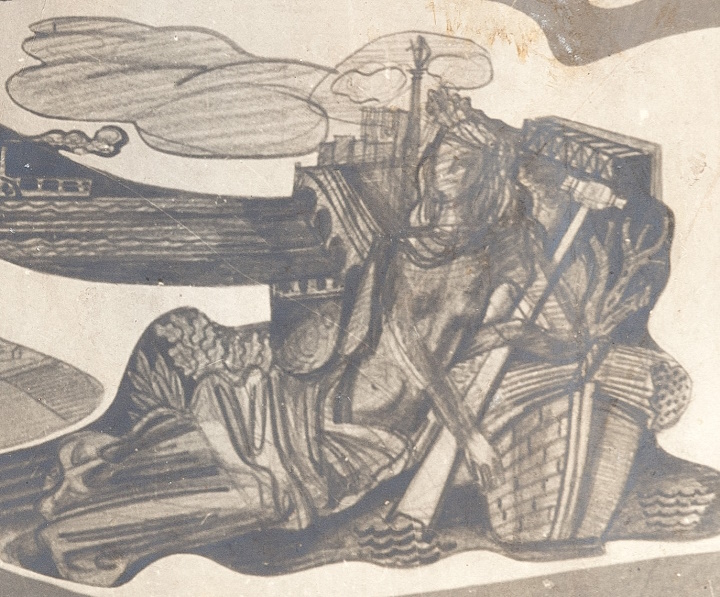 The shipyard at Gdynia, overseen by a representation of ‘Mother Poland.’ Gdynia, an early-1900s port city, was where almost all of the country’s shipbuilding took place. Because this was a fresco mural, parts of the finished work were applied in relief which is not indicated by this drawing.
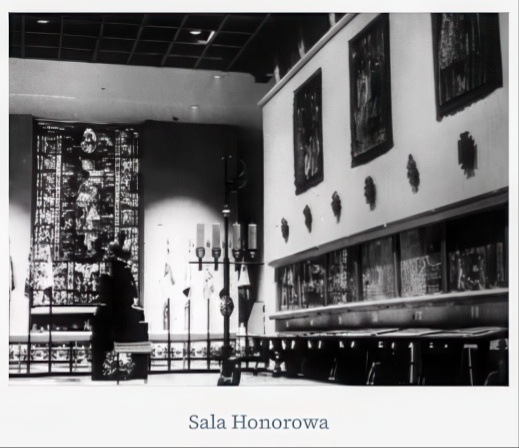 UPDATE, June 2025: This photo of part of the Hall of Honor was taken in 1939.
What Happened to The 1939 World’s Fair Paintings?
The Smithsonian’s website mentions that
With their country no longer in existence, the Polish government in exile ended up selling off most of the exhibits from their pavilion in New York
and the seven historical paintings were confiscated by one of the officials connected to the Pavilion in lieu of the salary he was supposed to have received from the Polish government. In 1958 that official donated them to Lemoyne University in upstate New York, where they remained until being repatriated after several decades of effort by the Polish Ministry of Culture. In 2022 they were finally returned to their homeland and toured the country during 2023. In 2024 they reached their permanent home in the new Polish History Museum in Warsaw.
Unfortunately, the fresco paintings created by Boleslaw and Marja could not have been easily removed. It’s almost certain that those came crashing down along with the walls when the Polish Pavilion was demolished in 1940.
Name Index of Cybis Sculptures
Visual Index (for human figures/busts only)
About the Cybis Reference Archive
What is Cybis?
Images of Cybis porcelains are provided for informational and educational purposes only. All photographs are copyrighted by their owner as indicated via watermark and are used here only as reference material. Please see the Copyright Notice in the footer and sidebar for important information regarding the text that appears within this website.
The Cybis Archive is a continually-updated website that provides the most comprehensive range of information about Cybis within a single source. It is not and never has been part of the Cybis Porcelain studio, which is no longer in business.
 THE CYBIS ARCHIVE