
Because so many original paintings have come to light via auctions during the past two years, I have decided to revamp my original two ‘Cybis paintings’ posts into three new retrospectives according to when they were created: 1920s, 1930s, and 1940s. Drawings and sketches by Boleslaw Cybis are already chronicled according to decade, and so these three ‘paintings’ posts now follow that same format.
All Boleslaw Cybis drawings and sketches created during the 1920s can be seen here, except for his nudes which have their own post showing all of his paintings and drawings in that particular genre.
The earliest physically-dated work by Cybis that I have so far discovered is a monochrome watercolor from May 1920. The works below are listed in order of their attributed or actual creation year. Some timeframes have their own reference according to where he was living at that time. All works on paper (watercolor, ink, crayon, pencil, etc.) are shown in the Drawings post for each decade.
1920 – 1922
 According to the 1971 Cybis in Retrospect exhibit catalog, Peasant Heads was painted “circa 1920”. It is an oil painting on canvas, 15″ wide and 14″ high. During the 1970s it was in the collection of the Dayton Art Institute in Ohio who lent it to the 1971 exhibit. This painting, as well as The Bride shown below, was later consigned by Dayton to the Sotheby’s Parke-Bernet Eighty-Four Gallery in New York and sold as a combined lot. The winning bidder was the Cybis studio, and Peasant Heads was initially hung in Joseph Chorlton’s office. What happened to it after the mid-1980s is unknown.
It is known that during 1921 and 1922, Cybis was living in Constantinople with fellow artists Constantin Alajalov and Pavel Tchelitchev, who he had met several years earlier while a volunteer soldier with the Ukranian Army during the Russian Revolution. When their cause collapsed, they fled to Turkey. The 1971 exhibit catalog describes Cybis’ time there:
[Cybis] ekes out a living of bread, olives and goats’ milk in exchange for sketching portraits in cafes, painting sidewalk advertisements…murals in nightclubs; painting and designing stage backdrops for ballets [and] fashioning clay pipes. One of his first ‘paid jobs’ is a gigantic billboard advertising Nestle’s chocolate.
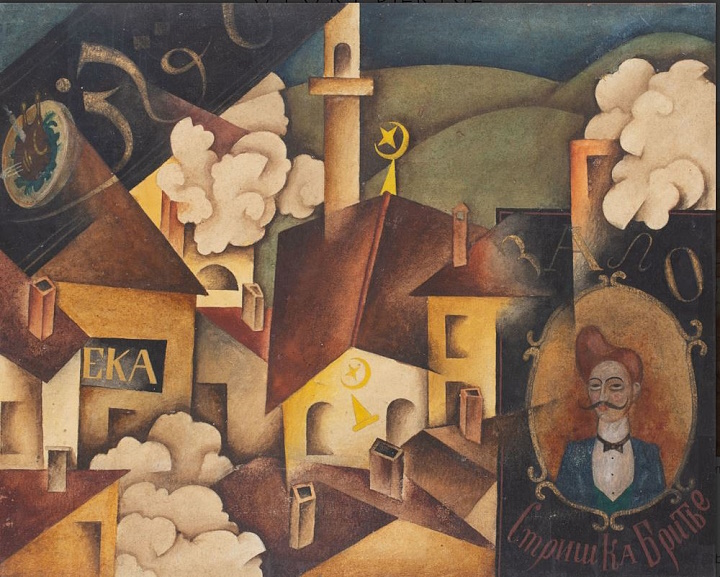 Cityscape with commercial signs in the corners, circa late 1920-1922; approximately 11″ x 14″.
 Port or Dock Workers, oil on canvas, approximately 28” x 35”.
Works on paper from this Turkish period can be seen in the 1920s Drawings post.
1923 – Summer 1925
Upon his return to Poland in 1923 Boleslaw Cybis enrolled in the Warsaw Academy of Fine Arts and upon graduation in 1925 joined the newly-formed Brotherhood of Saint Luke.
 Portrait of a Woman in a White Jabot Blouse, circa 1925, oil on plywood, approx. 14” x 13”.
 Susanna in the Bath, painted circa 1925, is approximately 45″ x 40″.
Autumn 1925 in Kazimiercz
Several drawings and sketches that were done in the village of Kazimiercz Dolny are physically dated September and early October 1925, so we can safely assume that these paintings are from that sojourn also. Kazimiercz is in eastern Poland along the banks of the Vistula River, and dates back to the 11th century. It was particularly favored by artists, which is why the Brotherhood of Saint Luke chose to spend an autumn there. The ruins of a 14th-century castle still exist
 This photograph of the town’s market square was taking during the 1920s.
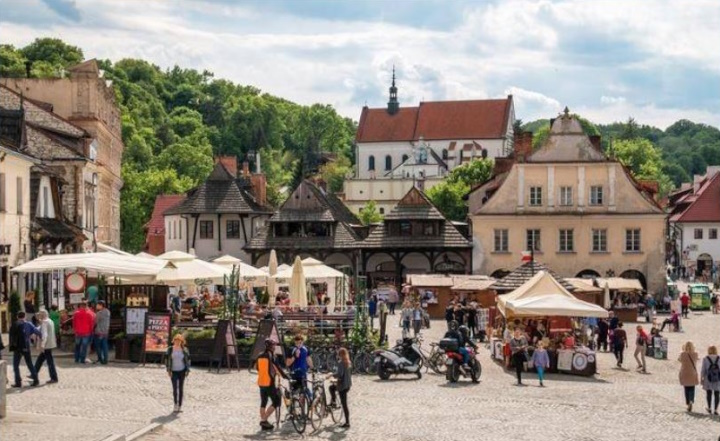 A 20th-century photo of the same square. The village was partially destroyed during World War II, but restored and rebuilt during the years that followed. It is still a very popular vacation and tourist destination.
 Water Well in Kazimiercz, oil on wood panel, inscribed on the reverse upper right: 6 cm | palisander. Size 10” x 8.5”. Palisander is a type of tropical wood (rosewood, jacaranda, etc.) and so the notation refers to the type and thickness of the panel.
 House in Kazimiercz, oil on plywood, approximately 4.5” x 3.5”
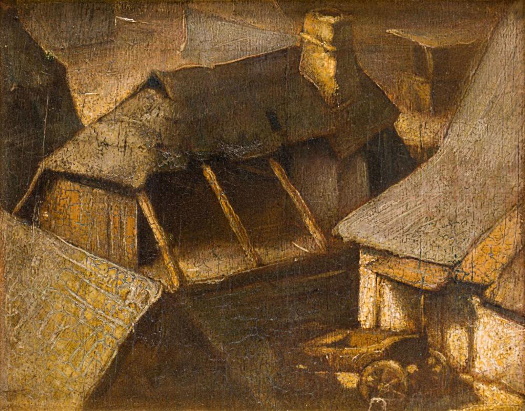 Village Yard, oil on plywood, 9.5” x 12”
 Old Cottage, oil on plywood, roughly 8.5″ square.
 Landscape with a Cottage, oil on panel, 11.5” x 9.5”.
 View of Kazimiercz Castle, oil on plywood, approx. 9” x 13”
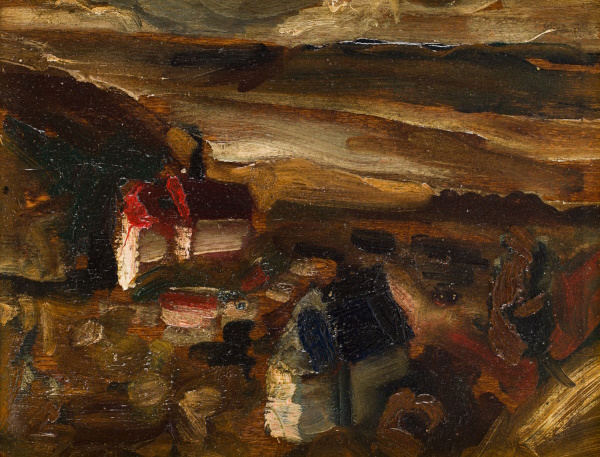 View of Kazimiercz from Above, oil on plywood, approx. 8” x 10”.
 View of Kazimiercz, oil on wood, dimensions unknown.
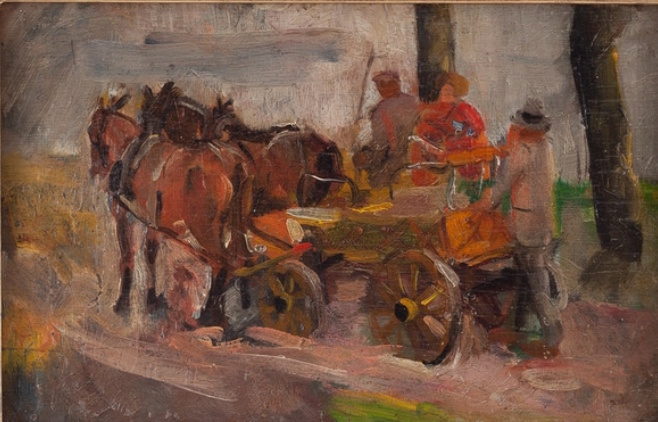 This oil on plywood Two-Horse Carriage measures approximately 8” x 13”.
 Peasants in a Bridal Wagon, oil on plywood, 13” x 9”
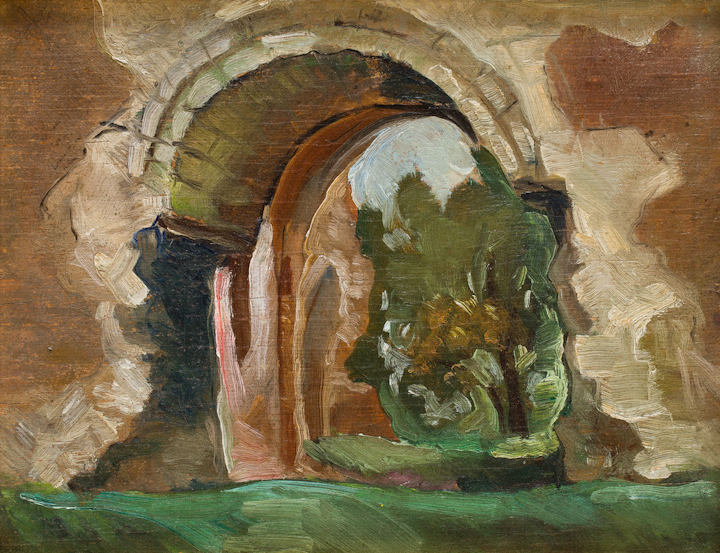
Archway, oil on plywood, dimensions unknown.
 Room Interior, oil on plywood, 9” x 11”
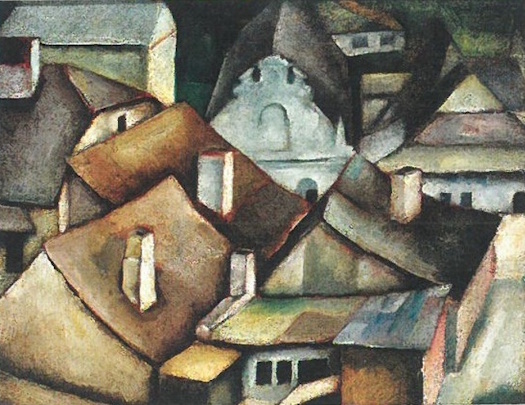 Kazimierz rooftops, oil on canvas, 12” x 16″
Circa 1925 – 1929
During the winter of 1925-1926, Cybis visited his friend Jan Stokowski in the village of Sobota near Lowicz, an area known for its rich and ancient heritage and use of traditional costumes. This is reflected in several of the portraits below.
 Young Girl from Lowicz, ca. 1926-1929 oil on plywood, 13” x 9”.
 Girl from Lowicz wearing a green scarf and orange skirt, oil on plywood, about 15” square.
 A Jewish man gesturing, ca. 1925, oil on canvas, approx. 23” square
 This Man in Pointed Hat was cited simply as ‘oil’, with no dimensions given.
 A very similar oil painting was pictured in an art publication only in black and white and titled Polish Peasant from Lowicz. It is dated 1926 in the lower left corner.
 Portrait of an Elderly Jew, ca. 1926, oil on canvas, 36” x 26”
 Elderly Jewish Portrait, ca. 1926, oil on canvas, size unknown
 Young man with paint tube, ca. 1925-28, oil on plywood, approx. 16” square and inscribed on the reverse lower left: Zaplacono 2 paczki (“Paid 2 packages”.)
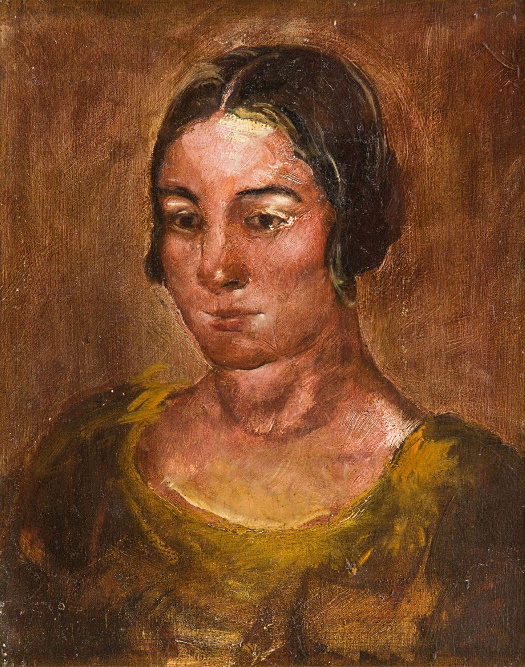 Woman with dark hair and green dress, ca. 1925-28, oil on plywood, 17.5” x 14” On the reverse side is a painting of a nude black woman carrying a large bowl on her shoulder
 Still Life with Fan and Key, oil on canvas, approx. 28″ x 24″. Date not specified but probably ca 1925-1926.
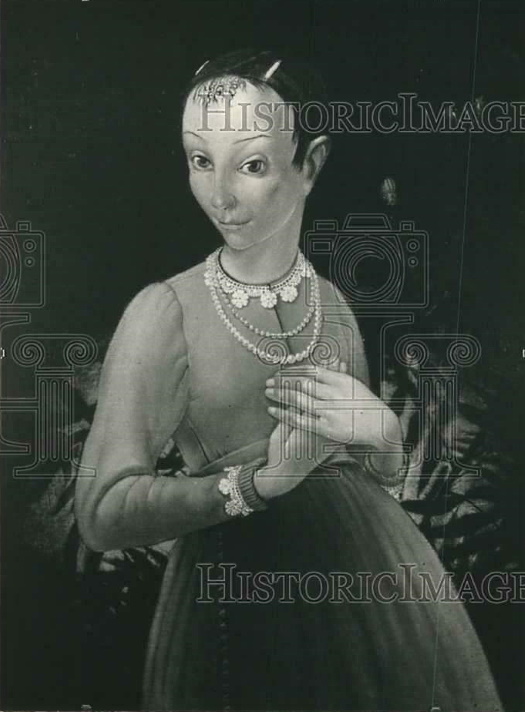 The original oil painting Portrait of a Young Lady was cited as dating from 1926 and resides in the Polish State Collection of Fine Arts; this photographic reproduction (also issued by the studio as a press photo) of it was included in the 1970-71 museum show.
 Motherhood, oil on canvas, signed 1926, 30” x 24”
 Portrait of a Man against a dark background, ca. 1926, oil on plywood, 19.5” x 16.5”. It is possible, based on the white undercollar, that this man may represent a local cleric.
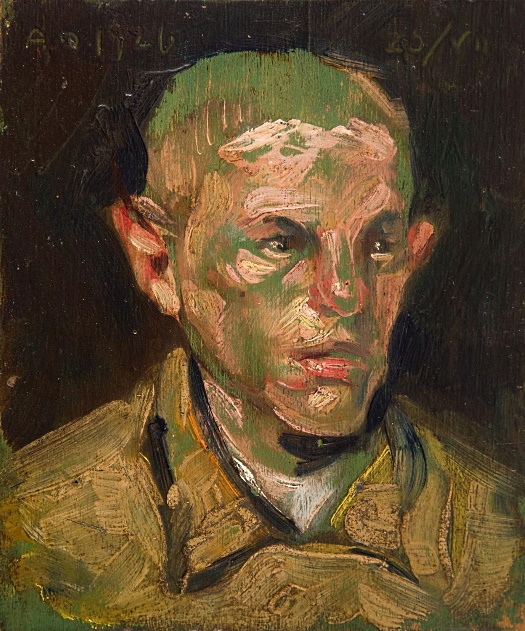 The auction house described this as ‘man’s head with green paint’ but I’ve titled my image Portrait of a man in green tones instead. Oil on plywood, approximately 8” square, and dated A D 1926 at the upper left. At the upper right the actual date is also written as 25/V (May 25th).
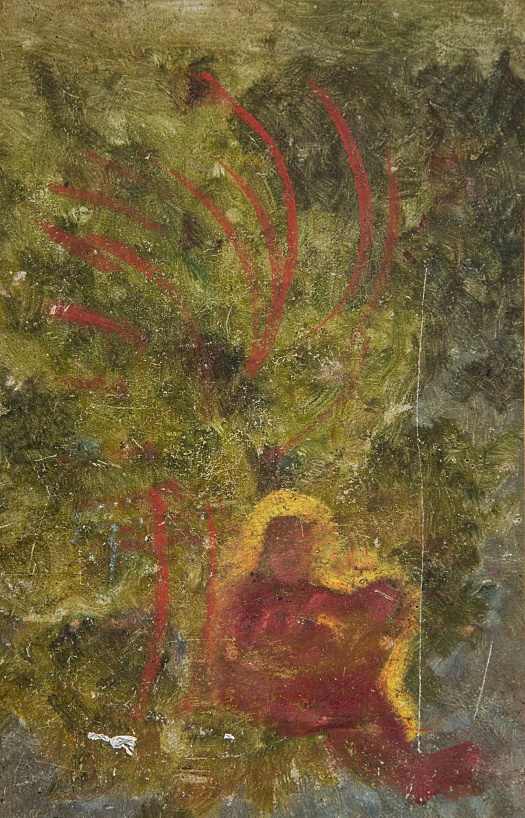 The Warsaw auction house DESA Unicum described this as Mother and child under tree, and there certainly is a suggestion of a tree here. The rather amorphous human shape could indeed be a woman cradling a baby, with a golden glow around them. Oil on plywood, 13” x 9”, circa 1926.
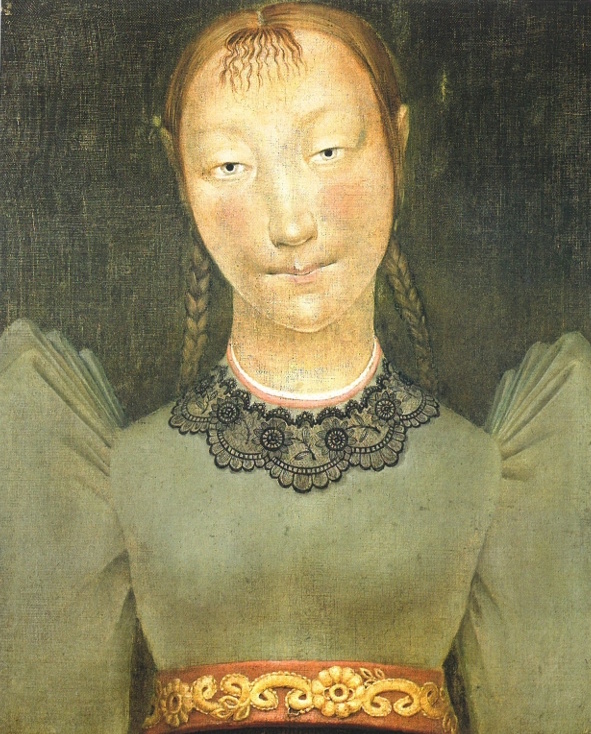 Stefa, oil on canvas and plywood, ca. 1927, 19” x 16”
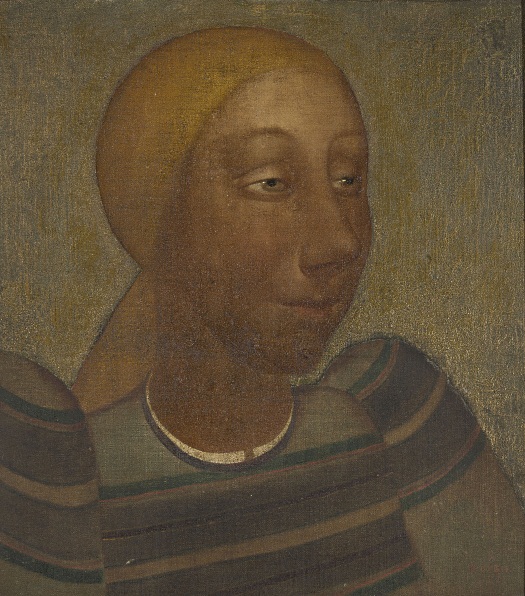 This oil portrait of a Blonde woman in a striped blouse is not known but it appears to be from the same mid-1920s period. Dimensions unknown.
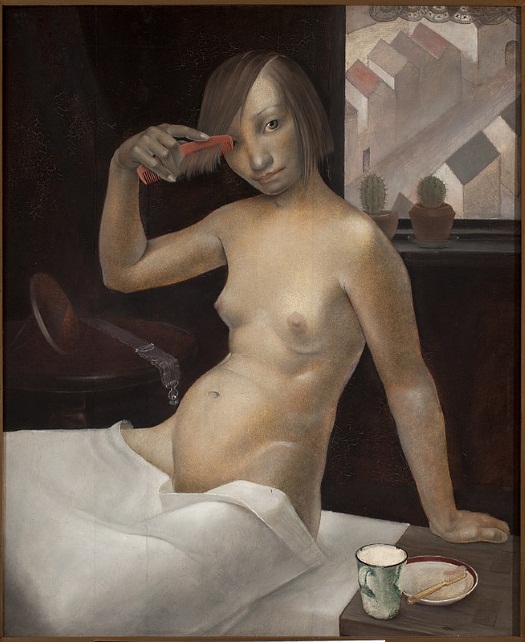 Toilette, oil on canvas circa 1928; dimensions unknown.
 This portrait of an Asian woman holding a cigarette has been given at least four supposed titles including Lady with Cigarette, Chinese Woman, and Chinka. Oil on board, approximately 22″ x 30″, circa 1928.
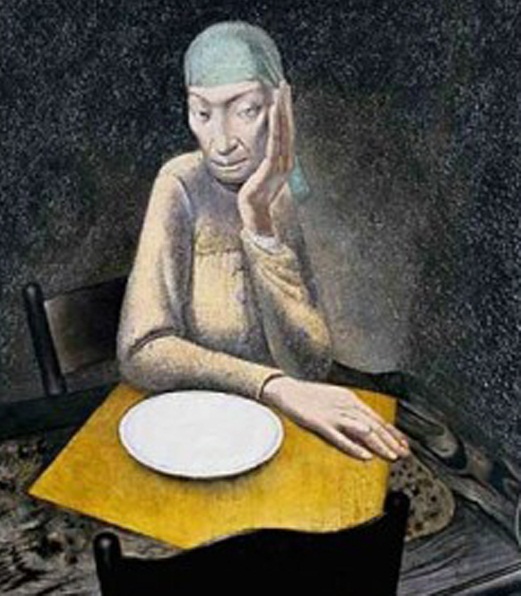 Although this Asian man seated at a table had no specifics cited by the auctioneer, it appears similar enough to the foregoing woman that it’s likely to be from the same period.
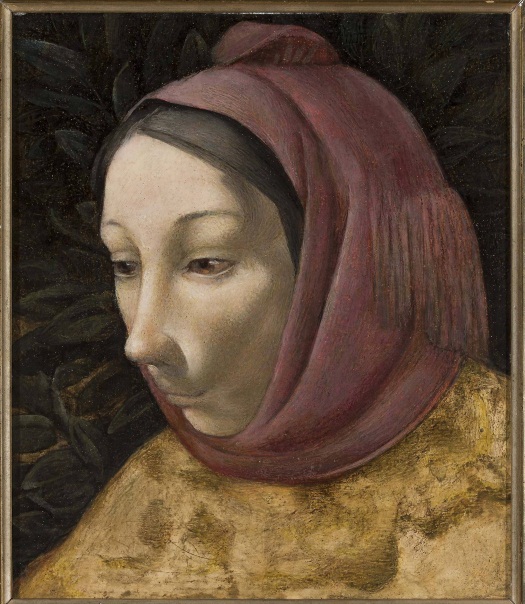 Woman’s Head Study was cited as being circa 1929 but no other specifications were given by the auction house, although it definitely appears to be an oil painting. (I’d have thought “woman in red scarf” would be a better description of this one.)
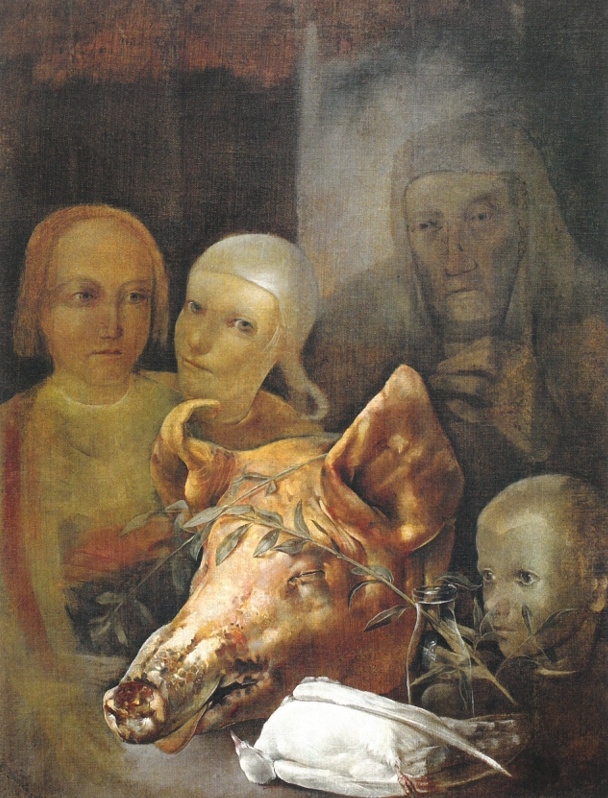 Peasants with a Boar’s Head, ca 1929, oil on canvas glued onto wood, 31” x 23”
 This Head of a Woman is oil on plywood, 12” x 10” unframed, and cited as circa 1929.
 On the reverse of the plywood are pencil sketches of what appear to be construction or architectural beams and supports, drawn for some unknown purpose.
 Portrait of a Young Girl, ca 1929, oil on plywood, 12” x 11”
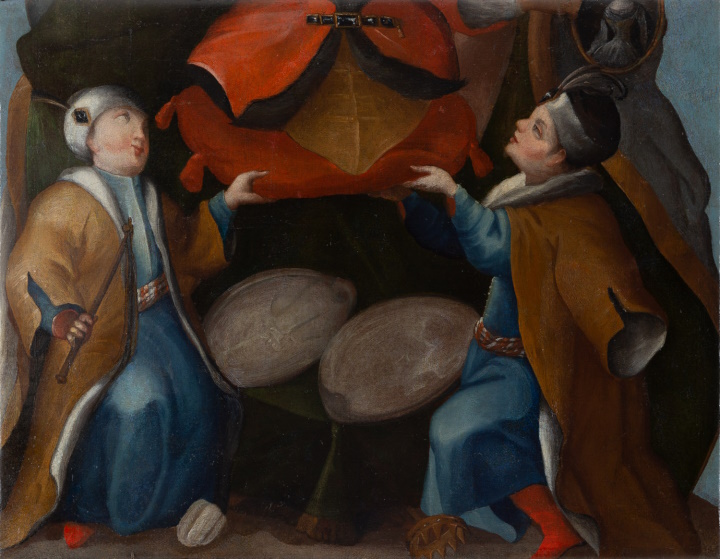 Two Noblemen or Courtiers was listed by the auctioneer as being “part of a larger, non-preserved and unknown composition.” However, it is quite a healthy size itself, being about 26” x 33”! It’s also challenging to deciper the subject. The courtiers are supporting a cushion, and there is a fallen crown just right of the bottom center. At the upper right is an oval frame with the lower part of a female portrait inside. The work was clearly influenced by Cybis’ time in Constantinople but, based on very helpful input which I received from scholar Ekaterina Aygün, is more likely to be from the late 1920s than from those actual years.
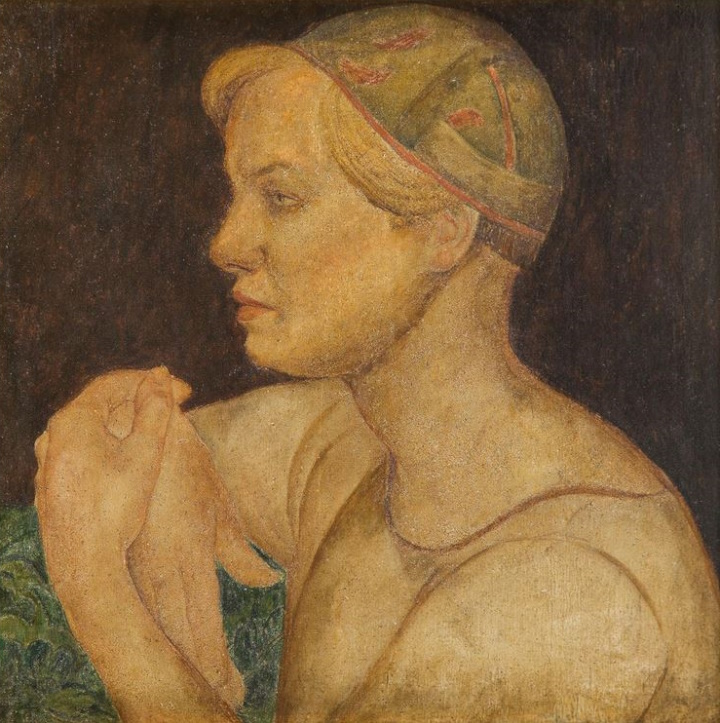 One source claims that this Portrait of Marja Tym Cybis, The Artist’s Wife was done in 1925 (the year that they were married.) I have been unable to find any confirmation of that particular year, however. It is done in oils and chalk on plywood, and is approximately 15″ square.
 Autumn Landscape, cited only as “before 1930”; oil on canvas, 15” x 18”
The Bride: Painted in 1929, or in 1930?
 In October of 1933 the Brooklyn Museum hosted an exhibit of Polish art, among which was Cybis’ oil painting The Bride (the later porcelain sculpture based on this painting has its own Archive post) which was subsequently acquired by the Dayton Art Institute. It was probably painted in late 1929 or early 1930, because the painting that appears to be a ‘follow-up’ to it (Birth at Lowicz) is physically dated July 1930. This makes it probable that The Bride was painted first, e.g., in 1929 or during the first half of 1930.
In 1980 the Dayton Art Institute decided to dispose of some of its holdings and consigned this painting, along with Peasant Heads, to Sotheby’s 84 Gallery in New York City where they were offered as a single lot (#112) in their April 10, 1980 auction. The Cybis studio was not aware of the auction until 24 hours before the sale began, upon which they decided to try to acquire the lot. There was a mad scramble for funding but the studio emerged as the winning bidder. Both paintings were subsequently examined under a black-light, which disclosed that there were several layers of revisions beneath the final product.
 The Bride was displayed on an easel in the studio’s showroom area for the next several years. This 1980 press photo shows Joe Chorlton with both paintings, plus their recently-released porcelain sculpture The Bride. However, when I visited the studio in 1992 and 1993 neither painting was on display. It is not known when, how, or if Theresa Chorlton ultimately disposed of either of these paintings.
 In 2022, I finally came across a color photo of The Bride in a scrapbook. However, there are two issues here, the first being that I don’t know whether this photo is of the actual painting, or is a photo of the 1970 photograph of the painting (i.e., a photo of a photo.) The second issue is the monochromatic appearance of the headdress, which makes no sense at all. I emailed this image to someone who saw the painting itself on a daily basis for several years, asking if it is an accurate representation. He said that this photograph “looks washed-out” and that the painting itself had “much more vibrant colors”. He could not explain the photo’s appearance of the headdress. Hearing this, I debated whether to include this photo in the Archive at all but decided that some color is probably better than none; I hope that someday the original will come up for auction online, at which point a good photo will undoubtedly be provided!
Paintings by Boleslaw Cybis during the 1930s are shown in this post.
Browse all posts about Boleslaw Cybis’ paintings and drawings
Name Index of Cybis Sculptures
Visual Index (for human figures/busts only)
About the Cybis Reference Archive
What is Cybis?
Images of Cybis porcelains are provided for informational and educational purposes only. All photographs are copyrighted by their owner as indicated via watermark and are used here only as reference material. Please see the Copyright Notice in the footer and sidebar for important information regarding the text that appears within this website.
The Cybis Archive is a continually-updated website that provides the most comprehensive range of information about Cybis within a single source. It is not and never has been part of the Cybis Porcelain studio, which is no longer in business.
 THE CYBIS ARCHIVE