
This second part of the chronological retrospective of Boleslaw Cybis’ art focuses on his paintings from the 1930s. I recently discovered that the timeline presented in the early-1970s Cybis in Retrospect exhibit catalog is at sometimes at odds with dates on the paintings themselves. For example, it claims that Cybis was in Italy during 1928 but a number of sketches of Italian landscapes are physically dated 1930.
All Boleslaw Cybis works on paper (watercolors, sketches and drawings) created during this decade can be seen here, except for his nudes which have their own post combining all of his paintings and drawings in that particular genre.

We will begin with Nativity at Lowicz which is a 39″ high x 30″ wide oil and tempera on plywood, signed and dated July 1930. It was brought to New York in July 1935 for an exhibit at the Carnegie Institute and was subsequently purchased by Andrey Avinoff who was Carnegie’s Director. It remained in his personal collection until his death in 1949, after which its whereabouts are unknown. See this Archive post for additional information about the painting and the eventual 1980s Cybis porcelain sculpture that was based on it.
 Yellow coral, circa 1930, described as “oil, merla on paperboard”, 9.5” x 10”. I could not find any definition of “merla” as an art technique and so am clueless as to what that medium may be.
 Portrait of Marianna Stanisława Cybisowa, the artist’s mother, early 1930s. Oil on canvas, approx. 18” x 14”
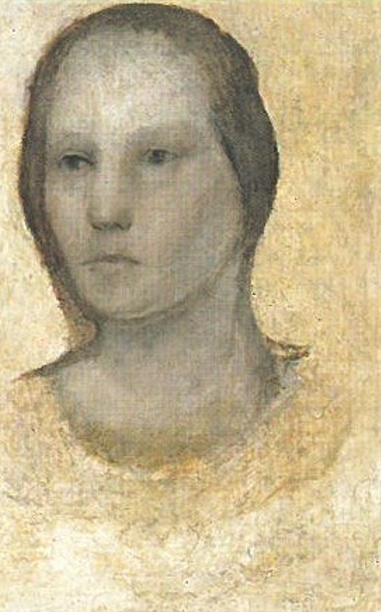 Portrait of a teenage girl, ca 1930, oil on gypsum board, 16” x 12”
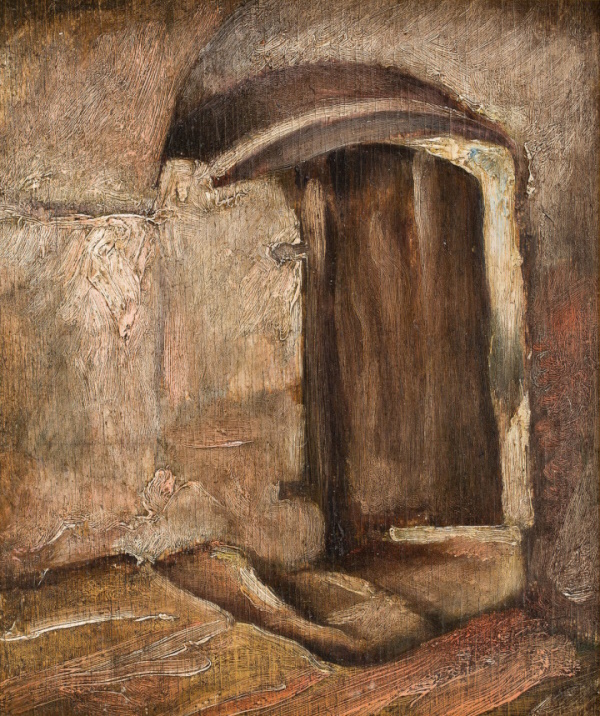 Entrance to the cellar, circa 1930. Oil on plywood, approx. 11” x 9”.
1930 (Italy)
 Copy of The Arrival of Saint Humiltas in Florence by Pietro Lorenzetti, circa 1930, oil/plywood, approx. 19” x 13”. This Cybis painting is a copy of one of the sections of the Sienese polytych by Lorenzetti during the mid-1300s.
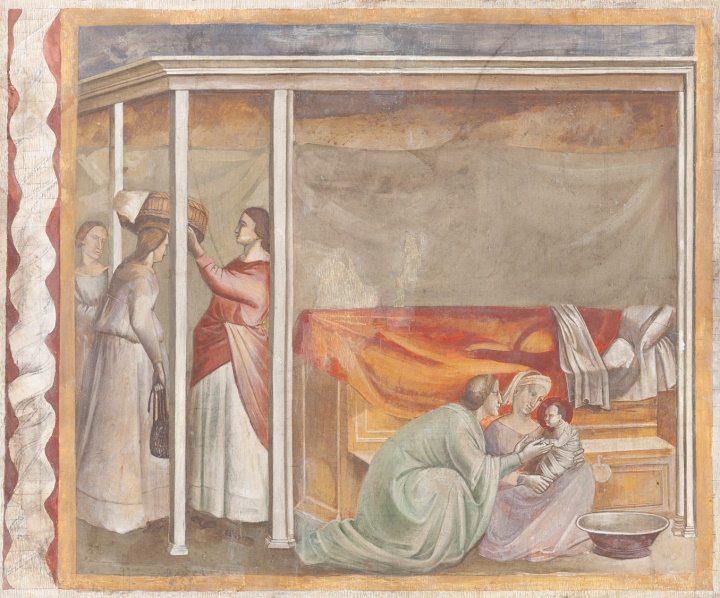 Copy of The Birth of Mary by Taddeo Gaddie, circa 1930, oil/plywood, approx. 19” x 23” and
signed on the plywood reverse B. Cybis. This painting is an unfinished copy of a fresco by Taddeo Gaddie from the Church of Santa Croce in Florence (1328-1338).
 Copy of The Annunciation by Fra Angelico, circa 1930, oil/plywood, approx. 46” x 40”. This Cybis painting is a copy of a fresco painted by Fra Angelico in the cloisters of the monastery of San Marco in Florence during the mid-1400s.
For drawings produced by Boleslaw Cybis during this sojourn in Italy, see the 1930s Drawings post.
1930-1932 (Africa)
The timeline of Cybis’ African-based work can seem complicated. As mentioned previously, some of the drawings from that trip are either physically dated 1930 or have the notation Tripoli in the lower right corner. The Cybis in Retrospect catalog’s timeline claims that he was exhibiting in Europe during 1930 and didn’t paint in Africa until 1932, but that is incorrect. Irena Kossowska, writing in 2003, relates that
“Technological experiments were expressed primarily in paintings containing reminiscences from a trip to Africa (Cactus, 1931; Mamruka, 1930). In these compositions, Cybis introduced textural effects imitating the material qualities of the reproduced objects: polished surfaces, relief elements, gilding, admixtures of sand to the base imitating plaster, fabrics pasted into parts of clothes (Meeting, 1931). The color range here is dull, tinted with gray, limited to pastel shades tonality (A Street in Tripoli, 1931).”
The word reminiscences implies that Cybis had already returned from Africa when he painted those, i.e., he created them in 1931 based on memories of his 1930 trip. Even though the original paper was written in Polish and necessarily run through an online translator, it is hard to see how wszystkim w obrazach zawierających reminiscencje z podróży do Afryki can be interpreted in any other way: Cybis was drawing and sketching in Africa during 1930, but at least some of the paintings were created after he had left.
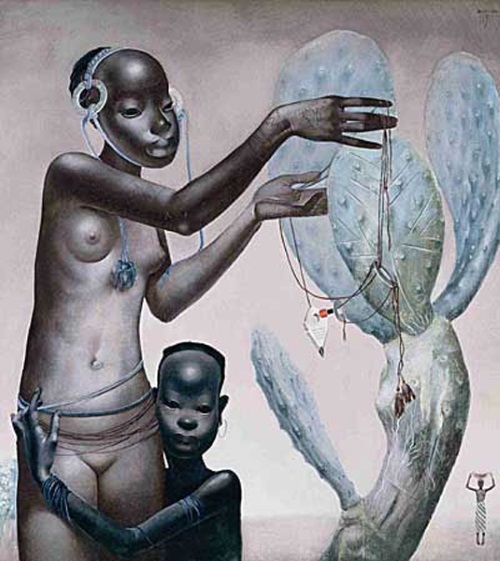 No dimensions were given for this portrait of a Libyan Woman and Child with Cactus which is an oil on canvas.
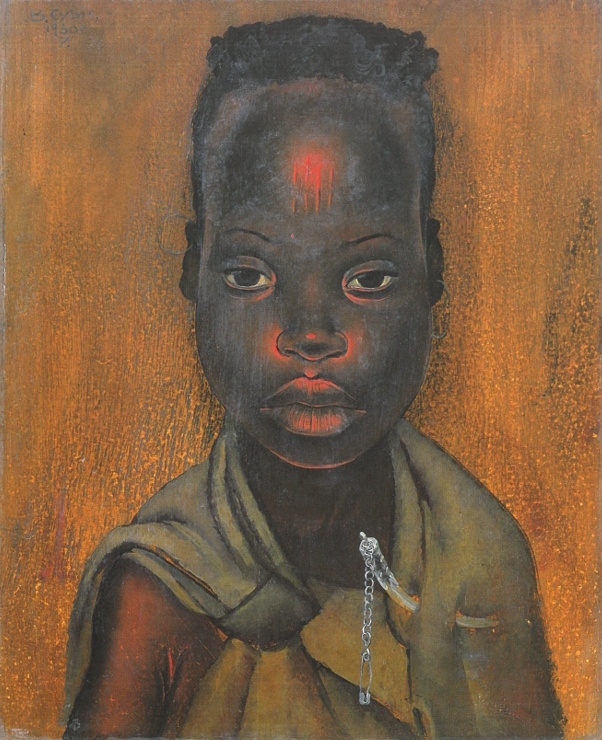 African Boy with Silver Brooch, signed and dated July 1930, oil on board, 17” x 15”
 Libyan Wall and Archway is likewise an oil painting.
 A Street in Tripoli, mixed media, 1931; dimensions unknown.
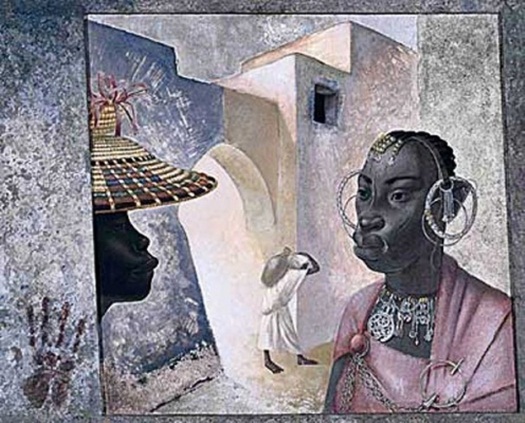
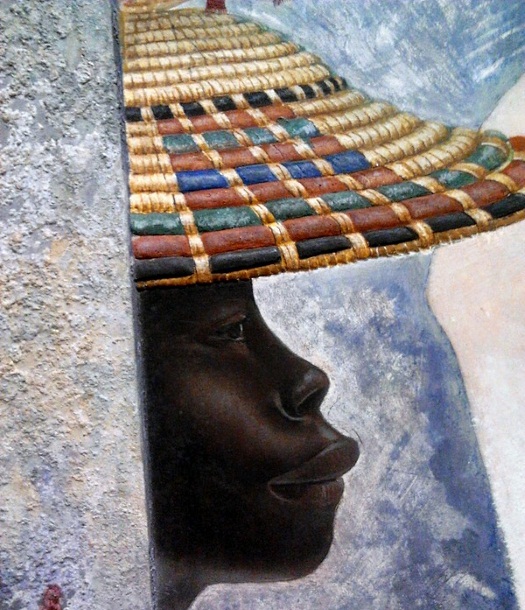 Meeting, mixed media on plywood, 28” x 23”, 1931. The Cybis in Retrospect catalog contains a black-and-white photo of this painting but incorrectly titles it as ‘Libyan Women in Window’ instead. The detail in the painting of the woman’s straw hat is very impressive.
1932-1939
By 1932 the Cybises were definitely back in Poland and one of Boleslaw’s first commissions there was for the interior decor of three ships launched by the Polish Merchant Marine. An article in the May 28, 1933 issue of the New York Times, titled ‘New Polish Liner Greeted in Harbor’, reports that
“The new motor-liner Batory, the second addition to Poland’s merchant marine…a trim, 514-foot liner, smart in line and efficient in every detail…was built at the Monfalcone shipyard in Italy…. On the promenade deck is a large American bar decorated with plaster relief work covered in silver, done by Boleslaw Cybis.”
This ‘plaster relief work’ is described in more detail by Irena Kossowska:
“…he covered the interior of the bar on the ship M/S Batory with relief decorations with African motifs – made of plastic clay of his own idea.”
Again, that last description is an online translator’s rendering of wykonanymi z plastycznej masy własnego pomysłu. It is tempting to wonder if this was the same as, or at least a forerunner of, what the Cybis studio would later call papka. The word plastic in this context means that it was very malleable, not that it was the modern polymer that we typically mean when we say ‘plastic.’
A magazine article described this same silver-gilt decoration in the American Bar as “…wall decorations representing motives [sic] of exotic beauties from the islands of the Indies made ‘en relief’, chiseled, [and] plated with oxidized silver”.
 Update, July 2025: This photo shows part of the decoration.
The other two Polish ships for which Cybis reportedly created decorations were the Chrobry and the Pilsudzki.
 Consolation, ca. 1932, size unknown (known only from this photograph)
 Lady in a Lace Dress, signed July 1934, life size oil on canvas, 65” x 43”

Another major project, begun in 1934, was commissioned by the Military Institute in Warsaw: A set of four historical frescoes depicting the national hero, Boleslaw the Brave; they are shown in detail in their own Archive post. The project was completed in 1937.
. A study for the fresco ‘Boleslaw the Brave marking out the borders of Poland on the Oder River’, 1934-1937, oil and tempera, approx. 17” x 15”. Signed on the reverse, in pencil, B. Cybis, and in blue crayon 201×120.
 Woman in Yellow Beret is quite large at 61” x 26”. Mostly likely done in 1935, it is oil on canvas.
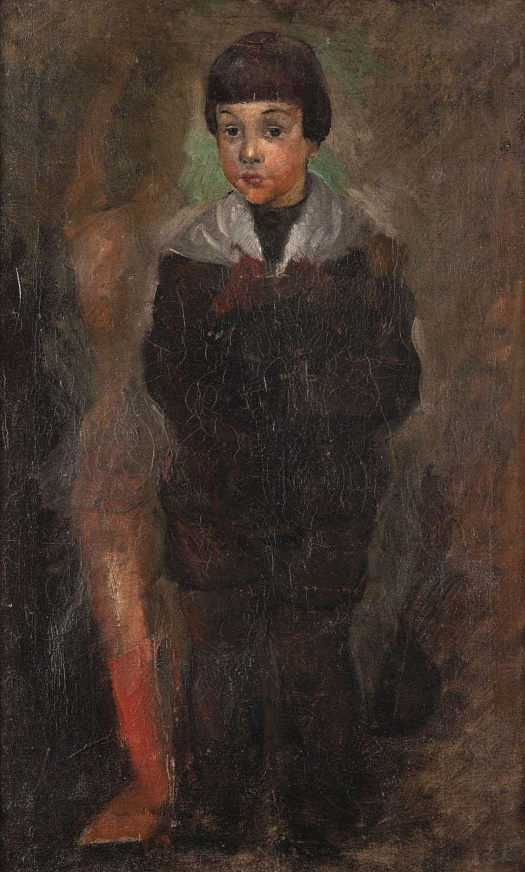 Portrait of a Boy Standing, circa 1935, oil on canvas, 30” x 18”.
 Newspaper Girl and Dog, ca 1935-36, mixed media on wood, 39” x 35”
 Woman in a Hat and Fur Collar, circa 1930s, oil on canvas, 24″ x 28.5″.
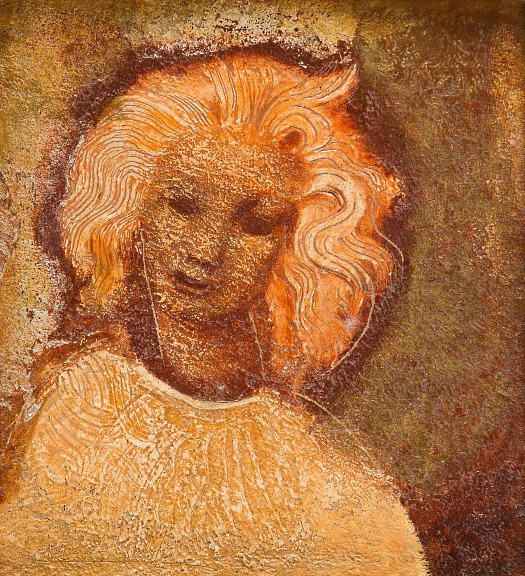 Golden-haired Girl, circa 1935-1936, oil on panel, approximately 14” x 12”.
 Primavera, an oil and tempera from 1936, measures about 34″ wide x 51″ high.

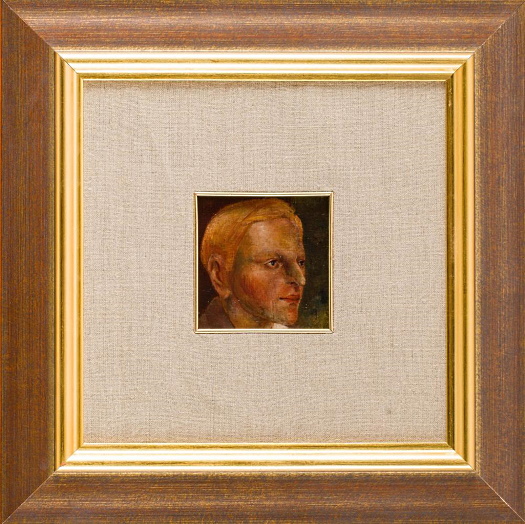 This portrait of Jeremi Kubicki is quite small, only 4.5” square unframed. Cited as circa 1937, oil on plywood which is inscribed on the reverse 10 cm | oksyda | brazowa | „Kozak” | platki | zlota (translation: 10 cm | oxidation | brown | ‘Cossack’ | flakes | gold) Jeremi Kubicki was a fellow-member of the Brotherhood of Saint Luke during the 1930s. He committed suicide at the age of 27.
 President Gabriela Narutowicza, oil on canvas, ca 1937, 39” x 30”
 Pigeon Sellers (or some variation thereof) would be a good title for this. It is a large oil on canvas, about 65” high and 37” wide, and is undated.
 Peasant woman, after Bruegel, oil on plywood. This is very small at 5.5” square.
 Boy in White Collar and Beret, oil on gypsum board, about 10.5” x 9”.
 The Cybis in Retrospect exhibit catalog also included this photo of a detail section of a circa-1938 painting described as a “mythological scene….al fresco mural depicting wild horses and trumpeters.” The style is similar to that used in the Military Institute frescoes.
 A study for the fresco ‘Armed action of Poles in the History of the United States’, circa 1938-1939, approx. 21” x 18”. Done in a proprietary technique in oils on a panel. The resulting fresco was created by Boleslaw and Marja together at the Polish Pavilion at the World’s Fair in New York in 1939.
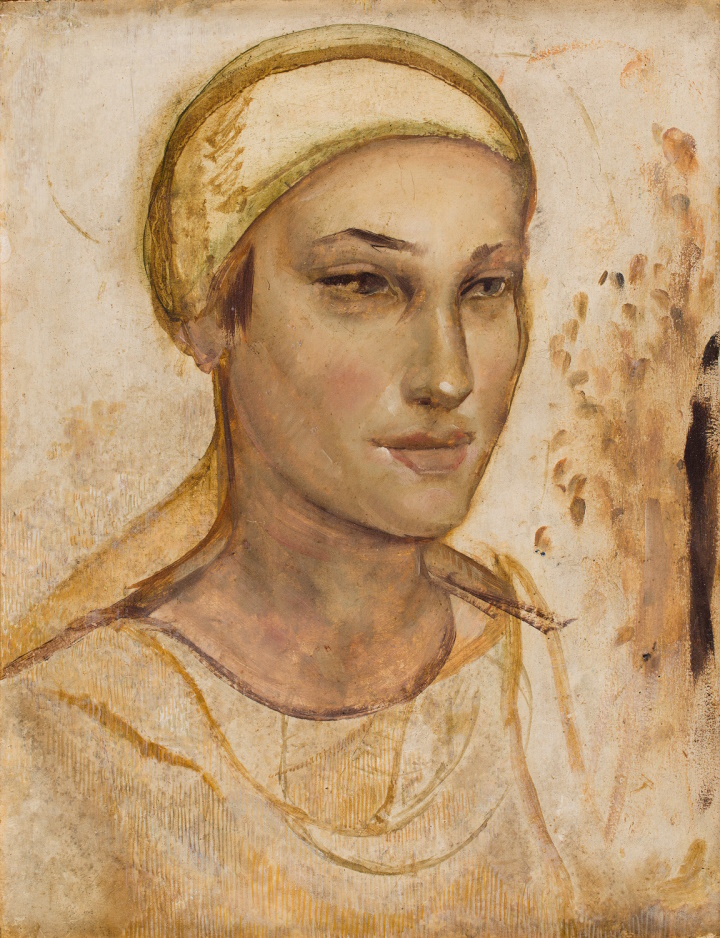 Portrait of Alicja Tym, the artist’s wife’s sister, 14.5” x 11”. Oil on gypsum board and plywood.
In early 1939 Cybis and his fellow artists arrived in New York along with the series of seven commissioned murals for the upcoming World’s Fair. The March 12th edition of the NY Times reported that
“A group of eleven Polish artists and architects arrived yesterday on the Gdynia-American liner Batory to complete the decoration of the interior of the Polish Pavilion at the Fair. The group, which included Boleslaw Cybis, mural painter, will work under W.T. Benda who is in charge of the artwork.”
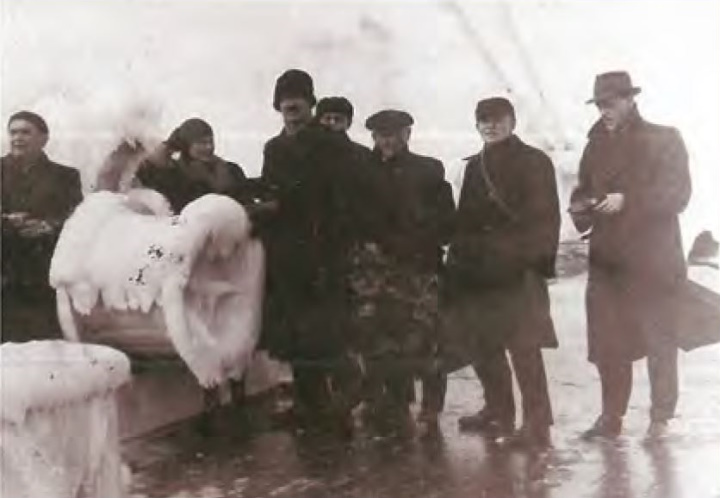 This photograph, taken on the deck of the Batory during that trip to New York, shows just how frigid a wintry Atlantic crossing could be; just look at that ice-encrusted winch! Marja Cybis is the woman with her right arm raised to her cap.
As related in the Boleslaw’s Restaurant post, shortly after the Cybises were stranded in America at the end of 1939 he created decorations for at least one – possibly more – restaurants or nightclubs in Manhattan, similar to the work he had done on the Polish ships. Cybis in Retrospect mentions several of these, including a set of five full-scale (3′ to 4′ wide x 7′ long) sketches for “al fresco murals designed for [a] New York Social Club”. Unfortunately, they were not described as to subject.
The other two nightspot items were exhibited as photo reproductions of two murals painted for “the Polonaise Club” circa 1939. A Google search produces a dead link for a vintage 1940s postcard for a “Polonaise Restaurant”; whether it refers to the restaurant in which Boleslaw was a partner is unknown, because polonaise can also be an adjective meaning simply ‘Polish’. The names given to the two mural photographs in the 1971 exhibit were Cossack and Hounds and Maiden and Hussars.
The third post in this three-decade overview of paintings by Boleslaw Cybis will look at his 1940s work.
Browse the Boleslaw Cybis paintings and drawings category.
Name Index of Cybis Sculptures
Visual Index (for human figures/busts only)
About the Cybis Reference Archive
What is Cybis?
Images of Cybis porcelains are provided for informational and educational purposes only. All photographs are copyrighted by their owner as indicated via watermark and are used here only as reference material. Please see the Copyright Notice in the footer and sidebar for important information regarding the text that appears within this website.
The Cybis Archive is a continually-updated website that provides the most comprehensive range of information about Cybis within a single source. It is not and never has been part of the Cybis Porcelain studio, which is no longer in business.
 THE CYBIS ARCHIVE