
Originally shown in 1930s Drawings, additional material has come to light that absolutely warrants giving this unusual work an Archive post of its own. This was one of the final two commissions that Boleslaw Cybis received and completed before leaving Poland for – of course, unknown to him at that time – his permanent residence in the United States.
In 1937 the Society of Friends of Sciences and Arts in Gdansk commissioned Boleslaw Cybis and Jan Zamoyski to paint a fresco on the auditorium ceiling of the Polish gymnasium. This institution was what we call a middle or junior high school today. Stefan Pluzynski was also commissioned to create additional art for the walls.
The theme of the ceiling was the various provinces of Poland, represented in allegorical fashion against the background of the night sky with its constellations. The ceiling was completed in 1938. During the Nazi occupation shortly thereafter, the fresco paintings were destroyed and the ceiling was covered with plaster.
The sketches and drawings shown below, attributed to Boleslaw Cybis, are original work-in-progress studies of what the Polish Sky ceiling was going to look like. These were consigned by public and/or private collections to the DESA Unicum auction house in Warsaw at various times in recent years.

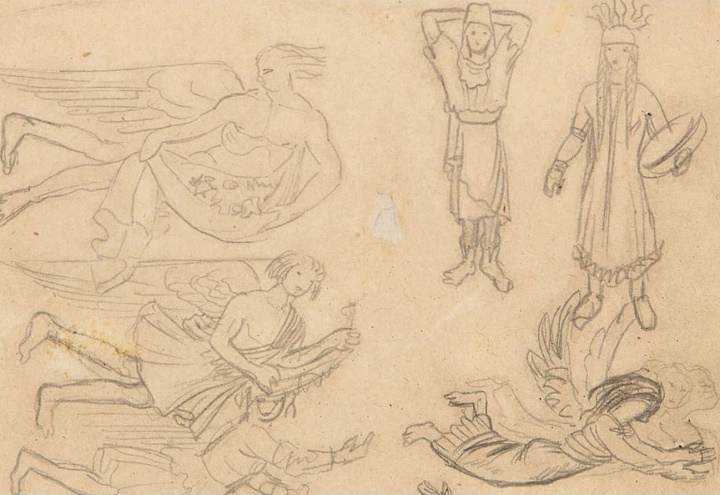
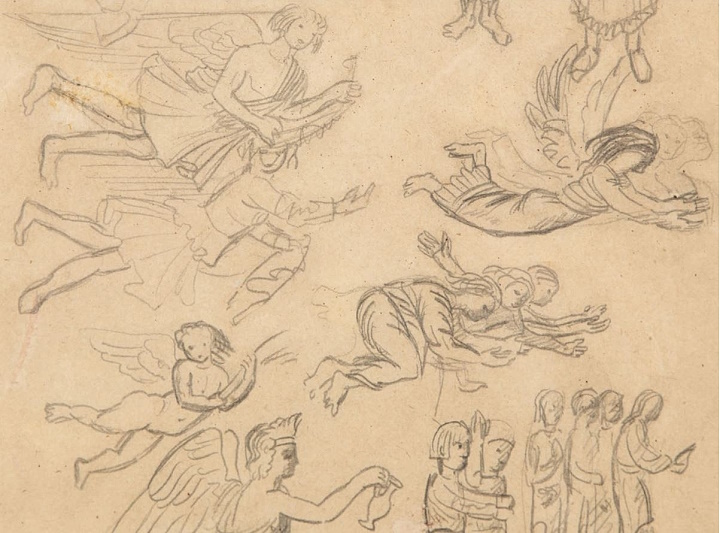
 This collage-like sketch contains several of the elements that we will see in subsequent refinements below. The sketch is only about 9” x 12”.
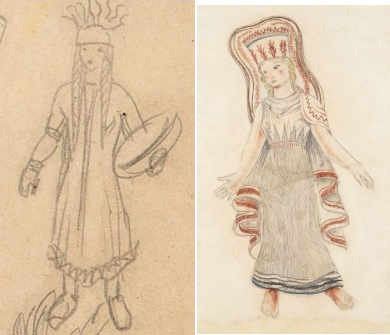 I was struck by the similarity of this Polish Sky figure sketch to a circa-1920s(?) Cybis drawing of a girl in a folk costume. I am now wondering if the completed drawing was actually done as part of that later project.
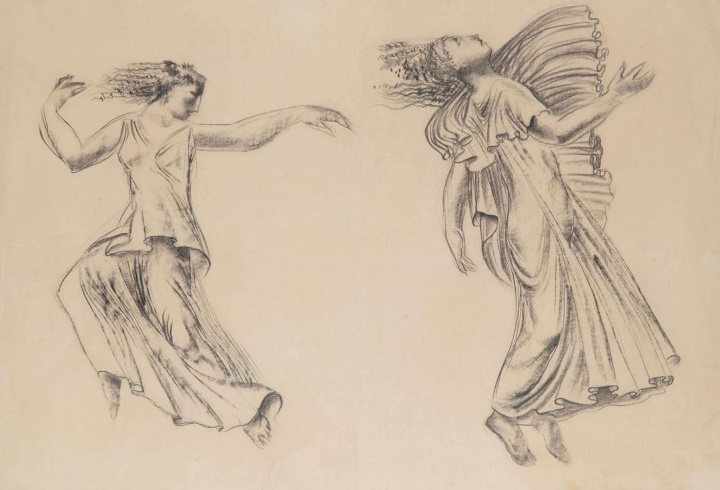 Sketch of two female figures, pencil and charcoal on paper, approx. 22” x 28”.
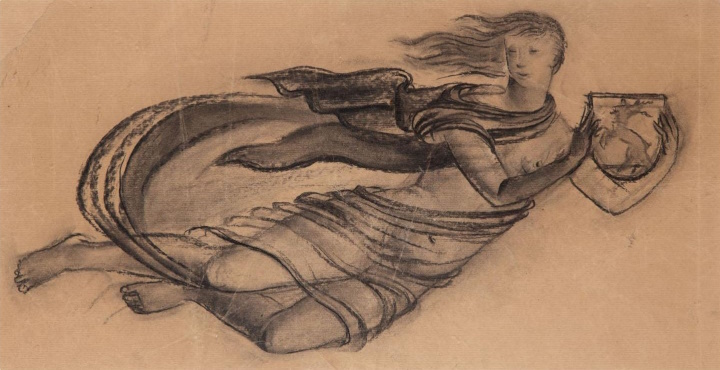 A flying female holding a small shield, charcoal on paper, approx. 22” x 23.5”.
A sketch of two nude women cited to have been among the ‘prep work’ for this ceiling can be seen in the Nudes post.
 This flying female with shield sketch may be the preliminary (or an alternate?) for the one shown previously.
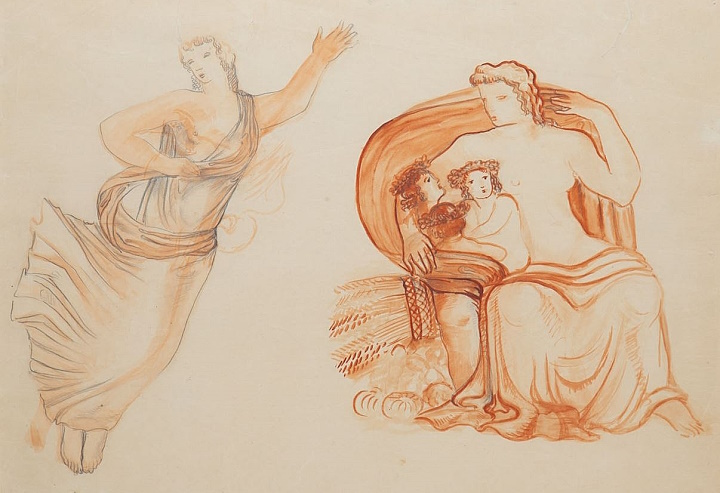 This watercolor and pencil described by the auction house as ‘sketches of constellations’ was consigned by the National Museum in Warsaw. It is about 20″ x 30″.
 Dancer with a sheer green scarf is done in crayon and pencil on paper. It measures 21” x 13”.

This is the most detailed Polish Sky preliminary study found thus far. Size is unknown; the media is possibly pastels and/or crayon.
 UPDATE, 2025: This black-and-white photograph shows some detail from the original ceiling. It’s unclear whether the photo was taken of a preliminary drawing, or of the ceiling itself.
How the ‘Sky’ Concept Evolved
According to his posthumously-published memoir, Jan Zamoyski claimed credit for the concept. Translated into English,
“After the building was completed, consternation ensued. The Hall resembled a stable rather than a place intended for artistic events. The decoration which could decisively change the mood of the Hall was, in our opinion [meaning himself and Boleslaw Cybis] to place the plafond centrally. To do this, it would be necessary to lower the ceiling beams by completely covering them, the result being that the ceiling would no longer be horizontal . In this way, a large, concave, rectangular plane of about 146 square meters, surrounded by a lower part of the ceiling [and thus] creating a frame for the plafond, would be formed. After returning from Gdansk we (B. Cybis and S. Płużański) were trying to decide on the subject of the paintings. At one point, we considered painting two Polish roads along the Baltic Sea under the windows: on one side, the old road (‘Vistula to Gdańsk’) and on the other side ‘Vistula to Gdynia.’ [My note: This concept was replaced by panoramas of individual Polish cities.]
“On the ceiling I proposed to depict a Polish Heaven. Against the background of Zodiac constellations, a figure symbolizing Poland would float in the center of of the plafond, surrounded by figures presenting industry, trade and agriculture. Further way, muses would be positioned on four sides: Peace, War, Science and Art – each supported by additional figures that visualize its individual elements, e.g., The Art [muse] would be supported by: painting, sculpture, architecture, poetry, music. Around this group – like the planets around the sun – there would be provinces and larger Polish cities presented as female figures holding shields with appropriate coats of arms. In the corners of the plafond you could put four seasons. My concept was approved by my colleagues. We immediately proceeded to make many studies and, after their acceptance, to develop cartons. In January 1938 we started the paintings. We emphasized the symbols of zodiacs and constellations in the plaster, giving them a general slightly muted blue background. This has given an unexpectedly interesting effect. Viewed from the bottom, they only receded and then depending on the direction of the light falling on them, they were a bit sharper or they were again almost melting into the background of the sky dotted with stars and cut through diagonally by the Milky Way. We also included Gdańsk in the districts circulating around the central group that created a wreath in an oval shape. After the outbreak of the war in 1939, the Gdańsk paintings were completely destroyed by the Nazis.” – from Jan Zamoyski, Lukashers and Paintings of the Brotherhood of Saint Luke,(tr.) Warsaw 1989, pp.105-107.
The official unveiling and dedication of the hall was scheduled to take place on September 1, 1939. At that time, a complete photographic record of the ceiling was to have been created. As it turned out, that was the day on which the Germans invaded Poland and World War II began.
The School, and the Ceiling Today
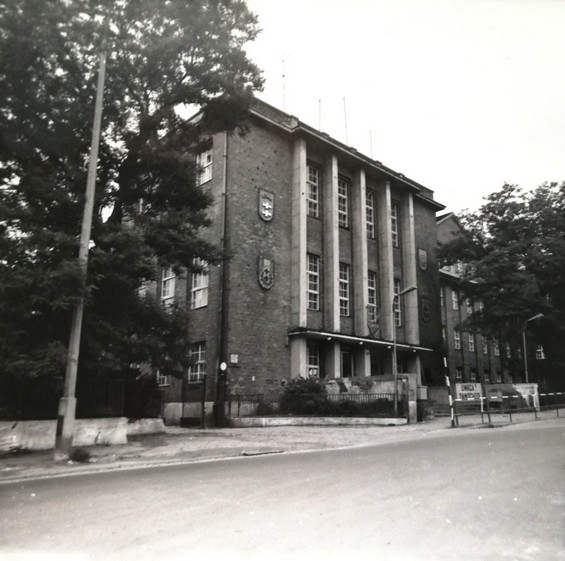
The school building was constructed in 1921 and operated between 1922 and 1939. It was the only Polish institution of its kind in Gdansk (a/k/a the German city of Danzig) and was run by the Polish Educational Society. The first headmaster was Jan Augustynski, and many of the teachers were journalists by profession. On-site living quarters were provided for the school employees. This post-war photo shows the main entrance section.
 Between 1936 and 1938, the trustees of the school (which was renamed the Joseph Pilsudski Mother School in 1935 after the death of that personage) decided to expand and modernize it; hence the commission for the auditorium ceiling. This 1936 photo shows the school exterior as the three artists would have encountered it when they began their work on the ceiling.
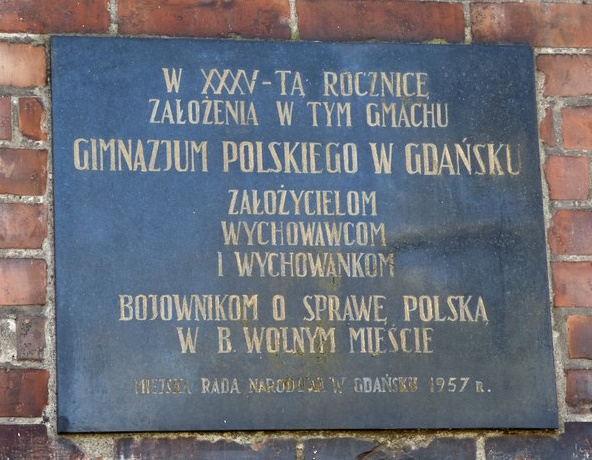 This circa-1950s memorial plaque on the exterior commemorates the Gdansk school. Translated:
On this 35th anniversary
of the opening of the building
POLISH GYMNASIUM OF GDANSK
To the founders
class teachers
and pupils
Fighters for the Polish cause
in a free city
City Council of Gdansk 1957
As mentioned previously, when the Nazis occupied Gdansk they objected to the nationalistic theme of the ceiling, destroyed the paintings and covered the surface with plaster. After the war ended, the building was used by other schools, and even – at one point – as a movie theatre. It was eventually sold to the local government and became embroiled in local politics. Eventually a new plaque was added to the building which (translated) reads: On the 80th anniversary of the erection of the Polish Gymnasium of Gdansk, To the founders, teachers and students, City Council of Gdansk, 13 May 2002.
 In 2012, the existing school (shown in this 2007 photo by Casimir Netka) was moved out of the building and work began on turning it into what was planned to be an administration center. The head of the Gdansk City Council stated in 2017 that
“The restored building will house the Memorial Room of the School Motherland, which before the Second World War was a stronghold of Polishness in the rather German city of Gdansk. Work on organizing this exhibition is in progress. We will allocate the largest room for this purpose. The paintings that existed in this pre-war Polish Junior High School will be recreated. The Nazis destroyed it after the German troops entered Gdansk. Based on pre-war illustrations, we want to revalorize this facility, remembering these rooms.”
The Re-Created ‘Polish Sky’ Ceiling
This Polish blog by Casimir Netka related in 2017 that “auxiliary drawings and sketches have survived; the description of the fresco was left by the local art teacher, Marian Szysako-Bohusz.”
A 2022 article on the official Gdansk website, outlining the full history of the school, states that
“The largest investment was the expansion of the Polish Junior High School with a new wing combined with a modernization of the interior, carried out mainly in the years 1935-1938. It was then that the famous monumental painting ‘Polish Sky’ [was painted], destroyed by the Germans in 1939 and recreated only on the basis of only a dozen or so preserved photographs four years ago. Today they can be admired in the interior of the former Junior High School, the building of which is currently used by the Pomeranian Marshal’s Office.”
Needless to say, I would dearly love to see any of those dozen circa-1938 photographs of the ceiling, and share them here! I have reached out to someone whom I hope may be able to help with that, and will of course add them here if I am able to obtain permission to do so.
Because the reconstructed ceiling is as faithful as it could possibly be made to the original, it is worthwhile to look at it in detail. The project took nine months (August 2017 to April 2018) to complete. According to the article Polish Sky Delights Again by Justyna Liptak (and from which the following photographs come) reporting on the finished project, it was done by “a seven-person team of artists associated with the Wall Painting and Stained Glass Studio of the Academy of Fine Arts in Gdańsk.”
 The work in progress: Here, an artist applies the preliminary sketches to a section of canvas. This will be the center of the ceiling.
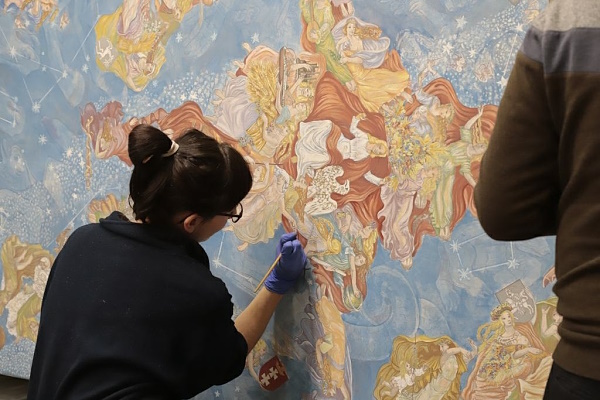 The actual painting, in process.

This photo gives an idea of the size of the canvas sections. The photographer used a fish-eye lens for this shot, which distorts the walls and makes them appear curved.
 This is how the sheets of canvas had to be applied to the ceiling. These are only in the ‘drawn’ stage of the work.
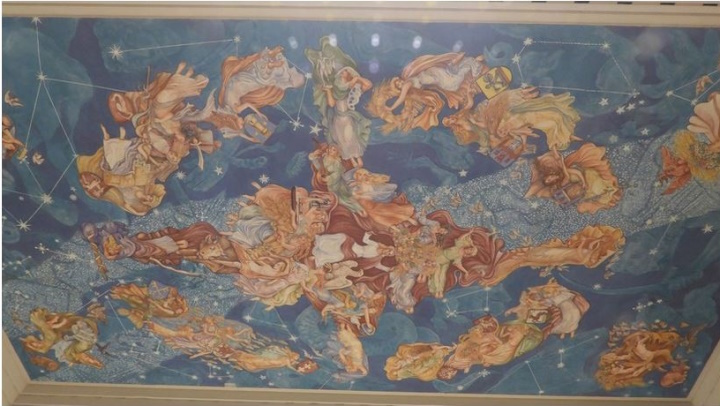 This is a view of almost the entire ceiling, from directly below. The seams between the canvas sections are imperceptible here. Research revealed that the sky represents the sky over Warsaw in August 1937.
 Focusing on the central pattern. Notice the provincial shields carried by a number of the flying maidens. I can see nine in this section . Two of the female figures (one with a lute, the other with flowers) near the center are extremely similar to those that Cybis painted for the Polish Pavilion ‘Abundance’ ceiling for the 1937 Paris Exposition. The central figure here is Mater Polonia, Mother Poland.
 Drilling down a bit more on the center. One of the maidens holds a ship, probably representing either the Batory or the Pilsudski which were the jewels of the Polish fleet at that time.
 Part of the Constellations background, with the actual constellation superimposed on a depiction of the character.
 The shield with the crown and two crosses is the flag of the city of Gdansk. The constellation in the background appears to be Hydra.
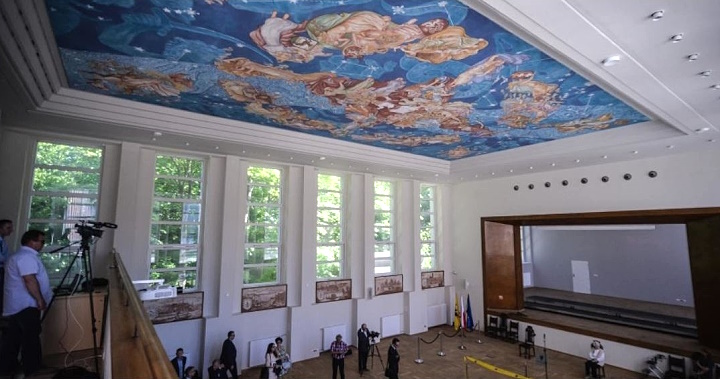 The completed ceiling on Opening Day. The sepia panels under the windows are re-creations of Stefan Pluzynski’s panorama’s of twelve Polish cities (including Gdansk, of course) that also originally decorated the school building before the War.
If I am ever able to obtain photos of the original 1937 ceiling, I will add them to the first section of this post. It is wonderful that it was able to be re-created almost 80 years after its destruction!
Name Index of Cybis Sculptures
Visual Index (for human figures/busts only)
About the Cybis Reference Archive
What is Cybis?
Images of Cybis porcelains are provided for informational and educational purposes only. All photographs are copyrighted by their owner as indicated via watermark and are used here only as reference material. Please see the Copyright Notice in the footer and sidebar for important information regarding the text that appears within this website.
The Cybis Archive is a continually-updated website that provides the most comprehensive range of information about Cybis within a single source. It is not and never has been part of the Cybis Porcelain studio, which is no longer in business.
 THE CYBIS ARCHIVE