
The 1980s limited edition Sleeping Beauty is one of the most difficult pieces to find in a truly mint (un-damaged) condition today. There is an area of porcelain lace that seems to attract breakage like a rare-earth magnet. Unfortunately, most online sellers either don’t know or don’t disclose the extent of the damage and so it’s helpful to have a visual guide.
 The official Cybis photo of Sleeping Beauty doesn’t clearly show 100% of the most common damaged area which is the lace on her headdress. It has a scalloped upper edge and the first thing to keep in mind is that there should be five (5) individual scallops along the length of the lace. In the photo below, I have numbered the ‘scallop areas.’
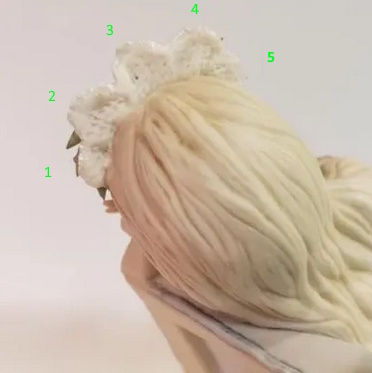 This rear view of an undamaged headdress shows the five sections clearly. The three central scallops are the largest and the two flanking ones are somewhat smaller and lower because they follow the shape of her head.
The second thing to keep in mind is that the outer edge of the lace has a thicker and slightly ‘rolled’ appearance. This is because the length of actual lace trim that was dipped into liquid porcelain (‘slip’), and then applied to the greenware, has a finished outer edge.

 The style of lace trim used for Sleeping Beauty’s headdress is called Venice lace. Here are two modern examples of a scalloped edge on a simple waffle-pattern lace weave which is what was used on the headdress. You can see that the outside edge is thicker because of the tiny finishing knots; this remained a thicker/rounded edge after the lace itself burned away in the kiln and left only the porcelain-slip shell.
So: Five visible scallops, all with a slightly thicker/rounded outer edge = an undamaged original headdress lace.
I must mention here that there will be some variation in the amount of “see-through” lace on individual sculptures. Some lace will have more open spaces within the waffle-pattern than others. Some porcelain lace areas may be very thin and delicate, while some may have very few or no open spaces at all. This is because every batch of porcelain slip was mixed by hand, and even the slightest variation in how much water was used or (even more important) how adept the ‘lace dipper’ herself was, as well as the individual porcelain-vs-kiln reactions, affected how closely the porcelain lace resembles the actual cotton fabric lace that was dipped. This is part and parcel of the no-two-exactly-alike characteristic of art porcelain.
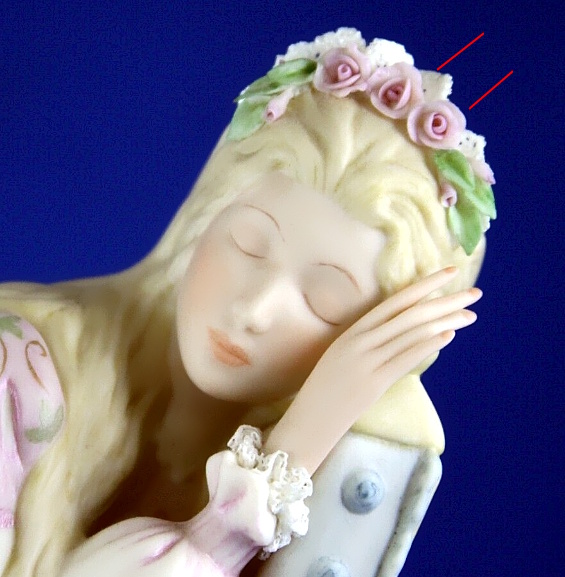
So now, having seen how a mint-condition Sleeping Beauty headdress lace appears, let’s look at examples of what is typically seen on sculptures offered for sale nowadays. In other words, let’s play ‘Spot the Damage’! I’ve numbered each surviving scallop, and inserted arrows pointing to the visible damage(s).
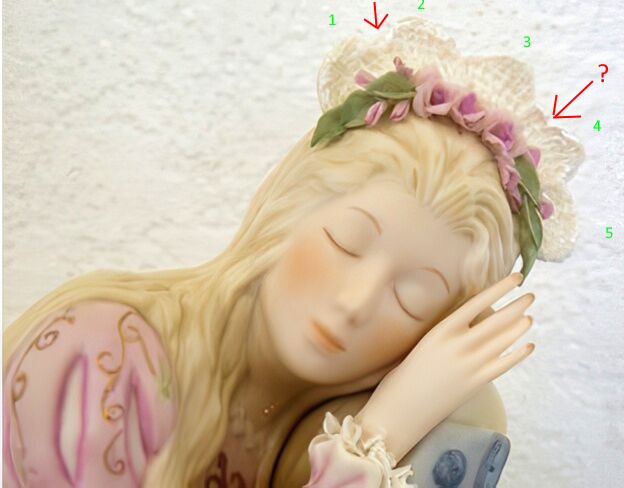 This headdress comes close to making the cut for mint, but the ‘dip’ between scallop #1 and #2 is damaged. I’m not sure about the area at the second arrow, hence the question mark.
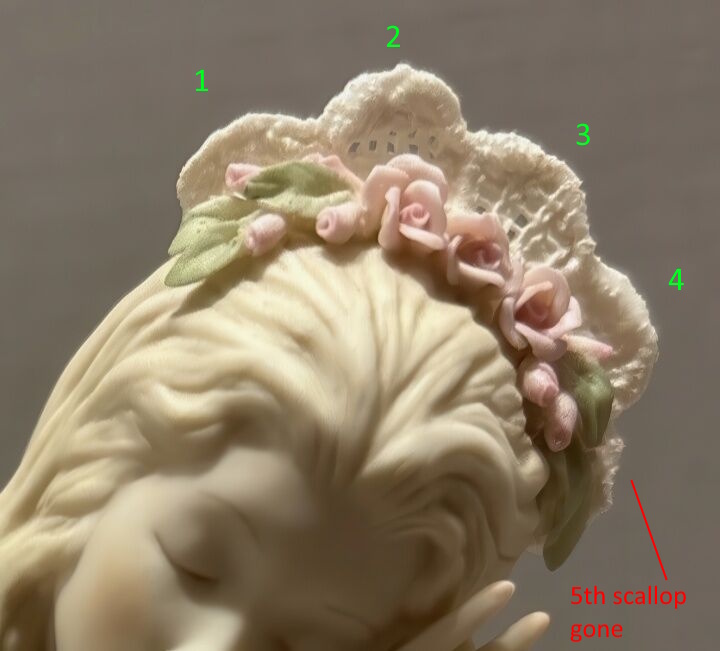 Oh, so close! But one of the end sections is broken off. However, this is a great photo to illustrate how the outer edge of a mint-condition and nicely-dipped lace SHOULD look!
 Only three-fifths of the original lace survived on this one. And part of an adjacent leaf is also broken off (no surprise there.)
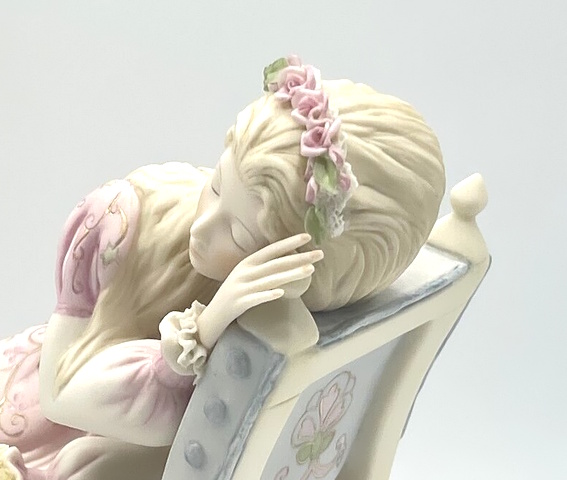

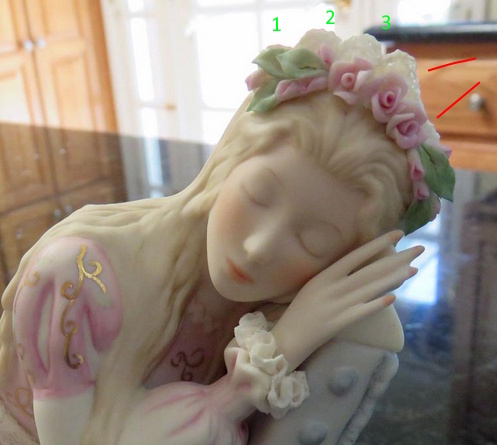
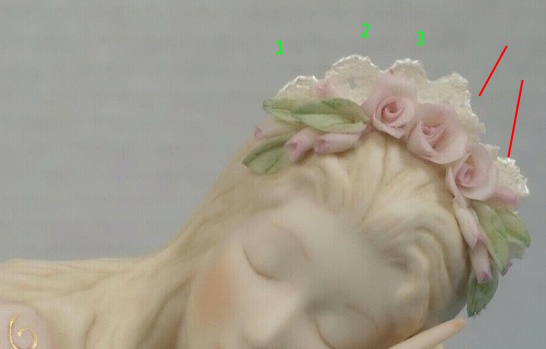 A small potpourri of other lace-headdress-damaged Sleeping Beauty pieces. From top to bottom: Lace almost all gone; a slice out of the center and possible damage to the far corner; center section mostly broken off; two scallop areas sliced off one end; and again, only 3/5th remains. There were other examples that were easily found but the photos were even worse than these, so I didn’t bother. But let’s end with two real whoppers.
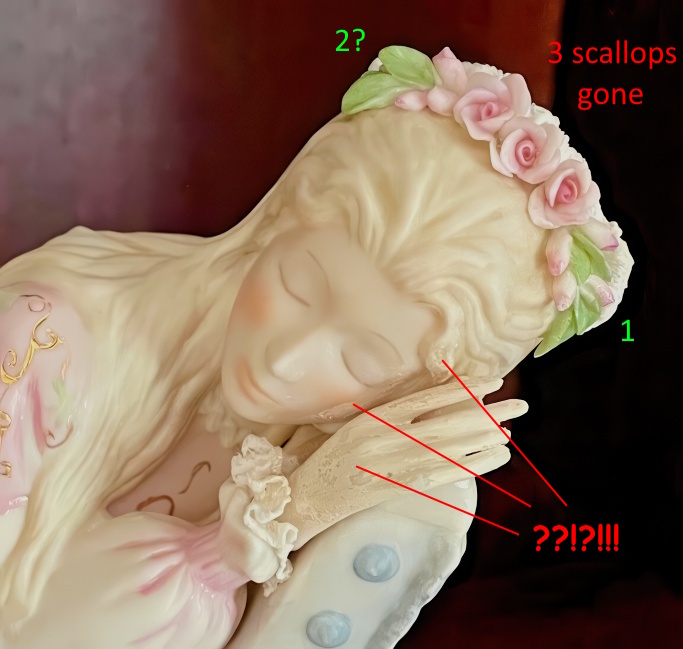 Okay, I am being charitable and assuming that MAYBE that #1 scallop MAY be undamaged, but honestly cannot be sure about the edge, based on the photo. The one on the opposite end may still be there, because the combination of photo angle and leaves might be hiding it. It may be there, it may be there with the outer edge missing, or it may not be there at all. But the three central scallops are definitely gone.
As for what the *bleep* is going on with her hand….well, I have only once seen a “repair” worse than this. This sculpture is currently on eBay, and my brain nearly exploded when I saw that the seller is asking (are you ready for this?) almost $350 “or best offer.” Add to this that they state its condition as “excellent” (do they even have eyes??) followed by a meaningless babble of a description that ends with a ludicrous claim that the piece has “a $900 value.” Oh, it has a damaged rear bow as well. It is listings like this that make me despair of the future of human intelligence and begin to entertain the thought that the dreaded AI Apocalypse might actually be a good thing. Yeeesh.
And as if that wasn’t bad enough, I will end with a ‘you have to see it to believe it’ example. Thanks to my Recent Sales Page, this particular Sleeping Beauty (#41) has a trackable sales history. Her story begins last year, when she appeared on eBay during the summer of 2024.
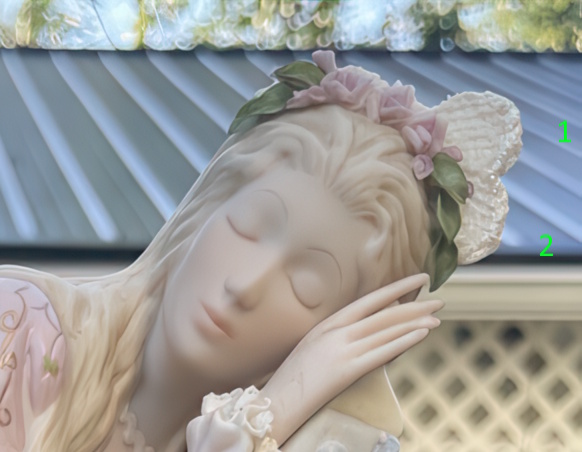
 The photos showed a damaged headdress lace: Three-fifths of it is gone. Notice that the surviving scallop edges do have the proper ‘rolled’ appearance, and that the waffle pattern of the original lace is visible even though the tiny spaces of the waffle pattern got filled with slip during the firing (a not uncommon occurrence.) The surviving lace is definitely original. This seller’s description was only partly accurate; it read:
Lot C1: You are bidding on a Vintage Cybis Porcelain Figurine. Our online research suggests that this Cybis figurine is Sleeping Beauty. The porcelain figurine is in great cosmetic condition. The Cybis porcelain figurine is being sold as is and cannot be returned. We have 50 different Cybis figurines listed. Check them out.
“Great cosmetic condition” is not what I’d consider an acceptable substitute for “areas of missing lace”, but oh well. This listing resulted a sale on June 2, 2024 which I reported on the Recent Sales Page:
Sleeping Beauty #41 – $34 on 6/2/24 on eBay. Seller’s condition statement suggested no damage, but their photos showed that 3/5 of the headdress lace is broken off.
Lo and behold, about 7 months after this sale, the same #41 Sleeping Beauty appeared again on eBay (eBay’s public sold search only looks back 3 months, a fact of which sellers are very well aware). It was very obvious that the January 2025 listing was not from the same seller as was the June 2024 one, but the condition of the headdress via these new photos is quite different.

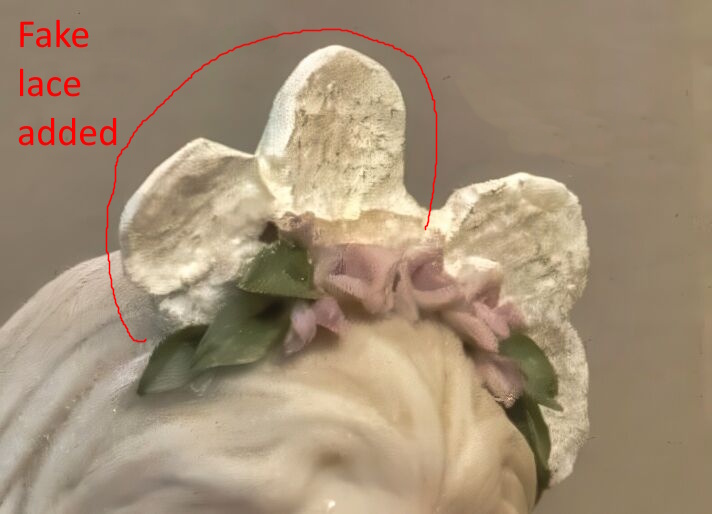
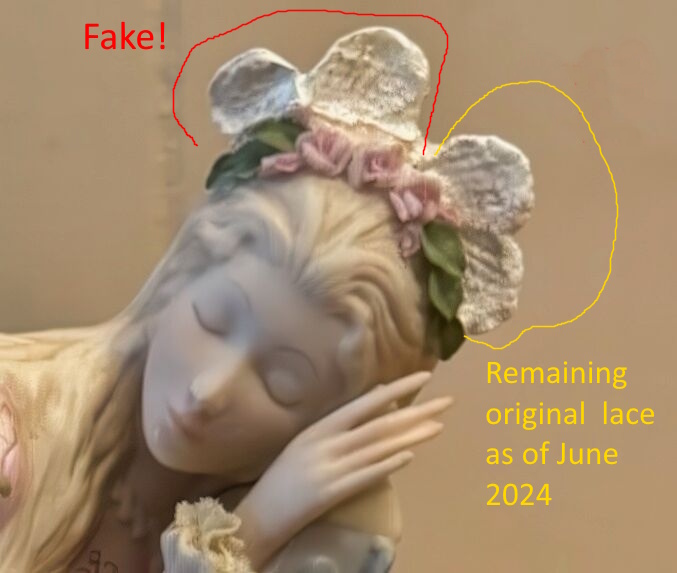 Fake lace (really really bad fake lace!) has been stuck into the gap left by the three missing scallop sections. This seller deliberately made no mention whatsoever of condition; their description was an amalgamation of stock (probably AI-generated) generic marketing phrases too utterly inane to repeat here. This has become a trend on eBay recently; so much so, that I am almost surprised when I read a listing description that is specifically relevant to the item being offered for sale.
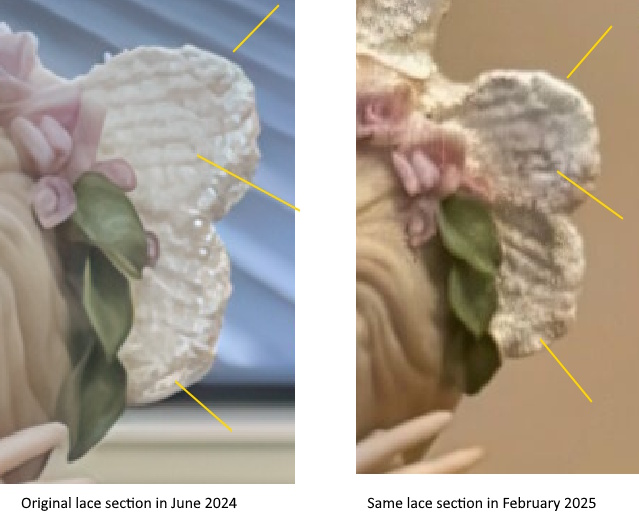 I wanted to make sure that I was evaluating the difference in condition correctly, so I upscaled both listing photos to very closely compare the two-scallop section that existed at the time of the June 2024 sale. The yellow lines point to the areas that do match, taking into account the slight difference in the camera angles and also the poorer quality of the January 2025 listing photos. The original section is indeed the same, but the fake section that was stuck into the circa-2024 empty space was obviously added after the June 2024 sale.
Sleeping Beauty #41 – $75 on 2/11/25 on eBay. This piece previously sold on eBay on 6/2/24, as shown below with my condition notes stating that 3/5 of the headdress lace was missing as the photos clearly showed. In this sale a poor ‘replacement’ section is present but with no mention of any repair. More than half of one of the bow loops is now broken off, but likewise not cited by this seller (not the same as the prior seller.)
Sadly, as I reported on the Recent Sales page, someone actually paid $75 on February 11, 2025 for this Sleeping Beauty. I’ve no idea whether they realized, when purchasing, that the “lace” on most of the headdress is a poorly-done fake replacement that was slapped onto the piece a few months ago. The listing photos also showed that one of the two bow tails on the back of the piece is broken – which brings me to the other damage-prone part of the sculpture: The rear bow.
 This is what a mint-condition, undamaged lace bow at the back of Sleeping Beauty looks like.

 The bow is sometimes seen with one bow loop broken off or damaged, and less often (but still very possible) a bow tail as well or instead of…as in these examples with the missing sections outlined in red.
That said, a damaged rear bow is seen far less often than a damaged headdress. This is probably because it’s very obvious that this is a damage-prone area and so most people are careful enough to make sure they pick up or hold this piece only by the chair. If I had to guess at a percentage, I’d say that maybe 20% of Sleeping Beauty pieces today have a damaged bow – but the percentage of damaged headdress lace is at least 80%. Maybe even pushing 90%. That’s why she ranks #2 on my recent Most Often Damaged Cybis list!
So, to summarize: If you are considering buying a Sleeping Beauty, please remember the most important headdress-condition rule: ‘Five Scallops and a Rounded Outside Edge.’ And for heaven’s sake, don’t ever buy #41. 😉
Name Index of Cybis Sculptures
Visual Index (for human figures/busts only)
About the Cybis Reference Archive
What is Cybis?
Images of Cybis porcelains are provided for informational and educational purposes only. All photographs are copyrighted by their owner as indicated via watermark and are used here only as reference material. Please see the Copyright Notice in the footer and sidebar for important information regarding the text that appears within this website.
The Cybis Archive is a continually-updated website that provides the most comprehensive range of information about Cybis within a single source. It is not and never has been part of the Cybis Porcelain studio, which is no longer in business.
 THE CYBIS ARCHIVE