
I recently discovered, via a Polish tourism site, an article from 10 years ago about a circa-1940s ‘lady head bust’ made at the early Cybis studio. It was in a small museum in the village of Kazimierz – a town familiar to anyone who has read the 1920s Paintings or the Timeline posts. Boleslaw Cybis spent the late summer of 1925 there. However, the bust itself was most likely made in the Church Street (first Trenton) studio.
Dated December 2015, the web article begins with
In one of the rooms of the Celejowska Tenement House, a branch of the Vistula Museum, as part of the “Treasures of the Tenement House” series, a mysterious head from Trenton was displayed for the holiday season.
and explains that the Vistula Museum acquired it in 1992 from a private collector. It claims that the head was made “during the 1950s” although I would suggest that “1940-1953” would be more accurate.
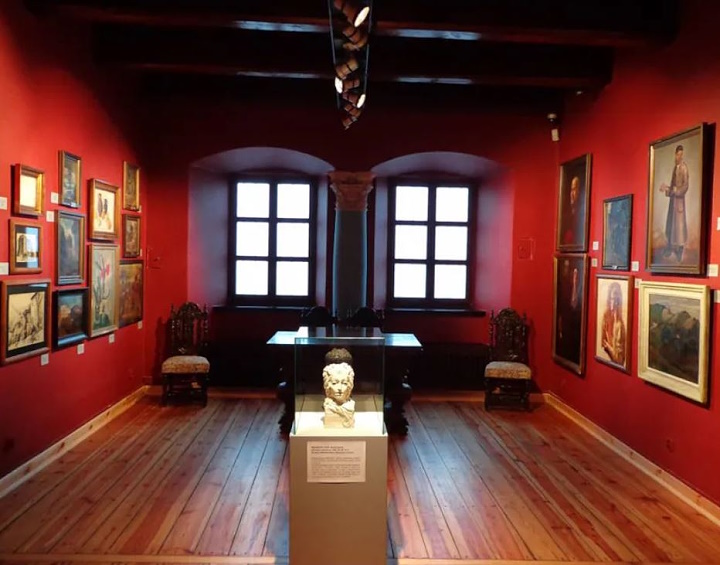
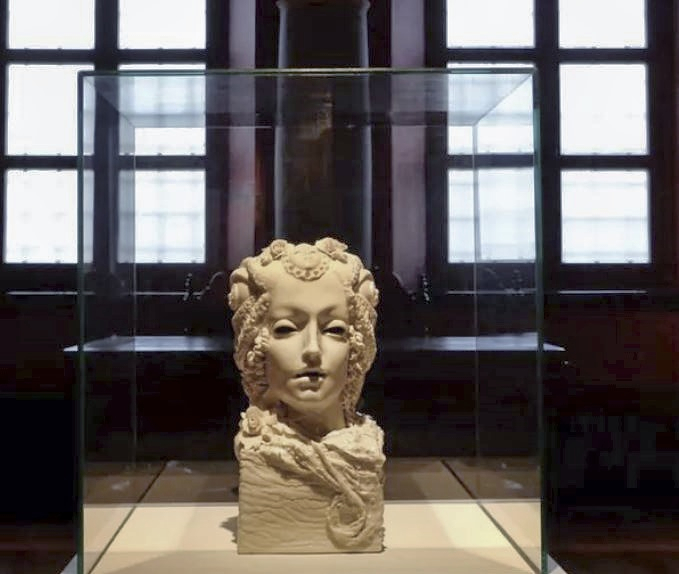
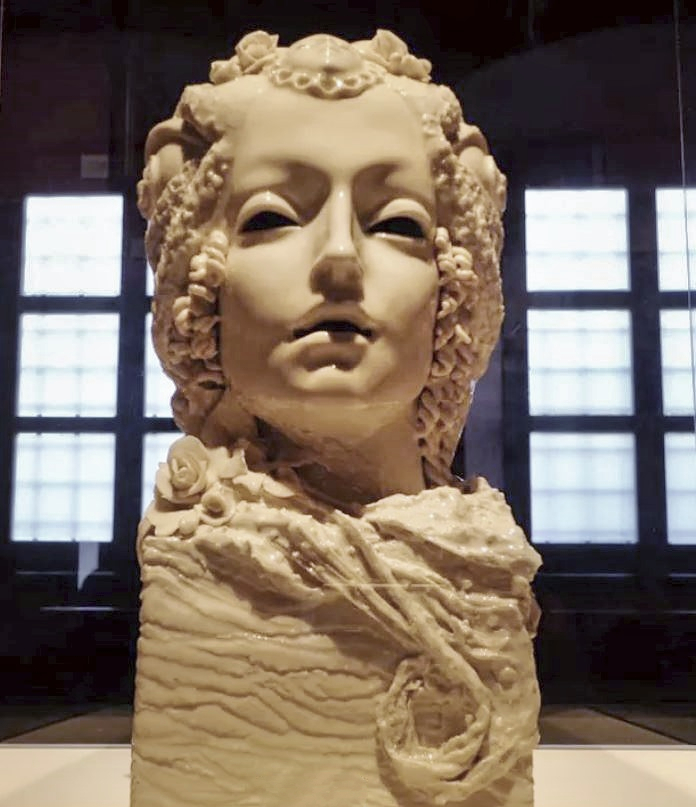 These photos show the bust on display at the museum in late 2015. Let’s see if we can narrow her ‘birthday’ down a bit by comparing her to other similar Cybis pieces.
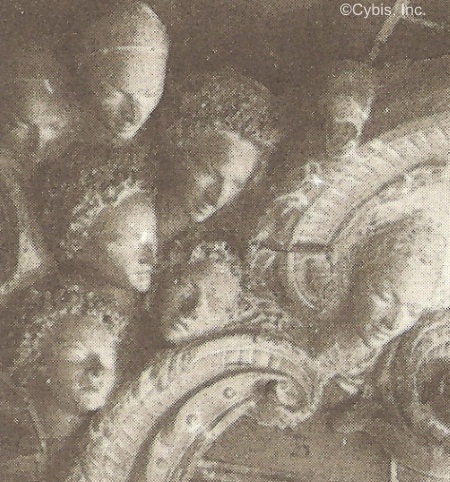 The face sculpt most closely resembles these life masks that once hung on the upper walls of the Church Street studio during the 1940s.

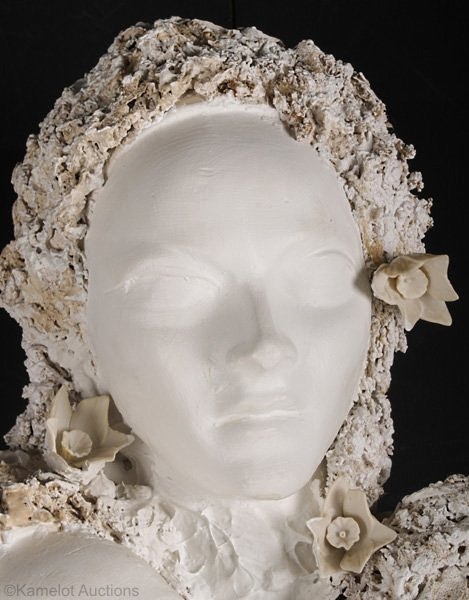 These later reproductions were sold at auction in Philadelphia during the 1990s. The dogwood flower molds are the same ones that were used for the 1963 Wood Wren with Dogwood and the 1965 Christmas Rose editions. Thus, we can say that these were made during or after the mid 1960s. Notice that they are not glazed. Glazing is a common characteristic of the 1940s and 1950s Cybis porcelain items, not of any post-1960 ones.
 Let’s turn to the eyes and mouth next. We see that cut-out style in this bust of Bacchus which is listed in the 1971 Cybis in Retrospect exhibit catalog as “circa 1946, created for a Cybis art film.” It is also described as being 14” tall and “porcelain, glazed and decorated.” Again we see that glazed = pre-1960s.
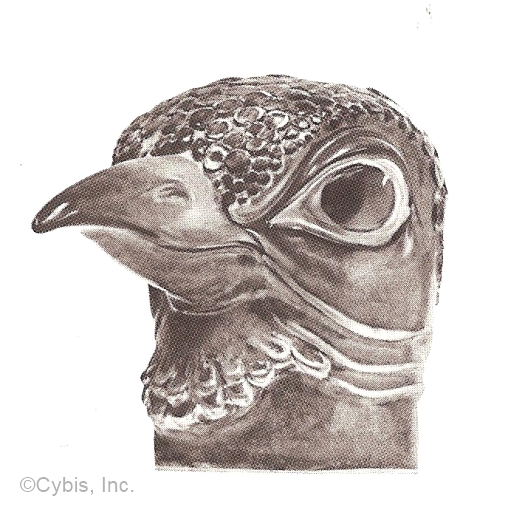
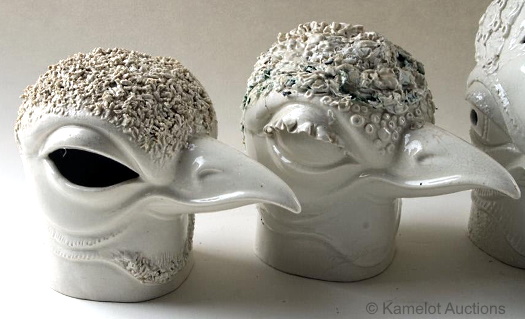
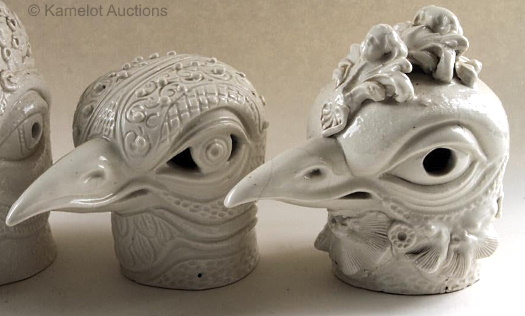 Here we get into the nitty-gritty with these glazed white bird heads that were among the back-stock in the studio’s 2019 liquidation auctions. The top image is a bird head shown in the 1978-79 Cybis catalog under the title Beaked Bird Head circa 1940s. The liquidation sale (Kamelot Auctions) photos show bird heads cited as being about 6” high and 10” wide. The ‘Bird’s Eye Lady Bust’ (as I’ve dubbed the one in Poland) has the same eye-area shape but has a different iris component and much more texture around it.
The various decorations on the Bird’s Eye Lady Bust (sausage-curl hair ringlets, dipped lace/fabric, and the style of the roses and leaves) all match what we find on Cordey items from the mid-1940s into (possibly) the early 1950s.
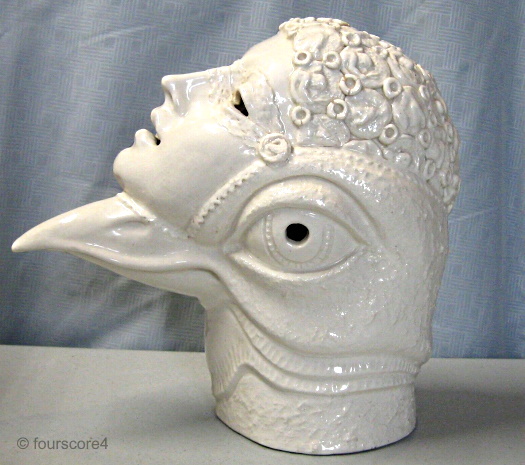
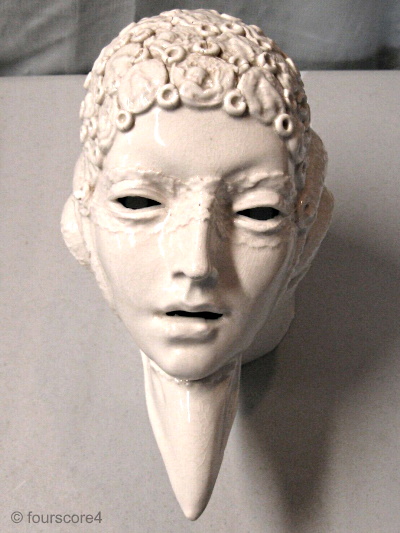 This similar bird/human combo (Bird/Lady Head) bust was part of the 2019 liquidation sales as well. Here the main sculpture is a bird, wearing a woman’s face as a sort of hat. The woman’s face is very much like the Polish one, but appears slimmer, especially around the chin. However, that may be a result of her needing to fit on top of the bird’s head without hanging over.
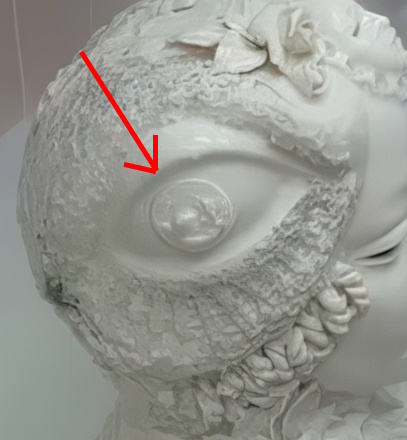 And we have a match between those two! The round medallion that serves as the bird’s iris on the Bird’s Eye Lady Bust is the same that forms most of the ‘cap’ on the Bird/Lady Head from the 2019 auction. My best guess for the ‘birth’ of the bust in Poland is the mid to late 1940s.
I am intrigued by the treatment of the base of the Bird’s Eye Lady Bust. Is it an actual wood block that was covered in porcelain slip and then fired? Or did they made a mold from a wood block and cast that? My guess is the latter, because if there is wood under the surface it would have begun to rot away over time. So, this piece is probably 100% porcelain throughout.
The article also mentioned that the head became very dirty while in storage at the Vistula Museum, so it was sent to
…the Zamoyski Museum in Kozłówka, to the conservation workshop, where, thanks to the kindness of the director of the local museum, Anna Fic-Lazor, it was subjected to specialized cleaning.
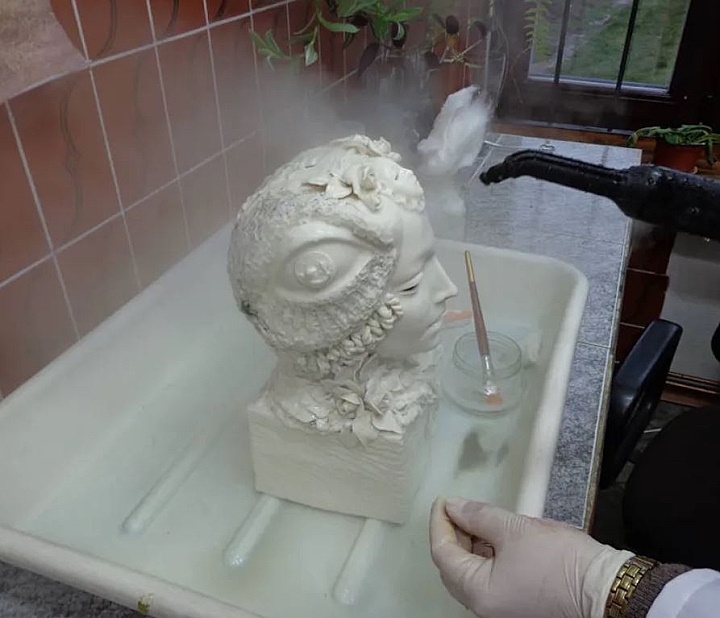
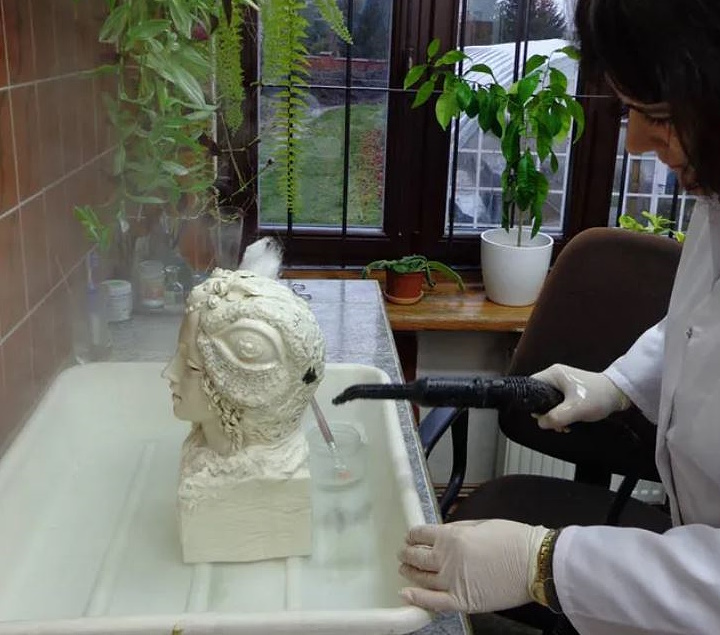
 These photos show the cleaning process. The Bird’s Eye Lady Bust was only on display for that 2015 holiday season.
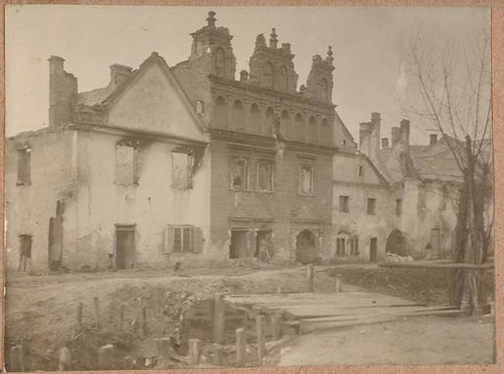 The museum in Kazimierz was once an apartment building, originally built during the early 1600s and privately owned. During the late 1800s it was used as a tannery before being mostly burned by the Russians during World War I (photo above showing the damage.)
 After the war, the Polish government bought what was left of the building and restored it for use during the 1930s as an art gallery. It has been a museum since 1964. This website has much more information on the building and its history.
Name Index of Cybis Sculptures
Visual Index (for human figures/busts only)
About the Cybis Reference Archive
What is Cybis?
Images of Cybis porcelains are provided for informational and educational purposes only. All photographs are copyrighted by their owner as indicated via watermark and are used here only as reference material. Please see the Copyright Notice in the footer and sidebar for important information regarding the text that appears within this website.
The Cybis Archive is a continually-updated website that provides the most comprehensive range of information about Cybis within a single source. It is not and never has been part of the Cybis Porcelain studio, which is no longer in business.
 THE CYBIS ARCHIVE