
During the early 1920s, Boleslaw Cybis had to flee his homeland and take refuge in Turkey. This period of time is very briefly mentioned in Cybis in Retrospect, but was a significant influence on his personal style. I recently translated some letters that the young artist of 25 wrote to his mother not long after arriving in Constantinople (present-day Istanbul). Notes and sources are given at the end of the post.
Letters from Constantinople in 1919
“I miss my mother again and it isn’t fun. I’m already in Constantinople, with no job, no money and nothing in sight. It’s true they keep promising me something here and there, but the second month is already over and there’s nothing. Also, I lost all my papers, they actually stole them from me in Feodosia, but I went there on impulse and now there is that seemingly insignificant nonsense added to the rest. I haven’t lost my spirits during these two months, but only God knows what will happen next. Constantly undereating has made me feel powerless, and hunger results in bad art.
Mother, what should I do? Can I go to your country? Invent a father? You are still there, alone among many, you have a son but he is gone. I’ll go to the Polish consul in a few days, maybe he’ll tell me something. Mother, don’t miss me and don’t cry.”
******
“Right now I’m sitting in one of the best theaters and restaurants in Constantinople, where I’m painting a sign. Size 21/2 × 5 pcs. They are supposed to pay me 5 lira. The second day of work is almost over. I am all out of money and I am hungry.
Thank God, I have tobacco, so that comforts me (Mary-narz gave me five cigarettes). The restaurant is called ‘Strelna’ and is run by Russian artists.
There are a lot of Russians here in Constantinople, but they are nothing like chickens! Bobrycki and I almost broke up because he is an incredible beast. A rare despicable man. Well, I’m finishing writing this because there’s a Greek sitting across from me eating a roll with cheese and looking at me unpleasantly, and I need to find a match.”
******
“I finished the sign tonight. In a few hours, the agent is supposed to come and get the sign. Then I will get the money. I have been hungry all week and only just now I have received five piasters and with them I bought a roll, which I have already eaten – I feel very weak. I’m exhausted.
Maybe God will send me a job or maybe he did, but life is not like that and it will be difficult.
Maybe I’ll be lucky [illegible] and I’ll be able to become a butler or a [illegible]. But it’s very difficult. I would like to work very much, I have so many good compositions in mind, but I have neither paint nor space. I spend the night in the yard near the wall, together with one sailor. Fortunately, the weather is good, it only rained once during the night. I caught a bit of a cold. This is all for now.”
******
“To all this, bad luck was added and this time I see no way out. In the morning when I was still sleeping against the wall, the inspector came and demanded documents. Well, I said that I was Polish, so they said “go to [illegible] and if you don’t, we will arrest you”. I couldn’t present any documents without having any documents. During the day I went to the consul, but it was too late, I could only ask questions and talk to the secretary, who could neither do nor tell me anything because I could not present anything. He told me to come on Monday (today is Saturday) and report the matter to the consul himself. Maybe they’ll arrange something for me then.
Well, I’ll try to hope! Because otherwise, without a passport and on the street, bad art awaits me. We’ll see.”
******
“I haven’t received anything for the sign yet, they say they haven’t yet paid my boss Milman, who takes advantage of my poverty and exploits me as much as he can. For example, he has now got a job as a decorator at Strelna and he has already delegated the job to me.
Right now I’m working on ‘Beautiful Helena’, which will be needed on Friday, today is Tuesday, I think I’ll be able to do it. I have already submitted the sketch and it has been accepted. Now I’m sitting and waiting for the canvas that they are going to deliver. It’s true that I don’t really know how to do these decorations, and I know that because I didn’t study naturalistic art, and this is where naturalism is needed.
But hunger isn’t my friend, I have to pay 15 liras, so I go on without thinking, what will be will be. My dream is to get a room. I’m a little hungry.”
******
“Now I’m sitting at the Polish consul and waiting. What will come of this is a big question, because first of all, I’m losing my job at Strelna because I only started the decoration for ‘Beautiful Helena’ yesterday. Secondly, I do not have any documents that would give me the right to obtain a passport. Well, we’ll see.
Yesterday I started decorating and to my great surprise, the director liked it, which was important. I just painted a few stone walls covered with ivy.
Today is Thursday, and ‘Helena’ will be shown for the first time on Sunday. I should make it. He’s going to be hit hard today because I haven’t been to the theater since this morning, and the play can’t go on without me.”
******
“I’ve been working for three days now. I handed over the walls and garlands to ‘Beautiful Helena’ [illegible] and now there’s no news on the passport. It didn’t work out [the rest of the page is illegible]
******
‘Beautiful Helena’ I did well. Yesterday was the main body of the decorations. Well, now I will be able to become a decorator without fear of not being able to handle it. It was a good test for me.
I haven’t gone to get a passport yet. What will happen with it? I haven’t received the money either. But there’s already a new job.”
******
“God help me, I got a new job, it is doing a curtain in a theater. I’m supposed to get 10 lira and create it in one day, alone. I took the job, we’ll see how it goes. Meanwhile, I don’t have any sketches either.
I’m writing this while sitting in a cafe in Zaułek near Pera. It’s raining. Lice are starting to eat me. I feel worse and worse.”
******
“Lice won’t leave me alone. I finished the curtain and it turned out perfectly. I got a new job, decorating ‘The Pub’ for the ballet. I’ll try to do that too. Then there are some more jobs upcoming. Maybe God will give them to me and I will be hired.
But with the Polish consul, it’s getting worse. I’m wasting my time and money on it. Eh! Nothing is going well for me. It’s been bad, but not as much as now.”
******
“Yesterday I spent the whole evening painting an advertising sign for Anna Stepova’s concert. I’m supposed to get 6 lira for two pieces. I didn’t finish one yesterday. But there’s not much left. This whole thing with the consul is taking up most of my time. But well, there’s nothing you can do.
I’m just afraid that the job at Strelna will disappear, but it seems to me that it shouldn’t.”
******
“Well, there you have it. I won’t get a passport from the consul. Bad, but not really bad, because I’ll somehow manage on my own. There is no work these days.
If this continues, the whole story will end badly. Tomorrow, at twelve o’clock, they’re going to invite me to play roulette, maybe I’ll get the Swiss player’s place there. That would be good. But these are just promises, so we’ll see what happens.”
****
“At roulette maybe they’ll tell me something interesting. I’ll go. I haven’t received the money yet. But the famine is now over. There is no work either, apart from advertising. I was looking for a room all the time, to no avail, because it was too expensive. One artist might give me a lead one of these days.
Day after day passes without meaning.”
Putting the Letters in Context
In 1917, Vladimir Lenin and his Bolshevik party seized control of the government of Russia in St. Petersburg in what’s known as the October Revolution. At that time, young Boleslaw served in the Ukrainian army and fought against Lenin’s forces. After the Bolshevik victory, he escaped to Turkey in 1919 and joined a number of other Russian and Polish artist refugees already in that city. Cybis in Retrospect’s timeline is wrong about this period: It says that he went there in 1921 and stayed until 1923, but a resume written by Cybis himself in 1925 says
Due to the Bolshevik mess, in 1919 I went to Turkey and spent 3 years in Constantinople. In 1922 I came to Warsaw…
Other sources verify that in 1922 that he was able to return to Poland by contacting his father, who sent documentary evidence from Poland that enabled him to get a passport. On July 20, 1922, Bolesław Cybis finally returned to Warsaw and enrolled in the Academy of Fine Arts.
In November 1918 the Allied Forces began the occupation of Constantinople, which meant that there was suddenly a great demand for music halls, cabarets, bars, and concert venues. This attracted a large number of performers, artists, musicians and restauranteurs. One of the most popular and successful of these ‘supper clubs’ was Strelna. Part of the memoir of a musician employed there at the time reads
We had filigree pavilions and fancy gravel on the walkways. The garden was flooded with electric lights, and this red glow could be seen from afar. […] For garçons we had society ladies and highborn aristocrats – not because this was our policy, but because such were the things in those days. Our cabaret was more than thriving. We were preparing a new performance – the Helen of Troy, with new Max Reinhardt-style tricks. Helen’s palanquin was brought to the stage by real Africans, some colossal guys from Nubia. Agamemnon rode on his donkey, while the King Menelaus, whom Polonsky played himself, arrived on the back of a traditional Turkish hamal porter. Add to this two orchestras, the corps de ballet, the choir, the original staging, the interaction with the public, the stunning lighting design, the colorful costumes – and you will understand what success our Helen of Troy enjoyed.
(Theatre buffs will recognize the name of Max Reinhardt who is considered the father of avant-garde stage productions.)
In such a city, the competition for jobs in the theatres, club, and cabarets was fierce. Boleslaw Cybis’ trouble with obtaining passage back to his own country was a more than typical bureaucratic snafu. In addition to a passport issued by the Russian Consulate, a person also needed a visa from the country to which they wanted to travel (in his case, Poland) and also visas from every country through which the person would have to pass while traveling. But the Russian Consulate at that time was refusing to issue a visa unless the destination country issued theirs first, along with some proof that when the person got there, he or she would be able to support themselves without governmental aid. Without papers of any kind for almost three years, Boleslaw Cybis was – in modern acronym parlance – pretty much SOL. It’s no surprise that he was sometimes reduced to sleeping on the street: “My dream is to get a room.”
Constantinople in the Early 1920s
 This photo shows one of the small theatres of the time (1920). The signs are in Turkish, Greek, and French – but the venue itself is called “The American Theatre”, complete with representations of the American eagle carrying the flag!
I am indebted to Ekaterina Aygün, who recently published her book Home Away from Home: Emigrant Artists from the Russian Empire in Istanbul, for the wonderful email conversations we had last year about Boleslaw Cybis’ time there. Among other insights, she explained that the “Bobrycki” mentioned in his letter is the artist Volodymir Bobritskiy, known later as ‘Bobri’. According to Wiki he was an artist, writer, composter and guitar historian. He earned his passage to the USA by designing sets for the Russian Ballet in Constantinople during this period. His association with Boleslaw Cybis began in 1917 when he was among the original ‘Group of Seven’ artists in Kharkiv.
Ekaterina’s fascinating web article A Walk Through the Russian “Montparnasse” in Istanbul mentions several places that would have been familiar to Boleslaw Cybis in 1919:
The Beyoğlu district, formerly called Pera, became an artistic, creative space that had a lot in common with the Russian artist enclave in Montparnasse, the district on the left bank of the Seine in Paris.[…]In the evenings, from 7 to 10 pm, the Russian painters were allowed to work in the studio not far from the Galatasaray High School…the studio’s visitors were mostly members of the Union of Russian Painters in Constantinople. Almost opposite of the Rose Noire, down Bursa Street…, you could find the Russian Lighthouse (Mayak). Mayak became perhaps the most important place in Beyoğlu, because it was here that a one-day exhibition of paintings was held in October 1921. It was hugely successful and initiated the formation of the Union of Russian Painters in Constantinople.
 This poster advertised just such an exhibition (perhaps the same one?) in 1921. It is very likely that Boleslaw Cybis would have shown his work there.
 The 1970s Cybis catalogs, as well as Cybis in Retrospect, mention that he painted a large sign for Nestle’s Chocolate while here. The sign in this circa-1920s photo (sorry for the bad image; it is from a scan of a PDF that included a scan of a very degraded photo) may not be that exact same one, but it would have been very similar.
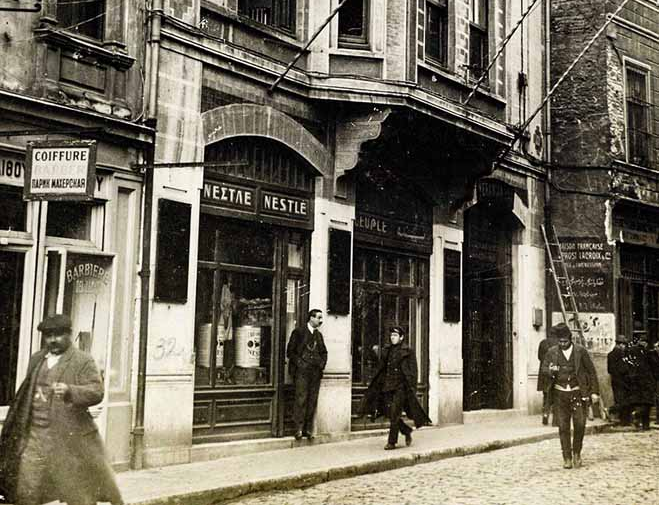 A typical Nestle store in Constantinople at that time. Note the tri-lingual signage; this was a very cosmopolitan, international city.
An interesting colorized and digitally enhanced antique early-1920s video of Constantinople can be found on YouTube. It has some excellent views of the city from the harbor, in particular, and includes some of the streets that perhaps Boleslaw Cybis walked during his three years there.
These letters written to his mother give us a much clearer picture of Boleslaw Cybis as a young man, away from home and family, and trying as best he could to survive. One wonders how many refugees in various countries today are experiencing something similar.
Sources:
(How to leave Constantinople in 1922) Published in the almanac Russkoe voskresenie [Russian Revival], January 1921.
(About the Strelna café) https://avezink.livejournal.com/285772.html
(Letters) Artist Bolesław Jarosław Cybis: a short sketch of life and work – Lubow Zwanko, 2018
A Walk Through the Russian “Montparnasse” in Istanbul – Ekaterina Aygün, 2023
Home Away from Home – Ekaterina Aygün, 2025
Name Index of Cybis Sculptures
Visual Index (for human figures/busts only)
About the Cybis Reference Archive
What is Cybis?
Images of Cybis porcelains are provided for informational and educational purposes only. All photographs are copyrighted by their owner as indicated via watermark and are used here only as reference material. Please see the Copyright Notice in the footer and sidebar for important information regarding the text that appears within this website.
The Cybis Archive is a continually-updated website that provides the most comprehensive range of information about Cybis within a single source. It is not and never has been part of the Cybis Porcelain studio, which is no longer in business.
 THE CYBIS ARCHIVE