
In 1935, Boleslaw Cybis and Jan Zamoyski were tasked with creating a fresco painting for the interior of the Military Institute of Geography in Warsaw. The Military Institute is an amalgam of different museums and study locations; for example, there is the Military Institute of Medicine, the Military Institute of Armament Technology, and so on. The Military Geographical Institute was founded in 1919, after the end of the first World War, in order to create a complete series of updated maps of the country.
During 1933 and 1934 a new headquarters building was constructed for the Geographical Institute, four stories tall and with a central hall. It was this hall that Cybis and Zamoyski were hired to decorate with a mural that would be almost 60 feet wide and 12 feet high. There was some disagreement among the Powers That Be (or, Were) over what the mural should depict. Initial suggestions included the 15th-century Polish navigator John of Kolno, or the 19th-century African explorer Stefan Szolc-Rogoziński. The latter ran into opposition when the inclusion of a tribe of indigenous African people was suggested. The ultimate choice was to show the more well-known historical figure Boleslaw the Brave traveling the country to establish the western borders of Poland. The official title of the fresco was The Heroic Acts of Boleslaw the Brave (which seems a bit redundant, but oh well.)

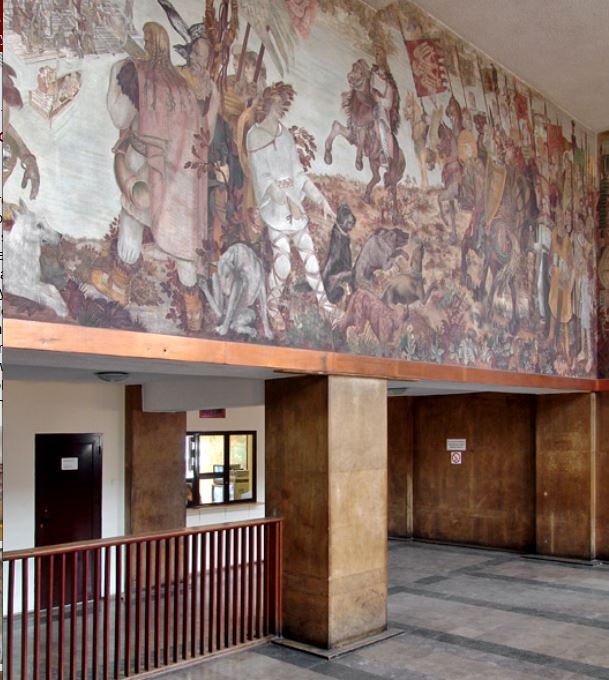
 Boleslaw Cybis and Jan Zamoyski had known each other from the early days of the Group of Seven and, later, the Brotherhood of Saint Luke. The creation of the fresco took two years; it was finished in the spring of 1937. The first image shows the fresco in its entirety as if it was stretched out, although the right-hand section actually wraps around a short wall. The other photos show where the fresco is in relation to the rest of the hall.
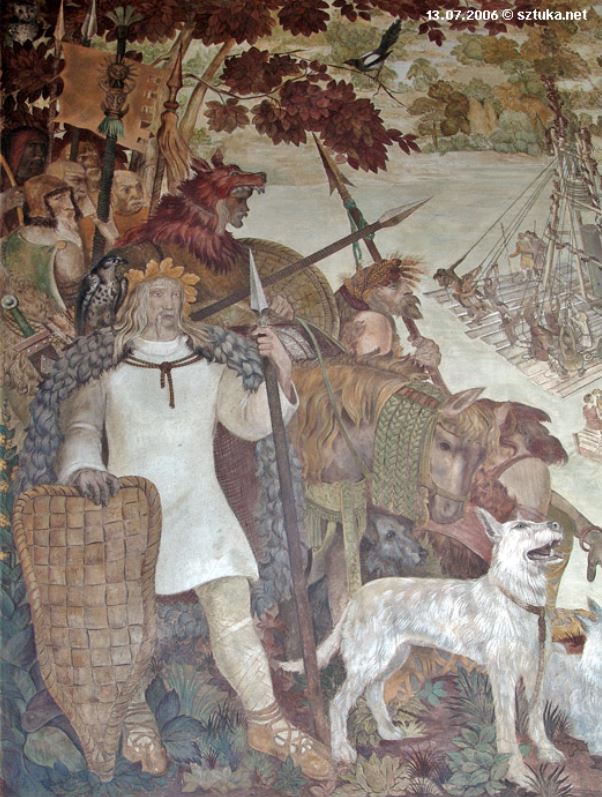 The far left edge of the left-hand section.
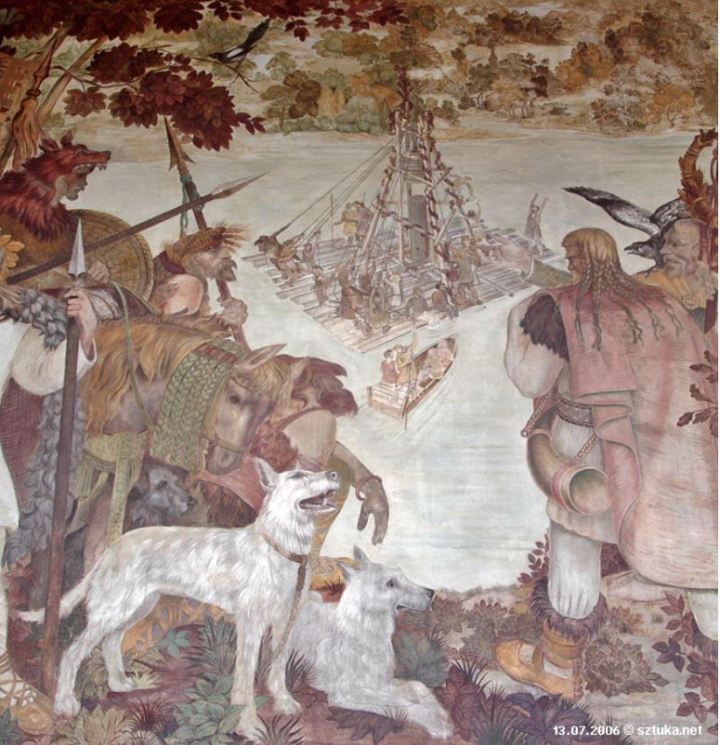 I can’t help but wonder what the team on the raft is doing!
 Even the dogs on the fresco are rendered with very realistic detail.
 In the central area, Boleslaw the Brave is shown in an appropriately-heroic pose on horseback.
 The flags flown by his retinue depict the various Polish territories.
 Again we have some great detail: a small green lizard scampers among the grass, and a young girl with bright blonde hair and a sweet expression stands next to her father, watching all the exciting goings-on as her father keeps a protective hand on her left shoulder.
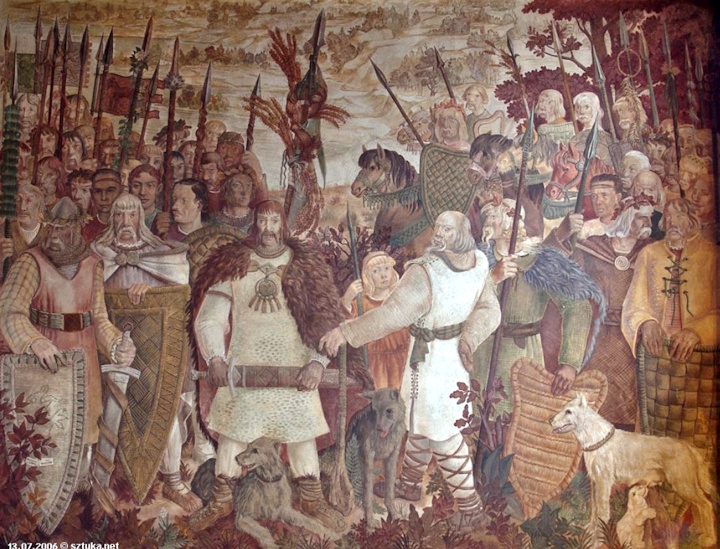 In the right-hand panel, on the short wall, we see another young girl. She’s wearing an orange dress and carrying a spear. And, of course, more dogs! Two of the men in this section are self-portraits of Zamoyski and Cybis; can you spot them? The answer is at the end of this post. :-)
 A closer view of the girl and her father, or perhaps uncle or grandfather.
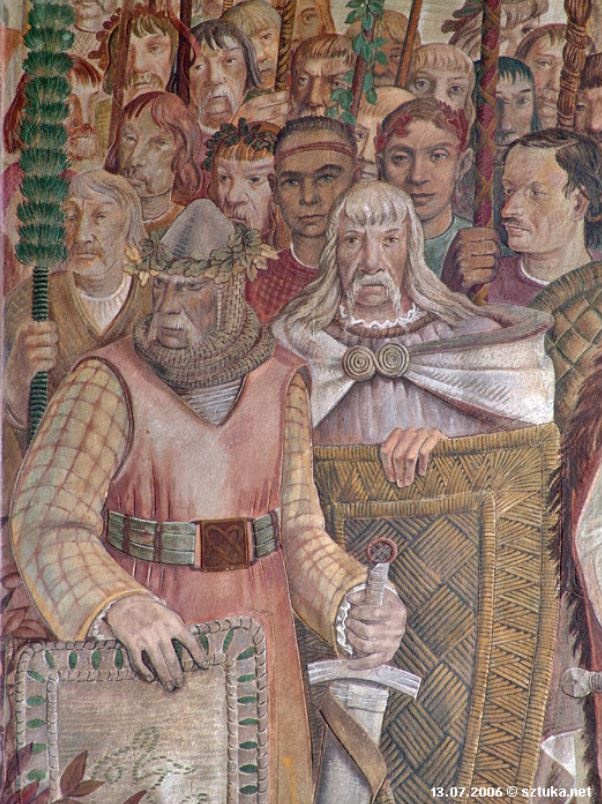 All of the shields in this fresco are depicted as woven of natural materials rather than being made of metal.
In 1939, less than three years after the fresco was completed and during the early months of the war, Jan Zamoyski was captured and sent to a POW camp. Knowing that Zamoyski had been one of the creators of the mural, German officers went to his wife’s apartment and demanded to know what event it represented. Mrs. Zamoyski, knowing full well that it represented an iconic Polish hero, replied that it showed “Polish people being driven into the Dnieper River” (thank goodness for that raft element!) which the Germans believed. Had they realized its true subject, the fresco surely would have been destroyed or at least massively defaced, as the original Polish Sky ceiling was. Even so, the Institute’s building was seriously damaged during the course of the war.
After the war ended and Zamoyski was able to return home, he tirelessly pressed the Polish government to approve and subsidize the restoration of the fresco mural. This was finally done in 1960, with Zamoyski’s assistance; the photos above are from that restoration. As part of the project, Zamoyski also created a new drawing of Nicholas Copernicus for the adjoining entrance; it can be seen through the doorway in one of the above photos. In his post-war life, he received many honors in Poland including the Cross of Military Virtue which is comparable to the Victoria Cross awarded in England and the Medal of Honor in the USA. Although he opted to remain in Poland, he kept in touch with Boleslaw Cybis during the 1940s and 1950s. His book describing the Brotherhood of Saint Luke was published shortly after his death in 1986, according to his wishes.
———
Locations of the self-portraits:


Name Index of Cybis Sculptures
Visual Index (for human figures/busts only)
About the Cybis Reference Archive
What is Cybis?
Images of Cybis porcelains are provided for informational and educational purposes only. All photographs are copyrighted by their owner as indicated via watermark and are used here only as reference material. Please see the Copyright Notice in the footer and sidebar for important information regarding the text that appears within this website.
The Cybis Archive provides the most comprehensive range of information about Cybis ever compiled within a single source. It is not and never has been part of the Cybis Porcelain studio, which is no longer in business.
 THE CYBIS ARCHIVE