
Although this site is laser-focused on Cybis Porcelain, I would like to add some recently-discovered information about the first Boleslaw Cybis large-scale commercial venture which was the Cordey China Company. As I describe in my History of Cordey China post, this was a partnership between Boleslaw Cybis and two Pennsylvania businessmen, Harry Greenberg and Harry Wilson, who already had a successful lamp manufacturing business (Arton Lamps and Touraine Lamps) in Philadelphia. The Cordey operation was launched in 1942. How was Cordey China faring, five years down the road?
A glimpse into its status was provided by a feature article in the October 1948 issue of the trade magazine Ceramic Industry News. It is titled Cordey China, New Jersey Creator of Old World Style Porcelain Pieces. The first bit of ‘new news’ for historical purposes is that this article answers the question of when Cordey production expanded from one of its original factory locations to the dedicated Cordey facility at 100 Enterprise Avenue in Trenton. I’d like to further dissect some of the information in the Ceramic Industry News article.
In the ‘Move to Trenton’ (from the Steinway studio in New York) paragraph, it says that
…Cybis with two partners rented a small building in Trenton. Thus, in 1942, the Cordey China Co. was born. The infant pottery employed six workers and was housed in a space 20 x 50 ft. The firm pioneered the production of mounted figurines ( i.e, figures with hand-formed additions of flowers, lace, etc. to the original body) in the United States.
The “small building in Trenton” was the first Church Street location which was indeed rented from its owner, Clarence Alderfer. Boleslaw Cybis purchased it outright in 1951. Judging from photos of #314, the 1000-square-foot building dimension cited in the 1948 article does indeed seem accurate.
As far as the claim of being the first to produce hand-decorated figurines in the USA, I take that with a very large grain of salt. I find it hard to believe that nobody was doing that on any sort of commercial scale. However, the only way to disprove it would be to find a vintage advertisement, dated 1941 or earlier, showing a similar figurine along with a manufacturer name that could be researched and confirmed as having operated in the USA at that time (this was waaay before the advent of offshoring.) To be honest, at this late date the Cordey decoration claim is not a hill that I have any desire to fight on.
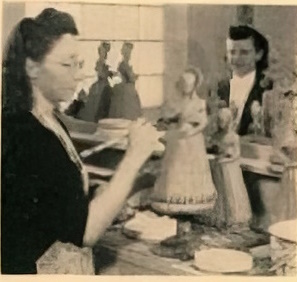 This accompanying photograph is captioned Lace, hair, flowers and other decorations are added to the basic cast shape in the area shown.
The second paragraph (‘Grow into Present Plant’) reports that
In July 1946 the firm moved into a large building in Trenton and continued its expansion. The structure and methods of production have been modernized and adapted to the newest techniques of art pottery making. A large part of the plant is air conditioned, and large areas of glass brick walls give it a light, airy appearance.
This shows that the combined Cybis/Cordey operation on Church Street lasted for only four years. Four employees of Cybis who began their work between 1963 and 1969 (before the studio’s move to Norman Avenue) have all described to me such working conditions as would not be tolerated nowadays: No heat, no cooling, inadequate ventilation, workspaces jammed so closely together that workers had to walk sideways, crab-like, in order to move between them, a constant hanging pall of cigarette smoke, a single tiny bathroom with a wonky door and unreliable plumbing….and an ever-increasing number of employees. There was no separate food space; employees had to either eat at their worktable, amidst paints and other chemicals, or sit outdoors in whatever weather prevailed. And all this for the princely wage of less than $2 per hour before taxes. (The office staff fared better, because their workspace was off-site in a rented room above retail stores on State Street.)
 This Sanborn fire map shows the layout of the Cordey factory described in this 1948 article. Although the map is from a few years later, it does accurately show the various areas. The article continues,
The plant’s focal point is an Allied circular tunnel kiln. In it the pieces, including the new line of dinnerware that Cordey is starting to produce, are fired to Cone 7. This firing is followed by hand decoration of the ware.
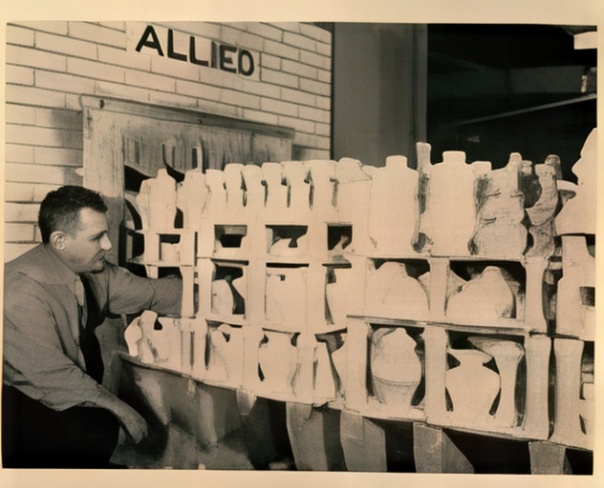 There’s a lot to unpack here. But first let’s look at this accompanying photo which is captioned Boleslaw Cybis, president and founder of the company, inspects ware as it emerges from the kiln. I should mention that because the original JPEG scan of the article is not large, the image portions were even smaller and needed to be upscaled by multiple factors. Digital upscaling inevitably introduces artifacts because the software needs to create additional associated pixels. Although I have one of the best software apps for that (Topaz Gigapixel 8), the massive upscale resulted in the unavoidable distortion of many curved shapes such as the greenware vases and Boleslaw Cybis’ face. However, we do the best we can with what we’ve got. ;-)
Let’s talk about that dinnerware mention. The article’s photo of a five-item grouping (coffee pot, teapot, creamer, dinner plate, cup and saucer) is captioned Part of a set of Cordey dinnerware. The firm has just recently entered the table china field.
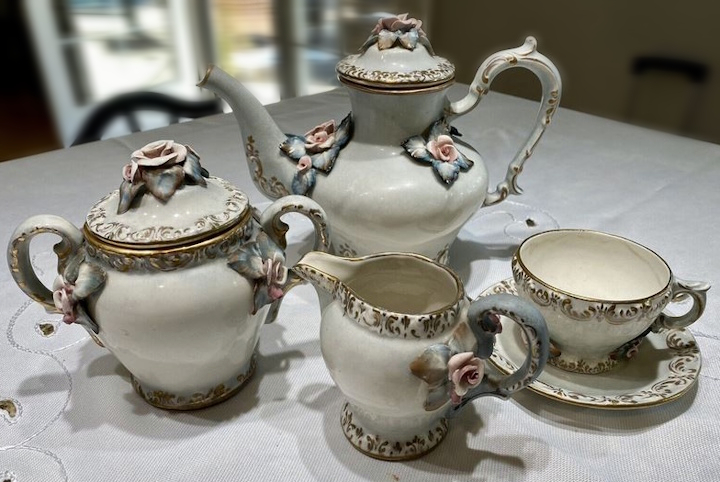 That photograph was so poor that Gigapixel figuratively threw up its AI hands and declared “Sorry, got nuthin’ to work with here’” …but luckily I was able to find an archived eBay listing of the exact same Cordey group, lacking only the dinner plate!
 It is interesting to note that this circa-1947 Cybis-marked tea set is not cast from any of the same molds as the 1948 Cordey ware shown above, even though most of the early-1940s M.B. Cybis-marked items did use Cordey molds.
Getting back to that 1948 article text,
A second firing in one of the plant’s three decorating kilns completes the job, and the ware is ready for final inspection and shipping. […] The plant now employs 250 people and produces 25,000 pieces of delicate Old-World style ware per month.
Now let’s talk a bit about those 250 employees in 1948. In 1953 a lawsuit was brought against Cordey, at this same Enterprise Avenue location, on behalf of six employees and District 50 of the United Mine Workers of America. The filing in the Chancery Division of the Superior Court of New Jersey states that “approximately 50 of a total of 85 employees had signed cards indicating their desire that the defendant union be their bargaining representative.” This shows that – assuming the 1948 reporting of a complement of 250 workers is accurate – the number of Cordey employees fell by 66% (a loss of 165 workers) in four years: From approximately January 1949 to February 4, 1953 which was when the union organization occurred. That is a HUGE drop in staffing, especially for a time during which the home-decor market for the rising middle class was booming. What was going on at Cordey during the four years after the Ceramic Industry News article was written?
This becomes even more puzzling when we consider what was going on ‘down the road’ at the Cybis studio on Church Street at that very same time. As outlined in my recent post about the newly-discovered D’Orsay and Americana brand entities, it looks as if Cybis was expanding whilst Cordey was dwindling. I now feel that it is no coincidence that Cybis was registered for the first time as a New Jersey corporation in November 1953. I would also very much like to know how many Cordey workers shifted over to Church Street in order to create those overcrowded conditions described earlier…although one has to ask, why would anyone leave a large, bright, air-conditioned workplace for someplace with physical conditions so much worse? Other records show that at least two employees (Ginny MacCotter and Dorothy Kaminski) did exactly that.
Boleslaw Cybis died in 1957 but we don’t know whether he ended his involvement with Cordey before that date. Either way, Cordey declared bankruptcy in early 1959 and the physical inventory was sold at two auctions held on the same day (May 7, 1959) at each plant.
Other Publications Mentioning Cordey
Three other vintage publications describe the Cordey China Company in detail. One, which I would like to access but am unable to, appeared as a small article in a 1955 issue of Ceramic Age magazine. A search-result snippet mentions that the collection of
…block and case molds in the shop contains over 2000 items that have been produced since 1942 when Cordey was founded.
and goes on to describe elements of the process of assembling lamps. Because Cordey lamps were produced in both the Trenton and Philadelphia plants, it’s impossible to know which location the 1955 article is describing.
In 1973, Spinning Wheel magazine contained an article about Cordey which was aimed at collectors. It cites the same employee and production quantity numbers as the 1948 article which it clearly drew from, but it goes a step farther by mentioning a factor that accounts for the dramatic employee-number drop.
The Korean War seriously affected Cordey and other American factories using skilled low-cost labor. Wage levels in the United States were drastically increased during the Korean War as skilled labor was drained away from low-paying ‘non-essential jobs’ into higher paying defense and large scale manufacturing jobs.
And here we have the reason for that two-thirds drop in Cordey plant staffing, in a nutshell: The Korean War began on June 25, 1950 and ended in July 1953, and the involvement of the USA was immediate. (Fans of the classic television series M*A*S*H probably figured out the connection in short order.)
The article goes on to explain an associated reason for deleterious effects on Cordey:
[Thus,] the American pottery industry was faced with a sharp increase in production costs at a time when foreign wares from Japan, Italy, Britain and Germany began to pour into the United States. Literally hundreds of American potteries began to close down from 1950 onwards.
Although this insight accounts for what led to the decline and demise of Cordey, it also raises big questions about why Boleslaw Cybis would launch two new commercial brands – D’Orsay China and Cybis Porcelains – during that same early-1950s period in which Cordey was clearly floundering. The intense focus of circa-1950s Cybis on religious figures can be explained by a decision to target a reliable niche market, but what about D’Orsay? Was it intended to be a replacement for Cordey, or merely a shell (paper) company by which to move funds around during a time of reorganization? Was it the original name of what we today know as the 1953-2020 Cybis porcelain studio? These questions are intriguing but, due to Theresa Chorlton’s failure to preserve the surviving Cybis studio records, we will never know the answers.
The third published article about Cordey appeared in the 1982 Schiffer publishing book Art Pottery of America by Lucile Henzke. The seven-page chapter skims the history of both Cordey and Cybis. Among the bogus information offered is that Boleslaw Cybis “studied in Saxony and Turkey” (he never lived in Saxony/Germany and was a street-artist refugee when in Turkey), “worked with Picasso and Cezanne” (there is absolutely no evidence that Cybis ever met either man), that the first studio inside the Steinway Mansion “overlooks Long Island Sound” (it is nowhere near the Sound, but does overlook Bowery Bay and the Rikers Island Prison), and – most misleading of all – claimed that many Cordey pieces were made of papka and that porcelain wasn’t used for Cordey until 1955…which is the craziest claim about Cordey that I’ve ever read! No piece of Cordey was ever made of papka. Five of the seven pages are photographs of Cordey items from the author’s collection; ironically, all of them are clearly made of porcelain.
This is the third and final Archive post about Cordey; the others cover the company history and their collectible Christmas trees. We will never know what led to the Chorltons’ decision, after taking over the studio ownership in 1958, to utterly erase Cordey from the official version of Cybis history. There is absolutely no acknowledgment of its existence anywhere in any piece of Cybis-produced literature. To my mind, this reeks of an ugly corporate divorce, especially in view of the fact that so many of the 1940s M.B. Cybis -marked pieces are Cordey clones. For the Chorlton-owned studio to have so deliberately and thoroughly disassociated itself from everything Cordey, there must have been more going on after 1950 than merely a disappointing market share, and/or union troubles, on Cordey’s end. It is noteworthy, however, that Joe Chorlton went to extraordinary lengths to avoid any unionization of the Cybis shop.
It also didn’t escape my notice that the pronunciation of Cordey (cor-DAY) and D’Orsay (dor-SAY) are remarkably similar. If I were trying to deliberately annoy an ex-business partner, a subtle dig such as that would very tempting….
We now return you to your regularly-scheduled Cybis programming. :-)
Name Index of Cybis Sculptures
Visual Index (for human figures/busts only)
About the Cybis Reference Archive
What is Cybis?
Images of Cybis porcelains are provided for informational and educational purposes only. All photographs are copyrighted by their owner as indicated via watermark and are used here only as reference material. Please see the Copyright Notice in the footer and sidebar for important information regarding the text that appears within this website.
The Cybis Archive provides the most comprehensive range of information about Cybis ever compiled within a single source. It is not and never has been part of the Cybis Porcelain studio, which is no longer in business.
 THE CYBIS ARCHIVE