
A cache of vintage documents recently obtained from the Syracuse University holdings contained a surprise: Two additional named companies associated with the Cybis studio! These business entities/brands were created after the establishment of the Cordey China Company but before the formal registration of Cybis Porcelain as a business entity in the state of New Jersey. The big question is, Why? What was their purpose? The two companies were named D’Orsay China and Americana.
D’Orsay China
A forensic analysis of the D’Orsay documents raises even more questions, because there is no record of a company by that name ever being formally registered in New Jersey. Search engines provide no examples of objects branded as D’Orsay China, although there is a dinnerware pattern by that name. The Syracuse documents consist of one folder of bank records, covering approximately three years of checking-account activity during the early 1950s. Let’s take a look at what they show; the most relevant data points are in bold text. (Publishing an image of the actual document is prohibited.)
The bank-statement images show that the account was held at The Security National Bank, in Trenton; this is the first anomaly, because an AI search showed that a ‘Security National Bank’ in NJ was not established until 1965…and even then, it was in Newark, not Trenton. Things get even more puzzling from there!
Update, July 2025: Thanks to a helpful Archive reader, I now know that there was a branch of that bank at the corner of North Olden and Brunswick Avenues which was the ‘Polish section’ of Trenton during that time. It is very likely that this was the branch where the accounts discussed here were held.
The address on the statement is D’Orsay China, 314 Church Street, Trenton, NJ. This is definitely one of the two Church Street buildings that Boleslaw and Maria Cybis bought from Clarence Alderfer on February 20, 1951. Alderfer had been the landlord from which they had been renting those studio buildings (#314 and #316 Church Street) for at least a half dozen years; prior to that, Alderfer had operated a ceramic studio or factory in them. The Cybises took out a $4000 mortgage from a private individual (Mary Gritzner) in order to finance the purchase of the two buildings; I have no idea who Mary Gritzner was.
The earliest statement is dated May 1, 1951 and shows a balance forward of $369.50. This indicates that the account was established earlier, but doesn’t indicate how much earlier. Was it established after the Cybises purchased the two buildings, or did it exist prior to that? On May 22nd, a $50 deposit was made. Two deposits of $100 each were made in June, bringing the balance up to $619.50 (a quick comparison: That would equal about $7660.00 in purchasing power today.)
In July 1951 we begin to see checks clearing: $4.25 to State Sales Office Equipment, $3.79 to PSEG (Public Service Electric & Gas), and two checks ($55 and $250) made out to Steve Erdelsky. A web search disclosed that Stephen Constantine Erdelsky (1903-1976) was born in New York City but moved to Hamilton Township in NJ when he was in his mid-twenties. He worked as a “rigger and trucker”; one of his employers was the Marshall Maintenance Company. What kind of work was he doing for Cybis in the summer of 1951?
In August 1951 we see a $200 deposit, and a check written for $4.50 to the Trenton Waterworks. In September, two more checks cleared: one for $16.70 to Merrill Bowden, and for $47.60 to Builders Lumber Supply. Merrill Bowden was a mechanic in his mid-thirties who was renting quarters in Trenton at this time. These recent expenses suggest that some renovation was being done to the studio buildings that the Cybises had bought outright in February. For the rest of 1951, this trend continues: another $25 and $24.18 to Merrill Bowden in October and November, and $8 to Bilbee and Craig although there’s no indication of what sort of company that was.
We continue to see monthly checks written to PSEG (always less than $5) and to Trenton Waterworks (between $4 and $5). It is via the cleared checks on the June 1952 statement that things really get going as far as what appears to be a significant renovation (or perhaps a complete gut-and-rebuild?) of the Church Street studio. Here are the payees from the D’Orsay account during 1952:
Prior Typewriter Company $27.50
Builders Lumber & Supply $47.99, $6.75, $36.24, $62.31, $7.56, $16.03
Trenton Lumber Millworks $32.85, $31.63
Unique Kilns of Trenton $300, $100, $100
The Carl H(illegible) Company $300
Morton Moulds $200, $100
Stevens-Peterson $100
Unique Kilns of Trenton had their office at 724 Bunker Hill Avenue and a manufacturing plant at 530 Spruce Street. A vintage advertisement during that period describes them as selling “Small Gas Fired Kilns, High Firing Electric Kilns with Kanthal Elements” and that their customers included Alfred University which already had a ceramic-arts program. (In later decades, the Cybis studio donated a collection of porcelain to that same university.)
We see more individuals being paid by D’Orsay China in 1952 as well. Joseph Viscocka received almost $250 during that year and John Wojtera was paid about $65. Mr. Viscocka is interesting because he was 10 years older than Boleslaw Cybis and was born in Lithuania. Living in Trenton with his wife and adult son, he was 65 at this time and listed his occupation in the 1950 census as “carpenter” and “factory handyman.” So now we have a very good idea of who was working with all of that purchased lumber!
Other individuals who received D’Orsay checks in 1952 included Hugh McCaulay (a 31-year-old mold maker), Rodney Rouse (a 19-year-old warehouse worker with an interest in art), and Harry Bodine (owner of a wholesale coal and fuel oil business in Trenton.) At the end of December 1952, cash payments were made to a lighting supplier and to the J.F. Morton Mold Company. At the end of 1952, the D’Orsay account still had a net balance of almost $700.
The checks themselves present a baffling scenario, because they were all signed by the same person: Doris D’Orsay. The 1950 Federal Census is available online, and so I went looking for Doris because hey, she was signing checks in 1951, so it should be a slam-dunk. Nope. There is no Doris D’Orsay (or Dorsey, or any imaginable permutation of that name) in the 1950 Census in New Jersey. I even checked Pennsylvania (because she could easily commute; the state line isn’t far) and New York (highly unlikely, as it’s a minimum 2-hour drive to Trenton, but she could have moved from NY to NJ after the 1950 census was taken) as well. No Doris anywhere. And yet…every check in these records is signed D’Orsay China – Doris D’Orsay. Frankly, I’m stumped! Did this woman really exist??
The construction frenzy on Church Street really ramped up in 1953, as evidenced by the following cleared checks between January and July:
Strawbridge & Clothier (a department store) $118
B.F. Drakenfield Company (ceramic paints) $9.42,
Unique Kilns of Trenton $225, $100, $200
D(illegible) Roofing $35
Millner Lumber $31.84
Trenton Lumber & Millwork $18.64, $31.07
Builders Lumber & Supply $27.82
United Clay Mines $31.38
Hovey Spray Equipment Co, $125
Frank Kubiak Electric $375, $172, $30.81
Payments to individuals such a Joe Viscocka, Martin Gessnis, Ted Turski and John Zinzek also occurred. However, a significant addition to that list happened in July 1953 because we begin to see two familiar Cybis names for the very first time: Annamarie “Ginny” MacCotter and Dorothy Kaminski, hired as decorators (painters). Both were being paid an hourly wage out of the D’Orsay China account, roughly every two weeks.
The flurry of check-clearing became a blizzard in October and November 1953. Because these checks cleared during those months, they likely were all written in September and October.
The Shade Shop $15.21
Norse Company $1.10
Angelo Bros $78.96
Watkins stove company $29.95
United Clay Mines Corp $52.00, $69.11
L. & L. White Metal Casting Corp $15.61
Innocenzi $10.50, $10.50
Frank Kubiak $31.50
Unique Kilns of Trenton $144.00, $100
Quaker City Felt Co. $4.62
Heidel Supply House $2.50
Ceramic and Plaster Arts Co $10.00
CTN Electric Motor Service $8.00
PSEG $55.69
Kuhn (or Kohn?) & Schildkraut $150.00
NJ Bell Telephone Company $35.00
Holland Mold Shop $38.25
R.W. Holt $300.00
Wm. Domanski and Sons (plumbers) $30.00
The Tattersall Co. $17.63
Barry Products Corp $46.60
Museum Pieces Inc $18.50
Checks written to Cash: $190.53, $10, $185.09, $146.06, $134.35, $22, $159.79, $29.97, $117.78, and $185.12
Perhaps most intriguing is the check to Museum Pieces Inc. I discovered that this company created reproductions of antique and vintage sculptures during the 1950s and 1960s; their 1950s catalogs advertised “Museum sculpture reproductions made from the originals” and “Handmade Sculpture Reproductions.” I would love to know what reproduction Cybis bought, and for what reason! Was it for their home garden? Or to be copied as a retail piece?
Deposits made into the D’Orsay Checking account were erratic. For example, there were none at all between November 1951 and April 1952, but starting in July 1952 there were several round-number deposits ranging from $200 to $400 each. During the summer of 1953 they became more frequent, totaling $900 in July, $900 in August, $2000 in October, and $425 in November. At the end of November 1953 there was $20.43 in the account. A final cleared check in December 1953 brought the balance down to 59 cents. The D’Orsay account had no further activity during the first four months of 1954, and was zeroed out/closed on May 13, 1954.
The company that we know as Cybis Porcelain was registered as a New Jersey corporation in November 1953. This meshes with the cessation of activity in the D’Orsay bank account.
Americana China
There is far less information about this company, but it actually isn’t a complete bolt from the blue because we’ve seen this name before….although only in one publication. The 1971 New Jersey State Museum exhibit catalog for Cybis in Retrospect, in section 8 which is titled ‘Reproductions’, this is the first paragraph:
Spatterware
Colors: yellow, red, blue, green.
Decorative motifs: rooster, school house, peacock, rose.
Marks: “CYBIS” in sans-serif capitals impressed, “AMERICANA” in capitals impressed, an eagle in a circle impressed.
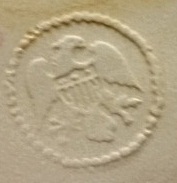 Although not illustrated in the exhibit catalog, two of these mold impressions (the CYBIS name mark and the circled eagle) are shown on page 108 of the 1978 Cybis catalog. A date range of 1947-1951 is shown beneath the eagle-mark illustration, but only a start date of 1945 below the block-capitals CYBIS name.
The eagle mark has been found on pieces that also have the Cybis name in some format.
 The AMERICANA mark is not mentioned in any Cybis-printed publication, but thanks to New Jersey State Museum Curator Nick Ciotola, I have this photo of the mark which appears on the reverse of a Schoolhouse-motif spatterware plate in their collection. There is no other maker’s mark on the plate. I never had any inkling that ‘Americana’ was anything but a sort of series name (if that) for the spatterware items; the idea that it might be an actual brand never occurred to me!
Nevertheless, the circa-1950s bank statement folder contained three pieces of evidence that this was indeed the case. First, a single Security National Bank statement/book with this account address:
Americana
c/o Marylin Kozach [sic]
68 N. Clinton Ave.
Trenton, N.J.
The date of the statement (September 4, 1951) shows a Balance Brought Forward of $214.44 and below that, a check on September 11th of that same amount, resulting in a zero balance. There is also an image of the canceled check, made out to Cash, and signed Americana – Marylin Kozuch, along with a blue-pen notation – probably by the bank teller – in the lower left corner saying closed. And finally, the September 1951 account statement for D’Orsay China showing a deposit of $214.44 into that account on September 11th.
I immediately looked in the 1950 Census for Marylin’s home address and found that it matches the address on the Americana bank book/statement. The address was an apartment building and Marylin is shown as age 28, her occupation given as “personnel manager”, her employer as “artistic novelty company”, and living in Apartment #2. Also living in the apartment is Lois Carey, age 23, with her marital status shown as ‘separated’. However, Marylin’s is shown as ‘married’, which is puzzling. Then again, census takers have been known to make mistakes (that’s the understatement of the year!) so it doesn’t necessarily mean that Marylin and Joe were already married in 1950 [but they could have been.] Another oddity to add to the pile is that in the column asking for the relationship of each person in the household to the other(s), Marylin is shown as “partner”. That does prompt the question of why Marylin’s home address was being used in connection with a business identity (Americana).
Dollars and Cents
Just in case the dollar amounts described in this post sound miniscule to some readers, I want to put them into perspective. Among the other documents in the cache were some payroll records from 1954; this is what people who worked for Americana/D’Orsay/Cybis were being paid during the mid-1950s.
Mildred Hillman, finisher – $1.31/hour
Joseph Nosari, caster – $1.45/hour
Elsie Matelski, decorator – $1.50/hour
Dorothy Kaminski, decorator – $1.60/hour
AnnaMarie (Ginny) MacCotter, decorator – $1.73/hour
Leon Koury, chemist/slip creator/caster – $2.00/hour
All of the salaries listed in the 1954 records range from a low of 99 cents/hour (only one of those; the next lowest was $1.05) to a high of $2/hr for Leon Koury whose job – creating the liquid porcelain from which all the pieces were cast – was absolutely critical. The majority of the salaries fall between $1.30 and $1.60 per hour. All before taxes, of course!
So the average Cybis worker in the mid-1950s was making perhaps $60 gross for a 40-hour week. For example, Victoria Moroz (whose job description I do not have) who was being paid $1.60/hr took home $53.32 for her forty hours of work. This hourly wage was actually in line with the average for a skilled hands-on worker, such as an auto mechanic, at that time.
Questions, Questions!
The list of questions that these mere three years of bank records poses is frustrating, to say the least. For example,
– Were all of historical reproductions originally intended to be an actual retail brand (i.e., Americana China), as was Cordey China at that time? We know that Boleslaw and Marja had a very large collection of antique transferware which was the inspiration for the reproduction pieces that were made.
– How long did the Americana company identity exist? Cybis in Retrospect indicates that the historical reproductions were made between 1948 and 1952. Did the bank account exist for all of that time and if so, where are 1940s records?
– Why was Marylin’s personal address used for the Americana bank account, instead of either 314 or 316 Church Street?
– Was the Americana account closed because it was decided to no longer make any of the spatterware and/or the historical reproduction items? Was it because they simply didn’t sell very well?
– What was the purpose of creating a brand or company named D’Orsay, and who the heck was Doris D’Orsay? Was she an actual person and if so, what connection did she have to Boleslaw or Marja Cybis?
– Why can no record of anyone named Doris D’Orsay be found in either the 1940 or 1950 Federal Censuses?
– Did D’Orsay China ever produce any physical items under that branding, or was it simply a ‘paper company’ for the purpose of moving money in and out of an account (such as renovating the recently-purchased Church Street studios)?
– Why were Ginny MacCotter and Dorothy Kaminski initially paid from the D’Orsay bank account instead of from the Cordey China Company account?
After the Cybis studio name was registered in New Jersey in November 1953, a new bank account under that name must have been opened – which means that the D’Orsay China account was no longer necessary. This easily explains the lack of activity in that account after that same month, and then its final closing after six months of inactivity (May 1954.) But of course the biggest question is
Why ‘D’Orsay China’ at all? Were the non-Cordey and non-Americana items originally meant to be branded as D’Orsay items rather than as Cybis items?
I tried to think of possible reasons and came up completely empty. I even looked into their citizenship status, but it doesn’t match up. Boleslaw Cybis applied for a Social Security number in March 1941; in July 1942 he filed a declaration of intention to become a US citizen; I did not find the record but assume that Marja did the same at about the same time. She became a citizen in May 1948; Boleslaw was naturalized in November 1949. However, Boleslaw was a partner in the Cordey China Company before he became a citizen, and Marja bought property in Trenton in 1947. So their immigration status seems unrelated to the existence of D’Orsay.
This new information expands the list of company names/brands that are directly associated with Cybis porcelain. In chronological order, they are:
Cybis Art Productions (the original studio name in 1940)
Cordey China Company (1942-1957; a partnership, with a factory in Philly and in Trenton)
Americana (1948?-1951 for spatterware and other historical reproduction items)
D’Orsay China (1951?-1954; a shell company? or the original name for what we now call Cybis??)
Cybis Porcelains (1953-2020? formal corporate dissolution status is uncertain)
The existence of D’Orsay during the early 1950s throws the assumption that the Church Street studio buildings “produced Cordey and Cybis items” into serious question. We know that starting in 1946, the Cordey items were made at an entirely separate location in Trenton (100 Enterprise Avenue.) Were Ginny MacCotter and Dorothy Kaminski initially hired to work at Enterprise Avenue and then moved to Church Street during or after the 1953 labor union issue? It’s definitely possible, especially if they chose not to participate in the strike that some of the other employees called in March of that year. It’s worth noting that although Ginny and Dorothy were paid “by D’Orsay” in 1953, the 1954 salary snippets originate from Cybis rather than D’Orsay because the D’Orsay bank account was not used after December 1953.
If only I could find the elusive phantom signer, Doris D’Orsay…!
Name Index of Cybis Sculptures
Visual Index (for human figures/busts only)
About the Cybis Reference Archive
What is Cybis?
Images of Cybis porcelains are provided for informational and educational purposes only. All photographs are copyrighted by their owner as indicated via watermark and are used here only as reference material. Please see the Copyright Notice in the footer and sidebar for important information regarding the text that appears within this website.
The Cybis Archive provides the most comprehensive range of information about Cybis ever compiled within a single source. It is not and never has been part of the Cybis Porcelain studio, which is no longer in business.
 THE CYBIS ARCHIVE