
SPECIAL NOTE: I originally wrote this post in 2017 for my personal blog site, which I discontinued a few years ago. Because Brielle Galleries was in large part responsible for kickstarting the Cybis studio’s success, I have resurrected the post and added some new images and information.
Most of us have a few special places that once – as the Beatles so aptly put it – “had their moments” setting them apart in our memories as something special; the quintessential gone-but-not-forgotten. For me, one such place was Brielle Galleries, a unique store owned by Ira Jacobson.
1950 – 1970: Launch and Growth
The store’s history begins 75 years ago. Ira’s parents were partners in a small New Jersey produce company which, in 1950, the other partners decided to dissolve. Among the assets allocated to the Jacobsons was a small parcel of land in Brielle, a shoreline community, at 707 Union Avenue. On that land was a small 1800-square foot building whose tenant, an antique shop, hadn’t been doing well….probably because a highway overpass was in the process of being constructed right over that location. Ira’s mother, Tillie Jacobson, decided to turn it into a gift shop despite the fact that the former tenant had left it in quite a mess. It needed a tremendous amount of work and lacked air conditioning or even proper ventilation. After assisting with the cleanup and renovation process, young Ira decided to work there full time at a salary of $25 per week. The new shop was named Brielle China and Glass. There was enough customer response that in 1951 the family invested $15,000 in order to increase the size of the building to 4100 square feet and install air conditioning, a proper heating system, and carpeting.
In 1951 the store’s stock was moderately priced table settings, glassware and assorted gifts but Ira wanted to bring in higher-end items. He especially noted the porcelain figurines being sold by the newly launched Edward Marshall Boehm studio in Trenton with prices ranging from $150 to almost $20,000. Contrary to popular retailer practice, Ira wanted to devote entire room areas to a single brand instead of mixing the items together; another innovation was putting actual tables set with china, as would be seen in a home setting, on the display floor so that customers could see how their dining room tables would actually look. Business steadily increased and in 1954 they were able to add additional square footage until finally, in 1964, the main floor totaled 8200 square feet; a second and third floor was also added to the rear portion of the structure.

 By the end of the 1960s it became clear that the store was still not large enough to accommodate the range of goods that Ira Jacobson wanted to offer to customers, nor – despite the ongoing improvements – have the upscale and arresting appearance that he was aiming for. The shop was expanded to 15,000 square feet and the façade was redesigned entirely in glass, which allowed the seven Waterford crystal chandeliers placed throughout the store to be seen from all sides. The interior lights were on each day from 9 a.m. opening until 11 p.m., allowing the store to glitter temptingly at passers-by. (Black and white photos are from Ira’s 2008 memoir, A Quest for Excellence.)
Marketing was Ira Jacobson’s forte and he employed several innovative methods. One of his earliest campaigns was to hire a small plane out of the nearby Lakewood airport to fly along the beachfront to the Oceanport area and back again, towing a banner advertising the gallery. In this way he could reach more than a half million beachgoers at the miniscule cost of only $300 per flight!
Another advertising method that would prove to be prophetic occurred in mid-1969 when the renovation shown above was completed: Ira held a small show, by invitation only to the store’s regular customers, to celebrate the event. It was the first occurrence of something that would eventually become a staple of the gallery’s ongoing reputation.
1970 – Late 1980s: The Boom Years
By the early 1970s, Brielle China & Galleries was offering an extensive collection of the best known brands of china and crystal but Ira had yet to secure one elusive vendor: the Boehm studio. Although he’d approached them initially, Boehm declined the opportunity; they were already working with Atlantic City retailer Reese Palley and didn’t think they needed another Jersey Shore outlet. So Ira turned to Boehm’s main competitor, also located in Trenton – the Cybis Porcelain studio owned by Marylin and Joe Chorlton. He also obtained retailer contracts from several international porcelain studios, prompting the New York Times to run an article titled ‘Shop is Showcase for Porcelain Art’ on September 8, 1974. Here is an excerpt:
Mr. Jacobson offers a 45‐minute tour and talk every day at 2 o’clock. There are 1,000 porcelains here. … [but] only a fraction—and a small one at that—of the 15,000 feet of floor space here is actually taken up by the porcelain art. Famous-name china, crystal and silver get a large play, and there are 800 patterns in china alone. The less expensive lines also are offered, and if you take the elevator to the third floor, there are real bargains to be found in the discontinued patterns. These sell at half their original price.
Ira knew that he could not be successful if he catered only to well-heeled Madison Avenue/country club/Gold Coast customers. A mainstay of his policy always was that a customer who spends $10 is just as valued as a customer who spends $10,000.
During the early 1970s Helen Boehm had expressed no interest in having Brielle carry their line, but after seeing the gallery and how well it was doing she realized her mistake and changed her mind. By that time the store was already carrying porcelains by Granget, Lladro, Ispanky, Royal Worcester’s Doris Lindner and Dorothy Doughty and, of course, Cybis. Brielle Galleries ultimately became the largest retailer of Cybis and Boehm in the USA.
 The Cybis display area was the first two rooms when one entered the store from the parking lot. The Connoisseur of Malvern sculptures were in the third room area. The sculptures on display date this photograph to the mid-1970s. I remember this room well from our collecting days!
 During the late 1970s Ira Jacobson wanted to create a range of porcelains that had a different focus than any other American studio. He found a small studio in England called Bronn Fine China, launched by two young artists: Brian Ormerod and Simon Joyner. He offered them the opportunity to relocate to America as a new studio, Bronn of America, whose art would be exclusively sold by Brielle Galleries. The studio was installed in a small house near the Gallery, where the two artists also had living quarters. Production was limited to small edition sizes, of exquisitely fine workmanship, and focused primarily on western Americana. In this photo, Ray Blackman (seated) discussed the Bronn Raccoon Boy with Simon Joyner (left) and Brian Ormerod (right.)
The Brielle Journal, The Brielle Porcelain Report, and A Quest for Excellence
Ira knew that his store needed to reach more far-flung customers than his New Jersey area. His first foray into long-distance advertising came in the early 1970s with the creation of The Brielle Journal.
 This ad appeared in the Wall Street Journal on May 8, 1974. I find it fascinating that the ad refers to a ‘National Porcelain Collector’s Center’! This is the only instance that I have found with this reference. The rather poor black-and-white photo is of the Cybis Turtle Doves ‘Doves of Peace’ which was produced from 1957-1970.
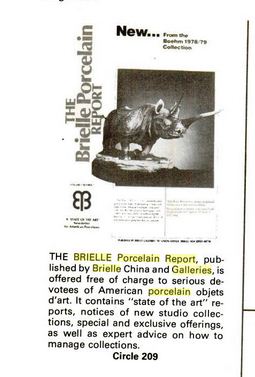 The late 1970s saw the first issue of the Brielle Galleries Porcelain Report, a four-page newsletter about new offerings which was an evolution of the earlier Brielle Journal. The ad above appeared in the American Bar Association Journal in 1978. Shortly thereafter, the Report was expanded to full color and re-titled A Quest for Excellence. It had an initial print run of 30,000 which grew to a subscriber base of over 500,000. The New York Times cited it in a story about great catalogs, and portions of Quest were sometimes included as a full color insert in magazines like Town & Country and Architectural Digest… publications in which Brielle regularly advertised.
 Perusing a selection of Quest issues provides a window into the evolution of the store and its customer base. This is the cover of the Spring 1980 issue, noted as “Volume 2, Number 2” which indicates that the first issue was during 1979. Noteworthy is the name change from Brielle China & Galleries to simply ‘Brielle Galleries’— a reflection of the store’s evolution from a ‘china shop’ to a purveyor of art porcelain and other beautiful things. This issue was 33 pages and features The (Polish) Bride on the cover. Brands featured in full-page spreads are Buccellati silver (a five-piece tea service for $50,000 is the most expensive item in the issue), Baccarat crystal, Wellendorf gold jewelry, and porcelain art by Cybis, Boehm, Granget, Ed Rohn, Burgues, Michael Sutty, and the newly launched Bronn of America.
In 1981 Brielle began carrying the work of British porcelain studio Connoisseur of Malvern. The 50-page Fall 1983 Quest featured their magnificent samurai portrait study on the cover and also showcased Waterford, Buccellati, Royal Copenhagen’s ‘Flora Danica’ dinnerware, Herend, Cybis, Boehm, Bronn of America, and Anri woodcarving.
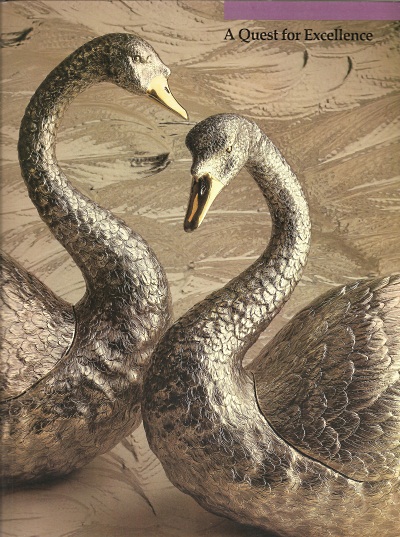 The pair of Buccellati silver swans on the cover of the Fall 1985/Spring 1986 issue was priced at a whopping $56,000. This issue included several new names in the moderately priced category such as Pat Thompson toys, Rosenthal, and Brian Rodden pewter miniatures. This may have been the one of the last catalogs in which Cybis porcelain appeared; I have no interim copies between this and 1993, so cannot pinpoint the year in which Cybis disappeared from the Brielle Galleries shelves.
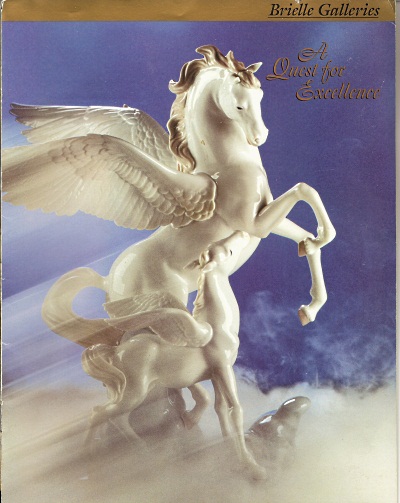
 By the early 1990s the retail landscape had changed, and the highest-priced items were significantly less expensive than they were a decade ago. The Fall 1993/Spring 1994 issue focused less on the biggest names in art porcelain; there is only a single page of Boehm, only one item from Connoisseur (the butterfly shown on this sample page), one from Bronn, and no Cybis at all. The priciest item was the Romanov Pen by Theo Faberge for $7200. The cover art and three interior pages feature Lladro with prices ranging from $95 to $625; the unicorns were the outlier at $1950.
The Fall 1995/Spring 1996 Quest was one of the last issues and possibly the final one. The 35 pages showcase a Theo Faberge ‘Kiev’ egg for $6500 as the most expensive item. More than 50% of the items shown retail for $500 or less and many were under $100.
The Brielle Staff
A brief introduction to the people at Brielle who, as the old saying goes, ‘made the trains run on time’! The black-and-white photos are from Ira’s memoir, A Quest for Excellence.
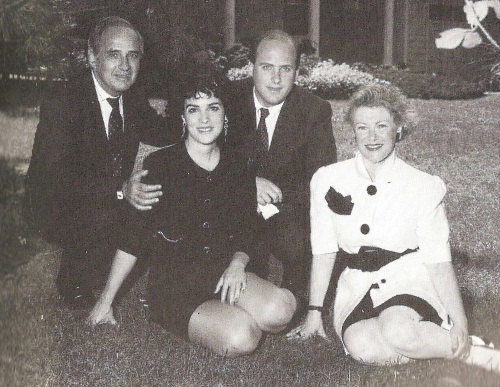 Ira Jacobson with daughter Lisa, son Dan, and wife Helene.
 Stephen Weston shared 25 years with Ira Jacobson as an ‘artist behind the scenes’ who was responsible for all of Brielle Galleries’ fine art restoration, manager of Bronn of America’s porcelain sculptures, and creator of many art projects for Boehm, Theo Faberge, Connoisseur and more. He and his family own the Weston Gallery in Manasquan, NJ which is one of the few experienced options for porcelain repairs.
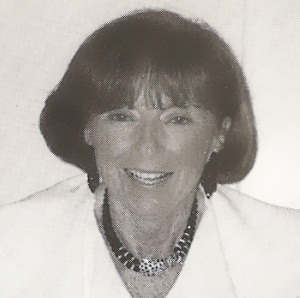 Eleanor Kuta started at Brielle in 1969, was their Head Buyer and one of their Directors. She was also the woman who knew everything! If you had a question about anything at all, Eleanor was the one to ask because she was invariably kind and helpful. She died in 2013 at age of 90.
Ray Blackman joined Brielle in 1979 after having worked for their main competitor, Reese Palley. He was Vice President in charge of Sales. He partnered with Ira and Stephen Weston in their Bronn of America studio venture. I have heard through the grapevine that Ray may have relocated to the West Coast but was not able to confirmed this.
 Carolyn Langdon also joined Brielle in 1979 and headed the Marketing department. In this photo she holds the 1988 Global Peace Dove by Boehm.
Ruth Paperth was the head of the jewelry department; yes, Brielle sold fine jewelry also! She passed away in 2009 at age 93.
The Annual Events
From that first 1969 ‘renovation’ party grew a tradition that made Brielle Galleries stand out from the pack of art porcelain retailers. Their gallery events, held in May and November, were designed to coincide with the annual Spring and Fall introductions of new pieces from the porcelain studios and were organized around a theme. Thousands of regular customers received invitations and hundreds attended these one-day events. Often the featured studio would create a special sculpture design that was available only to event guests. Only a limited number of such “event pieces” would be produced.
A 1984 interview with Ira Jacobson in the Asbury Park Press gives an idea of the elaborate preparation and execution:
Many months of planning and work precede each Hollywood-style gala. As soon as one show is over, plans begin for the next. “It takes six months work to do six hours,” Jacobson said, with a twinkle in his eye indicating that it is, indeed, a labor of love. On a recent day at the Galleries, several of the 40 to 60 employees were addressing invitations to a party next month. Of the 5000 invitations sent to those who are known to be collectors, the acceptances usually run a phenomenal 40 percent. The twice-yearly shows (there have been more than 30) are held in a 500-square-foot circus tent that goes up in the parking lot behind the Galleries.
Here are some photos taken at Brielle events during the store’s heyday. The first major event was the spring grand opening of the Cybis Gallery which clearly demonstrated that the store’s interior was too small, even for the few hundred who attended. Their second show started the tent tradition. At that show, they added an auction for some specially-painted open editions, some of which went for hundreds of dollars more than the corresponding standard edition’s retail price. These semi-annual events never had fewer than 1500 guests and often many more; there were 41 such event/parties during the store’s existence.
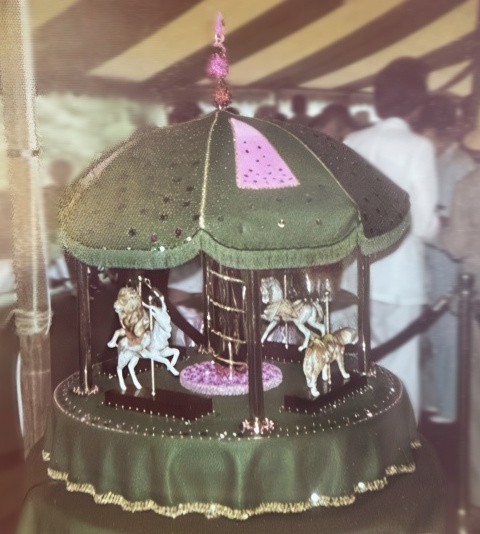
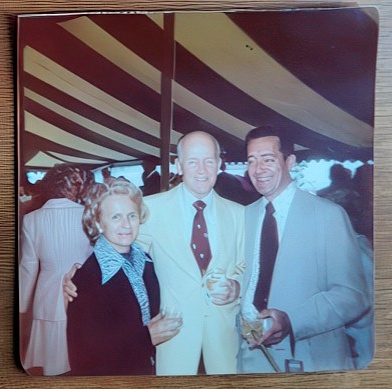 The June 1975 Cybis party featured the Carousel pieces: the 1973 Horse and Goat, the 1974 Lion and Tiger (all four are seen in this display), and the new 1975 Bicentennial ‘Ticonderoga’ carousel horse. The second photo shows Marylin and Joseph Chorlton inside the tent with an unidentified dark-haired man.
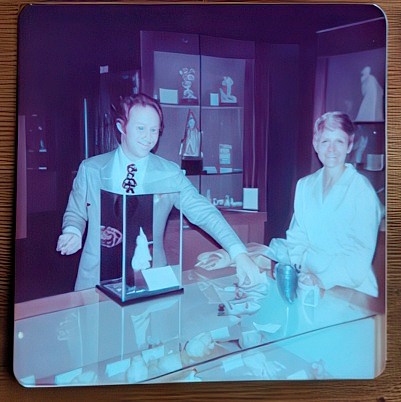 Cybis sales representatives Frank Reddan and Helen Karen Wood at Brielle’s 1976 Cybis event. When walking into the store from the parking lot, the Cybis area was the first that a visitor encountered. The smaller Cybis pieces were inside the glass-topped counter; the larger ones were displayed in the wall cabinets on both sides.
 The 1977 Boehm event featured a huge exhibit of their porcelain as well as a new Aida rose created to commemorate the Garden State Arts Center’s 10th anniversary. Opera star Jerome Hines gave a special performance for the event guests.
The Asbury Park Press reported that Brielle’s theme for their 1978 Boehm event was The Treasures of Tutankhamen, for which
….Alice Berger, [of] West Long Branch, designed and Mrs. William Blair, [of] Monmouth Beach, sewed costumes for live mannequins to wear. Just before the show each mannequin’s body was painted gold.


 Several scenes from the party, which showcased Boehm’s new collection. The sphinx in the center of the display was made by a local company who provided many of the custom decorations for the Brielle event-parties. I believe that the gentleman in this photo is Ray Blackman.
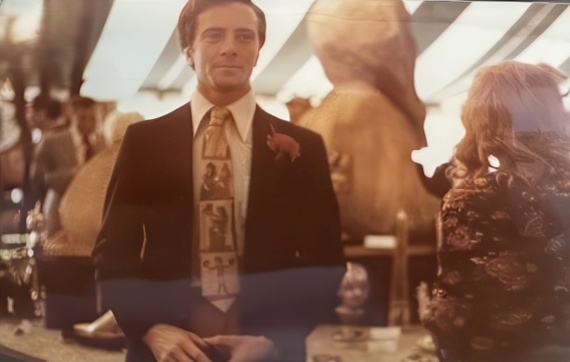 Brielle employee David Fitzmaurice at the event. David began working part-time at the store in 1973 while he was still in high school. He continued his connection with the gallery throughout college and into his career as a teacher. What a wonderful association!
The 1979 Cybis event that introduced their retail Chess Set had a medieval theme including madrigal singers, jongleurs, and International Grand-master Arthur Bisquier playing 20 simultaneous games of chess with event guests.
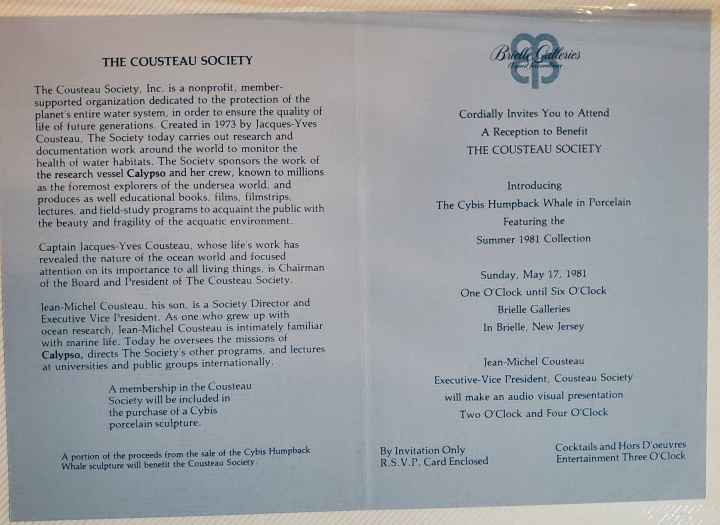 The Cybis event in May 1981 that introduced their summer collection featured the Cybis Humpback Whale and Arion the Dolphin Rider, which were created in collaboration with the Cousteau society. Jean-Michel Cousteau attended the event and autographed the pieces that were sold there. Unfortunately, the Cybis studio applied a faux signature to the ones that were produced afterward; the All at Sea post shows how to distinguish the true from the false, as well as the backstories of the whale and of Arion. Three thousand guests attended, and eighteen Humpback Whale sculptures were sold at $1750 each.


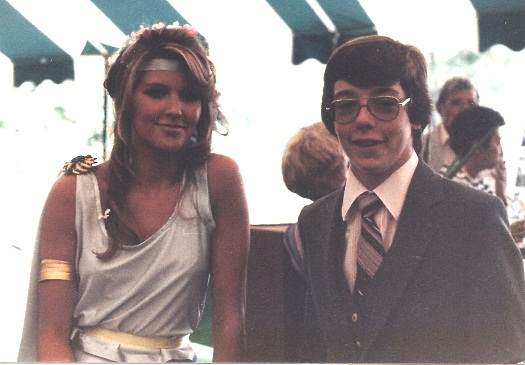 The 1982 event featured the presentation of a Cybis-designed award bowl to actor Tony Randall (upper photo). The event also introduced the Spring 1982 Cybis collection, the star of which was Persephone. In the second photo, George Ivers paints a sample piece; a live model of the subject is shown in the third photo next to the son of artist William Pae who created the sculpture. More than three thousand people attended this show.
The Asbury Park Press reported that Brielle’s spring 1983 event
…introduced the Shogun porcelain of Connoisseur of Malvern (England). All 10 limited editions were sold at $24,500 each. The spring ’83 show was a two-day affair and guests who bought the new Peony porcelain (240 people) were treated to their hotel accommodations and a black-tie dinner dance Saturday night. After breakfast the next day, they joined the throng jamming the tent behind the Galleries to participate in a Japanese extravaganza. The entire area inside the tent and out was transformed into a Japanese garden complete with trees filled with porcelain birds and a little bridge. Guests were entertained by a Japanese dancer. Yura, a well-known caterer and Sumo wrestler, provided the food a Sushi bar and other authentic Japanese dishes. The food was served in Bento boxes and later guests got to take the boxes home. Before the show ended, Yura and friends gave an exhibition of martial arts that left the guests gasping.
The Spring 1985 event was a mock horse race to benefit the Monmouth Park Charity Fund. From Ira’s account:
Eleanor painted colorful miniature wooden horses. People placed mock wagers on the horses and cheered like mad for their little wooden horses as they circled around the track, moving as many spaces as a wheel-of-fortune dictated each time it was spun. Monmouth Park sent its professional announcer, who called the race as if there were live thoroughbreds rounding the track. (The winners received prizes of Baccarat crystal.)
The Lladro show in November 1989 featured a flamenco dancer and an exclusive nurse figurine in a limited edition of 300, each signed by Senor Juan Lladro who was the guest of honor. When Buccellati silver and fine jewelry was featured at one event, armed guards were provided to ensure the safety of the merchandise which was valued at several million dollars.
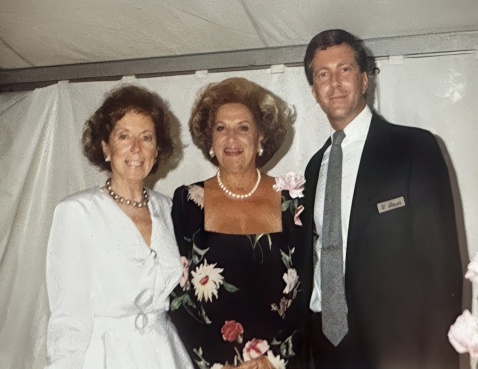 From left to right: Eleanor Kuta, Helen Boehm, and David Fitzmaurice at the 1990 event. This event marked the 40th anniversary of both Brielle Galleries and the Boehm studio. The Cybis studio’s 40th anniversary had been marked at the same 1980 event that introduced The Bride.
Sometimes the bill for the two-day events topped $100,000. The food was abundant, always delicious, and there were two open bars inside the store… one of them next to the jewelry case (a very smart location choice!) Many thanks to David Fitzmaurice for the newly-added ‘party pics’! :)
The 1990s: Twilight
The change in the art porcelain market between the 1980s and 1990s was significant, and is described in detail in this Archive post. Several elements combined to form a ‘perfect storm’ for retailers such as Brielle, but in his memoir Jacobson puts most of the onus on the Federal Trade Commission changing the rules regarding manufacturer pricing and retailer discounting. In his book he describes how studios such as Lenox “were mixing in current products with the discounted merchandise at their outlet centers to unload items in which they were overstocked. However, the only discounting we did was in the form of special sales which were held twice a year.”
The porcelain studios themselves were also changing in response to the times and economic pressures. Connoisseur of Malvern was sold in 1994 and the new ownership abandoned the relationship with Brielle. The relationship between the store and the Cybis studio had soured as a result of the mid-late 1980s management changes there and so Brielle joined the long list of retailers who were no longer stocking Cybis. Even Boehm was struggling and was partnering with mass marketing retailers like The Hamilton Collection in an effort to reach a larger customer base.
From a December 1993 newspaper interview:
Ira Jacobson sees himself as one of a dying breed — a retailer who targets a select market of those who can afford the finest tabletop, collectibles and gifts. Soon after Jacobson helped his mother open the Brielle Galleries gift store 43 years ago, he developed the retailing concept of building a high-income clientele that could special order, buy through his catalogs or make purchases during one of his periodic extravaganzas. When he implemented this concept, there were about 100 other U.S. gift retailers catering to this particular clientele. “Now there are only nine left,” he says. And his frustrations with the current trend of retailers to play the discounting game lead him to say, “We’re going to be the only one in the United States left. We’re a glorious dinosaur!”
Ira was correct: Brielle Galleries ultimately was the last remaining such store. In 1995 he was approached by a prominent businessman about acquiring the corporate-sales side of the shop’s business. This didn’t appeal to Ira until a second person expressed an interest in creating a luxury goods line that was made in the USA. By this time Ira was 70 years old. From his book:
[this person] gathered a group of investors to form a limited liability company that purchased the store. It included 22 of the finest professionals in luxury goods, publishing, technology and other sectors. A former executive from Steuben Glass would head up the company, and I would oversee the retail store operations.
The sale of Brielle Galleries took place in early 1996. The name of the purchasing group, structured as a venture capital firm, was Premium Gifts Acquisition, LLC. Ira stayed on as President but had no actual ownership in the company although he retained ownership of the building and the land it is on, as well as part of the inventory. Three of his veteran employees (Eleanor, Ray and Carolyn) stayed on.
The new format didn’t work out. In Ira’s words,
As I became more familiar with the new Brielle Galleries, I realized that this was no longer the business that I had built from a tiny, flat-roofed storefront in a bad location. It was a corporation with new priorities and a new focus….After working with the company for less than two years, I decided it was time for me to move on….I parted ways with the store in 1997. ..The Brielle Galleries that I knew was born with me and, in many ways, had died the day I signed the closing papers on the sale.
Three years later, in May 1999, the new investors closed the doors of the store. The Asbury Park Press reported in June that “the new owners had planned to phase out the retail end of the business and concentrate on the corporate market but that the plan had foundered due to a ‘lack of needed financing’. By that time there were only 20 people employed by the store.” In November the NY Times reported that
The building [ownership] reverted to former owner Ira Jacobson, who, fighting competition from discounters…sold the store in 1996. Jacobson now faces the unpleasant task of selling the building and laying to rest the store that he devoted nearly half a century to. Donna Bouchard, the former CEO of Brielle Galleries [since 1996] told the local New Jersey press that the store was shut down because of a lack of necessary financing…Apparently, the $4 million in revenue (half of it from corporate gift business) that Brielle generated in 1998 was not sufficient to sustain it. It may be that, as is often the case, a corporation taking over a family business failed to maintain those qualities that had made the store a success in the first place.
The 2000s: Day’s End
When Ira left the company in 1997 he still retained a portion of the inventory, which he worked on selling via online and at brick-and-mortar shops on consignment, for two years. During this period it was all stacked in his garage!
In 2001 he went to an internet marketing seminar with his daughter Lisa and hatched an idea. He still had the usage rights to his approximately 75,000-name mailing list of retail and corporate clients, as well as about 100 remaining pieces of leftover inventory. He decided to start selling again both online and brick-and-mortar. He couldn’t use the Brielle Galleries name again because it had been acquired and retained by the venture capital group, so chose the name Luxury Galleries. He still owned the Brielle building, so he decided to reopen about 1/3 of the space (5000 square feet) on August 22, 2002 as the Luxury Galleries showroom. During that year Ira worked with Waterford to create a one-of-a-kind crystal sculpture commemorating the police and fire department heroes of 9/11, and the sale price was donated in full to the NYPD/FD Widows and Childrens Benefit Fund.
However, despite all of his efforts Ira had to ultimately sell the physical property and business in late February 2004. As reported in the Coast Star newspaper:
Earlier this year Mr. Jacobson, 77, decided to retire again, and this time sold his entire business – client lists and all – to Steve Rice, owner of International Corporate Golf (IGC). Mr. Rice’s business, founded in 1998, specializes in corporate and executive gifts and is heavily involved in event planning, sports memorabilia and golf tournaments. “We’re essentially a marketing and promotions company”, he stated.
Mr. Rice took over the rear section of the building, where Brielle Galleries’ office spaces originally were. He did not purchase the building. According to the same newspaper article, “an engineer purchased [the building] and has plans to remodel and, most likely, sell it once the renovations are complete.”
 As seen in this circa-2013 photo, the original Gallery building was expanded with a new structure to the rear which, according to a 2010 for-lease advertisement, totals 17,300 square feet. The complex was renamed the ‘Brielle Galleria’ and the building’s ownership shown as Brielle Holdings, LLC; as of July 2025, it has at least a half-dozen tenants along with about 3000 square feet available for lease on the third floor of one of the structures.
 In 2017 Ira Jacobson, by then in his early nineties, was still making signing appearances for his 2008 hardcover memoir A Quest for Excellence: The Incredible Story of the Most Beautiful Store in the World. It is out of print but can be obtained via Amazon and also book venues such as Abebooks and Alibris. My copy brought back so many wonderful memories of my visits to Brielle Galleries during the 1970s and 1980s.
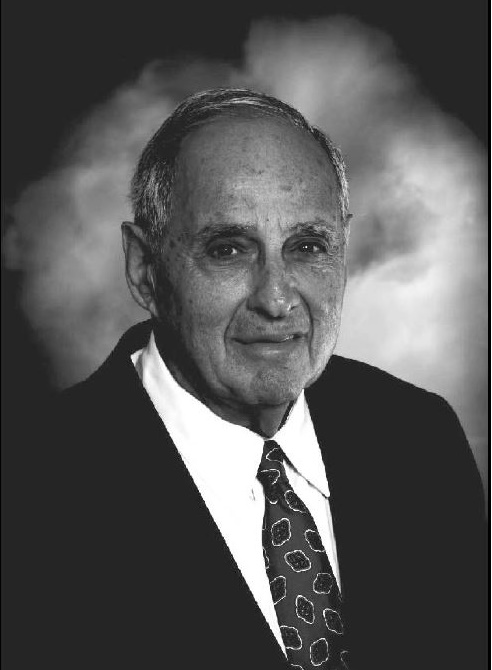 Ira Jacobson suffered a stroke in October 2021 and entered a hospice facility; he passed away on December 13th at the age of 94. Please see my In Memoriam post for more details about his life. Anyone who ever knew him, or stepped even for a little while into the magical world that was Brielle Galleries, knows that Ira’s quest for excellence was the most glorious success.
Name Index of Cybis Sculptures
Visual Index (for human figures/busts only)
About the Cybis Reference Archive
What is Cybis?
Images of Cybis porcelains are provided for informational and educational purposes only. All photographs are copyrighted by their owner as indicated via watermark and are used here only as reference material. Please see the Copyright Notice in the footer and sidebar for important information regarding the text that appears within this website.
The Cybis Archive provides the most comprehensive range of information about Cybis ever compiled within a single source. It is not and never has been part of the Cybis Porcelain studio, which is no longer in business.
 THE CYBIS ARCHIVE