
Because more and more 1940s items signed M.B. Cybis have shown up online during the past couple of years, this new Archive post is bringing them all together in one place. It will also examine the mystery of why some M.B. Cybis items were numbered but the others were not!
All of the M.B. Cybis items have one thing in common: They were made during the 1940s. Most (although not all) are in a style that is essentially the same as the Cordey-branded items which were being made at the same time in both the Trenton and the Philadelphia facilities. Some (not many) of the M.B. Cybis items were numbered, and a very few (so far) of them were also dated with the year, in the same blue paint that was used for the signature. One known item was made in 1940, during the very first full year that Boleslaw and Marja Cybis were in the United States; it is the earliest M.B. Cybis item thus far discovered.
There are two possible scenarios that could account for the existence of M.B. Cybis items.
(a) The M. B. Cybis pieces were the studio’s first foray into the general retail marketplace. If this scenario is correct, then we should find retail advertising mentioning Cybis items before 1942 (which is when Cordey was launched). The earliest Cordey-brand retailer ads that I have been able to find are from 1944. However, not only are there some 1941-1944 retailer advertisements that show Cordey-style items described as “by the artist Cybis”, but there are items (shown below) that are signed M.B. Cybis and dated 1945. This shows that some production overlap definitely occurred.
(b) The M. B. Cybis pieces were produced only at the Church Street studio location. Remember that the Cordey operation had two locations: In Philadelphia (lamps, figurines, and décor items) and in Trenton (figurines and décor items only; no lamp assembly.) We know that Boleslaw Cybis would sell items directly from his studio (see this post for the story of the sale of a pair of lady-handle mugs) well into the 1950s and so this scenario is definitely possible. It would also account for the much smaller number of M.B. Cybis items seen nowadays compared to those marked Cordey, of which there are always hundreds for sale on eBay.
My gut feeling is that both of these scenarios are true. In fact, several of the examples below prove that the date range for the M.B. Cybis signature items is likely longer than was first thought. It definitely runs from 1940 through 1945, and theoretically could extend into the first half of the 1950s. The Cordey China Company was not officially launched until 1942.
M.B. Cybis Lady Busts

 This particularly sweet-faced M. B. Cybis lady bust has her own Archive post. She is about 13” high overall, and her owner described her as being unexpectedly heavy. She is numbered 252.
 This hatted lady bust is from the same mold but wears a hat that rather resembles a dish! No open top on this example. The seller cited it as being signed M.B. Cybis.
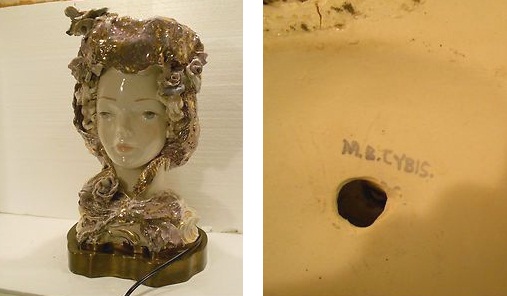 Here’s another example of this mold; it was put onto a lamp base to create a lady bust lamp. Was this a later conversion? Or was it originally made as a boudoir lamp (because the base shape so closely matches that of the lower part of the porcelain)? This bust was numbered #105 according to the seller’s description although their photo does not show it.
The seller also described the base as being a brass-finished metal and the overall height as 16″. This makes sense because the other two are 14” and the lamp base must be a couple of inches thick. Unlike the typical Cordey lamp bases which include a vertical pipe leading to the bulb and shade above, this one was described as having:
an opening on the top of the head for the light to shine out…. when the light is on, the face has a beautiful glow to it… [and it has] a lot of gold plating and lavender coloring.
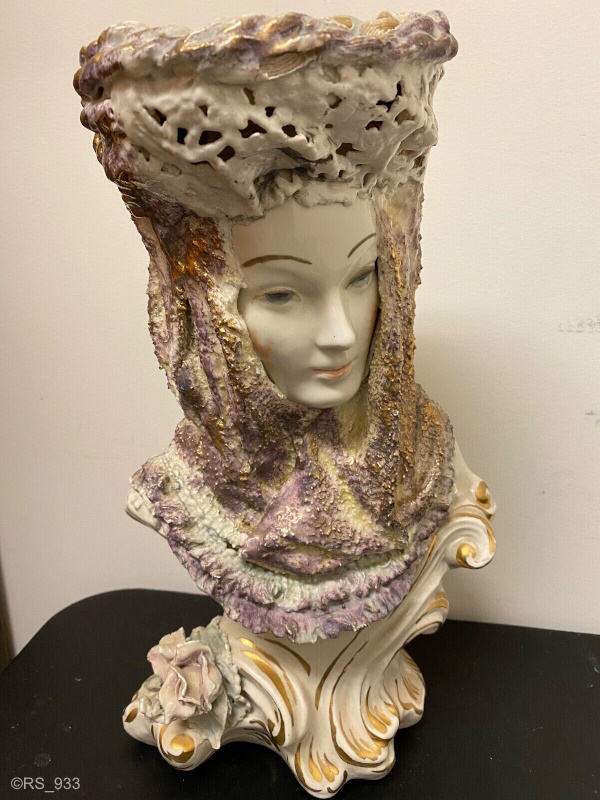 This lady bust wears a heavy veil/scarf draped over a large headdress. The piece itself is large, being just shy of 16″ tall. We see the lavender-and-gilt color scheme here as well.
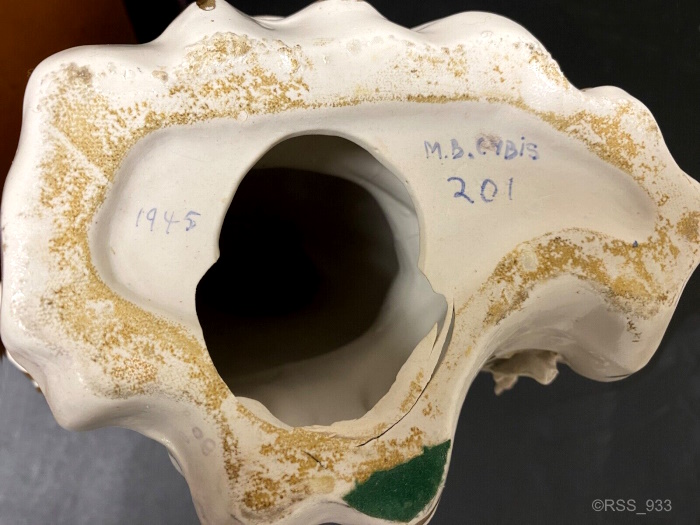 It is very Cordey-esque in style but is signed M.B. Cybis along with a date (1945.) Remnants of green felt and adhesive remain on the bottom, added at some point by an owner.
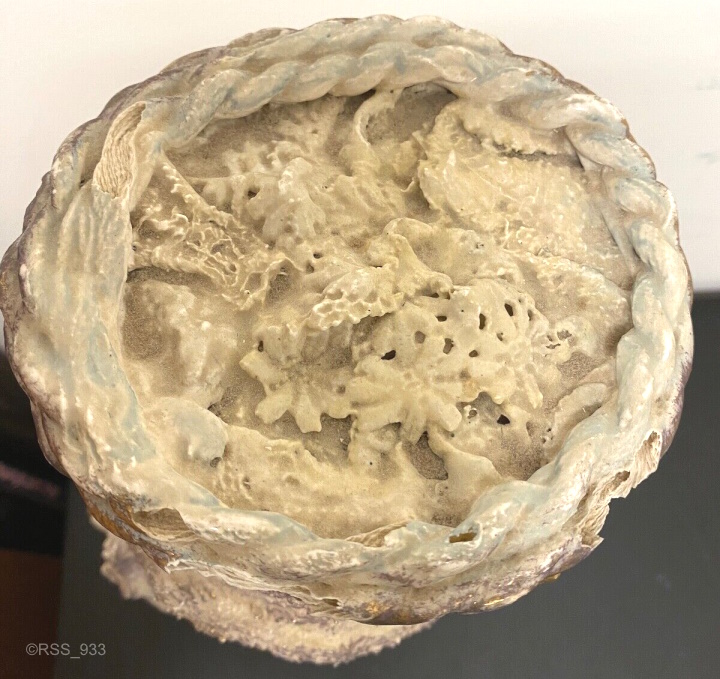 This overhead photo of the top of the headdress shows how it was constructed. The lengths of porcelain ‘slip’-dipped lace were literally piled up in a coil. The top edge of the headdress was made from a dipped rope or string; the broken off surface at the upper left reveals the threads or string from which it was constructed.

 A vintage magazine article about Cybis porcelain included these photos of a lady bust with roses and scarf which is clearly marked M.B. Cybis.
 She is a version of the Du Barry bust that appears in an old Cordey salesman’s catalog.

 This 7” high lady bust with lace is signed M.B. Cybis and also has a Cordey mold impression. The Cordey design code is also a mold impression which appears to be 5003. I have no idea why the painted signature has a pink background and have never seen this effect on a Cybis piece before. If this were a decal instead of being a painted signature, I would ascribe it to a faulting firing of the decal – but Cybis never used any decals until the late 1980s and then only on a very few pieces.

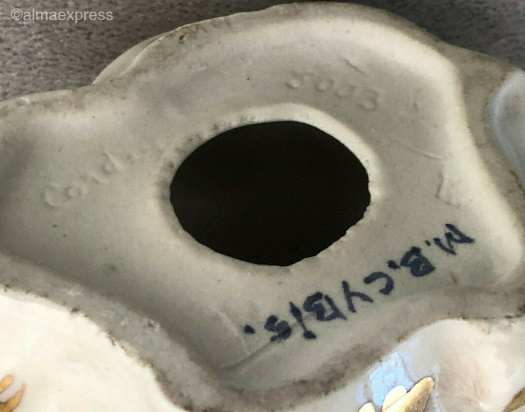 Here’s a somewhat plainer version of the same 7” lady bust, also marked both Cordey as a mold impression and M.B. Cybis in paint; it has the 5003 Cordey design code. It is hard to tell whether the signature was done in black paint or in a very dark blue.
 Here is the Cordey catalog page with their #5003 small bust on it. The other bust is #5005. They look like the exact same mold to me!
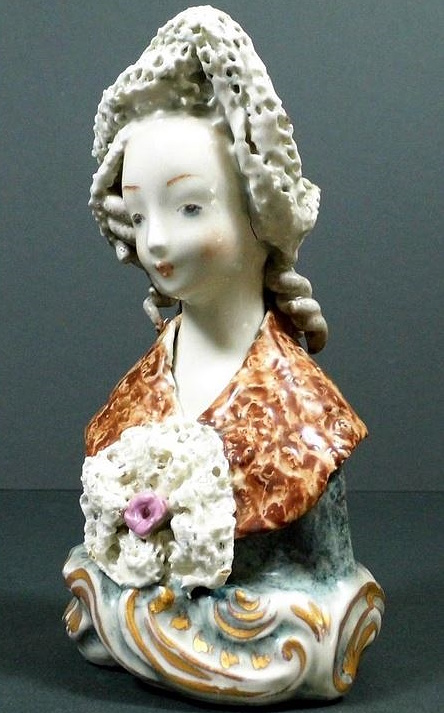 Yet another small lady bust that was dual-marked. It is just a skootch taller than the other two because of the pointy lace headgear. Although this old eBay listing didn’t include a photo of the underside, the seller described it as “signed in blue Cordey and M.B. Cybis” which suggests that this one may be marked in the same way as the example that follows:
 A word of warning: I have downsized my photo of this very garish small lady bust in an effort to spare my readers’ eyesight and aesthetic sensibilities! The larger version, and additional views and commentary are in her own separate post, but because she is marked M.B. Cybis she is in this one as well.
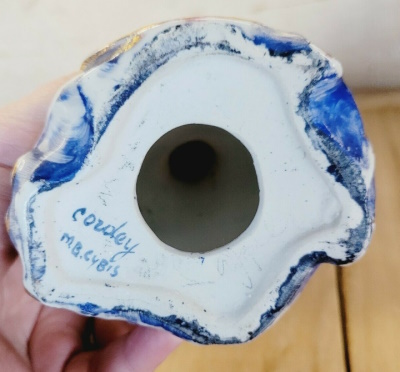 Here is the M.B. Cybis signature AND also a ‘Cordey’ signature in the same blue paint. This is really very odd and I can’t fathom why it was done this way. Yes, there are several dual-marked items in this post but those combine the M.B. Cybis signature with either a Cordey mold impression (because the body mold had already been cast for a Cordey branding) or a Cordey design number (probably for the same reason.) Perhaps the same artist painted this one and also the one with the pointy lace headdress and orange collar?

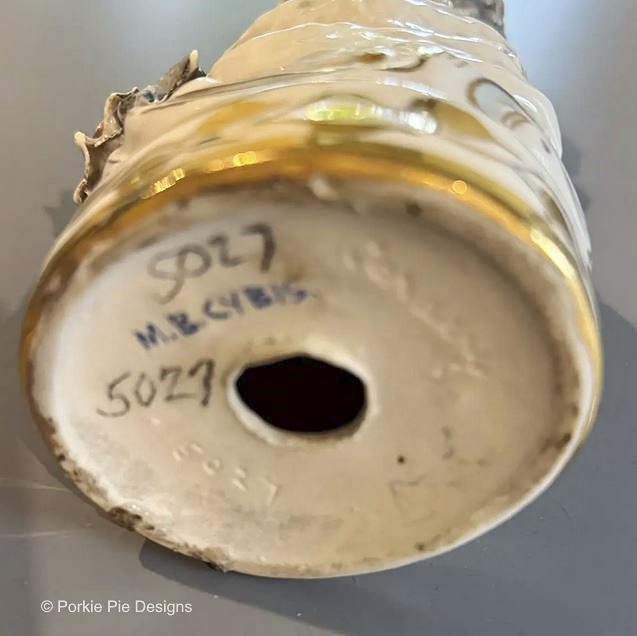 This lady bust with a conical hat has more Cordey markings than the lone M.B. Cybis signature! There is the Cordey mold impression, the design number mold impression, and the design number handwritten not once but twice (why?).
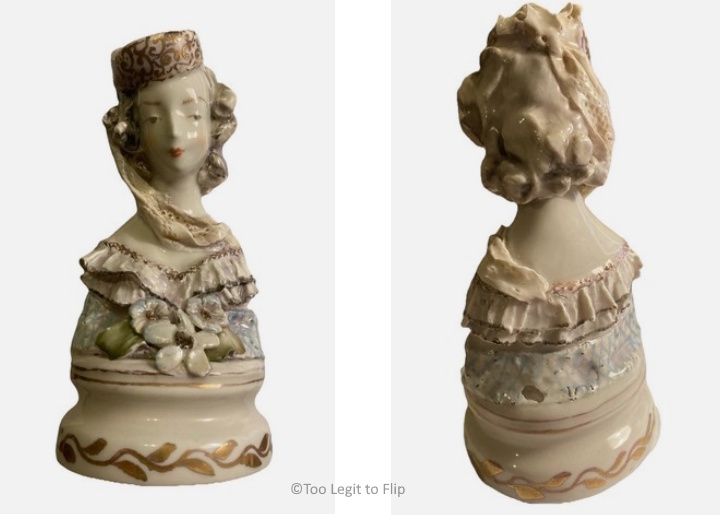
 And this fashion-forward lady bust wears a pillbox hat…years before Jacqueline Kennedy made them popular!
 I personally believe that this lovely lady was meant to be a mermaid bust. Not only does she have shells in her hair but sections of her head scarf resemble seaweed in form and/or color. She is 16.5” high overall. If she is indeed a mermaid, then she is the earliest of only four such Cybis designs. She is the same face mold as the first lady bust pictured in this section.
 This praying lady bust‘s headgear and attire (and especially the necklace!) means that she is NOT a madonna…but simply an especially-devout lady.
M.B. Cybis Human Full Figures
The very earliest M.B. Cybis items that I have found are really early…so much so, that they were done in papka!
Although very few Angelic Orchestra examples have been found, and those have been marked with the MC monogram (for Marja Cybis), we know of two that are signed M.B. Cybis:
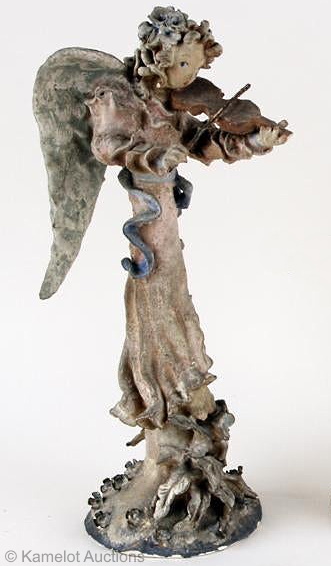
 This Violinist, sold at the studio’s 2019 liquidation auction, is signed both ways and dated 1940. Although many other 1940s items had modern signatures applied by the Chorlton studio after 1990, this is definitely not one of them because those later-added signatures were always applied in the modern Cybis script style along with the copyright symbol. That 1940 date means that this angel was made during the very first full year of the Cybis studio in America.
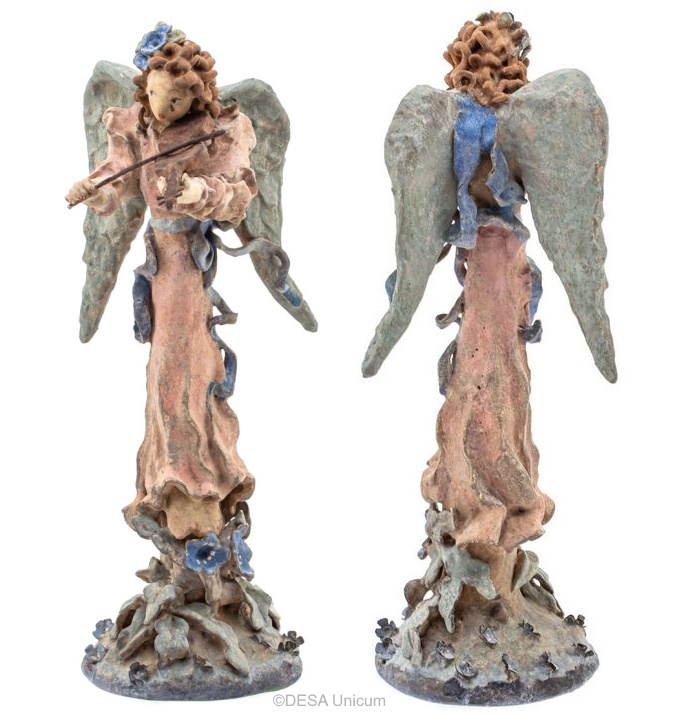

Here is another Violinist, who is depicted weeping (for Poland) as she plays. Notice the richness of the blue flowers and ribbons as well as the deeper pink of her gown.

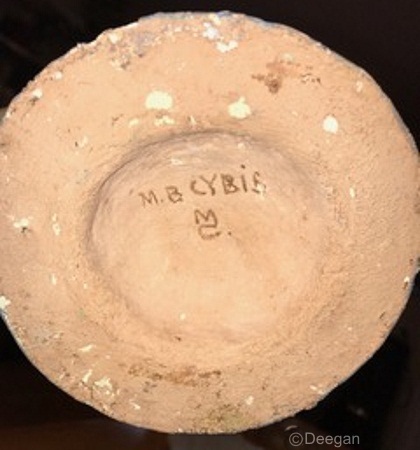 This Mandolinist example was sold on eBay. She is not dated, and the signature and monogram were applied with brown paint. However, the existence of these two angels makes it probable that there were other such 1940 or 1941 M.B. Cybis items made at that very first studio at the Steinway Mansion in New York. The problem is that papka is incredibly fragile and so the odds of them having survived 80+ years is very slim. :-(
 This Asian couple is 22″ and 24″ high; both of them are signed M.B. Cybis. They were cited by the auctioneer as having losses and repairs. The material (porcelain) and style (Cordey) mean that these could have been made at any time between 1941 and the early 1950s.

 These are the two Cordey salesman’s catalog pages showing the same figures as the Cordey Chinese Mandarin (design #5097, 27” tall) and Mandarin Lady (design #5099, 27” tall.)
 Here’s another example of a Mandarin Lady mold that has an M.B. Cybis signature instead of Cordey.
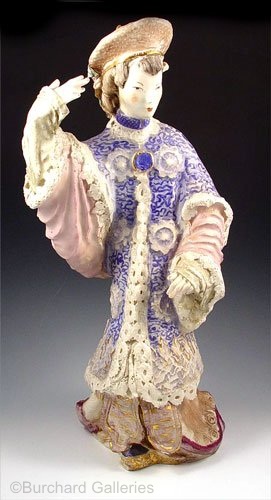
 This Asian man was cast from the same mold as the Mandarin Lady, except for the head mold which is different; it is signed M.B. Cybis on the inside of the mold.


 Both of these Asian ladies are signed M. B. Cybis although parts of both signatures have faded or worn away. They are about 12” tall.
 The Cordey-branded twin to this figure was called Chinese Coquette. Notice that the other figure (on the right) is titled Chinese Mandarin Lady with design #5071. They are essentially the same except for the clothing/decoration. This Chinese Mandarin Lady is not the same as the 27”-tall Mandarin Lady which was design #5099.
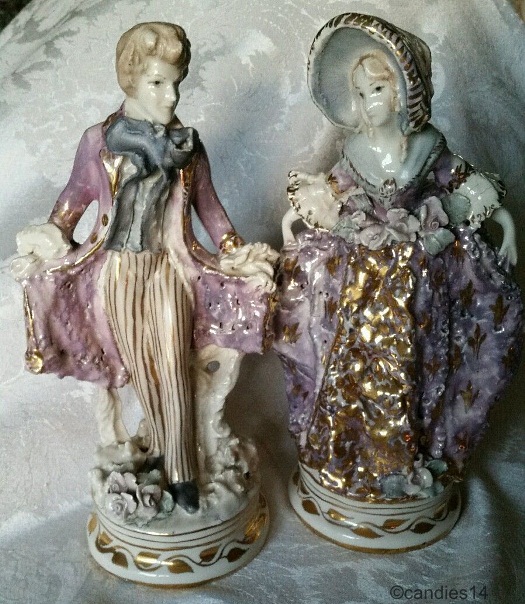
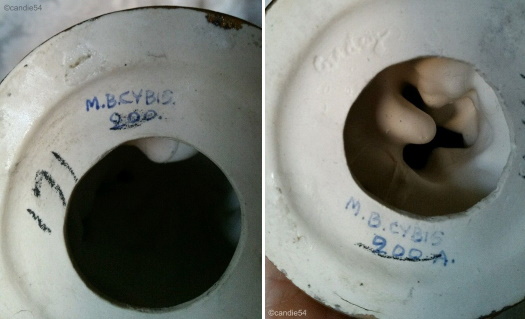 Here’s a pair that have dual signatures: both Cordey and M.B. Cybis. This couple is smaller, at about 11″ high, and is very much in their ‘old world European’ style. These were clearly made as companion pieces, shown by the design numbers being 200A and 200B. Yet another lavender-and-gold color scheme! Because of the posture of the two figures, I’m going to dub them the Dancing Man and Woman Pair.
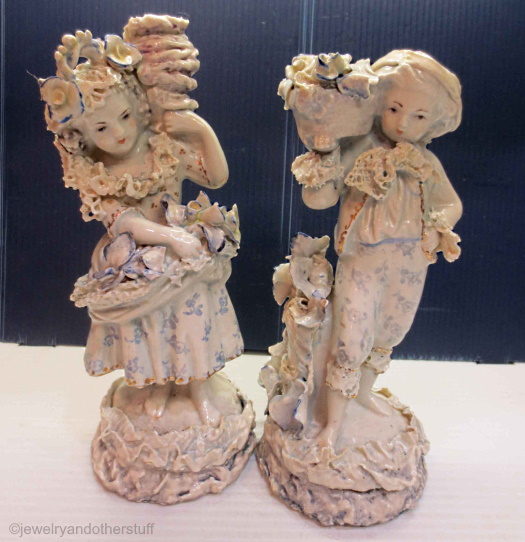

 These two peasant children are signed M.B. Cybis. There are no Cordey marks or mold impressions on them.
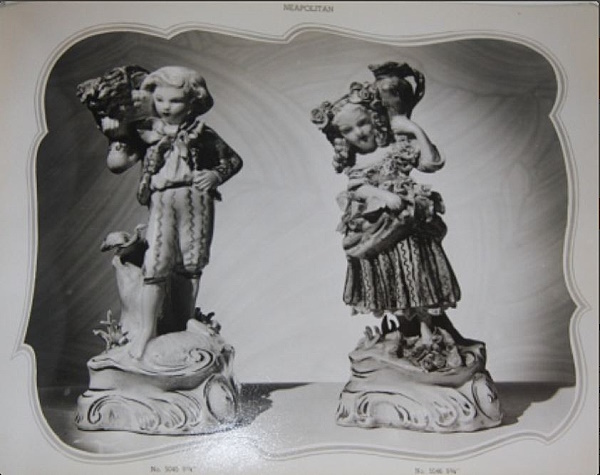 Their Cordey siblings do not have as much lace; their catalog page is titled Neapolitan. In the Cordey version, the girl is carrying a jug but I’m not sure what the M.B. Cybis girl is carrying; it looks rather like a stack of large pancakes! The Cordey boy also wears no hat.

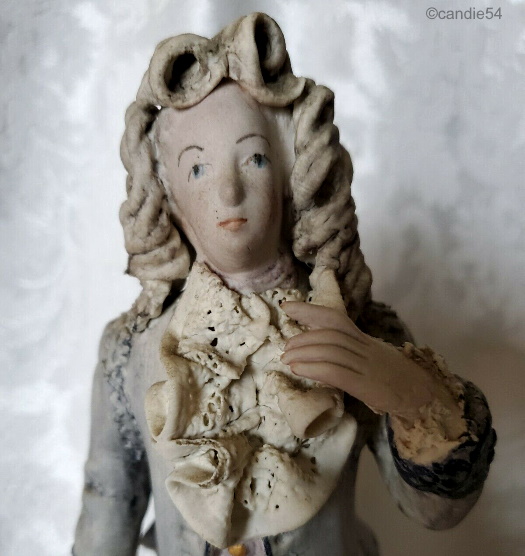

 Here’s an M. B. Cybis example of a Restoration-era court gentleman. The number here is 194.M … does that mean there was a matching M.B. Cybis lady that was numbered 194.F ?
 Two versions of this same mold appear in the old Cordey catalog: Colonial Squire as design #5043, and Gentleman as design #5043A.


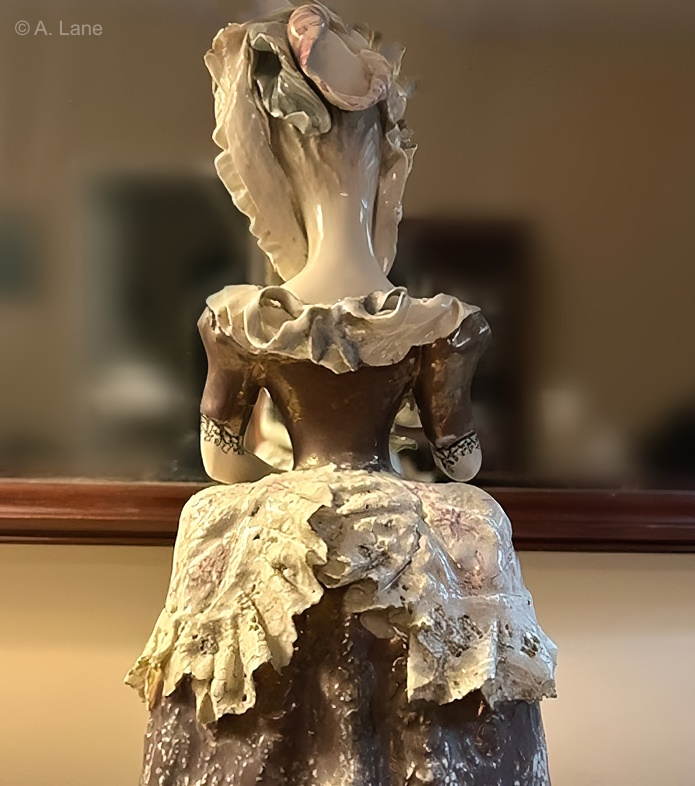
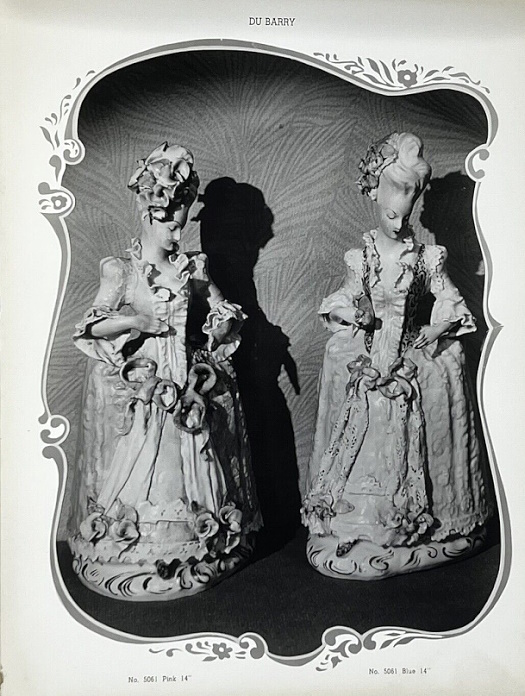 Thanks to a helpful Archive reader, I can include this M.B. Cybis version of the lady who appears in the Cordey catalog as Du Barry (one of their two versions of Madame Du Barry, the other being the bust.) The dipped-lace panniers on the M.B. Cybis example were laid atop the basic lower body (hips) mold shown in the Cordey catalog. My guess is that the panniers began life as a lace-trimmed handkerchief that was cut to the proper shape and size.
M.B. Cybis Animals, etc.

 Here we have a fish among purple seaweed. It is just short of 6.5” tall and has its very own Archive post with many more photos and a detailed commentary.

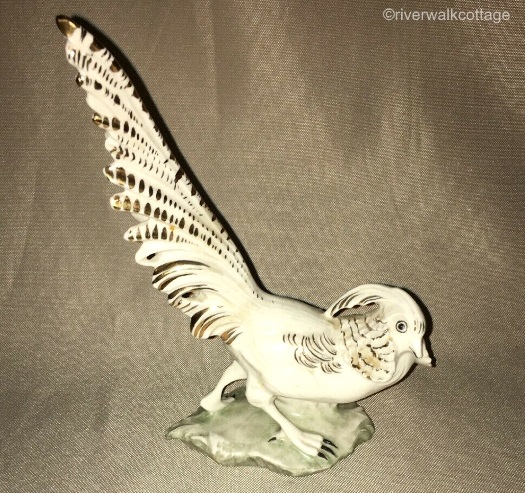
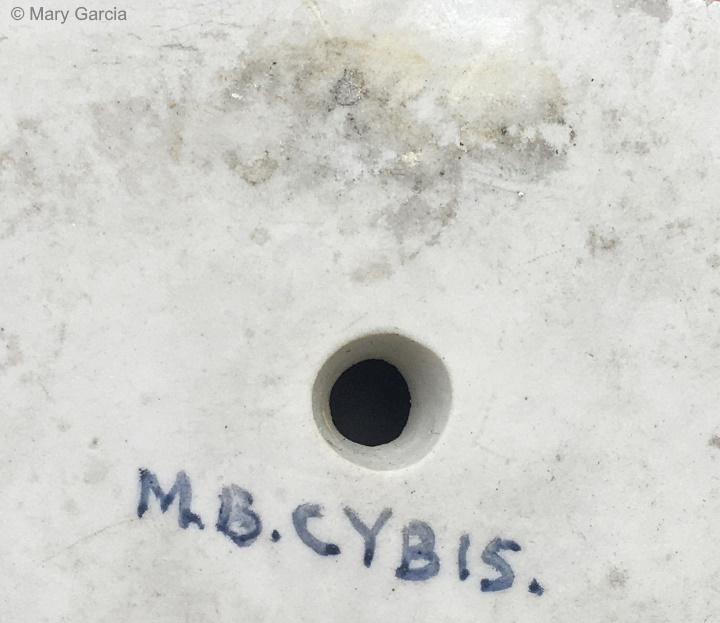
Among the earliest of the Cybis-marked porcelain birds (the papka ones were earlier) are these examples of a fowl which is probably the small pheasant mentioned in a name-only sculpture list in the 1974 Cybis catalog. Each is marked in blue paint M.B. Cybis and MC (for Marja Cybis); a photo of the underside is in the Early Birds post. This is a representation of the Golden Pheasant rather than the more familiar Ring-Necked Pheasant; the telltale hints are the large wattles and the crest, neither of which the Ring-Necked has.
M.B. Cybis Home Décor Items

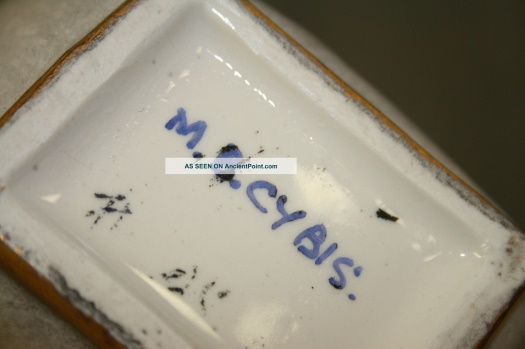 This flat-fronted vase with roses and gold decoration is signed M. B. Cybis on the bottom. The same vase mold, but with a bas-relief geisha added to the front, has been seen among Cordey items on eBay.

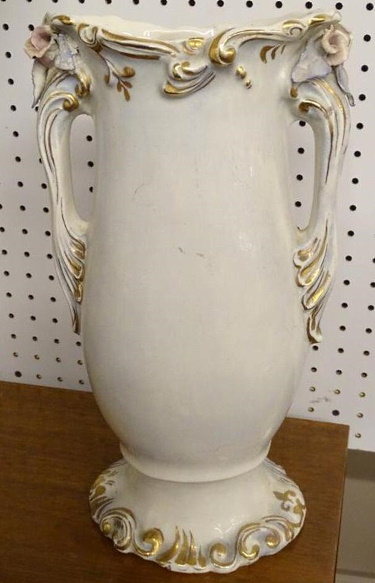 And speaking of bas-relief appliques, this M. B. Cybis vase has a court gentleman applied to the front. The back of the vase is plain. Many thanks to the helpful Archive reader who sent me these photos!

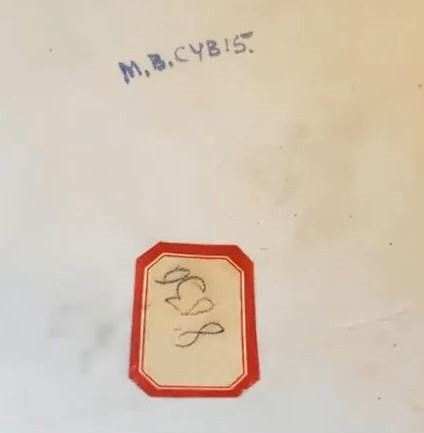 Here is the same M. B. Cybis vase with a slightly different treatment. Instead of the gentleman we have a spray of applied roses, but in all other respects the vases are the same. The red sticker is the same as one that was used on some Cybis items during the 1940s and possibly also the early 1950s.
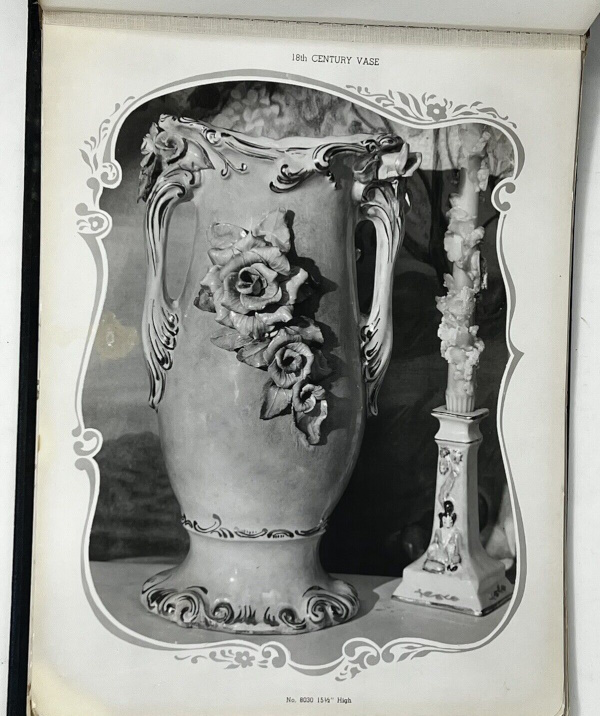 The Cordey catalog shows this identical item with the title 18th Century Vase, design #8030 (just like the sticker!) and 15.5” high.
 And here is a version with enough gold paint to require the use of sunglasses. Yikes! Here the applied flowers are different; it is a spray of dog roses (wild roses) and the roses decorating the top of the handle are wild roses as well. This vase is numbered 186 and is unusual in that the signature and number are in gold paint…but, clearly, the artist had plenty of it to spare! Additional views of this, as well as an overview of all the known Cybis vases, can be found in the Vases post.
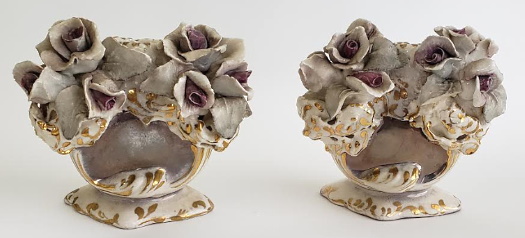

 From the massive to the teensy: Here’s a really cute pair of miniature vases with rose handles — and I do mean ‘miniature’, because both are less than five inches high (4.5″ and 4.25″, respectively.) The fact that they are numbered 197 and 198 shows that they were either meant as a pair or were painted one after the other. They are clearly marked with the year they were made.
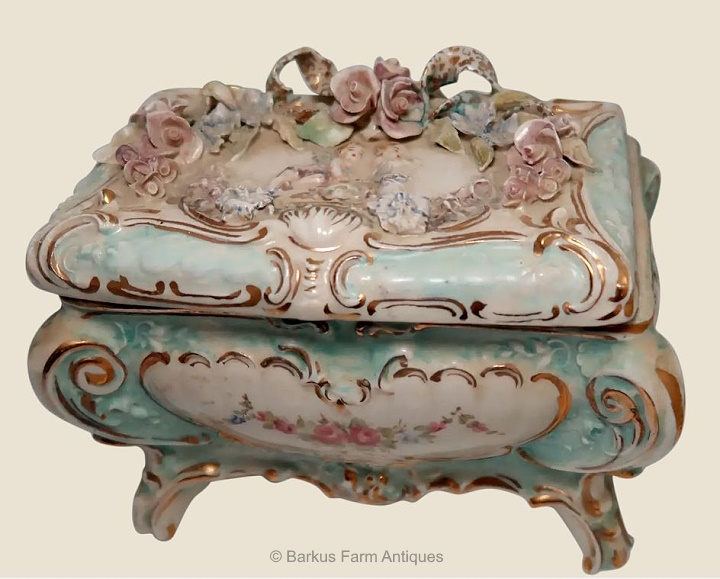
 This trinket box with roses and cherubs measures 7″ x 5″ and is about 5.5″ high with the lid in place. There is a piece of royal-blue velveteen placed on the bottom of the interior by a previous owner. This same box mold is a known Cordey-branded item although the M.B. Cybis example is more elegant in technique.
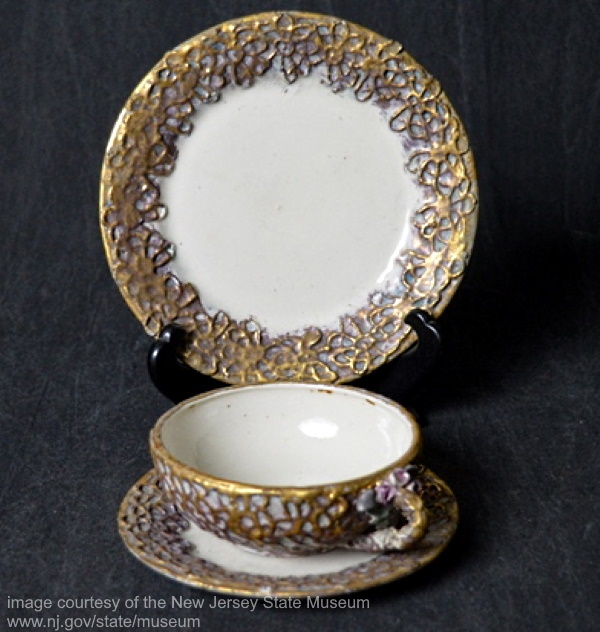
 This unusual tea cup, saucer, and dessert plate set is signed M.B. Cybis on all three pieces. Additional photos are in the Tableware post. The black numbers are the museum’s inventory codes.
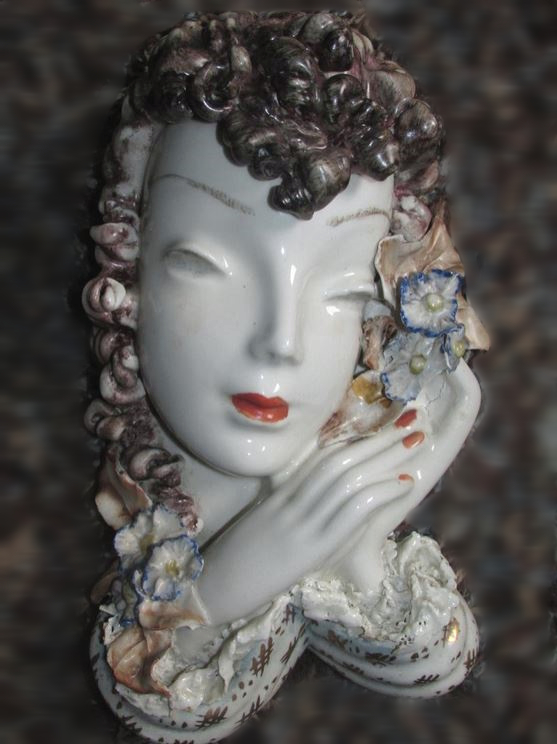 Lady-face wall hangings and wall pockets were very popular during the 1940s, and I have noticed a few Cordey examples for sale online in recent years. However, those were not the same mold as this one. This is the first lady-face wall hanging that I have seen that is signed M.B. Cybis instead of Cordey. For some reason, the seller decided to photograph it against a shag rug that is the same color and texture as the lady’s hair…so I have blurred that background as best I can.
 The back side shows the signature on the inside (there is no Cordey mark anywhere.) I’m not sure what the residue along some of the back edges is from; perhaps a prior owner decided to mount it onto a plaque? Normally, such items simply hung by a nail or two by the hole(s) in the mold.
 And now for something completely different: Two tankards whose handle is the form of a very scantily-clad lady! Both of these lady-handle tankards are signed M.B. Cybis and the underside also still has the mold impression of the company from whom Cybis bought the mold (Nassau China Company.) These are so unusual that I gave them their own Archive post which has many more views and details. About a year after I wrote that post, a reader sent me photos of two similar mugs that were purchased in 1956 by a check made out to Boleslaw Cybis directly. That pair is marked simply CYBIS in blue paint, rather than as M.B. Cybis, however. The decoration on the 1956 pair is also different from the pair pictured above; it is more in keeping with the prevailing mid-1950s style than with the 1940s which is the decade that I believe the M.B. Cybis tankards date from.
List of Known Numbered M.B. Cybis Items
The reason for the existence of numbers on some M.B. Cybis items is a huge mystery. They do not correspond to the Cordey system, nor to the design number system that the Cybis-branded items began to use during the 1950s. Therefore, they could have been meant as either design numbers or as individual item numbers – but we have no idea which it was. I assume that all of the M.B. Cybis items were made in the Church Street studio in Trenton rather than in the Philadelphia location which only produced Cordey and would have no reason to mark anything as M.B. Cybis.
Our very first/lowest number entry is one for which we have no photo (Murphy’s Law). I found it within an old newspaper Q&A column, in the March 3, 1985 edition of the Miami Telegraph Herald but there was no accompanying photo:
I have two Cybis figures which have been in my family for nearly 50 years. One is marked on the bottom M.B. Cybis, the other M.B. Cybis 99A. They are delicately painted and have lovely faces. Any information would be appreciated.
The columnist responded with a brief history of Boleslaw and Marja Cybis coming to America and founding Cordey and Cybis, without addressing the number aspect at all. The interesting part is the fact that the questioner’s pieces were both human figures and that one of them had a number as well. It’s too bad that there was no photo or more detailed description.
99A = unknown (no photo) human figure or bust
105 = lady bust as a lamp base
174 = tea cup with gold paint drizzled over the exterior
175 = saucer to match the tea cup
176 = dessert plate to match the tea cup
186 = large handled vase with roses and extensive gold paint decoration
194.M = Regency gentleman, full figure
197 = very small vase with large roses along the rim, dated 1945
198 = a second such vase, matching the other and dated 1945.
201 = lady bust with a large ‘hat’ and heavy dipped lace veil or scarf under it; open top is filled with lace; 16” high, dated 1945
252 = lady bust, 13” high, with dipped-lace scarf but an open top of head
Notice that the three dated-and-numbered examples found thus far are very close: 197, 198, and 201. All from 1945.
If these numbers were intended to keep track of each individual item that was signed M.B. Cybis, then that means there were at least 252 of them. However, the only way to determine whether the numbers were instead design codes would be to discover an additional example of any of the above items that have a different number written on them. For example, finding a Regency gentleman almost identical to the one shown here but with a different number on the bottom would indicate that 194 was an individual item/sculpture number rather than being a design/mold number.
There is also the mystery of why some M.B. Cybis items have a number but others do not. Curiouser and curiouser, indeed…!
If anyone happens to have any M.B. Cybis item(s), I would love to be able to add more examples to the Archive and to this post. There is a contact-page link below. Many thanks!!
Please note that I have no information about Cordey items other than what is shown here and in a few other Archive posts. I do not/cannot provide information about Cordey pieces that are not ALSO signed either M.B. Cybis or Cybis.
Name Index of Cybis Sculptures
Visual Index (for human figures/busts only; no Cordey)
About the Cybis Reference Archive
What is Cybis?
Images of Cybis porcelains are provided for informational and educational purposes only. All photographs are copyrighted by their owner as indicated via watermark and are used here only as reference material. Please see the Copyright Notice in the footer and sidebar for important information regarding the text that appears within this website.
The Cybis Archive is a continually-updated website that provides the most comprehensive range of information about Cybis within a single source. It is not and never has been part of the Cybis Porcelain studio, which is no longer in business.
 THE CYBIS ARCHIVE