
Although two of my Archive posts (Signatures & Marks, and Authenticating, Part Two) delve into the subject of the various Cybis signature formats, I hadn’t addressed the occasional discovery of pieces that have no signature at all, despite being undoubtedly a Cybis-made item.
There are three possible scenarios that can account for a Cybis sculpture lacking a Cybis signature.
Aggressive Cleaning
Because the Cybis signature, copyright symbol (if any), and sculpture number (if any) are all applied after the final firing, as the very last step in production, they are – unlike the fired-on colors – not permanent. The degree of vulnerability to abrasion and/or cleaning products depends in part on the location of the signature. A signature on a white bisque (unpainted) part of a figure has a pretty good chance of surviving because some of the paint will soak very slightly into the porcelain surface and may still be faintly visible if that area is cleaned. However, a signature applied to a painted area is more vulnerable because that surface will be less porous.
Although these painted marks will survive a gentle rinsing with plain water and being allowed to air-dry, there’s no way to know if any given cleaning substance will remove (or smear) a signature.
This card accompanied the original purchase of Cybis porcelains, back in the day:
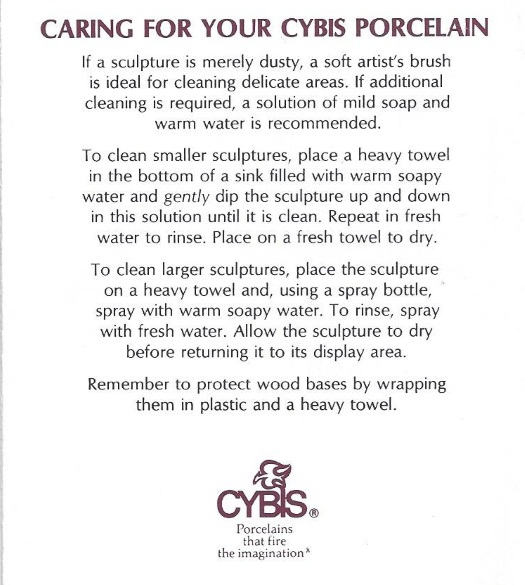
As noted in my Cleaning Porcelains post, I don’t 100% agree with this procedure but the fact that the studio was specifically recommending “mild soap and warm water” is telling. Whether “mild soap” was meant to include something like Dawn dishwashing liquid is open to question but it certainly didn’t mean Formula 409 or LA’s Totally Awesome Cleaner from the dollar store (which does indeed work awesomely and can easily remove algae and mildew from white vinyl fencing, for example.) That said, a friend of mine often uses Formula 409 to spray down filthy eBay acquisitions and has never experienced a signature-loss yet. So, when it comes to cleaning, it seems to be a ‘do I feel lucky’ scenario vis-a-vis the signature. Notice that the Cybis instructions do not mention any kind of wiping: only “dip” or “spray”. It would have been helpful if they had added “Do not wipe!” to their recommendations because wiping that area can be risky…and especially so for sculpture numbers on the limited editions.
A missing signature may well have been the victim of a cleaning attempt, especially if the cleaning was aggressive or careless.
‘Oops!’
An ‘oops’ in this case means that someone at the Cybis studio forgot to add the signature before putting the finished piece on the shelf to await packing and shipping to a retailer, and nobody noticed the omission. Were the shipping-room personnel told to check every piece before burying it inside the Styrofoam ‘snow’ and shipping box? Maybe. If so, did they do it every single time, without exception? Probably not, especially during one of the busy shipping seasons such as before the Spring and Fall new-introduction gallery events, or the winter holidays.
Assuming that someone at the retail gallery – or a potential buyer – noticed the absence of a signature, a phone call would surely be made to the studio to inform them of the fact. It’s more probable that an unsigned piece would be an open edition (a limited-edition sculpture would also need to be numbered, and its specific shipment cross-checked with that design’s production paperwork), and so it wouldn’t make economic sense to have it sent to Trenton and then back again, all at Cybis’ expense, for the sake of a two-minute application of a one-word signature. It would be much easier and faster for the studio to tell the retailer that a replacement will ship out immediately, with apologies, and they could keep the unsigned one. Someone at the store would get a freebie to keep or to give to a friend or family member, and the studio would write the unsigned one off as a production loss. Mystery solved.
Thus, the two most likely reasons for a missing Cybis signature are cleaning and accidental omission. There is a third, however, which a friend of mine calls ‘studio escapes.’
Studio Escapes
These are pieces that, for whatever reason, went home with a Cybis employee. If there were significant mistakes in the painting, or if a post-firing repair didn’t go as well as hoped, the options for that piece might be either that or the trash can. Test pieces, unless things went really badly, were more likely to be signed and possibly even marked A.P. (one person’s ‘mistake’ may be another’s ‘creative’.) The fact that completely-unpainted examples of Cybis designs that never had a white-bisque retail colorway occasionally appear for sale online proves that some pieces did go home with employees. In fact, I own just such a piece, given to me by a Cybis employee; it is the first example shown in the Evolution of a Cybis Turtle post. It is not signed, but I was also given a decorated version that was never offered at retail, which shows that it was a just-for-fun piece. That one is signed Cybis in paint and also dated in pencil. It was given to the Cybis employee by George Ivers who was the Art Director at that time.
I suppose the only difference between a Cybis ‘studio escape’ and an ‘artist adoption’ is the manner in which it left the studio: Either surreptitiously or openly!
A missing signature on an otherwise-normal-looking piece is probably completely innocent; actual knockoffs give themselves away via their workmanship, as is clearly shown in the Hall of Shame post. And, an unsigned test/experimental/fun piece may sometimes be even more attractive than the signed retail-production examples are. So, no real worries.
Name Index of Cybis Sculptures
Visual Index (for human figures/busts only)
About the Cybis Reference Archive
What is Cybis?
Images of Cybis porcelains are provided for informational and educational purposes only. All photographs are copyrighted by their owner as indicated via watermark and are used here only as reference material. Please see the Copyright Notice in the footer and sidebar for important information regarding the text that appears within this website.
The Cybis Archive is a continually-updated website that provides the most comprehensive range of information about Cybis within a single source. It is not and never has been part of the Cybis Porcelain studio, which is no longer in business.
 THE CYBIS ARCHIVE