
This post falls into the morbid-curiosity category, inspired by the flood of Cybis porcelain ‘variations’ and ‘resurrections’ that began during the 1980s and rapidly gathered steam through the next two decades.
 So, how should we define a ‘new, original’ Cybis design? A decorative variation is NOT a new design! Sticking a bowtie and two tiny dabs of black paint onto the 1981 Bunny ‘Bon Bon’ and naming the resulting 1991 retail introduction Bunny ‘Puttin’ On the Ritz’, doesn’t qualify. It is a pre-existing design whose decoration was slightly modified in order to introduce a new SKU (in today’s parlance.) Yes, Cybis gave the later introduction its own production-identification code (a/k/a design number; Bon Bon’s design number was 612, and Ritz’s was 6062) but that doesn’t change the fact that the only difference between them is a minor decoration and, of course, their respective retail prices. The original bunny-body mold that the studio named Bunny ‘Bon Bon’ (i.e., the sculptor’s final original design) was not changed between 1981 and 1991. There were numerous instances of such decorative spin-offs, and not only with the 13 (!) Bon Bon clones.
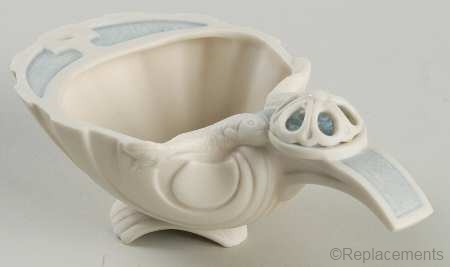 Likewise, a sculpture that Cybis retired, completed or closed, and then later brought back into their retail lineup with a slightly different title and new design number but with no change at all to its appearance, isn’t a new design either. It’s a resurrection; another applicable word is re-introduction. For example, the 1975-1977 Bonbonniere Baptismal Shell (design numbers 818B and 818P for the blue and the pink colorways) was resurrected in 1990 as the new introductions Baptismal Font Blue (20923) and Baptismal Font Pink (20924). There is absolutely no difference between the 1975 and 1990 introductions other than the design numbers and the retail price. The first part of the original name (bonbonniere, meaning “a small fancy box or dish for bonbons”) was meant to show that it could be used as a small candy dish instead of a baptismal item.
Let’s look at the studio’s actual design history, meaning how many truly new pieces they introduced, decade by decade, under the Cybis brand name since 1950. Just FYI, the phrase ‘original Cybis designs’ means designs that were brought to retail under the Cybis brand name after having been created (designed/sculpted) either by an in-house Cybis artist or a freelance artist. The difference between these and almost all of the 1950s Cybis-branded items is that the later-decade original designs were produced – ‘manufactured’, if you prefer – only by Cybis.
New Cybis in the 1950s
We will start here because the 1950s marks the beginning of the modern retail studio, in the sense that their items are no longer made in the 1940s/Cordey style and they are stamped or signed simply Cybis. The vast majority are cast from ready-made molds that Cybis bought from various mold-making companies such as Holland and Atlantic. It isn’t until the second half of the decade that we begin to see any original Cybis-branded designs, and that reflects the fact that Marylin Chorlton was steadily taking over the studio’s operations until, in 1957/58 with the deaths of Boleslaw and Marja Cybis, it became hers completely. It would be wonderful if there were some 1950s price lists available but I have never found any.
Based on currently available records and photos, there were definitely nine original Cybis-branded designs offered during the 1950s. Three of those were designated as limited editions by the studio. There may have been more than nine original/new designs but without photos or documentation it is impossible to know. Analyzing the 1950s production stream is extremely difficult because of the almost complete lack of records.
New Cybis in the 1960s
During this decade, Cybis introduced a few ‘pair’ issues – meaning two different and separate sculptures that were intended to be displayed together and were only sold as a pair for a single price, never separately. But they also introduced some individual ‘companion’ pieces that were only offered separately. For example, the Blue Gray Gnatcatchers (pair) are two separate sculptures, one showing a male and the other a female, sold as the pair only. But the Carolina Paroquets, created in the same manner (a male sculpture and a female sculpture) were only sold separately. Despite the fact that the pair introductions had both sculptures selling under a single name and design number, for purposes of this post I have counted those as two new designs because each sculpture of a pair is an entirely different creation by the designer/sculptor. They are not twins. On the other hand, the very few identical-twin pair offerings (such as the Guardian Angels and Kneeling Angels from the 1950s) were counted as only a single new design. [See the Pairs, Companions and Sets post if you are interested in this category of Cybis editions.]
There were 84 new Cybis designs introduced at retail during the 1960s. The edition-type breakdown is 44 limited, and 40 open (non-limited.) This decade, under Marylin Chorlton’s leadership, is when the Cybis ball really began rolling.
New Cybis in the 1970s
The number of introductions increased during the 1970s, with 55 limited editions and 67 open, for a grand total of 122. Contributing to that total during the early 1970s was the Limnettes series of twelve designs created by George Ivers, and additional Carousel and North American Indians sculptures as well.
Marylin Chorlton passed away in 1977; her death had a profound effect on the studio’s operation during the ensuing decades.
New Cybis in the 1980s
The limited-edition population truly boomed during the 1980s, with 103 new designs in that category. But there were even more new open editions: 170! This total of 273 new designs was a record for the Cybis studio. The launch of the second Nativity Series in 1982 contributed to that large open-edition-sculpture total. Intended initially as a series of twelve pieces, with three introductions per year, the studio decided to expand it in 1989.
It is interesting to compare the year-tallies at the beginning and end of this decade. In 1981, Cybis introduced 17 limited editions and 12 open editions (29 designs in all.) In 1989, celebrated as their 50th Anniversary, there were five limited editions and 19 open ones (24 pieces in all.) But one of those five limited 1989 editions was the Knight in Shining Armor which was a declared edition of 25 at a jaw-dropping price of $27,500. There is no way to know how many were made because, other than the one always on display at the studio, it was only being created on a to-order basis and there may have been no more than ten actually made (the #10 piece has the special 50th-Anniversary stamp on it.) Clearly, the biggest production drop during the 1980s occurred in the limited-edition category.
New Cybis in the 1990s
The studio temporarily shut down at the end of 1989 and discharged all of their existing employees. The 1990s was a chaotic decade, marked by the steady loss of retailers, the reduction of work hours, increasing reliance upon on-site sales and factory-tour participation, and the ongoing bad financial situation. To make things worse, eBay appeared on the scene in 1992 and instantly created competition that Cybis had never faced before.
There were new introductions, yes; but most of them were decorative variations and resurrections, including the Hall of Fame editions which all were downsized copies of previously-closed and retired designs. Those did not sit well with long-time collectors who had believed the studio’s promises that retired and completed pieces would “never be made again” because “the molds were destroyed.” The only differences between the original 1975-1984 Lady Macbeth and the two 1993 Hall of Fame versions Lady Macbeth II and Lady Macbeth III are the heights (13”, 11” and 10”) the paint colors (gold, unknown, and purple), and the design codes (483, 5097, and 5096.) The sculpture itself is the exactly the same for all three, because downsizing a mold is very easy.
There were only 52 new designs introduced during the 1990s; of those, eight were limited editions and 44 open, which included a new series that began in 1989 (the Twelve Days of Christmas ornaments) and continued into the 1990s with one new ornament design issued each year. Obviously, those had all been designed during the 1980s.
Given the precipitous drop in originality compared to the prior decade, it’s useful to look at the actual 1990s output of new design introductions year by year. Many of these had been designed during the 1980s. So although they were new to the public, the models had been sitting on the Cybis studio’s shelves for years.
1990
New Limited-edition designs: 2
Carousel Horse ‘Golden Thunder’ (an additional Golden Anniversary design)
Cinderella ‘Belle of the Ball’ (an additional Golden Anniversary design)
New Open edition designs: 17
Bunny with Carrot
Football Player
Girl Gathering Flowers with Chipmunk
Girl with Lamb
Golf Bunnies (all the same mold, but sold with different names and hat colors)
Gone Fishing
Here Comes the Bride
Holiday Bell
Little Chick
Little Cowboy
Madonna with Rose
Sleeping Squirrel
Soccer Player
Three Little Pigs
Two Turtle Doves ornament
Unicorn Plaque
Young Eagle (later renamed Bald Eagle)
1991
New Limited-edition designs: 3
Carousel Horse ‘Patriot’
Circus Horse Trio ‘Showtime’ [created during the early 1980s]
Nefertiti Bust (either this year or 1992)
New Open edition designs: 7
1991 Angel Child Ornament
Bull (later renamed Taurus)
Girl Holding Daisies ‘Loves Me, Loves Me Not’
Little Swimmer
Nativity Camel II
The Acrobat
Three French Hens ornament
1992
New Limited-edition designs: NONE
New Open edition designs: 3
Ballerina ‘Time Out’
Four Calling Birds ornament
Holy Family nativity group
1993
New Limited-edition designs: NONE
New Open edition designs: 6
Andy, Boy Reading
Bunny ‘Cuddles’
Chippy with Nuts
Five Golden Rings ornament
Heavenly Music Plaque
New Jersey Violet (I am giving it the benefit of the doubt that this might not be merely the base section of the ca-1980s Goldfinch.)
1994
New Limited-edition designs: 1
Carousel Buffalo
New Open edition designs: 2
Mermaid
Six Geese a-Laying ornament
1995
New Limited-edition designs: NONE
New Open edition designs: 2
Golden Princess (the 1995 Collectors Society piece, which was initially available for purchase by people who joined the Cybis Collectors Society)
Seven Swans a-Swimming ornament
1996
New Limited-edition designs: NONE
New Open edition designs: 1
Eight Maids a-Milking ornament
1997
New Limited-edition designs: NONE
New Open edition designs: 2
Angel Ornament with Harp (I am being charitable because I have never seen a photo of this; I’m pretty sure that it is just another decorative variation of an earlier piece, but cannot know unless one turns up for sale someday.)
Nine Ladies Dancing ornament
1998
New Limited-edition designs: 1
Fire Dancer
New Open edition designs: 1
Ten Lords a-Leaping ornament
1999
New Limited-edition designs: 1
Indian Warrior, a/k/a Proud Warrior
New Open edition designs: 3
Eleven Pipers Piping ornament
Prima Ballerina [created during the early to mid 1980s]
Twelve Drummers Drumming ornament
New Cybis in the 2000s
The final Cybis introductions all appeared during the first eight years of this decade. There were two new limited editions and six new open editions, for a grand total of eight not-seen-before designs. I have no idea who created any of them. Because the Cybis website was not updated regularly, the actual introduction years are unknown except for these three:
- The Millenium Ornament was an open edition in 2000.
- The limited-edition Carousel Reindeer appeared in 2008 based on its website description, and the open-edition Partridge Ball Ornament as well, for the same reason.
As for the remaining five new designs, the Nativity Guardian Angel appeared sometime between 2002 and 2007. The other open editions (Sabrina, the Scottish Terrier, and Yoga, Girl in Motion) could have been introduced at any time between 2000 and 2008. The Buccaneer was the other new limited-edition design; I have never seen one for sale and know it only from a single photo that was on the Cybis website.
It’s a Numbers Game
All of this math gives us a total of 548 truly original Cybis designs released at retail from approximately 1956 to 2008. Of that total, 215 were limited editions and 333 were open editions. These figures are not exact because there are several designs on the earliest price list I have (Spring 1963) that I have never seen a photo of and whose names do not appear in any other Cybis material that I have. Those may be original Cybis designs, or they may not. There’s no way to know unless examples someday turn up. If they do, I’ll edit this post.
 I placed all of this data into a graph that sums up the ‘originality’ chronology at a glance, and additionally compares the new (original) design quantities to ALL of the Cybis introductions (original and not) that appeared in each decade. ‘New Original Designs’ means the total of all limited and open edition new designs, which is then further broken down into Limited and Open.
The tricky decade is the 1950s because of the missing-data problem. It’s impossible to know how many individual retail offerings (i.e., different items that retailers could order from Cybis) existed during that decade. A text-only list that appeared on one page of their 1973 catalog starts with this disclaimer:
In the early years no formal records were kept […] While it is difficult at this late date to list each porcelain released by the studio, verified Cybis sculptures are as follows:
I have compiled my total number of 1950s Cybis items from three sources: the 1973 catalog list, the 1978 catalog Appendix, and a head-count of all the 1950s sculptures that appear on this website (as of this writing) that do not appear within either of those sources. I am certain there are 1950s retail offerings that aren’t included in this number, and also that the vast majority of them were not Cybis-original designs. All we can say at this point is that Cybis was manufacturing at least 180 separate product designs during the 1950s, almost all of which were cast from molds that they purchased from another company.
No Cordey designs were included in this overview or table. Designs that later became retailer-event pieces aren’t included either, because those were all based on an existing mold.
It is a shame that the decade in which the Cybis studio produced the greatest number of designs in all four categories was the same one that saw their financial situation implode due to gross mismanagement. One wonders what the 1990s and 2000s graph – especially the ‘New Limited Editions’ bar – would have looked like if that had not been the case!
Name Index of Cybis Sculptures
Visual Index (for human figures/busts only)
About the Cybis Reference Archive
What is Cybis?
Images of Cybis porcelains are provided for informational and educational purposes only. All photographs are copyrighted by their owner as indicated via watermark and are used here only as reference material. Please see the Copyright Notice in the footer and sidebar for important information regarding the text that appears within this website.
The Cybis Archive is a continually-updated website that provides the most comprehensive range of information about Cybis within a single source. It is not and never has been part of the Cybis Porcelain studio, which is no longer in business.
 THE CYBIS ARCHIVE