
Although the vast majority of Cybis porcelain pieces were completely hand-painted, there were some exceptions to that ‘rule’ at various times during the studio’s existence. Interestingly, the exceptions are remarkably consistent in terms of genre. But first, an explanation of the processes by which a decal is used to decorate china or porcelain.
All decals begin their life as some form of paper product on which a design is printed, and then a ‘cover coat’ is applied that will burn off during the firing process. There are differences in the materials used to manufacture decals and also differences in the methods by which the decal is transferred to a ceramic object.
Decals are classified as either ‘low temperature’ or ‘high temperature’. Low-temperature decals also tend to also be low-quality; the inks used on them don’t have a long shelf life and the decals may not adhere very well. However, they are inexpensive and don’t require a high-temperature kiln. These same characteristics make them unsuitable for application to fine porcelain. A high-temperature decal is what’s needed for that, and this is where the different application techniques come in.
An on-glaze decal application is exactly what it sounds like: The decal is placed over a piece of ceramic that has already had a high-temperature glaze fired onto it. This decal application firing is done at a kiln temperature that is LOWER that that which would melt the existing glaze; typically 1350-1450°F. The printed design of the decal remains on the surface of the still-intact glaze. If your fingers are sensitive enough and you use a very light touch, you may be able to feel a very slight difference in the surface of the decal-design areas versus the ones where there is no design. Depending on the ambient lighting, you may be able to spot a very faint difference in the outline of the colored (decal) areas versus the ‘blank’ cover-coated areas which the kiln has burned away.
An in-glaze decal application uses a higher kiln temperature (usually 1850-2200°F) and, as a result, the decal does actually melt into the existing glaze layer. Because the glaze layer is only softened, not destroyed, when the glazed surface cools it hardens again and seals the decal design inside it. If done correctly, you probably won’t be able to feel or see any difference in the surface between the colored (decal pattern) parts and the plain glazed white parts of the surface. Obviously this process is trickier to perform precisely, because the melting and cooling temperatures are so critical.
An under-glaze decal application is what some refer to as the “quick-and-dirty” method. The decal is applied to an unglazed china or ceramic object and then a clear glaze is applied over it. The item is then fired once at a temperature high enough (2200-2550°F) to melt everything onto the ceramic surface at once. Unfortunately the glaze can easily diffuse the colors on the decal and so it’s easy for any really tiny fine details in the design to be lost. This method is fine for simple decal patterns, though. The surface of the object after this kind of application is typically extremely smooth.
Regardless of which application method is used, the object is then fired again to permanently fix the decal’s pattern; this is called the decal firing. If a decal contains metallic gold ink, it will need to be fired at a somewhat lower temperature; the same adjustment is required for hand-painted gold accents.
Now that we know how it’s done, let’s see what the Cybis porcelain studio did with decals.
1950s Cybis Religious Items with Decals
All of the known circa-1950s decal-decorated Cybis are in the religious category.
 The Lord’s Prayer Book was produced as a tabletop plaque item and also as a vase. The book mold itself is only 3” high and 5.75” wide.
 Assigned design number 242, there were two available versions of the Lord’s Prayer decal: the Catholic version (at left) which was design code 242, and the Protestant version which was 242-P.
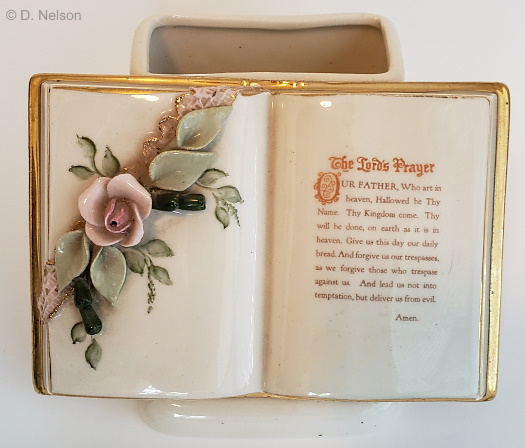 The Lord’s Prayer Vase is the same Prayer Book mold but affixed to the front of a small (1” x 3”) vase instead of to a wedge mount. The Cybis design code for this usage is not known.
 The Hail Mary Prayer Scroll is about 4” high and was assigned design code 226 in this wedge-back iteration. It’s logical to assume that there was probably a vase version of this as well.
It’s logical to also hypothesize that there was probably a ‘Lord’s Prayer Scroll’ (in either Catholic or Protestant format) as well.
Because almost all of the 1950s Cybis-branded items were cast from mass-produced molds made by other companies, it’s not surprising that these religious items utilized text decals. Decals of these familiar prayers were easily obtained.
The Limnettes Series (1971-1972)
All of the Cybis Limnettes used a decal as the main design, to which certain small elements or accents were subsequently applied by hand. Compared to the heavily glazed 1950s items, the surface of a Limnette has only a subtle satin finish.

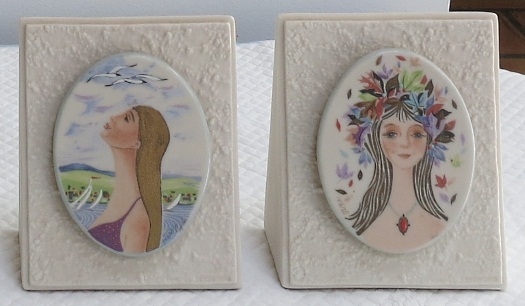 For example, on the ‘Wonderful Seasons’ Limnettes, tiny paint accents on necklace beads, sweater trims, berries, and sailboat flags were hand-applied after the decal was fired onto the porcelain. The kiln temperature range for a non-metallic paint firing is lower than that for a glaze, and the temperature for an 18k or 24k gold paint firing even lower than that.
 Looking at my own Autumn Limnette, the following accents are hand-applied:
- seven orange berries
- five red berries
- six turquoise-blue berries
- eight necklace ‘beads’ in the same turquoise blue
- nine individual autumn leaves highlighted in gold paint over the decal’s brown
- a pendant with an oval stone painted red, surrounded by a bezel in gold paint
- the lady’s hair strands overpainted in two shades of gold paint (bright gold and a darker/duller antique gold); both are reflective
You can see in the photo that the gold-paint highlights were done over the existing decal colors of the brown leaves, hair, and pendant bezel. The berries were applied freehand according to a general location pattern layout.
Everything else on the Limnette design is the decal, including the Ivers name. I have no idea which company manufactured the decals for the Limnettes, but it would have been done by taking a professional photograph of George Ivers’ final prototype and then using those photos as the basis for the printing of the decals. This is the same procedure by which limited-edition prints on paper are made; the only difference is that instead of giclee or archival paper stock meant for framing, the images are are printed on decal paper instead. However, the Cybis © 1972 and the individual Limnette number (236) along the outside edge were hand-painted as the final step in the retail-item workflow.
 On the ‘Everyone’s Fun Time’ pieces, hand-applied paint areas include pompoms on winter clothing, lights adorning a Ferris wheel and carousel, balloons, patterns on beach umbrellas and swimsuits, beach shells, and kite sails.
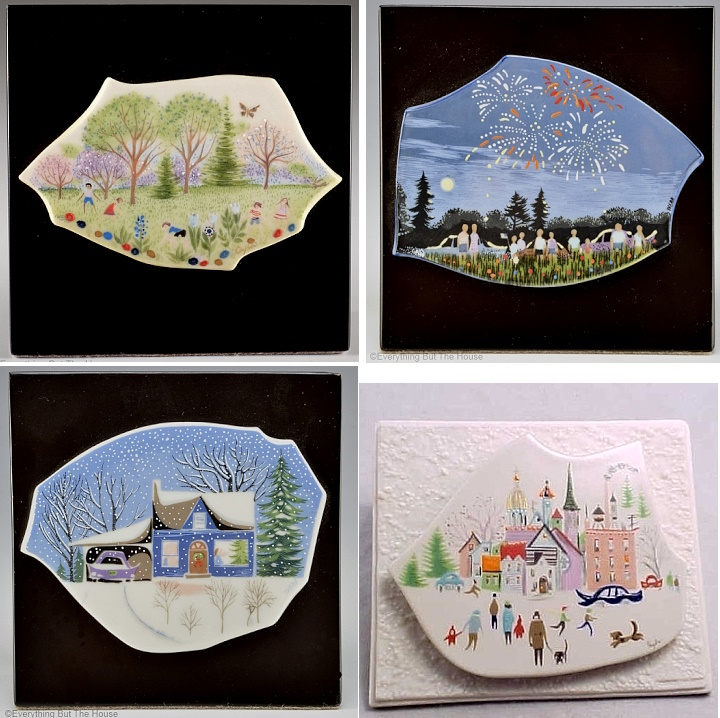 The ‘When Bells are Ringing’ quartet includes hand-paint accents such as flowers, Easter eggs, articles of clothing, fireworks, snowflakes, and architectural elements.
The Limnettes were the most extensive and complex use of decals on Cybis retail items. They required far less painting time than most Cybis bisque color sculptures but, even so, they entailed multiple firings:
- the initial bisque firing
- the glaze firing
- the decal application firing
- the decal firing
- the paint firing for the hand-applied accent colors (other than gold)
- a final low-temperature firing for the gold paint accents, if any were applied
A production upside to the Limnettes was that, because of their small size, a large number of these little plaques could be fired at one time, even in the studio’s small kilns. After the plaques were completed, signed and numbered, they still needed to be attached to their wedge mount before being shipped out to retailers.
The following Ivers-designed items do not appear on any retail price list that I currently have, but are definitely from the early 1970s also.
The Biblical Tales Decal Items

 These four free-standing pieces were among the lots in the studio’s 2019-2020 liquidation auctions. They have their own Archive post. At first I thought they were hand-painted but I later realized that these were created in same manner as were the Limnettes. They are all about 12”-13” high overall, which means that the decal portion is about half that. Notice that these four do not appear to have any hand-painted accents.
 The decals were also fired onto small plaques, about 7” high and 3” wide. Here we see 24k gold paint accenting the sun, moon, Moses’ robe and staff, Noah’s boat and also one fish. Red paint decorates the other two fish, as well as the flowers at Moses’ feet. Those appear to be the only two accent paint colors that were used. (The framing was done by the purchaser, not by Cybis.)
On these items the Cybis name is actually part of the decal! On the Limnettes the signature was added in brown paint, as was standard procedure for Cybis pieces, while the Ivers signature was within the decal.
 This sample plate, 11” in diameter, displays the original decals fired in greyscale. The plate is dated November 1973 on the reverse and also notes “fired on Lenox”. These four decal designs are one of only two known methods of the Cybis name not being hand-painted; the only other is the paint-stamp that was used during the 1950s (shown in Signatures and Marks.) The paint-stamp signature was discontinued during the early 1960s.
A 1987 Probable-Decal Plaque
 As I explain in its own Archive post, my opinion is that the Rose Plaque (Nature’s Beauty) which appeared in Spring 1987 as a limited edition of 500 is a decal product as well. Is the Cybis signature part of a decal design here too?
The Cybis description in the Spring 1987 brochure says that it is “a beautifully painted porcelain with frame” and “is one of the new ideas from Cybis.” The fact that the tip of the lowest leaf, the outside of two left-hand leaves, and all three stems are abruptly truncated is incredibly strong evidence that this is a decal. A freehand painting would never have edges like this! Are there perhaps painted brush strokes over parts of the flowers or leaves? We have no idea, because this is the only known photo of this item.
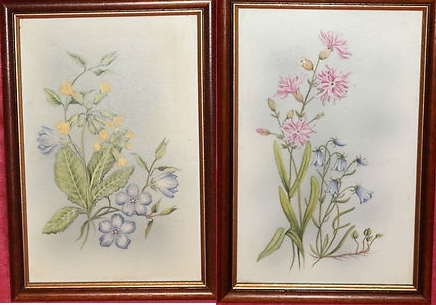 This is the way an actual completely-hand-painted floral study porcelain plaque would be done. These two (Primroses and Ragged Robin) were created at the Connoisseur of Malvern studio during the late 1980s and painted by their in-house artist Freda Griffiths.
So, even if we don’t count the 1987 probably-but-not-definitely-a-decal rose plaque, that still leaves 15 retail Cybis item-designs that were definitely created by using a decal as the primary art, plus four others (the Biblical Tales) that date from the 1970s but may have been only sold at the studio itself during the 1990s and 2000s to the walk-in trade…if even at all.
Compared to the total volume of known Cybis designs, tallied in my unabashedly-nerdy ‘truly-new Cybis’ post as 548, nineteen is a mere drop in the bucket: Only about 3% . So it’s not as if the studio made a habit of this, especially as all but the 1950s items and the 1987 plaque were George Ivers creations.
So, Why the Decals?
The answer to the ‘why use decals’ question is simple: The studio wanted to publicly showcase George Ivers’ unique style of art, but the only practical way to do that was via the decal method. The main image would need to be a decal, and then hand-painted color (or gold) accents could be easily added. More easily and quickly than on a dimensional sculpture, in fact, because no shading or blending of colors was required. It was very straightforward and simple to do.
Naturally, the Cybis studio was careful to not call attention to the fact that very little of a Limnette was actually painted. The brochure that introduced them was titled
CYBIS LIMNETTES
Small designs in porcelain brought to you by artists with the gift of enchantment.
 Almost all of the brochure’s text is about the word that they chose to describe the series; it says almost nothing specific about the Limnettes themselves other than the dimensions that are in the photo captions. No doubt this was because if they had done so, the correct description would need to be that they are hand-decorated, rather than hand-painted. The Limnettes do not appear in any of the Cybis catalogs, by the way. (See the Limnettes post for my nit-picking identification of the five errors in this text, and I’m not talking about the puzzling choice to use the British spelling of ‘color’ by a proudly-American studio either.)
I find it fascinating that Marylin Chorlton, who during her lifetime had not allowed the use of decals as backstamps (which was common procedure in the trade) nor to allow a designer’s name to appear on any Cybis item (except for Nashua), made those two exceptions for George Ivers only. This is not a criticism, but rather – in my opinion – a mark of the very high esteem in which she must have held him and his unique artistic style. The only alternative to using decals would have been to have an extremely small series of original items, each entirely painted by Ivers himself, which would have put them out of reach of most collectors price-wise. Thus, the decal method was the only possible way for Cybis to offer an affordable retail George Ivers series.
As for that Rose Plaque, well, what can I say except that there were quite a few bad decisions made by the Cybis studio during the mid to late 1980s and that plaque was definitely one of them. I do hope that one will eventually surface online – assuming that any were sold at all – and with good-quality photographs which will answer the decal-or-not-a-decal question once and for all!
Name Index of Cybis Sculptures
Visual Index (for human figures/busts only)
About the Cybis Reference Archive
What is Cybis?
Images of Cybis porcelains are provided for informational and educational purposes only. All photographs are copyrighted by their owner as indicated via watermark and are used here only as reference material. Please see the Copyright Notice in the footer and sidebar for important information regarding the text that appears within this website.
The Cybis Archive is a continually-updated website that provides the most comprehensive range of information about Cybis within a single source. It is not and never has been part of the Cybis Porcelain studio, which is no longer in business.
 THE CYBIS ARCHIVE