
In my December 2023 post, The Art of Making Art Porcelain, I described the ‘finishing and mounting’ process as Step #7. Depending on how many individual molds made up each component of a particular design, this could be quite a complicated process. Not only did each element need to be assembled (‘mounted’) but then that element might need to be securely mounted along with the others in order to create a complete sculpture.
It’s interesting to look at several finished multi-element Cybis pieces that have accidentally become dis-assembled, to get an idea of how the actual assembly was done. They are shown in chronological order by retail introduction year.
Little Princess
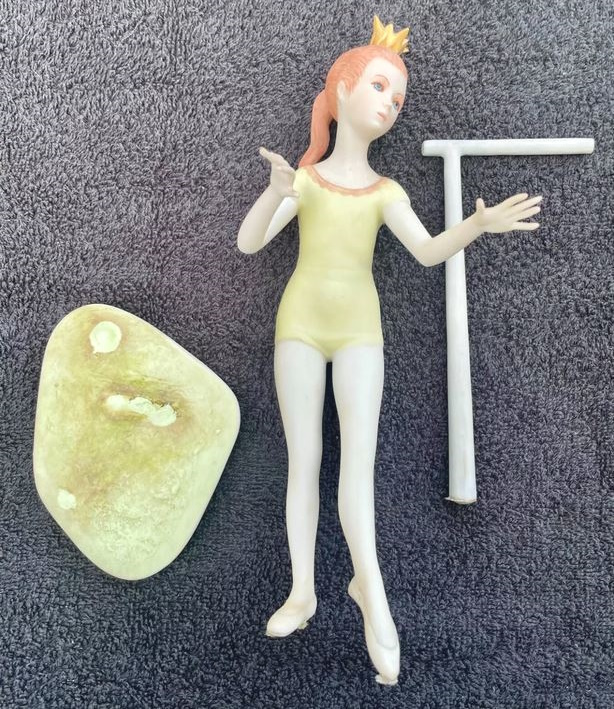 Let’s do a quick original-mold-pieces count for the 1968 Little Princess:
- porcelain base
- barre
- body mold (head/torso/legs)
- left arm
- right arm
- base mold
- crown
This is a straightforward case of the three attachments (left foot, right foot, and barre) to the base failing over time…no doubt helped along by repeated liftings-up via the girl’s body.
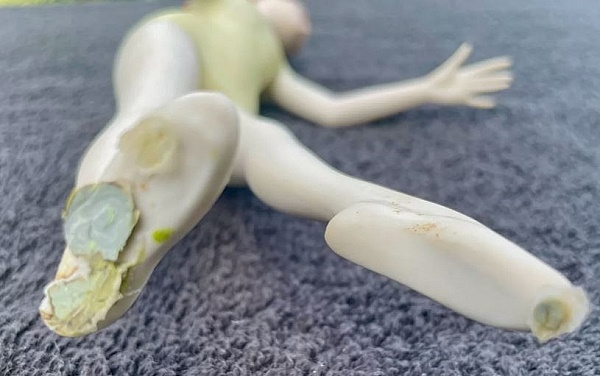 Here we have what I call the ‘grey goop’ adhesive still attached to the bottom of her shoes, but we can also see some of the paint that was used on the base. This grey-goop material was used by Cybis as far back as the 1950s, where it has been found attaching a wooden halo to the back of at least one of the Jesus busts.
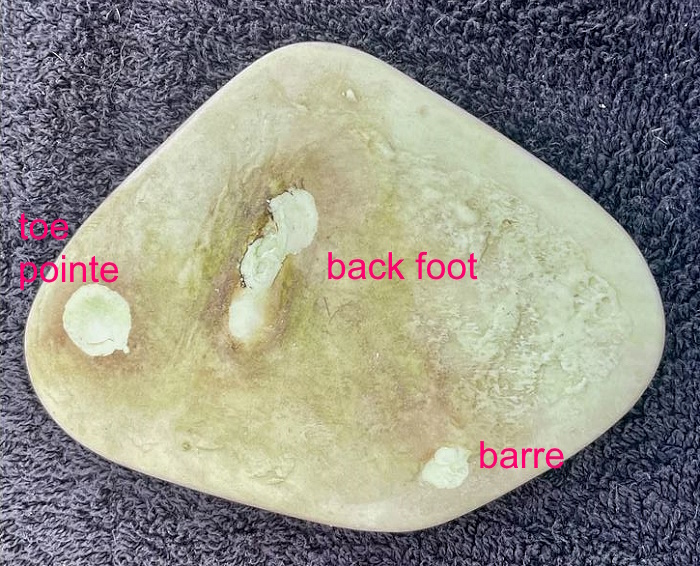 It is difficult from this photo to tell whether the attachment areas for the feet are slightly concave (in the mold) or not, because of the dried goop that remains in those areas.
Darby and Joan
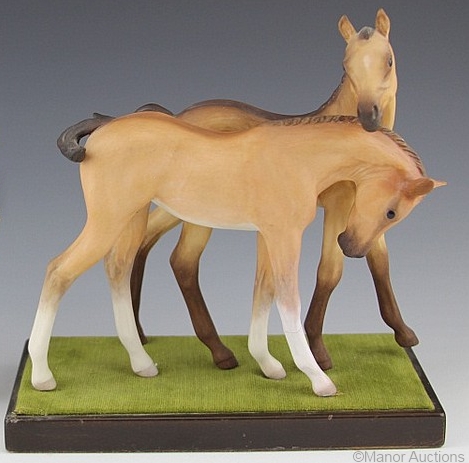 I’m embarrassed to admit that although I once owned one of these, I never took particular notice of how they were attached! This sculpture was introduced in 1969 and sold with the accompanying velvet-topped base shown here.

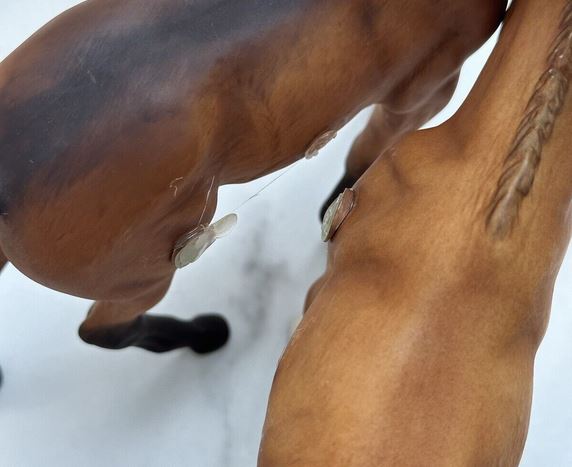
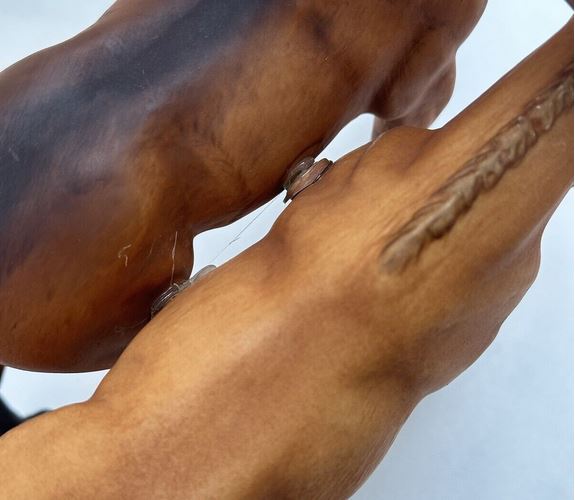 This is a straightforward case of two fully-completed horse figures being attached to each other by what appears to be a silicone(?) adhesive between porcelain rounds which themselves appear to have been attached to the horse figures before painting began; I can think of no other reason that the circular dark-brown paint ‘edges’ seen in the first photo would be there.
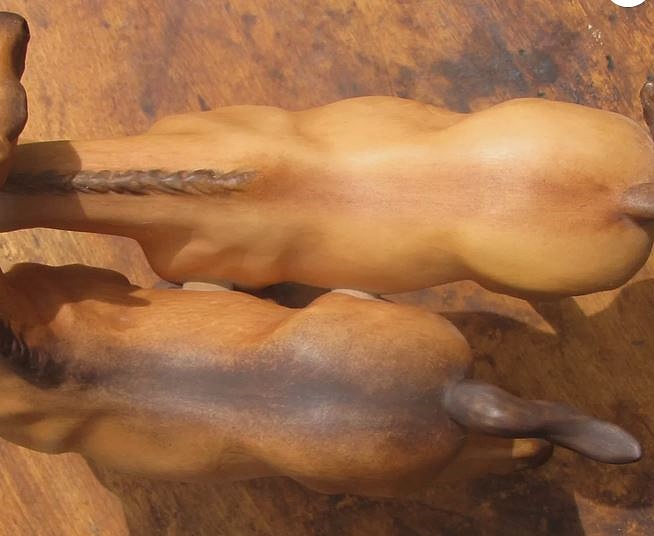 At first I thought that the silicone was a post-sale repair, but after finding a couple of photos of original-condition Darby and Joan such as this example, it became clear that this was indeed how the horses were originally connected.
Unicorns ‘Gambol and Frolic’
 With the 1977 limited-edition Unicorns ‘Gambol and Frolic’, we will again find grey goop on the separated sculpture below.
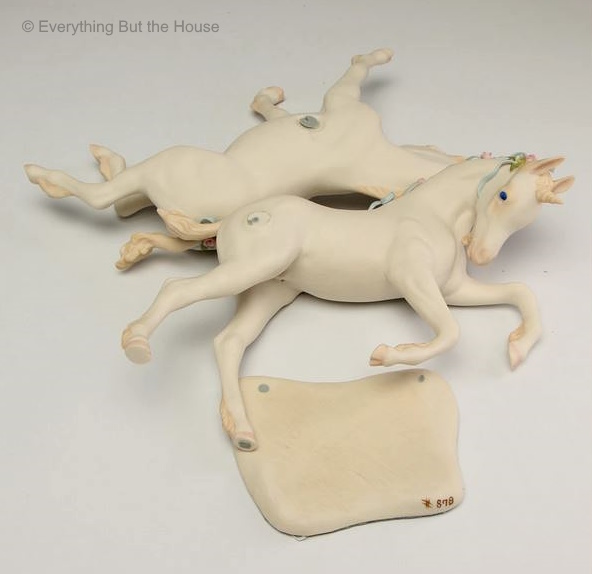 There is only one point of attachment between these two, which is neither molded (convex/concave) nor using silicone. Goop originally attached two of the four hoofs that normally connect the unicorns to the porcelain base; those two are the forelegs of one unicorn. The hind feet of the other unicorn were also attached, although I see the goop only on the bottom of one hoof and none at all remaining on the corresponding area of the base. Given that there is only one connection point between the unicorns, it’s not surprising that the two might become separated.
Christopher, the Sea Listener
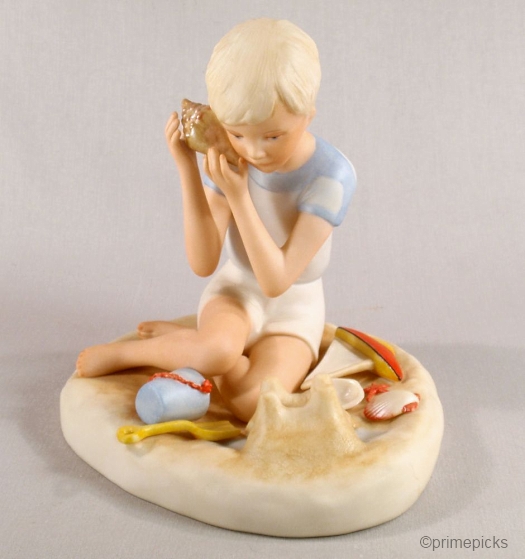 This 1979 open edition is made of nine elements: Christopher (who himself is composed of at least four individual molds), the conch shell, pail, shovel, sand castle, sailboat, two cockle shells, and the porcelain base.

 Here we have a detached Christopher but everything else remained in place. These photos allow us to clearly envision how the decorator (painter) worked on the already-completely-assembled (fully mounted) piece, because the ‘sand’ paint color is heavier around edges where Christopher’s posterior and feet meet the base.
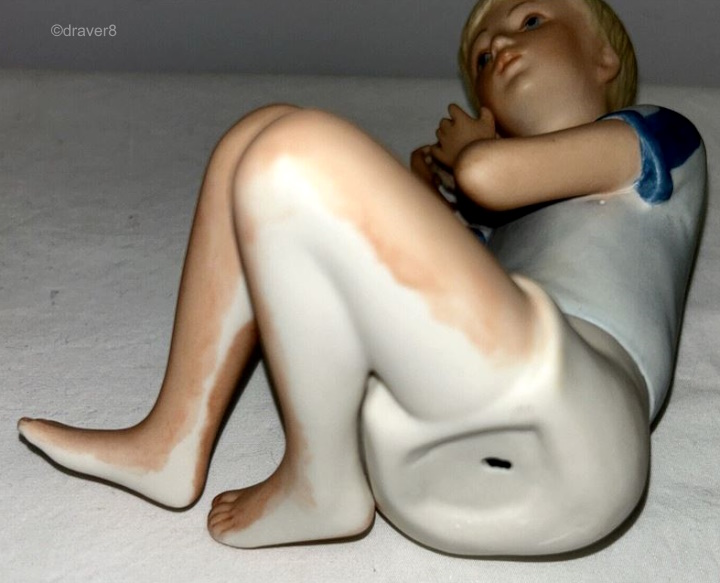 The concave area under his posterior fits over the corresponding convex area on the base. A close look at the edges of that area reveals evidence of the liquid porcelain ‘slip’ that affixed the boy and the base together; no evidence of goop anywhere. The sand castle was probably already attached before painting began, but whether the smaller items/molds were there also, or were painted separately and then attached, cannot be determined from these photos.
Pegasus Colts ‘Flight and Fancy’
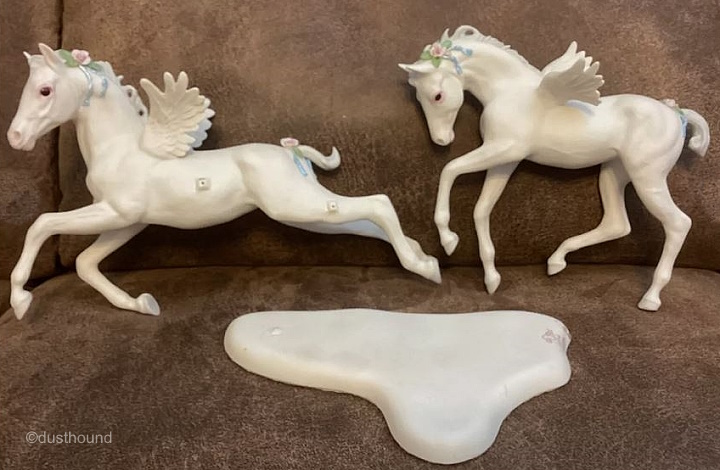
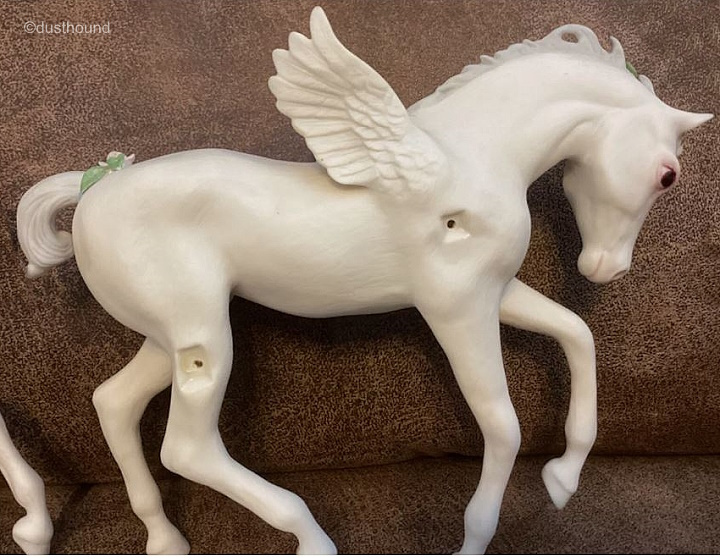
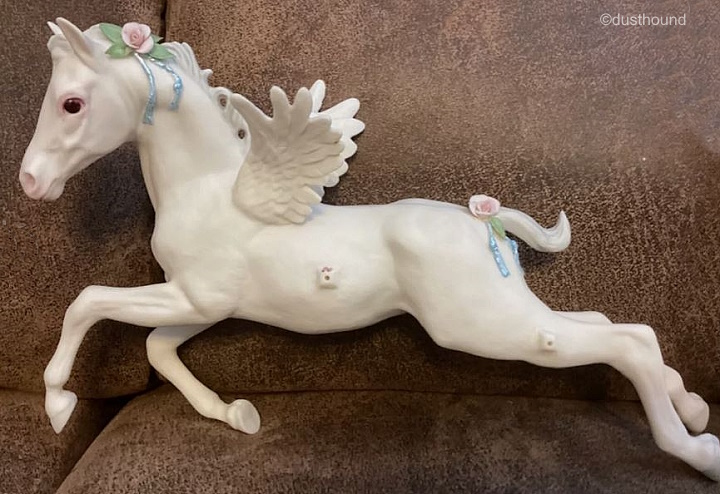 This 1984 limited edition is similar to Gambol and Frolic in that these require attachment to the porcelain base in order to stand upright. Here we see the same type of attachment areas (convex/concave) as seen in Christopher, and also traces of slip inside a couple of the concave squares. Anyone with a tube of Superglue and steady hands could successfully re-connect these two airborne equines.
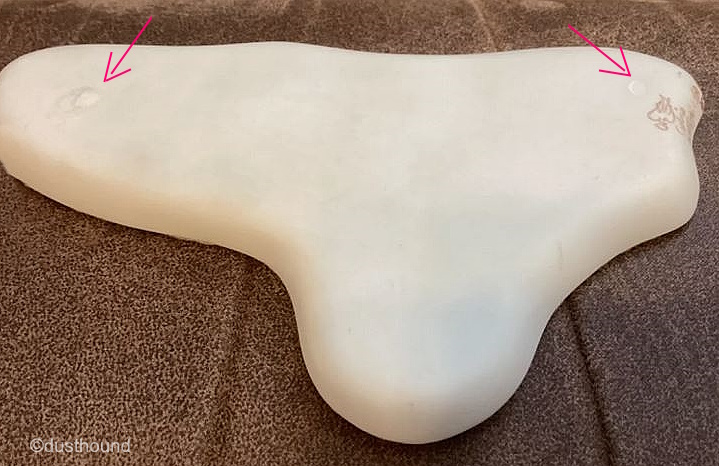 The arrows indicate two of the three original attachment areas to the base; they are where the right foreleg and left hind leg of the ‘lower’ pegasus were attached to it. The other pegasus had only one attachment area: the point of his right hind foot! Because that contact area was so small compared to the other two, it may have been attached with glue only. That single very tiny attachment ‘grounding’ point for that pegasus is why it was so important to have the two figures firmly connected to each other. Obviously it wasn’t sufficient for the way this sculpture was handled. :-(
 This overhead photo of an intact example shows how the attachment method is invisible. A huge improvement from the circa-1960s Darby and Joan method!
Sir Henry, the Knight
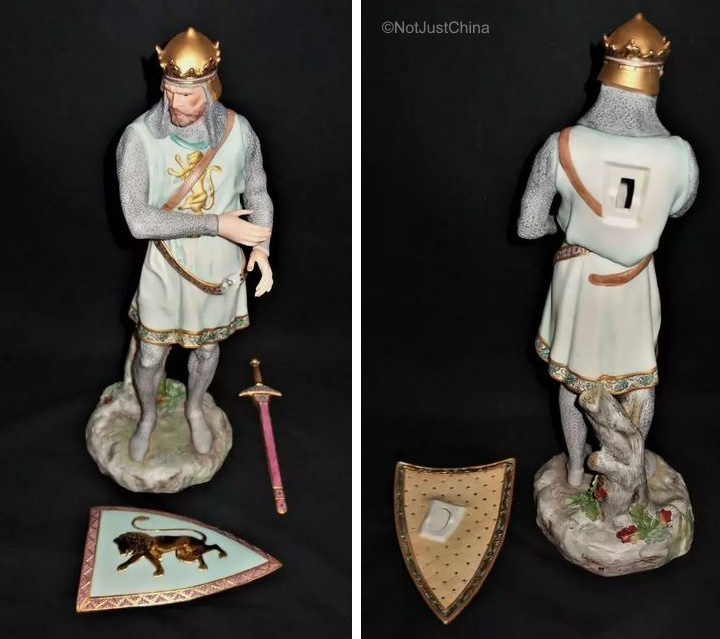 The 1986 limited-edition Sir Henry is a great example of accessory detachment – in this case, his sword and/or shield.
 The shield has the classic convex/concave attachment method which should have been done with slip but I’ll be darned if I can spot any residue here (of anything.)

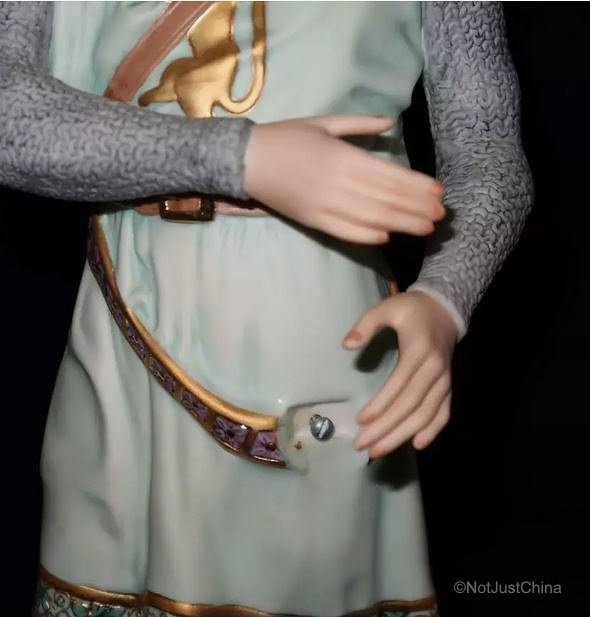 The sword/scabbard is more problematic because although the method is the same, there’s no room to have very much convex/concave contact. Because gravity works in our universe, the attachment area is augmented by a screw-and-keyhole method. But any mold piece that extends out into the air, as most of this scabbard does, is going to be vulnerable to any kind of accidental mishandling or pressure.
On this piece it’s clear that the body, the shield, and the scabbard were completely painted separately and then the accessory pieces were attached as the final step before signing and numbering.
The Lady and the Unicorn vs. Lady Elizabeth
 This is The Lady and the Unicorn, an edition of 750 introduced in 1986 and designed by Lynn Klockner Brown. The three major mold components are the Lady, the Unicorn, and the flowery-mead-design base.
In the second half of the 1990s the Cybis studio decided to introduce the lady as a separate declared limited edition of 1500 (in fact, I would be very surprised if even as many as 100 were ever made and sold) under the name Lady Elizabeth. Unfortunately, they did not bother to make any changes whatsoever, either in size or in colorway, to the original 1986 lady mold. Talk about an invitation to confusion!! That is why Lady Elizabeth has her very own Archive post.
As you can see from the completed 1986 sculpture, there is potential for the lady and/or the unicorn to become detached from the base. In fact, that’s exactly what happened to the lady in two sales recorded on the Recent Sales page: #107 in January 2022, and #243 in October 2023.

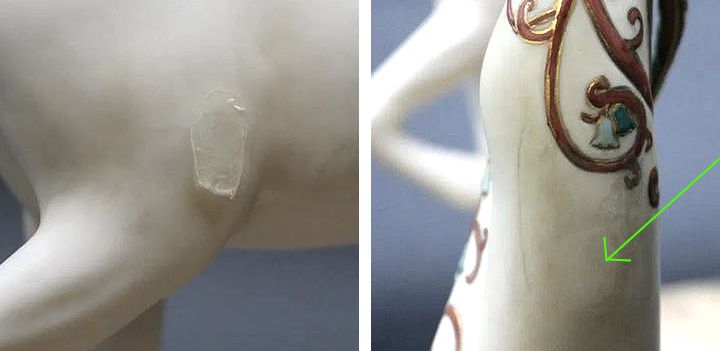 These photos show the separated #107. It is easily seen that the lady and the unicorn are connected at the unicorn’s left front flank and at the lady’s right side, just below the upper skirt decorations. The completed Lady and the Unicorn sculptures are signed and numbered only on the base section’s ‘back’ side adjacent to the Cybis,1986, and phoenix-logo mold impressions. Neither the lady nor the unicorn are signed or numbered themselves.
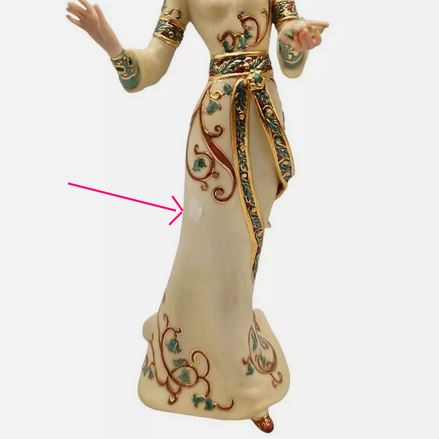
 The fact that the circa-1990s Lady Elizabeth is identical in every way to the 1986 ‘unicorn lady’ means that it’s possible for a detached lady to be wrongly offered for sale as a supposed “Lady Elizabeth”…which is exactly the situation with the above piece. However, this is nothing more than a detached lady; one wonders what happened to the unicorn and the base. There are two tip-offs that this is definitely not a Lady Elizabeth: The presence of attachment-material residue (indicated by my added arrow in the first photo, and pink lines in the second), and the fact that she is neither signed nor numbered. The second photo allows us to see the two areas where the unicorn-ladies were originally affixed to the top of the base section (the brown marks are Cybis studio production notations.) I happen to know that the seller has been advised of the improper identification of their item but, as of this writing, has not chosen to correct it; the old adage about leading a horse to water comes to mind, followed by the equally-apt caveat emptor!
Molds, Molds, Molds: Little Jamie
 Although this piece is still intact, it’s illuminating to look at how many individual molds (at least 15) had to be assembled together to create the 1981 open edition Little Jamie. I’ve informally categorized the assembly process into three stages: Primary, Secondary, and Tertiary. The primary assembly molds are Jamie’s body (torso, arms, legs, and head) and the porcelain base. Jamie’s separate hat mold was then attached to his head.
Next came the six individual baby chicks and the four pieces of the basket (body, handle, and two lids.)
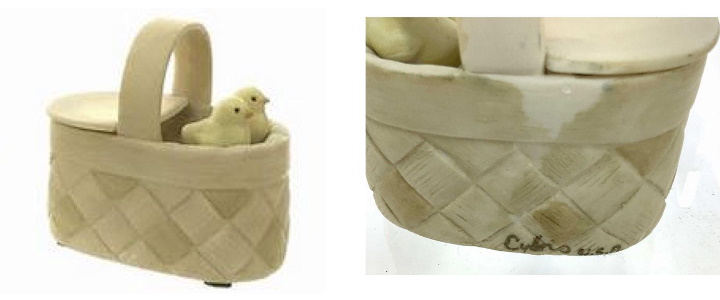 Here is a detached basket that was undoubtedly offered at the studio during the 1990s and 2000s as one of their low(er)-priced entry-level items aimed at the factory-tour-bus trade and other visitors. Most, if not all, of those pieces were molds that originally were accessory elements within larger or more complex sculptures. Many such items appeared in the 2019-2020 studio liquidation auction lots. Notice that the front lid of this basket is missing. How do I know that this piece was once attached to a Little Jamie? Because of the missing paint on the bottom of the handle and top section of the basket, where Jamie’s back originally connected to it, and also the small traces of blue paint which matches the color of his overalls! Rather than throw the detached basket away, the studio stuck some tiny felt circles on the underside and added the Cybis signature, without bothering to fix the missing paint or add the missing lid. Tsk, tsk.
The third step in the assembly process was the final combination of the completed Jamie, the completed basket, and the four remaining chicks, atop the base mold. Little Jamie, a/k/a Jamie (boy with chicks) in some Cybis advertising, was produced for three years (1981-1984) and sold for $345…which may sound like a lot of money for a six-inch-high figurine, until one considers all of the steps that were required merely to put it all together!
Name Index of Cybis Sculptures
Visual Index (for human figures/busts only)
About the Cybis Reference Archive
What is Cybis?
Images of Cybis porcelains are provided for informational and educational purposes only. All photographs are copyrighted by their owner as indicated via watermark and are used here only as reference material. Please see the Copyright Notice in the footer and sidebar for important information regarding the text that appears within this website.
The Cybis Archive is a continually-updated website that provides the most comprehensive range of information about Cybis within a single source. It is not and never has been part of the Cybis Porcelain studio, which is no longer in business.
 THE CYBIS ARCHIVE