
Although unknown to the Cybis collecting community, Gertrude Fass created some of the studio’s most well-known portrait figures. Mrs. Fass was not only a sculptor, however; she was also a painter and a writer for print, radio, stage and screen.
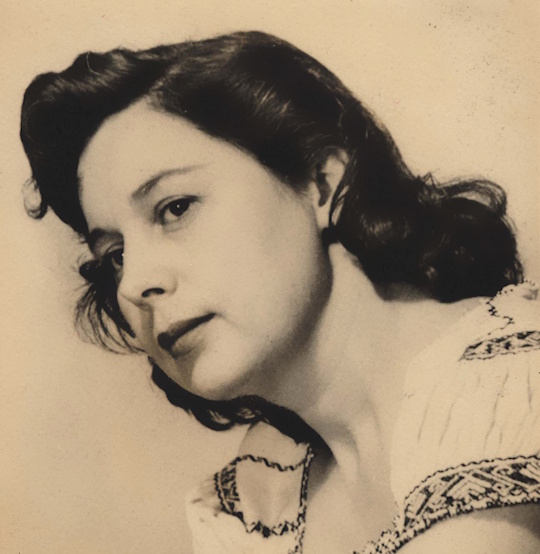 Born Gertrude Joan Kossoff in July 1909 to parents Philip Kossoff and Rachel Gindes, she is shown in the 1920 census as living with her parents and four siblings in the Bronx, NY. Within the next decade the family moved to Queens. The 1940 census finds Gertrude, her parents, and her brother Larry in Brooklyn. Gertrude is now 30 years old and gives her occupation as a high school art teacher. This photo was taken during the mid to late 1930s. A few years later, Gertrude married George Fass; the couple had a son and a daughter. George Fass’ career as a screenwriter for radio and television prompted the family to move to Manhattan.
Gertrude worked in the same industry, writing scripts for radio shows during the 1940s and adding television screenwriting during the 1950s and 1960s. A complete list of her movie and tv credits can be found on the IMDB database; it includes such iconic series as Death Valley Days, Peter Gunn, Highway Patrol, 77 Sunset Strip, and Science Fiction Theatre. She also wrote scripts for several serialized radio shows including Suspense (1946-1947), The Whistler (1948), and Murder by Experts (1949-1950.) A contemporary review of her episode Fly by Night, written for the Radio Detective Story Hour, reads:
A thrill-packed story written by George and Gertrude Fass and adapted by Mort Fine and David Friedkin with Elliott Lewis directing. A convergence of talent that also stars screen actor Joseph Cotten in a well-acted understated role as Micky Manning. Manning is trying to clear his name but finds himself a scapegoat in a crime with some interesting twists and turns.
 One of my favorite and vastly-under-appreciated 1950s television series is The Adventures of Robin Hood starring Richard Greene; the episode One Man’s Meat, shown in the third season, was written by Gertrude Fass. This photo was taken in 1955. The series itself was a ground-breaker, not only because it was among the first to be shown on Britain’s then-fledgling commercial television, but also because it was the first UK/USA partnership for a tv series. I cannot resist inserting this short YouTube of the theme song; depending on how old you are, you may remember it first-hand!
However, there was something even more important about Robin Hood. At that time, the industry in Hollywood engaged in the deplorable practice of ‘blacklisting’ writers and actors if they were targets (however unjustified) of Senator Joe McCarthy’s persecution of suspected Communists. The developer of the Robin Hood series was Hannah Weinstein. In a 2023 essay published on Zocalo, it is related that
Weinstein developed the series with leftist writers Ring Lardner Jr., Ian McLellan Hunter, and others. […] Lardner and Hunter had both been targeted by the House Un-American Activities Committee (HUAC), and were unemployable as screenwriters. Their involvement in Robin Hood was known only by Weinstein and two or three others on the show who were sworn to secrecy. […] Still under surveillance by the FBI and the CIA for her own political activities back home in New York, the petite former journalist implemented a strict procedure for getting scripts and notes back and forth across the Atlantic. She did the same with getting the writers paid—no easy feat, considering they had to use pseudonyms for everything.
Gertrude Fass was among the cadre of US-blacklisted writers. The Robin Hood series was a huge hit on both sides of The Pond, which created a bit of a problem because although the actors received widespread acclaim, the screenwriters remained unacknowledged because all were writing under pseudonyms! Years later, after the witch-hunt madness had passed, the writers were given proper credit under their actual names. This IMDB entry for Gertrude Fass credits all of her work.
 The final script of Science Fiction Theatre’s 1955 episode The Long Day sold at auction a few years ago. DeForest Kelley, later beloved by legions of Star Trek fans for his role as Dr. Leonard McCoy, appears in that episode as the character Matt Brandon.
George Fass died in 1965, after which Gertrude went back to teaching although not full-time. She taught high school English in Tenafly, New Jersey and also devoted time to writing and sculpting for casting in porcelain and/or bronze. It is during the 1970s-80s period that the Cybis designs were created.
Cybis Porcelain Sculptures by Gertrude Fass
Thanks to a treasure-trove of information received from her daughter, I can now properly credit all 30 of the sculptures that Gertrude Fass created for the Cybis studio.
LIMITED EDITIONS:
 Robin is one of only two limited-edition child busts that Cybis produced. She is the largest (tallest) at just under 11” high overall, and was an edition of 1000 in 1982.
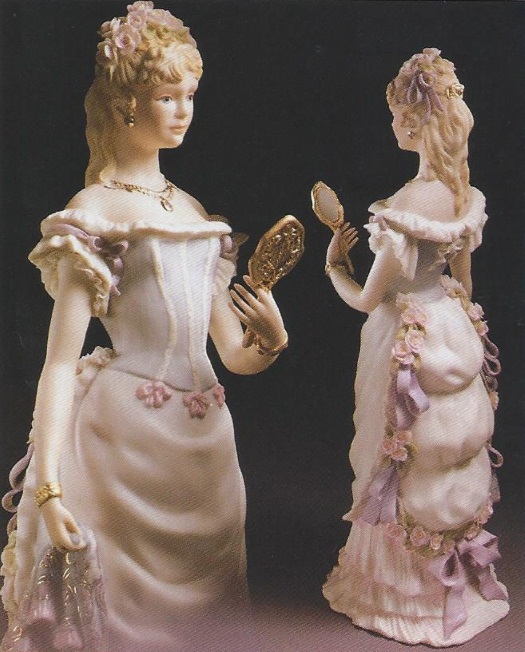
 Camille was the first Gertrude Fass sculpture to appear in the studio’s Portraits in Porcelain collection. An edition of 500 in 1983, she is shown here in the model stage as well as the finished-product stage. She is 14” tall.
 Othello was introduced in 1983 as an edition of 350. He is one of the few male Portrait in Porcelain figures by Cybis; the majority were female. Othello’s companion sculpture, Desdemona, was created by Lynn Klockner Brown.
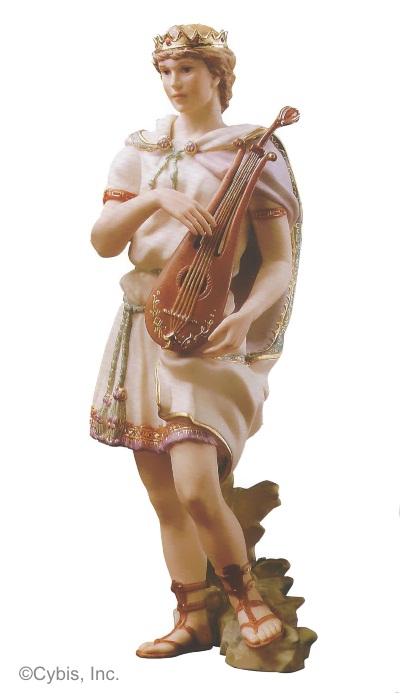 King David appeared in 1985 as an edition of 500 which was reduced by the studio to only 350 a couple of years later. It is not known who designed his companion piece, Bathsheba.
 Leda and the Swan was one of the first three sculptures in the studio’s new Classical Impressions series in 1986, as an edition of 500. This white-bisque-only series was intended to mimic classic Parian marble, but two years later Cybis added color versions to each. I have never seen a color version of Leda.
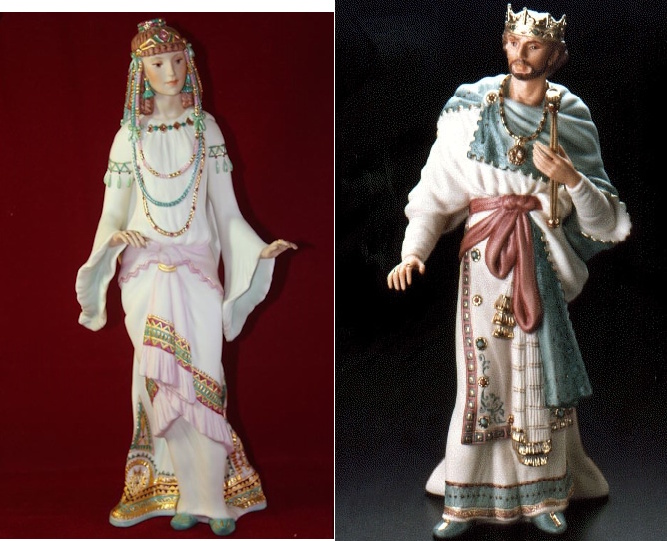 The Queen of Sheba appeared in the spring of 1987; her companion piece King Solomon was introduced that autumn. Both were editions of 500 and between 14” and 15” tall.
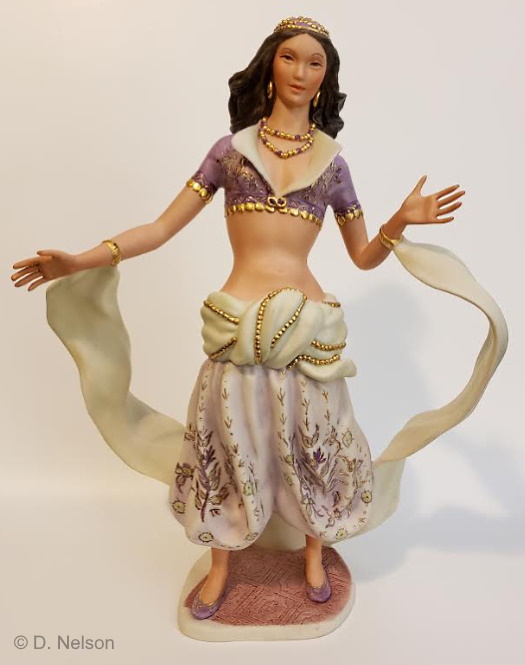 The final Gertrude Fass limited-edition retail release was Scheherazade in 1989. The introduction year means that these should all bear the 50th Anniversary mark. She is 13” tall and was an edition of 500. Scheherazade should have had a companion piece….but more about that later!
OPEN (NON-LIMITED) EDITIONS:
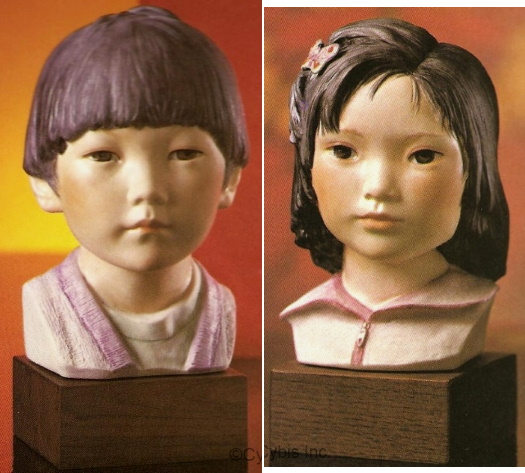 Oriental Boy ‘Cheerful Dragon’ and his companion piece Oriental Girl ‘Lotus Blossom’ were introduced by Cybis in 1979 and 1980 respectively. They are 10” high overall, which was the typical size for these on-base child portrait busts.
 Psyche, introduced in 1980, was the long awaited companion piece to the mid-1970s Eros. One of the two Cybis-designed collector dolls produced by The Hamilton Collection was based on this head sculpt.
 Madonna ‘Queen of Peace’ also appeared in 1980 but was produced only in that year and in 1981. She is 7.5” high. This is the only Cybis edition that was regularly marked with the production year on the underside, adjacent to the signature. It was produced in white bisque as well as color. She was also the first new madonna design that Cybis introduced after the 1950s.
 Edward and Victoria were both introduced in 1981 and were the final entries in the Children of the World Collection, which disappeared as a named collection that same year although these two busts were not retired until 1983. However, there was another pair of child busts that was never produced – as I will explain below!
 Two Fass angel studies joined the flight during the early 1980s: Adoration in 1981 and Angel ‘Annunciation’ in 1982. Adoration is 6” high and was available in either white bisque or color. The baby and creche were later sold separately as a gift item (Baby in Cradle) in a choice of three blanket-and-diaper colorways.
 A terribly clunky alteration of the original 9” tall Angel ‘Annunciation’ was added to the 1980s nativity series in 1989, after the studio had retired the original angel; the nativity version was called Nativity Angel II (standing).
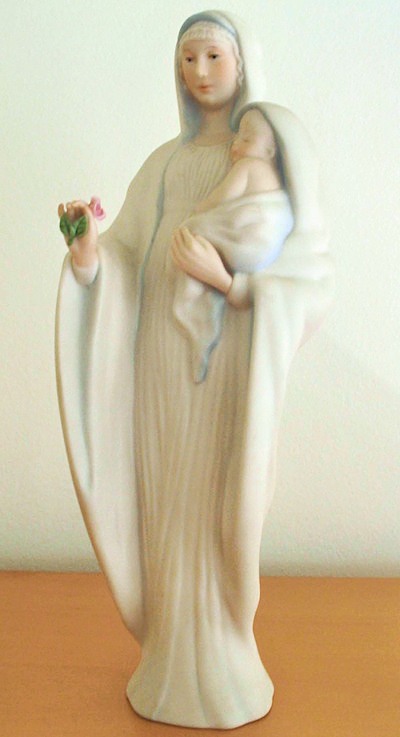 Madonna ‘Mother of Love’ appeared as an open edition in 1983; she is 9.5” high. She was retired after only a couple of years but reappeared in 1989 (one of many such resurrections) as an “Anniversary replica edition” under the name Madonna with Baby. The only change to the sculpture was to replace the original pink rose bloom with a single white lily flower.
 David, Shepherd Boy is a representation of King David as a youngster (although I see no slingshot.) He is 8.5″ high and was introduced in 1983.
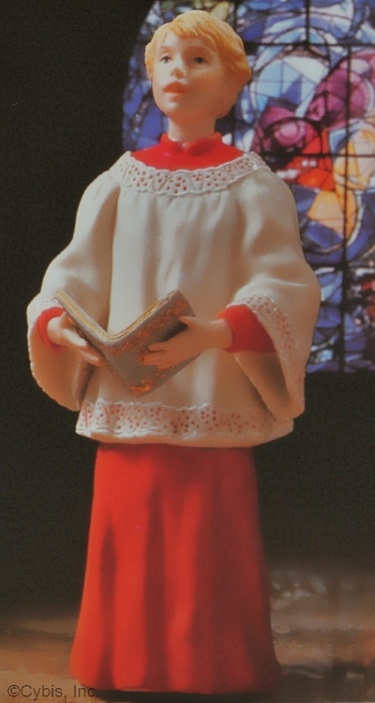 The Choir Boy is just under 9” high and was introduced in 1984 as a proceeds-benefit piece for the American Boychoir School.
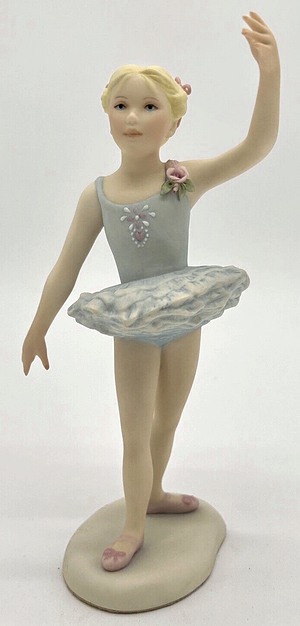 Recital has the unusual distinction of having the shortest retail availability run of any known Cybis open edition: Fewer than six months! Introduced in autumn 1985, she is shown as already retired on the studio’s next (February 1986) price list. I can only assume that there was some type of production problem but have no idea what it could have been.
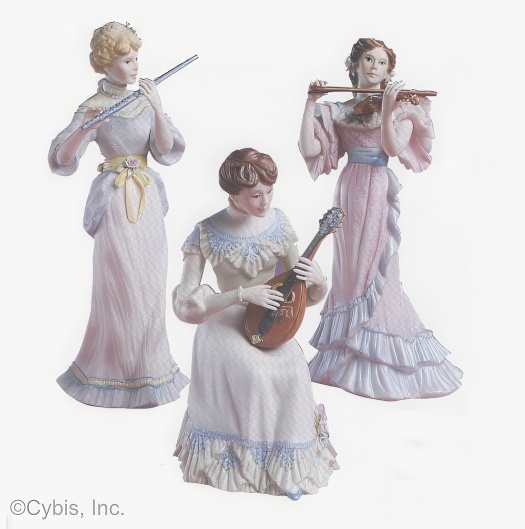 This trio of female Victorian musicians were introduced as separate pieces in 1985: Felicia, Flutist (9.25” high), Vanessa, Violinist (8” high), and Marguerite, Mandolinist (7” high.)
 These three terracotta-model ladies are remarkably similar to the Cybis trio.
 1986 saw the simultaneous introduction of Bedtime Jody and Bedtime Beth. Both are 5” high, and for a short time were offered as a pair for a slightly discounted price.
 In 1988 Cybis introduced a wedding-theme collection which included two representations of a wedding party. The Flower Girl and the Ring Bearer were created by Gertrude Fass; they are both 4.75” high. The Bride and the Groom were limited editions by Lynn Klockner Brown, and the teen-age Bridesmaid was also known asYoung Rose.
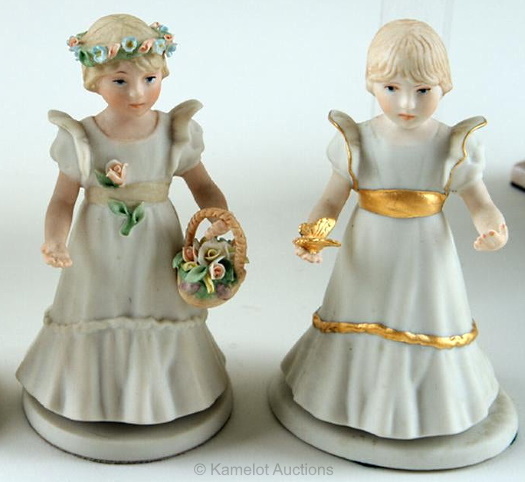 The Flower Girl morphed into the Little Princess figure in 1997 when she was decoration-tweaked into being the Cybis Collector’s Society piece for that year.
 My final production example is not on any known Cybis retail price list. This item appeared within the studio’s 2019-2020 liquidation auction sales and was the only one I’d ever seen. I was immediately struck by its style similarity to Adoration but had no idea who had created that piece either. I assumed that it was meant to be a cherub.
 However, I believe that the mystery is either partially or wholly solved by this photo, received from Mrs. Fass’s daughter, of a piece captioned “Cupid“. The liquidation-auction piece has now been re-titled here in the Archive as Cupid in Flight.
Created for Cybis but Not Produced at Retail

 Another longtime mystery was solved by these photos of a Mexican Boy Head and Mexican Girl Head. I knew that they existed because I spotted both in the background of a snapshot taken by one of the Cybis artists during the early 1980s. I have no idea why the studio never included these in the Children of the World series; frankly, the omission of a pair of Latino/Hispanic children seems inexplicable given the supposed purpose of the series. I like to imagine that if they had been produced, they might have been named ‘Manuel’ and ‘Rosita’!
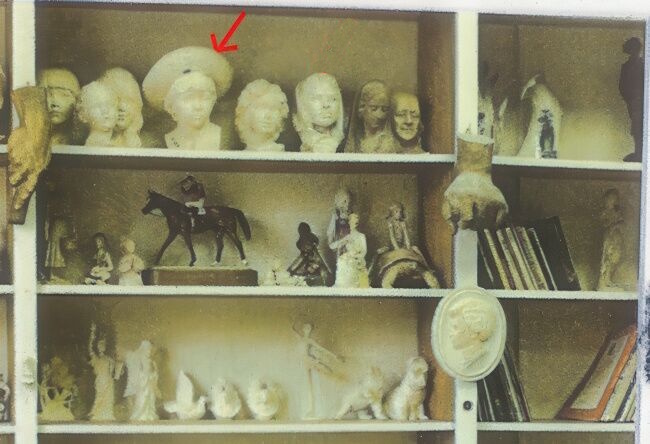 At least one of the busts is seen in the 1980s snapshot.


I really really would have loved to see Cybis produce Sinbad the Sailor! He would have fit nicely into the Portraits in Porcelain, especially because his cycle of stories was a (albeit latter-day) addition to the Thousand and One Nights tales of Scheherazade. Not to mention the fact that he would have been a far better representation of a seagoing character than the dubiously-designed circa-2000s Buccaneer was. I assume that Sinbad is probably 14” tall which is the average height of most of the Cybis portrait figures. This is, of course, the original model.
Gertrude Fass Designs for The Franklin Mint
Most of these were produced as music boxes by the Franklin Mint during the 1990s and manufactured in Thailand.
 At least they did credit Gertrude as the designer, although only via a package insert rather than on the music boxes themselves.
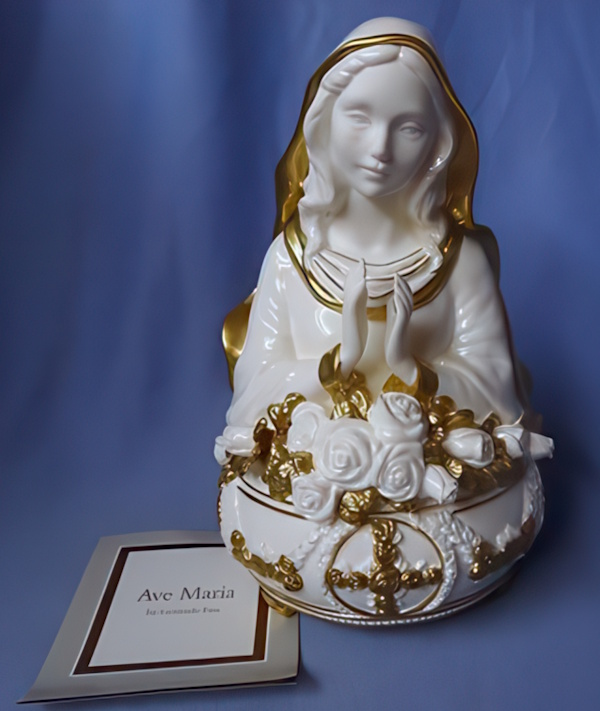
 The Ave Maria music box is just over 8” tall and plays the tune of the same name. This one apparently was available in two colorways: white with gold accents, and full color. I have only found the others in white-with-gold.
 The Madonna and Child music box is 9.5” tall and plays ‘What Child is This.’
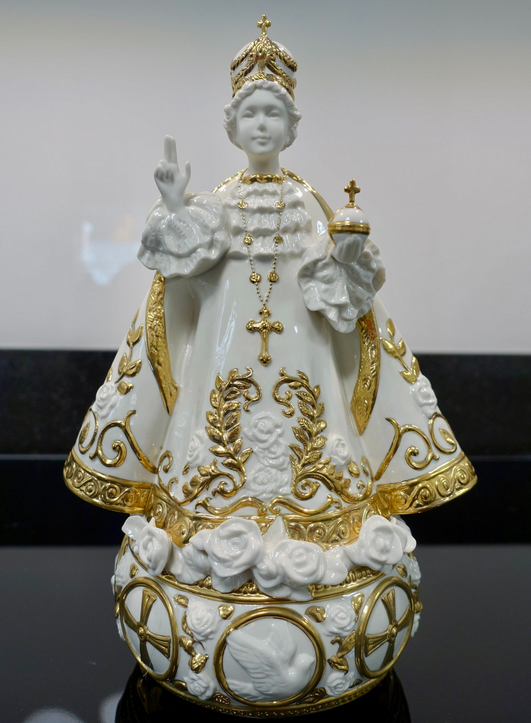
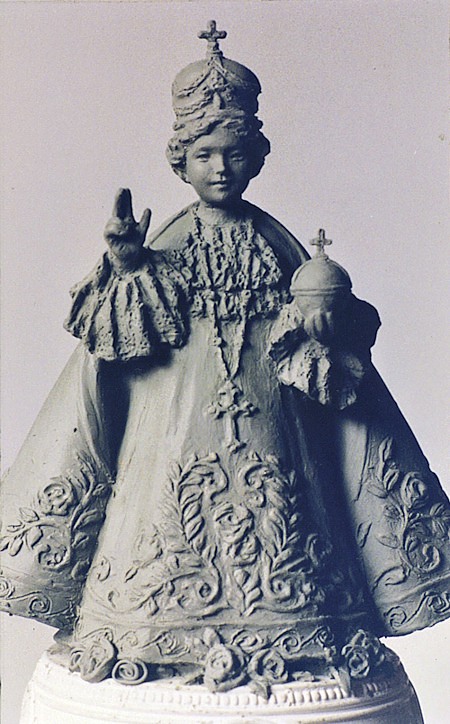 The Infant of Prague music box is 9.5” tall. I have been unable to discover what tune it plays, because most sellers describe it merely as “a classic melody” – which means they don’t recognize it either. 😉 The original model is also shown.
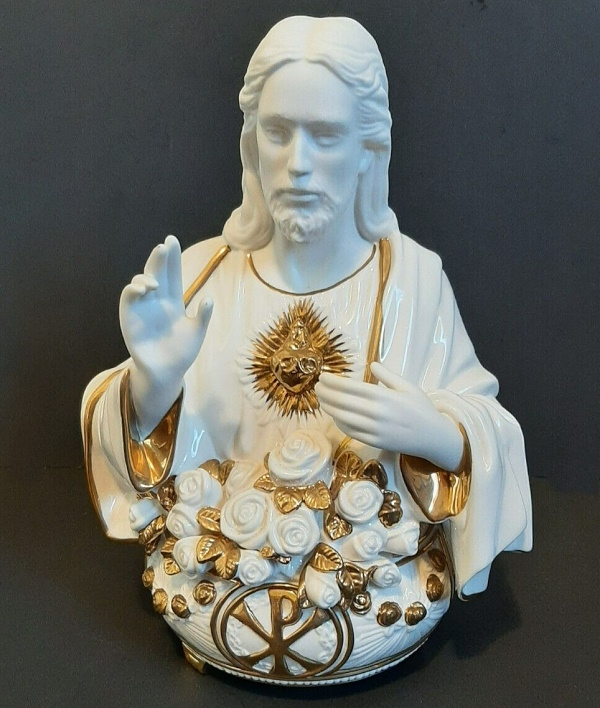 The Sacred Heart of Jesus music box is the same size. Some eBay sellers have described the tune as being ‘The Lord’s Prayer.’
 A group of all four Gertrude Fass music boxes together.
 A Tender Moment was produced as a figurine by the Franklin Mint circa 1990. It is just short of being 10” high
In the upcoming second part of this Profile, I will further examine the artistry of Gertrude Fass via her bronze and terracotta sculptures, dolls, paintings and drawings.
Name Index of Cybis Sculptures
Visual Index (for human figures/busts only)
About the Cybis Reference Archive
What is Cybis?
Images of Cybis porcelains are provided for informational and educational purposes only. All photographs are copyrighted by their owner as indicated via watermark and are used here only as reference material. Please see the Copyright Notice in the footer and sidebar for important information regarding the text that appears within this website.
The Cybis Archive is a continually-updated website that provides the most comprehensive range of information about Cybis within a single source. It is not and never has been part of the Cybis Porcelain studio, which is no longer in business.
 THE CYBIS ARCHIVE