
The early 1960s saw the birth of what is recognized today as the Cybis Porcelain studio. After the deaths of Boleslaw and Marja Cybis in 1957 and 1958, the Cordey influence (as seen in the M.B. Cybis items) disappeared and the instances of Holland-Mold-based items waned. Original designs became the new focus. How did the Cybis studio approach the challenge of selling themselves during the 1960s? A fascinating glimpse into this process was provided by a cache of correspondence from several of the studio’s regional marketing representatives between 1962 and 1965; these were independent contractors, not in-house employees of Cybis.
Malcolm Wing Hatch was hired during the summer of 1962 to represent Cybis on the West Coast. Based in Santa Monica, CA, his territory also included Oregon, Washington, Arizona and New Mexico.
Frank Quinn, of Park Ridge near Chicago, had Illinois, Indiana, western Ohio, Michigan, Wisconsin, Minnesota, Iowa, Missouri, Nebraska, and the Dakotas.
Fred “Ozzie” Osbourne was based in Dallas, from which he covered Texas and Oklahoma for sure, and possibly Arkansas and Louisiana as well.
Dan Sneburger had the Mid-Atlantic region: eastern Ohio, Pennsylvania, New Jersey and possibly Maryland and Washington D.C.
A fifth representative who only signed himself “Raymond” serviced Tennessee and probably points south as well; there was only one piece of correspondence from him.
A sixth rep who had no correspondence but who was identified in three letters from Joe Chorlton as “Mr. Thornton” covered New York and Connecticut. Whether his territory also included the New England states is not known, but is likely.
Unfortunately, I do not have permission to reproduce images or full transcripts of these documents but I will do the best I can with descriptions and short excerpts in order to convey what they contain.
Sales Accoutrements
A typical well-equipped manufacturers’ rep had a home-base showroom where his clients’ wares were always on display, a portable display (the stereotypical traveling salesman’s suitcase), a sales book containing photos and the current wholesale price list, and brochures highlighting current offerings. In addition to visiting current and prospective retailers individually, they also attended trade shows. The Cybis correspondence shows their reps attempting to obtain these supplies from the studio. Their frustration is evident, especially in a letter from ‘Mal’ Hatch in late 1962 stating that he was having difficulty “explain(ing) away the matter of delays and what not.” He asked Joe Chorlton specifically for a list of the sculptures that the studio currently had on hand or would definitely have available for delivery on receipt of a sales order, and also for a written statement showing the “normal production time” for things that were not actually in stock.
Another issue was the lack of photographs to go with price lists of new items:
I’ve been asked questions already what the items look like on this list and I’m naturally at a loss to either describe or commend them.
Based on the early-1963 communications, it appears as if the reps did not yet have a method by which to take samples to retailers. In January 1962, Mal Hatch asked for a portable display case that would contain “at least a dozen of the smaller Cybis pieces along with several of the birds” and that the case should be “compactly and lightly built” for ease of handling. One wonders how (or if) that was accomplished, given that he also suggested that the case be “richly layed [sic] out inside so that each piece can be distinct and individualized.”
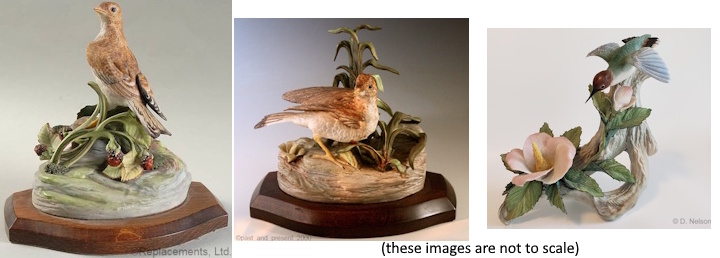
A desperate plea from “Ozzie” Osbourne in May 1963 for more samples for his showroom bemoaned the fact that he had neither a Skylark pair nor a Hummingbird – which is puzzling because the hummer was a 1959 introduction. The 1978 Cybis catalog says that it was retired in 1963, which makes me think the omission of samples was deliberate, i.e., the studio had already decided to make no more of them; but if so, why not inform their sales reps? The Skylark pair was a limited edition that was not completed until 1970, so one can certainly understand Ozzie’s frustration in having no actual sculpture for retailers to see. In the same missive:
WE ALSO SHOULD HAVE ROAD SAMPLES SO THAT THE SHOWROOM IS NOT ROBBED….PLEASEEEEE!!! (or don’t we rate that good with you???) The Gift Show is NEXT month..we need samples for the above—new literature with prices and all those other things we agreed on in September. Remember?
Mal Hatch neatly summed up the situation by closing a communication to Joe Chorlton that same month with the advice to remember old sales adage that “you can’t do business from an empty wagon.”
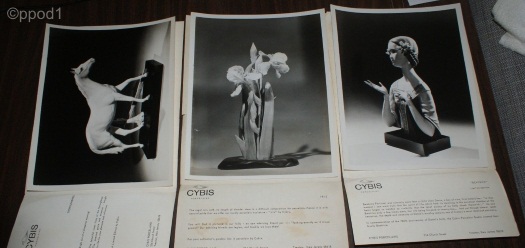 This photo shows what the sales reps would have received at that time: a black-and-white glossy and an accompanying printed blurb. From left to right: the 1966 Thoroughbred, the 1963 Iris, and the 1965 Beatrice. The Iris was one of the planned Fall 1963 introductions cited in Mal Hatch’s May request, so I do hope that he got his photos!
Acquiring New Retailers
Cybis was aiming to place their product in a range of mid-to-upper-level retailers, but the majority of those were the small independent shops that have become so much less common nowadays. Many comments about certain prospects were quite illuminating.
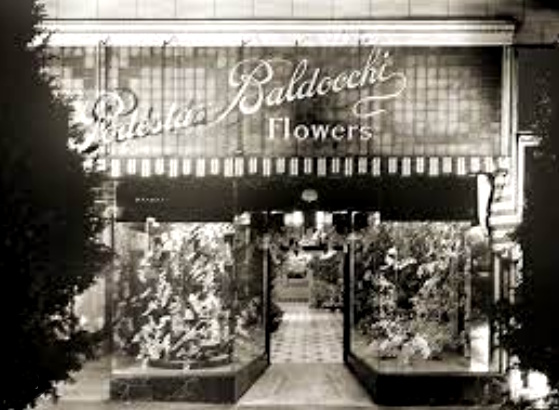
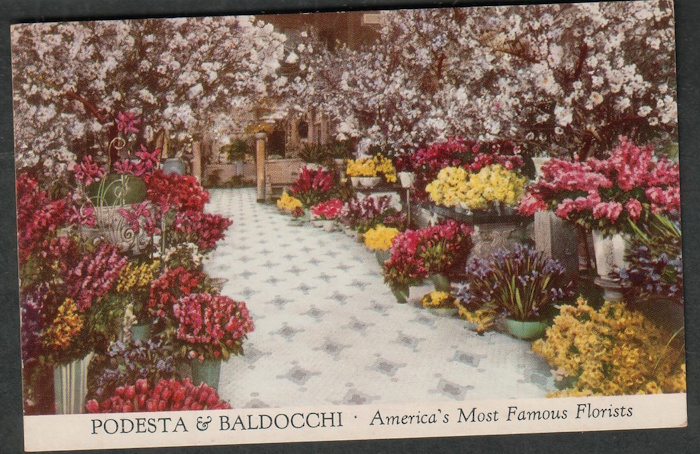 In May 1963, Mal Hatch signed Podesta & Baldocchi, the storied florist in San Francisco and a fixture in that city since the 1800s, as a Cybis retailer. In addition to their own location, they had space within SF’s most prestigious hotels. The upper photo shows the storefront in the late 1950s; the color image is a P&B postcard from the 1960s.
On a less lofty retail plane, Frank Quinn assessed some Midwestern jewelry shops in the autumn of 1962 in a detailed prospect-resume to Cybis. He mentions two high-end jewelry stores, Bitterman’s and Kruckemeyer & Cohn, but says “I don’t think they will prove too enthusiastic.” (Kruckemeyer & Cohn eventually became a major Cybis retailer during the 1970s.) He recommended Detterman’s as the best store “for the religious goods”. Some prospects were damned with faint praise (“I don’t think much of Hillman’s, but you might give them a look”) or a blunt assessment: Rowe’s Import Shop, an existing account of his for Waterford crystal and described as “old friends”, nevertheless contained a caution that their “credit is very limited” and that “they have a hard time paying their bills”.
A summer 1963 note from ‘Raymond’ (was this Ray Blackman at the very start of his career, I wonder?) mentioned a Chattanooga,TN, retail shop owned by a Mr. Gotzel who was already selling “Boom-Boom and Dowdy” and thus would likely be a decent prospect for Cybis. Obviously, “Dowdy” means Dorothy Doughty pieces by Royal Worcester, but after reading this, Boehm will now forever be “Boom-Boom” in my mind!
However, the regional sales reps also depended on follow-up from the Cybis studio and if this wasn’t forthcoming, all the rep’s efforts might be for naught. A letter from Osbourne in the spring of 1963 enclosed something he had received from one of his good customers in Albuquerque: a copy of a letter the customer had sent directly to Cybis, with the handwritten note along the bottom:
“Mr Osbourne, Please note the above letter to Cybis. They just don’t answer. We should like very much to do business with this line but apparently they aren’t interested. What should we do?”
Ozzie informed Joe Chorlton that this customer (Tellman’s Jewelry) was the largest account, on another product line, in his entire territory and that he would “hate like everything” to lose the account. Fortunately, my review of subsequent actual retailer orders shows that his fears were groundless and so I assume that Joe did quickly get touch with Mr. Tellman.
The plums, of course, were the department stores that had multiple branches but attention sometimes had to be paid to how close such retailers were to each other geographically. An example is a 1963 missive from Hatch asking for an update on the “matter of Saks Fifth Avenue” but reminding Joe that if they ended up being signed as a customer in the Los Angeles store as well as the San Francisco one, that would shut the door on also signing “Bullocks Wilshire who have no wish to compete with Saks.”
Even some small retailers insisted on having absolutely no local competition. A letter came from a gift shop in an upscale area just north of New York City who had received a verbal assurance of exclusivity from the sales rep (Mr. Thornton) as well as their first and second order of sculptures….but never received a written agreement that they would be the only Cybis retailer in Westchester County. This is an area covering 450 square miles and includes the wealthiest town in New York State. The shop owner was not happy and threatened to return the sculptures if nothing was confirmed in writing, ending with his observation that “It is most annoying that such a fine product should be handled in such an un-businesslike manner.” Ouch. (But, true.)
Of course, no sales pitch works all of the time. A September 1963 letter from Osbourne detailed his earnest efforts to convince the gift buyer and merchandise manager at Neiman-Marcus in Dallas that Cybis would be just the thing for their customers. Despite seeing all of the floral pieces on display in the Osbourne showroom and pronouncing them “quite beautiful”, they nevertheless said that Cybis was “not for their department” and punted Ozzie to the manager of the Gallery which was a dedicated retail space within the store that had a changing collection of featured items ranging from clothing to home decor to art objects. It was clear that Neiman-Marcus was not interested in carrying Cybis on a permanent basis, and Ozzie had no better luck with the Gallery curator. At that point he gave up, saying “it looks like we just can’t make a dent in N-M…..maybe one of these days we will come up with something they just can’t live without.”
Eventually they must have done so, because a separate set of documents showing which retailers bought which limited editions in 1965 through 1967 includes many orders from Neiman- Marcus.
Damage Control
Shipping something so fragile inevitably resulted in some breakage issues, and who was the retailer gonna call? Not Ghostbusters, that’s for sure. The regional rep took the flak first, as quite a few of the communications show. Frank Quinn reported that “two of the Owletts [Baby Owls]…have the tips of the little leaves broken off” and asked if the studio could repair them. He also complained that the eyes on the Baby Owls in a client’s shop
…. have no life to them. They are just a dull, dead black. They do not look as good as our showroom samples or others I have seen. Did they miss a final touch-up or something?
Sometimes the damage was more serious than a chipped leaf. In January 1963, Osbourne reported that two birds in a recent customer shipment were “badly broken in shipment” and wanted the studio to know about it
…so steps can be taken to correct (maybe you didn’t throw this one off the second storey to test as you did the Infant.)
I really hope he was kidding about that last bit, because the mental picture of a shipping box containing an Infant of Prague being thrown off the roof of Church Street as a ‘packing test’ is unnerving, to say the least!
Another retailer was very unhappy because their late-November shipment of three limited-edition birds came to them “broken and crushed and in ‘a million pieces’..” despite their shipping cartons having no damage whatsoever (“did not have a single mark on them”). The carrier’s response to the retailer’s claim was that the breakage “was due to faulty, loose packing”, resulting in the sculptures within being “pulverized.” The birds had been ordered by customers intending them for Christmas gifts, which now could not happen.
A rather shocking situation was reported by a Memphis retailer directly to Cybis, about the Europa and the Bull that they received in December 1962, which had been sent to them by air express in order to arrive in time for the holiday. Herein lies the tale:
The retailer reported that they “had difficulty assembling the piece” [uh-oh] because inside the box “Europa and the Bull were each wrapped separately.” [say what??] The retailer reasoned that the two pieces had previously been glued or cemented together [yes indeed...considering that the piece is a girl riding on the back of a bull] because there was “excess cement” left on both the back of the Bull and on Europa’s knees [this gets worse and worse] when the two pieces were separated [which should never have happened] . The retailer then used “acetone solvent” to remove the extra cement [talk about going above and beyond] but “the small pieces of porcelain from Europa that were attached to the Bull refused to come loose.” The retailer then figured out that the bits of porcelain were “plugs which had been cast on one of the pieces for insertion in the holes on the other.” [holes were on the Bull, I assume] This plug/hole assembly technique was often used by other studios but less often by Cybis (see Putting it All Together for examples) so it’s interesting that they did it with this early-1960s piece. The retailer then observed that when Europa was put onto the Bull in her apparently-proper position, “the only point of actual contact between the two was at the broken point.” Because the retailer wanted to put the piece on display ASAP, they decided to glue the two pieces together using Eastman 910 glue (which ironically is the exact same product that most porcelain studios use if they don’t attach something with porcelain slip) but, because they worried about the overall strength of the bond, concluded their letter by oh so politely “requesting that you advise us concerning this situation with as much detail as possible as to how the two pieces of this figure should be assembled.”
Well.
If I were that retailer I’d have burned up the phone line within five minutes of unpacking what was supposed to be a single-piece sculpture and finding two that clearly had once been attached to each other. But that’s just me. Anyway….
Someone at the Cybis studio deliberately shipped a broken piece. That level of incompetence is pretty mind-blowing. My guess is that the damage happened in the shipping room itself and the guilty employee(s) decided to send it anyway; did they think the retailer wouldn’t notice?? I found this you-can’t-make-this-stuff-up tale especially interesting because of the sculpture involved.

Europa and the Bull is one of the pieces that I have never seen a photo of, but can imagine from the myth itself and have always assumed that it was simply the 1960-1965 limited edition Bull ‘God of the Thunderbolt’ (above) with a female figure astride him. But after reading the letter, I decided to dig a little deeper into various artistic representations of the two, and discovered something very interesting.
 It turns out the Cybis Bull is a ridiculously close copy of this mid-1920s bronze by Carl Milles. There are a couple of very minor changes such as the shape of the horns, the precise angles of the front legs, and the removal of the tongue, but essentially it’s a copy. I don’t know whether the Cybis Europa figure was a copy as well, but I would not be surprised if it is. I know for certain that Marylin Chorlton often brought outside pieces of art (especially bronzes) into the studio and directed the artists to adapt them, so I assume that this was another such case. The artist (possibly Ispanky) probably changed the position of Europa’s legs so that both knees contacted the bull’s back instead of only one. I do hope to find a photo of the Cybis sculpture someday…preferably still in one piece.
Not all of the issues concerned breakage. In December 1962, the Grace Herbst Shop in Illinois reported that their shipment contained three items that they had never ordered. In March 1963, a jeweler in Chicago complained that they were billed for three First Flight but received only two of them, and had gotten no reply (or a third sculpture) after notifying Cybis about the mistake almost a month previously. In June 1963, Mal Hatch queried the status of several back-ordered sculptures that had not yet shipped, including limited editions to Podesta & Balducci, closing with “I do hope you are getting caught up, also hope that the Pheasant problem has been licked.”
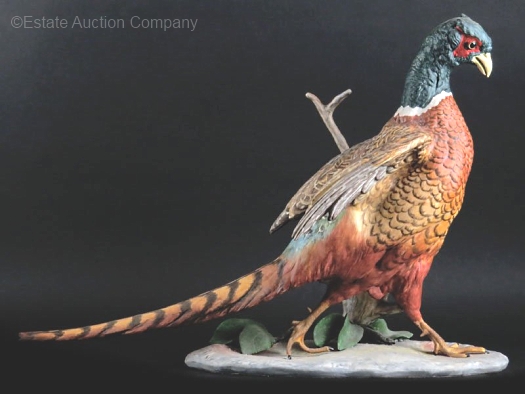 That last comment bothers me because now I will always wonder what the production problem was with the Ring-Necked Pheasant!
Reading through all of the correspondence (much more than I have described here) gives me the impression of Cybis going through all the ‘growing pains’ of a brand-new company even though it had been operating for more than 20 years. That said, the pieces coming out of the 1940s and 1950s studio were very different stylistically from what Marylin and Joe Chorlton envisioned when they took the reins in 1958; I’ll wager that if not for the name on the items, most people today would never connect the products of the post-1960 Cybis studio with anything that had come before.
We don’t know whether the pre-1958 studio signed up any regional representatives (meaning sales personnel other than people who worked directly out of the Church Street studio) or, if they did, whether it was on the same scale as we see happening during the 1960s.

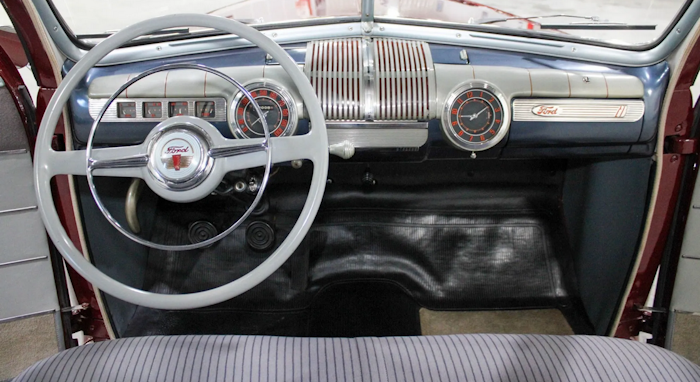 Did the 1940s Church Street studio salesmen load boxes of Cybis samples into the back seat of their 1946 Ford Super DeLuxe Tudor sedan (yes, that’s the way it was spelled),
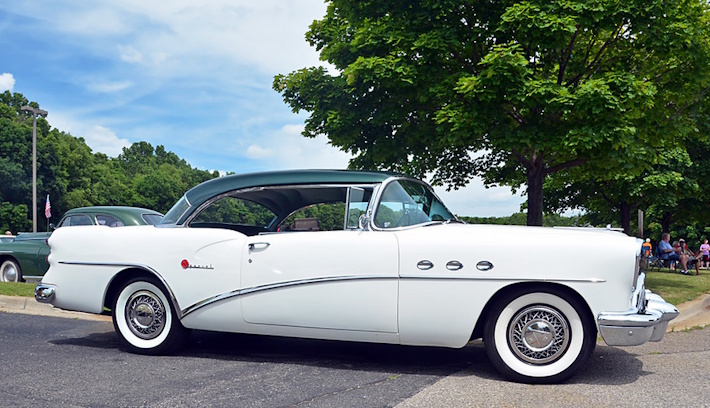 or later into the capacious trunk of a 1954 Buick Riviera and, with their Rand-McNally road map on the seat beside them, spend the next several weeks criss-crossing the USA?
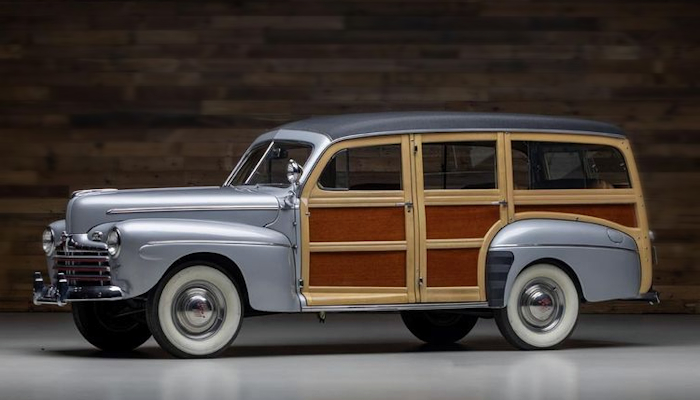 Or perhaps deliver orders in person from a 1946 station wagon like this? (An anecdotal report has Joe Chorlton doing these things as part of his first job there as a salesman.) Perhaps…but none are still with us now to ask.
It’s clear that the Cybis studio was trying hard to find its feet in the new porcelain-art marketplace of the 1960s. Several comments from the sales reps indicate that the religious items were becoming much more of a niche genre than they had been during the previous decade; one of them even asked for a completely separate set of photos and lists because the more upscale stores were only interested in the birds, flowers, animals and secular human figures. A quick look at the 1960s section of the Introduction Year index bears this out; with the exception of Exodus and Flight into Egypt (which were both very atypical in style and are love-it-or-hate-it items), there were only three religious introductions during that decade: the Madonna with Lace Veil (an almost-identical white bisque version of the early-1950s #201 glazed bust), Moses (a 1963 limited edition), and the Madonna with blue veil which is simply the head and shoulders of the 1950s House of Gold full-figure madonna.
The regional representatives – Hatch, Quinn, Osbourne, Sneburger and others – were very successful in establishing the Cybis brand nationwide. I compiled a list of the retailers who were buying certain limited editions from 1962 to 1968; if anyone is interested in who and where they were and would like to download the PDF, click here. Keep in mind that this was before either Brielle Galleries (NJ) or Armstrong’s Gallery (CA) began carrying Cybis! Those two retailers – especially Brielle – quickly became powerhouses in terms of placing national advertising into high-end magazines and newspapers, turbocharging Cybis’ retail presence during the 1970s and transforming it into one of the two premier American porcelain art studios.
That was a great accomplishment indeed, but it all began with the hard work of selling Cybis in the Sixties.
Name Index of Cybis Sculptures
Visual Index (for human figures/busts only)
About the Cybis Reference Archive
What is Cybis?
Images of Cybis porcelains are provided for informational and educational purposes only. All photographs are copyrighted by their owner as indicated via watermark and are used here only as reference material. Please see the Copyright Notice in the footer and sidebar for important information regarding the text that appears within this website.
The Cybis Archive provides the most comprehensive range of information about Cybis ever compiled within a single source. It is not and never has been part of the Cybis Porcelain studio, which is no longer in business
 THE CYBIS ARCHIVE