
The recent discovery of part of a circa-1950s Cybis wholesale price list contained a series of single Nativity figures that are entirely different from the 1950s Nativity Murals shown in the studio’s published catalogs. This did not come as a complete surprise to me, though, because in 2021 I came across an unfamiliar figurine marked Cybis that did not match any of the molds in the murals. I wrote about it in this post and showed that the figure (one of the Three Kings/Magi) matched a Holland Mold hobbyist set found online…but did the lone Cybis-marked king indicate an actual retail offering, or was it merely a sample or test piece? It was the only such item I’d ever seen during more than a decade of intensive Cybis research.
The newfound 1950s price list answered that question: It was part of the very FIRST nativity series that the Cybis studio produced. The list itself – which contains only religious subjects – contained no photos of the nativity pieces, although it did include a few other religious items. However, the sizes and descriptions of the Cybis pieces match those contained in the Holland Mold Company set. Until or unless more of the Cybis pieces turn up online, the best I can do is to offer photos of hobby versions that were cast from the same Holland molds that Cybis used.
The First Cybis Nativity Series
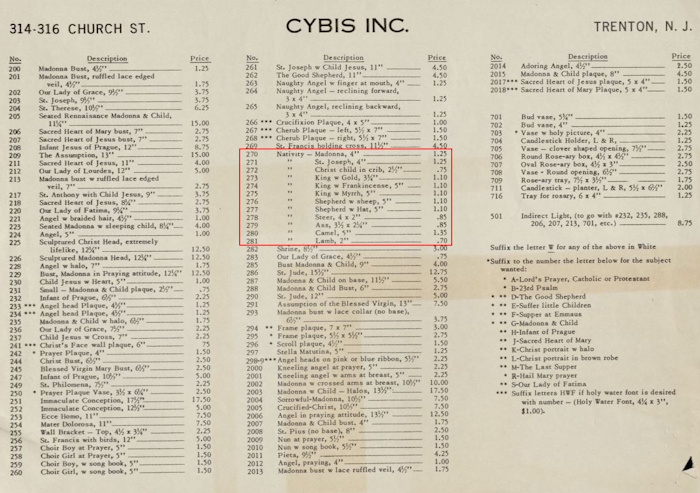 The section of the sales rep’s price list that contains the series is boxed in red. By comparing the prices of some non-nativity figures on this list with the same ones listed in the 1978 Cybis catalog Appendix along with their starting and ending retail prices, I found that the wholesale prices on this list are very close to 50% of the retail prices in that Appendix. Thus, a $1.25 item on this list would likely have cost about $2.50 in a store during the 1950s, which the 1970s Cybis catalog Appendix would have rounded up to $3.
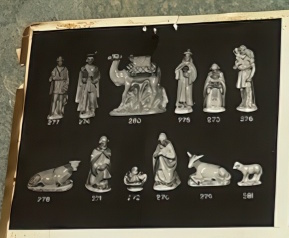 Update, July 2025: This portion (about 25%) of a phone pic of one of the pages associated with the above list, shows the Nativity figures together. Although I tried to globally upscale the original 600-pixel-wide image, it introduced far too many AI artifacts and so this is only a 1.1x upscale. [page photo courtesy of a helpful Archive reader]
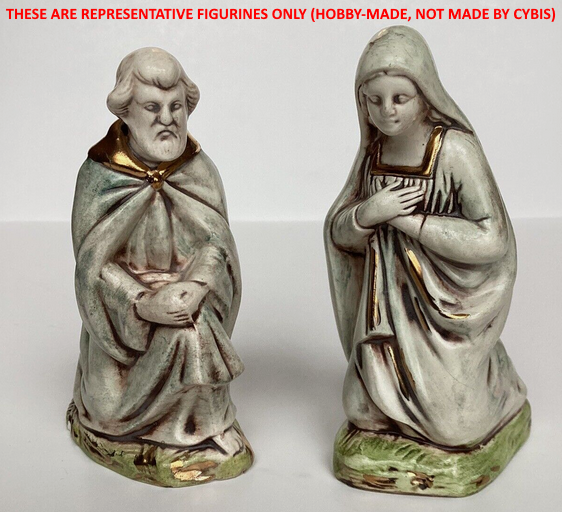 In this list, Mary is titled Madonna. She is 4” high. Joseph is titled St. Joseph. He is also shown as 4” high but there is probably a 1/8” or 1/4” difference between him and Mary in reality. Each one wholesaled for $1.25
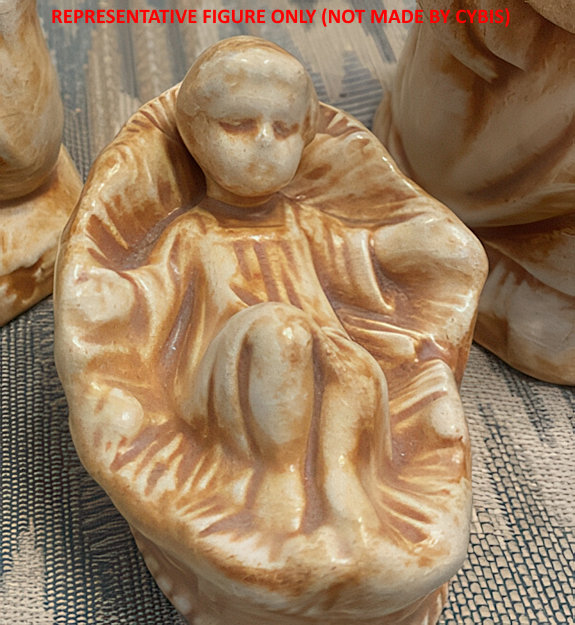 Christ Child in Crib is only 2.5” high and priced at 75 cents wholesale. This means he probably cost about $1.50 at a retailer.
 The Camel is listed as 5” high. It is the most expensive of the nativity figures at $1.35, and probably cost $3 to purchase.
 Cybis chose to produce only two of the three Holland Mold set’s shepherds. They are prosaically listed as Shepherd with Sheep and Shepherd with Hat, are both 5” tall (the same height as the Camel? Seriously?!?? Talk about not being in proportion…) and wholesaled for $1.10 each.
 Cybis chose to title this as Steer – which sounds more Western than Biblical, but oh well – and describes it as being 2” high and 4” long, with a wholesale price of 85 cents.
 The donkey is listed as an Ass (there goes this post’s PG rating, lol), 3.5” high x 2.25” long, and priced to match the cow/steer/bovine at 85 cents.
The least expensive Nativity series item was a little 2”-high Lamb at 70 cents. See my group photos below for the two possible mold candidates.
I’ve left the three kings/magi until last because of the identity-assignment exercise. The studio only identified them according to their gifts: gold, frankincense, and myrrh; so, let’s sort them out.
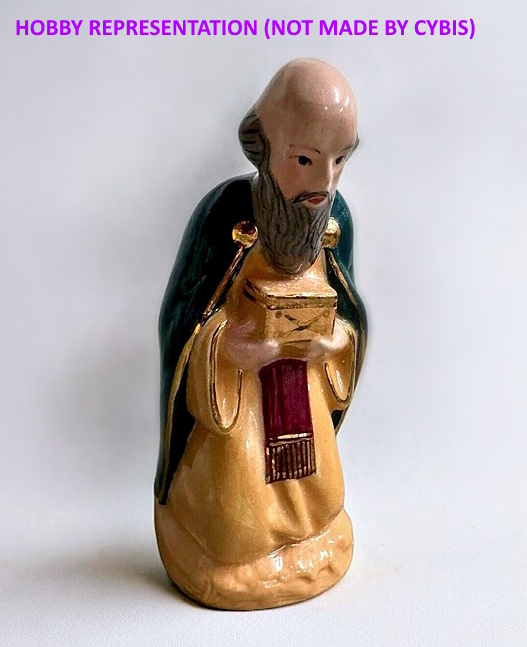 The King with Gold is easy to identify because he’s cited as being only 3.75” high which means he’s kneeling. All of these royal visitors were $1.10 wholesale.
 So we’re left with the frankincense and myrrh guys who are 5″ tall. Which container is carrying what? Both frankincense and myrrh are a type of resin found in tree sap, and both were used to make perfume, so that’s no help. But frankincense is more likely to be used to create, well, incense, and the container held by the fellow on the left looks more like a censer than the other container does, so let’s say he’s the King with Frankincense. (Why he is dressed like someone from King Henry VIII’s court is a nagging question that I will not even attempt to answer here.) And so we now have our turban-wearing King with Myrrh.
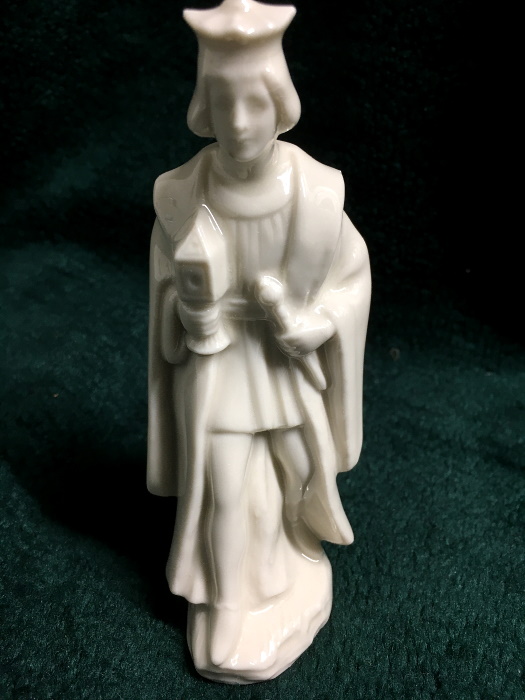 This is the lonely Cybis-marked King with Frankincense. See more views of him in his own Archive post. The 1950s list does not mention anything about the color of this Nativity series, but this example shows that they did at least make it in glazed white.
Although the Cybis wholesale list is not dated, we can make a good stab at it by comparing it with information available elsewhere. For example, I found the original copyright registrations by Holland Mold Company for these individual figurines; they were all registered in February 1952. This means that the Cybis wholesale list is highly unlikely to date from before that year. Based on what other religious items are not on this list, and the actual age of a number of other Cybis documents found within the same storage, my guess is that it was printed sometime between early 1953 and early 1955. “Circa 1954” sounds logical to me.
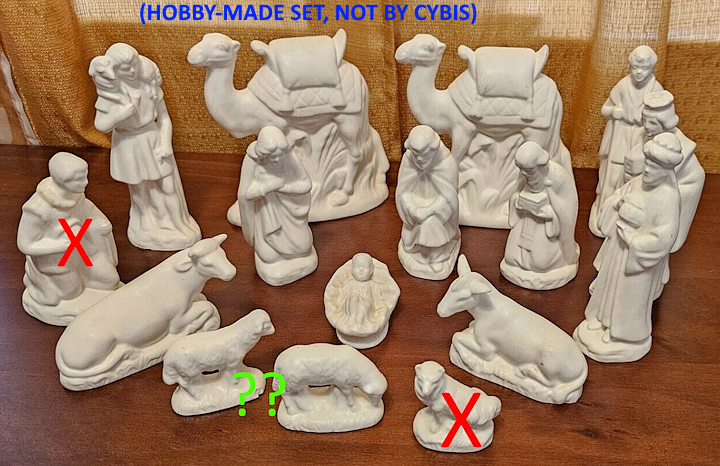
 These photos show hobbyist-made sets in plain white and in a brown wash which is a paler version of the ‘Cypia’ finish that the studio used during the 1950s. I’ve X’d out any figurines that were not in the Cybis-produced 12-piece series. The question marks near the two sheep mean that at present, I have no idea which of these two sheep molds Cybis used.
The bad camel-human size problem really stands out here. My inner nerd is compelled to point out that the average camel (Dromedary) stands 6.5 ft tall at the shoulder. When measured from ground level to the top of its head, it’s 8 feet. But in fairness, the next Cybis nativity series – which was cast from Atlantic Mold Company molds – is even worse in this regard, because in that set the three kings are taller than the camel! And the final (and the only original-design) nativity series from 1980s has the camel the same overall height as all of the standing humans. Makes one wonder if any purchasers ever noticed the weird proportions.
As indicated in the group photos above, Cybis decided to not make four of the Holland Mold pieces (the angel, the kneeling shepherd, the sheepdog, and one of the sheep.)
What Happened to this First Series?
The first problem (for the purposes of this Archive) is how to correct the identification of the Nativity Murals from “the first nativity series” to their proper status as the second series and also to relegate the 1980s series to its correct position as the third. Some post-editing is in order, although I don’t want to change those URLs in case anyone has them bookmarked. The question then becomes: How long did Cybis offer this very first nativity series, and when was it replaced by the Atlantic-Mold-based, entirely different ‘Nativity murals’?
The 1978 Cybis catalog appendix says that the murals were introduced in “the 1950s” and retired in the “late 1950s.” If we operate on the assumption that the newfound list showing this first series dates from 1953 or 1954, this means the murals series – examples of which are, unlike these earliest pieces, occasionally found on eBay – probably debuted in 1955 or 1956. These first figures may well have been offered for only a year or two. Disappointing sales would have prompted the studio ditch this group and replace it with the Atlantic-based mural series….which, according to the 1978 Cybis catalog, were retired four or five years later (“late 1950s.”)
Name Index of Cybis Sculptures
Visual Index (for human figures/busts only)
About the Cybis Reference Archive
What is Cybis?
Images of Cybis porcelains are provided for informational and educational purposes only. All photographs are copyrighted by their owner as indicated via watermark and are used here only as reference material. Please see the Copyright Notice in the footer and sidebar for important information regarding the text that appears within this website.
The Cybis Archive provides the most comprehensive range of information about Cybis ever compiled within a single source. It is not and never has been part of the Cybis Porcelain studio, which is no longer in business.
 THE CYBIS ARCHIVE