
Laszlo Ispanky was one of only five artists who were ever publicly identified by name in Cybis advertising literature as having created Cybis sculptures (the others were Marja Cybis, Marylin Chorlton, Lynn Klockner Brown, and Patricia Eakin); their names appear in the early pages of the studio’s 1964 and 1965 catalogs. However, Ispanky is the only ex-Cybis artist known to have subsequently developed his own studio/brand that was sold directly to retail stores. The Ispanky-Cybis partnership was a tumultuous one, so it is best to begin at the beginning.
Laszlo Ispanky was born in Budapest in 1919. Little is known about his early years other than that he was the youngest of ten children and his father owned a restaurant near a sand mine, where the young Laszlo was fond of creating sand sculptures. A family friend suggested that his talent could be developed at the Budapest Academy of Fine Arts; he studied there until 1943.
During the 1950s the Hungarian government was a puppet regime controlled by the USSR. In October 1956 a group of university students organized a protest at the Parliament building in Budapest and a number of them were killed by the state police. This sparked the uprising known as the Hungarian Revolution, which was quelled by the Russians in less than two weeks. The 37-year-old Ispanky joined one of the local Hungarian militia groups that formed after the October protest. The militias did not fare well: 2500 of them were reportedly killed. Almost 200,000 Hungarian refugees fled the country to Austria; Laszlo Ispanky was among them and ended up living with a friend in Vienna.
In November 1956, US President Dwight Eisenhower launched ‘Operation Safe Haven’ in response to an urgent plea from Austria, the country to which almost all of the Hungarian refugees had escaped. Under that initiative 35,000 Hungarians were awarded a special visa and brought to the USA, specifically to Camp Kilmer in Piscataway, New Jersey. It is not known exactly when Ispanky arrived, but it would have been between November 1956 and July 1957.
Meanwhile, a group of students at the Cranbrook Academy of Art in Bloomfield, Michigan established a scholarship fund of $2600 in order to give one Hungarian refugee artist a year of study there. They reached out to the administrators of Operation Safe Haven in order to ask if they had any artists who might qualify.
 The candidates were asked to write a letter to Cranbrook’s Student Council for consideration. Because Ispanky knew no English, his was written in Hungarian. The fourth paragraph reads,
My thanks to you for reaching out to me with something that is inherent in the sacred name of freedom and for lending me hope. It feels good! I have waited with anxiety to hold the clay with which to give birth to the flowers blooming in my heart – to the hidden music that lives within me, to turn the material into form and into a million statements.
(I do not know why it was written on the letterhead of the Jackson Memorial Hospital in Miami.)
 Ispanky was chosen as the recipient of the Cranbrook students’ scholarship award for one year’s study; online search results that say he had a “fellowship” or that he “taught there for three years” are incorrect. The photos and information I present here are from a Cranbrook site which also says that Ispanky was grateful for the total freedom he was allowed there. He remarked that it was “the most fantastic thing . . . a huge studio, and you do whatever you want.” While at Cranbrook, Ispanky sculpted at least 32 works in terra cotta, bronze and plaster and was given the nickname “Speedy Gonzalez” by his fellow students. This fits perfectly with comments I have heard from artists who worked with Ispanky at Cybis: “He worked fast and rough”!
 This is a bronze that Ispanky created at Cranbrook in 1958. He left there in the spring when his one-year study scholarship was over. Some biographical literature published by Goebel in later years claims that he graduated from there, but the Cranbrook site specifically states that he was not a graduate. It may well be that he found a job locally, teaching sculpture, before moving to Trenton. It is not known how long he lived in Trenton before being hired by the Cybis studio.
I found no evidence that Boleslaw Cybis and Laszlo Ispanky ever corresponded or knew each other; when Ispanky first came to the USA in 1956-1957, Cybis was either dealing with various health conditions or already deceased. Marja Cybis died in 1958, while Ispanky was still at Cranbrook. I suspect that Ispanky may have done some work for the Holland Mold Company when he first arrived in Trenton; many sculptors either worked there for a time or sold models to them. If that is what happened, the owner, Frank Hollendonner, might have suggested that Laszlo interview for a position at the Cybis studio which had been buying molds from Holland for more than a decade. But however it came about, Marylin and Joe Chorlton gave him the position of Art Director in 1960.
Cybis Porcelains Designed by Ispanky
Because of the design overlap between many of the Cybis pieces by Ispanky and those he later produced on his own, this Part One of his profile will focus on his time at Cybis. Examples of his non-Cybis work, which covers a much longer timeframe, will appear in Part Two.
The following are the Cybis porcelains known to have definitely been designed by Lazslo Ispanky.
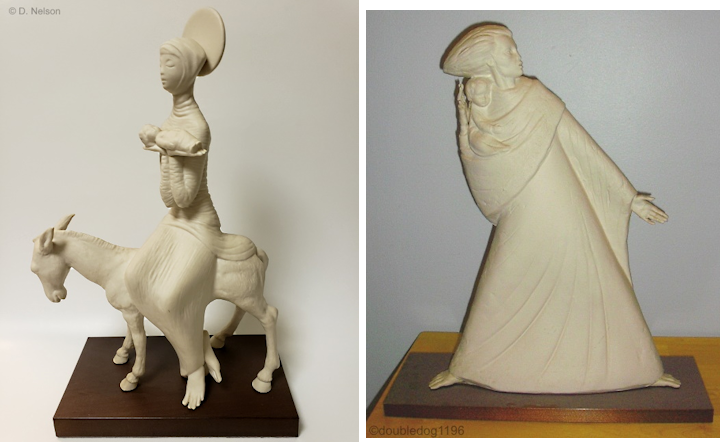 Flight Into Egypt (left), a 1960 edition of 50; and Exodus, also a 1960 edition of 50.
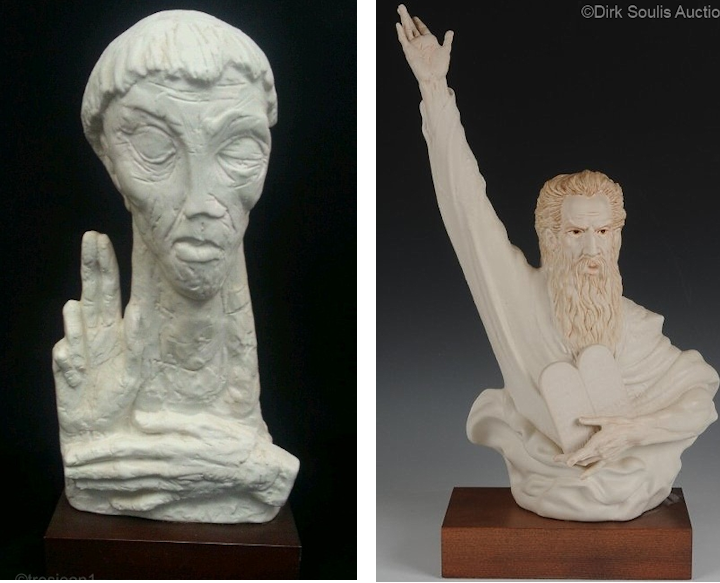 The Prophet, a 1960 edition of 50; and Moses ‘The Great Lawgiver’, a 1963 limited edition of 750.
 The Horse was a 1961 edition of 100. It was originally sold with a wood base as shown here. In 1972, President Richard Nixon gave one of these to the Shah of Iran.
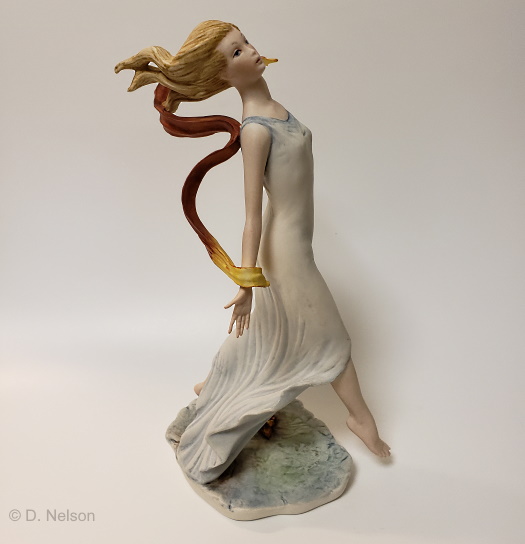 Dawn has dueling introduction years in two different Cybis publications. The 1971 museum exhibit catalog Cybis in Retrospect says 1961, while the 1979 Cybis catalog appendix says 1962. This was an open (non-limited) edition. In 1977 an only-slightly-modified Dawn was introduced as the limited edition Queen Titania.
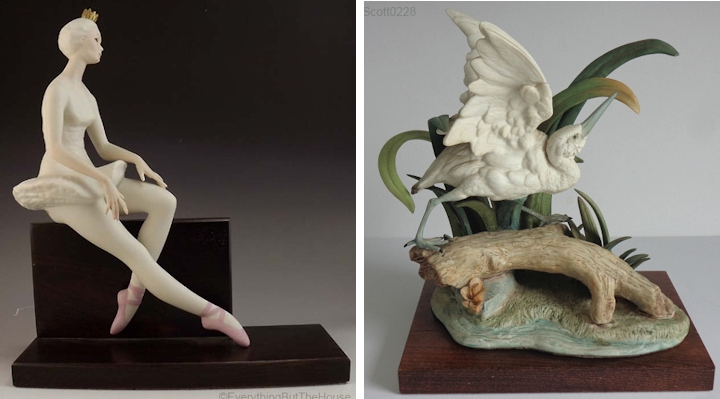 Ballerina ‘On Cue’ was an open edition in 1963; the Little Blue Heron was a 1960 limited edition of 500.
 The Iris was a 1963 limited edition of 250. The bottom of the piece is shaped so as to fit into a circular well in the center of the accompanying wood base.
 This JFK Tribute sculpture was not sold at retail (as far as I know) but would have been created in late 1963 or early 1964. It has all the characteristics of a Laszlo Ispanky work although I have not found any formal attribution to him.
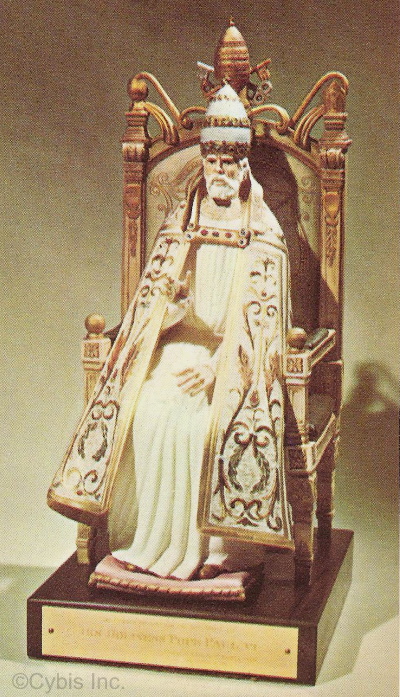 Saint Peter was never a retail edition either, but was created in 1964 as a gift to Pope Paul VI as a commission from the Archdiocese of New York. It was not actually given to the Pope until 1965.
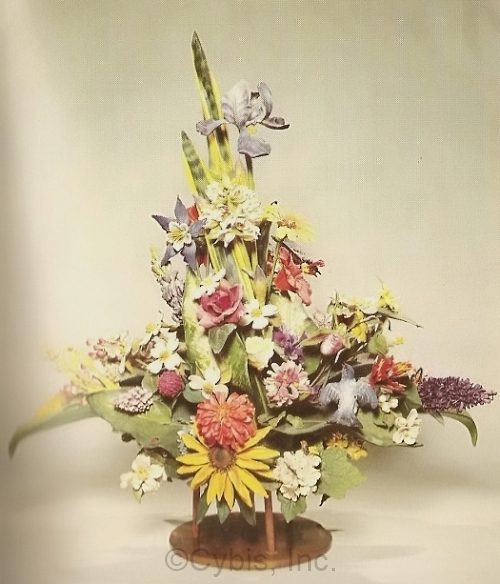 Part of the Cybis studio’s exhibit at the 1964 World’s Fair in New York was the Flower Bouquet of the United States. It has its own Archive post because of its rather complicated story! The studio hired a number of new artists in order to create the flowers themselves; one of them later became the studio’s most prolific in-house designer!
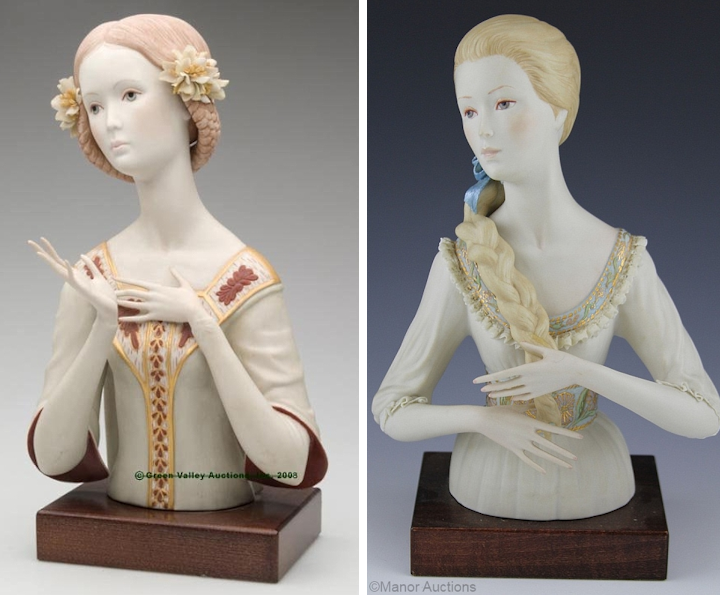 Two limited-edition female portrait busts: Beatrice, an edition of 700 in 1960; and Guinevere, an edition of 800, in 1967. They are in very typical Ispanky poses.
 Hamlet was a 1965 limited edition of 500 pieces. The Cybis introduction years do not necessarily reflect the year in which the sculpture was designed, which is why some Ispanky pieces appeared after his association with the studio ended.
 Another portrait bust was Juliet, an edition of 800 in 1960. The 1967 introduction on the right was was advertised by Cybis under several names: Symphony of a Conductor’s Hands, Conductor’s Hands ‘The Maestro’, or simply Conductor’s Hands. It was an edition of 250.
The Bull Problem
 In his self-published catalogue, Ispanky claimed that he had created the Cybis Bull ‘God of the Thunderbolt’ and I had no reason to question this attribution until recently. As part of my research for my recent Selling Cybis in the Sixties post, I obtained a letter from a retailer regarding the Europa and the Bull that they had received early in that decade. This is a piece that I’ve never found a photo of, but have always assumed was the Bull with a figure of Europa carried on his back. I wanted to show a few other artworks depicting that subject, and was amazed to find something that almost exactly matches the Cybis bull:
 This is a small-scale replica of a nine-foot-tall bronze fountain in Sweden that was created by sculptor Carl Milles during the mid-1920s. The Cybis bull is essentially a copy of this. I looked further into Carl Milles and discovered he relocated permanently from Sweden to the USA in 1931 as a result of being offered a teaching position at the Cranbrook Academy of Art! He headed the sculpture department there until 1951 and then moved to Rome where he lived for the rest of his life. This means that Ispanky never met or studied under Milles, but Cranbrook had acquired an extensive collection of Milles’ work. Thus, it is certain that Ispanky was familiar with the Milles ‘Europa Fountain’ design and may even have had a replica such as the one pictured above available to him for study purposes.
Another possibility is that Marylin Chorlton acquired one of these replicas and asked Ispanky to create a slightly-modified porcelain version of it, as she is known to have done with other items. The main differences are the omission of the tongue and the slight alteration of the bull’s left foreleg. But either way, Ispanky was not the original designer of the Cybis Europa and the Bull, nor the spin-off separate Bull ‘God of the Thunderbolt‘.
It has been claimed anecdotally that Ispanky “designed the first 90 pieces of Cybis”, but this is mathematically impossible. As shown in my When A New Cybis Was Really New post, there were only nine original (meaning not produced from Holland or Atlantic mold company molds) Cybis designs introduced during the 1950s. Ispanky did not come to New Jersey until late 1958 at the earliest, and more likely it was 1959. The only confirmed original Cybis design introduced in 1959 was Tinker Bell. Peter Pan had already made his retail appearance in 1958, which means he must have been designed before Ispanky left Cranbrook and possibly even before he arrived in the United States. The fact that Ispanky produced an almost-identical ‘Peter Pan’ in his own studio in 1966/67 does not mean that he created the 1958 Cybis sculpture.
There were 84 new (original, not from Holland or Atlantic Molds) Cybis designs introduced during the 1960s (40 limited editions and 44 open editions.) However, 16 of those 84 are confirmed to have been designed by someone other than Ispanky; and those 16 include only one confirmed to have been created by Marylin Chorlton even though it is certain that she designed more. It is also extremely likely that many of the 1960s Cybis pieces were sculpted by Patricia Eakin. I’m willing to accept that Ispanky may have created 20, or perhaps even as many as 30 (at a stretch) total pieces for Cybis; but definitely not “the first 90”.
The Big Goodbye
So, what led to the parting of the ways in 1965? It seems that there were multiple areas of contention between Ispanky and the Chorltons. In no particular order, I have been told by reliable sources that:
- Ispanky wanted them to produce more of the rough/abstract pieces (similar to Exodus, Flight into Egypt, and The Prophet) but the studio refused, citing low customer interest;
- Because Ispanky’s human studies ‘as designed’ tended to be rather minimalist, the studio wanted delicate applied details added (such as flowers, leaves and lace) and this was something Ispanky often objected to;
- As mentioned at the top of this post, the studio did identify him in their 1964 and 1965 catalogs, which are essentially the same as far as their text content goes. However, Ispanky wanted more recognition than this. I was told by someone who was there at the time that a Cybis employee happened to be vacationing in Florida and saw a sign outside a local gallery advertising an Ispanky exhibit. Upon entering, the employee discovered that several Cybis retail sculptures were on display with signage claiming that they were designed and produced (actually made) by Ispanky, with no mention anywhere of Cybis. When this got back to the studio’s management it was either the proverbial back-breaking straw or pretty close to it.
 This photo appears in the 1964 and 1965 Cybis catalogs. It is not known where it was taken; the white bisque bust in the background appears to be Juliet, but none of the other three sculptures in the photo were ever produced by Cybis.
Part Two of this artist profile examines Ispanky’s work after he left Cybis.
Browse all of the Cybis Artist Profiles
Name Index of Cybis Sculptures
Visual Index (for human figures/busts only)
About the Cybis Reference Archive
What is Cybis?
Images of Cybis porcelains are provided for informational and educational purposes only. All photographs are copyrighted by their owner as indicated via watermark and are used here only as reference material. Please see the Copyright Notice in the footer and sidebar for important information regarding the text that appears within this website.
The Cybis Archive provides the most comprehensive range of information about Cybis ever compiled within a single source. It is not and never has been part of the Cybis Porcelain studio, which is no longer in business.
 THE CYBIS ARCHIVE