
This second part of his Artist Profile delves into his work after his 1965 departure from the Cybis porcelain studio.
The Ispanky Studios
After leaving Cybis, Ispanky found an investor named George Utley and opened his own studio. A 1973 article in the New York Times related that
He bought an old garage in Trenton and became a one-man organization, building benches and tables, making plaster molds and designing, painting and kilning [sic] his creations. He took time out only to cook and to sleep in a small room behind the studio. One year passed without a sale. Then, in 1967, the managers of a wholesale china and crystal concern in New York took on the Ispanky line.
 This is the backstamp of the first Ispanky studio. Notice that it says ‘Utley Porcelains’ rather than ‘Ispanky Porcelains’ under the buffalo logo. This was the first in a dizzying series of Ispanky studio brandings. This version lasted for less than two years before being changed to a backstamp saying only Ispanky Porcelains. I have no idea what happened to George Utley or their partnership. These two backstamps date from roughly 1967 to 1972, at which point the brand name was slightly altered to Ispanky Porcelains Ltd. as shown here.
In 1970, Laszlo Ispanky was hospitalized with an ulcer; his future wife Susan Toft was a nurse there. The couple were married in May 1971 and moved to Hopewell, NJ the following year. They had one child, their son Jason.
The 1973 New York Times article quoted above went on to say that
So successful did Mr. Ispanky’s studio become that it spread eventually to five separate locations in Trenton; finally, in June 1972, they were consolidated into a 12,000-square-foot building on Route 31 in Hopewell. The Ispanky line is now distributed to 126 selected dealers throughout the country. There are no plans for further expansion.
The Ispanky studio existed as an independent atelier until 1976 when he sold it to Germany-based Goebel with the understanding that he would now design new pieces under the branding of Goebel of North America (and then in 1979 as simply Goebel.) Goebel handled all of the marketing and gave him plenty of name recognition in advertisements, packaging, and on the pieces themselves.
The Goebel era lasted for about eight years. When Ispanky and Goebel parted ways, he resumed marking pieces with his own studio branding; this time around, it was Ispanky Creations. This was succeeded by his final branding iteration, Ispanky Studio, which survived for barely a couple of years: in late 1986 or early 1987, he ceased commercial production altogether. One can find various examples of the exact same sculpture bearing any of the Ispanky brand backstamps depending on the year in which that piece was physically created: Utley Porcelains, Ispanky Porcelains, Ispanky Porcelains Ltd., Goebel of North America, Goebel Crafts of N.A., Goebel, Ispanky Creations, and Ispanky Studio.
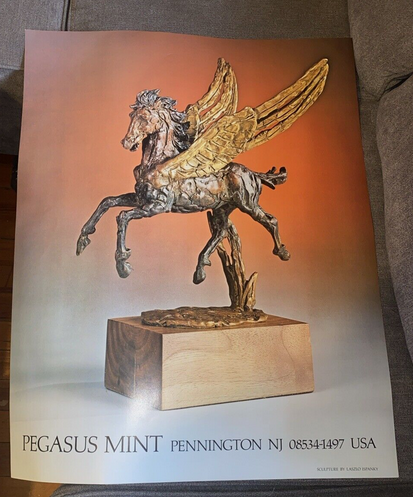 Laszlo Ispanky had a great affinity for working in bronze. During the 1970s he partnered with a local firm called The Pegasus Mint to market his bronze line. The sculpture on the cover is Pegasus Triumphant; it is 8.5″ high overall.
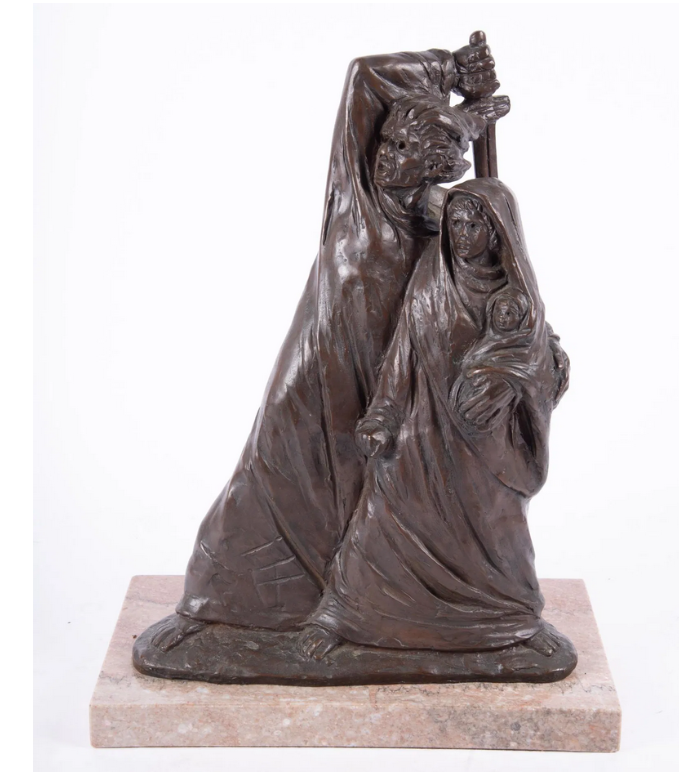 The bronze Exodus, an edition of 100, is 16” tall and 12” wide. His Cybis porcelain Exodus is a figure of a woman carrying a child, but is similar to this in style and shape.
 This circa-1980 figure of Olympic gymnast Nadia Comaneci is 25” tall.
A quick Google will bring up a number of other Ispanky-branded bronze pieces, some of which had porcelain counterparts. Which came first? I have absolutely no idea….
Ispanky Porcelains
Before looking at a small representative sample of the many porcelain figures that bore the Ispanky name as his own studio I would like to show a couple of examples that closely resemble the pieces that he had done for Cybis. The earlier (Cybis) item is shown on the left.
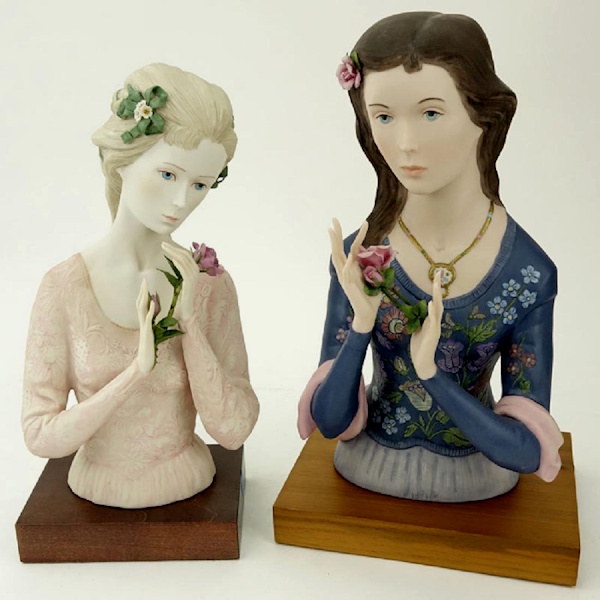 Cybis Juliet, a 1965 edition of 800, 12” high overall. Ispanky’s Diane, an edition of 500, probably from 1966 or 1967 based on the Utley logo.
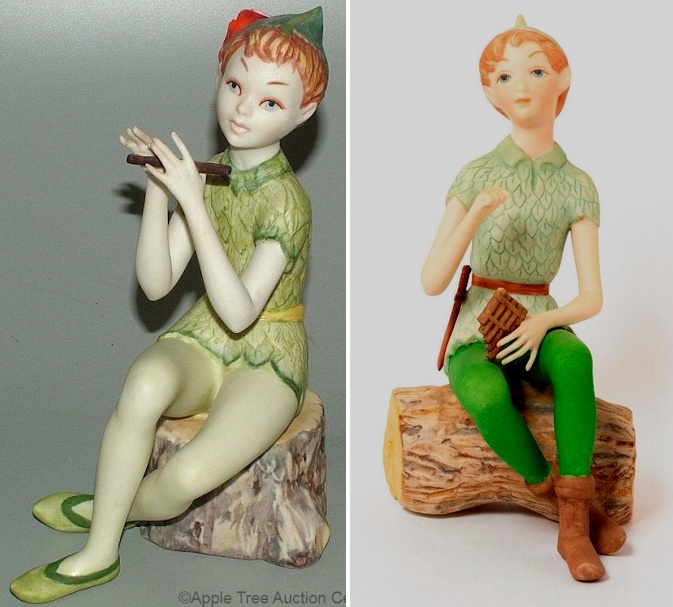 The Cybis Peter Pan (at left) was an open edition from 1958 (before Ispanky came to Trenton) until 1967. The Ispanky Peter Pan has the Utley backstamp which dates it to 1966-67, although examples are found bearing the subsequent Ispanky Porcelains Ltd. backstamp.
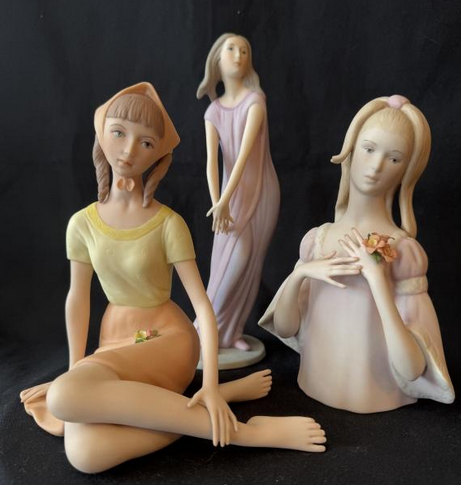 Ispanky female figures tend to have very similar facial expressions, as this group of three demonstrates. Fingers and toes are usually elongated, and hair styles are often simplistic – no ringlets or elaborate carved curls such as are often seen on Cybis sculptures.
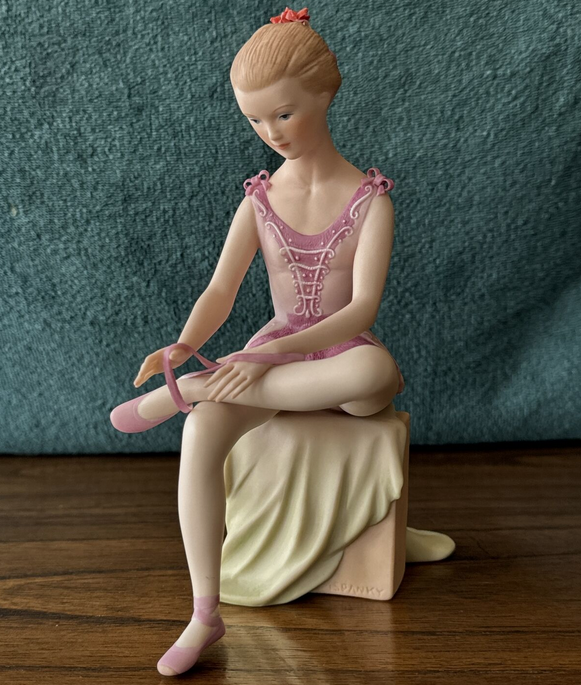 This seated ballerina is unusual in that some examples have a painted metal shoe ribbon while on others it is porcelain.

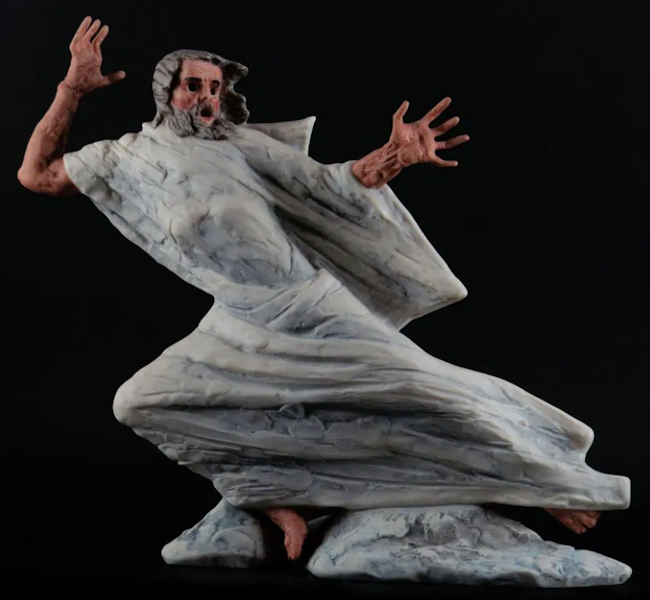 Apotheosis of the Artist as Creator and Storm are limited editions done in the rough-hewn style of the 1960 pieces done for Cybis. Storm was also available in white bisque.
 A portrait of the Biblical David.
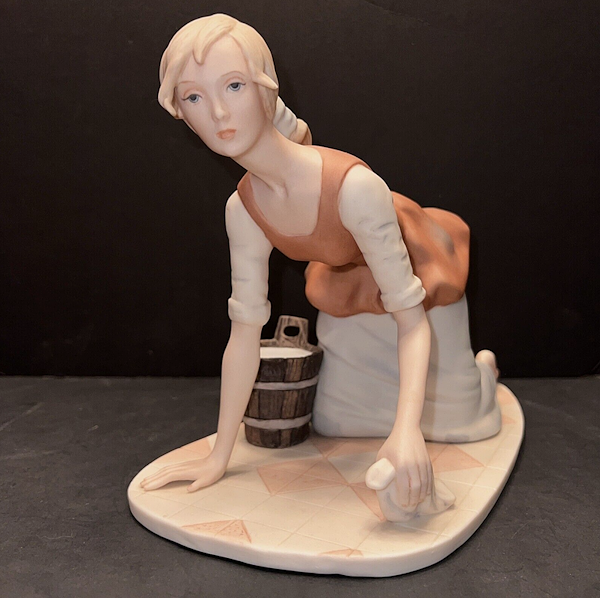
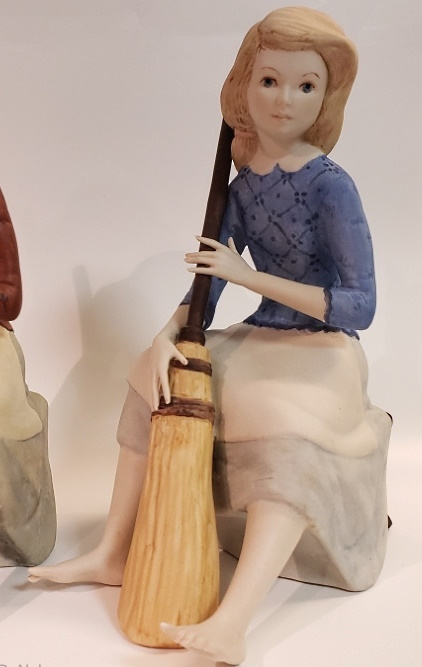 His depiction of Cinderella prior to the fairy godmother’s visit is very different from the Cybis Cinderella showing her at the same part of the story. The Cybis version also shows a younger girl; Ispanky’s version looks more like a girl in her late teens or perhaps even early twenties.

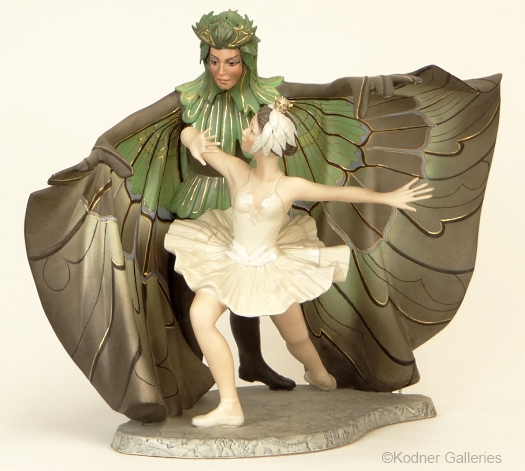 Likewise, the Ispanky Swan Lake is very, very different from the Cybis version shown below it.
 True Love (the title of this piece) can be found in a pond as well as on a stage!
Goebel-Branded Ispanky Porcelains
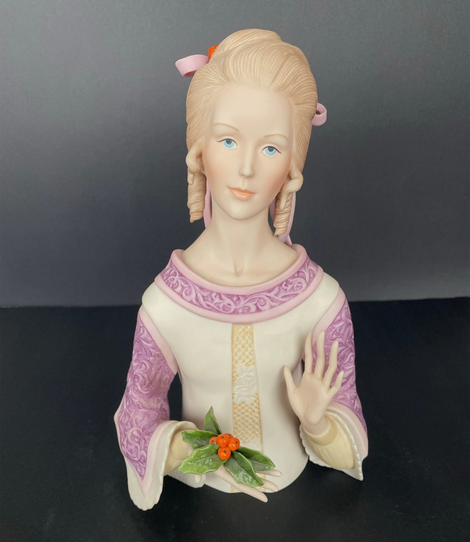 Ispanky’s Guinevere bust holds a sprig of holly, which begs the question: Why holly, rather than a flower? And was that decision Goebel’s, or Ispanky’s?
 The full-figure sculptures of King Arthur and Queen Guinevere were sold as separate limited editions.

 Awakening was the Goebel Collectors’ Club piece for 1979. This one was autographed by Ispanky, possibly at a retailer event.
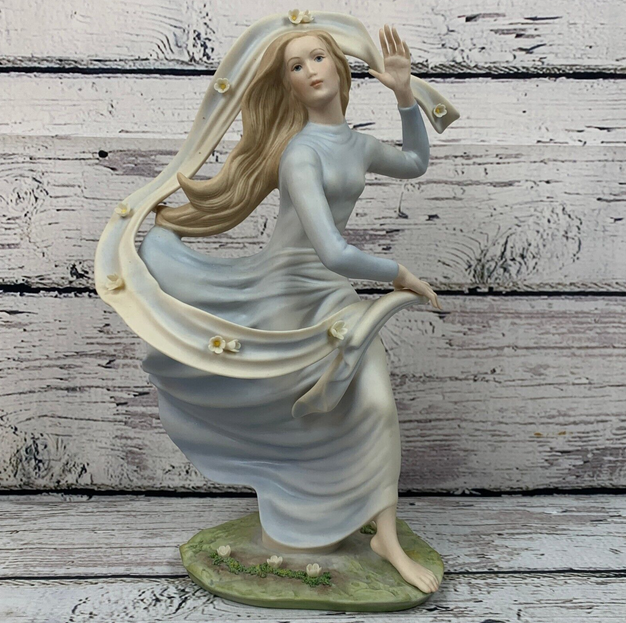 Spring Fever reminds me more than a bit of his Dawn for Cybis.
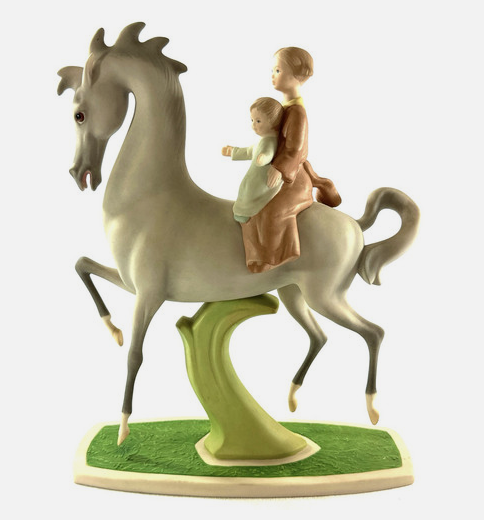 I don’t know the name of this fanciful study but it is very similar in style to something that George Ivers would have probably drawn or painted!
The ‘Golden Touch’ Series
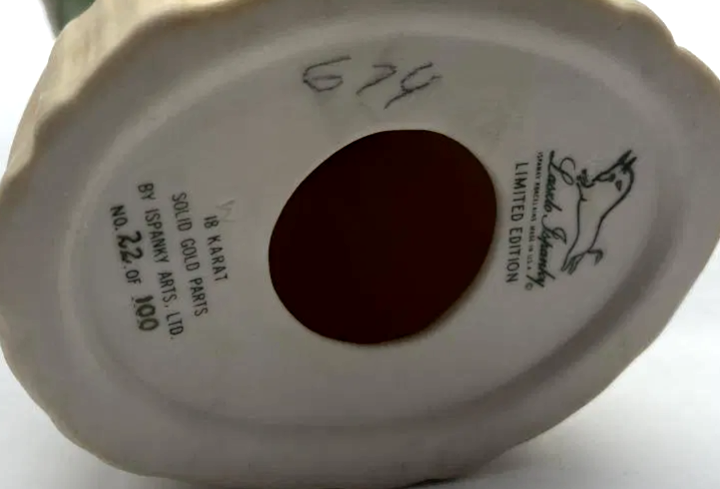 A very unusual five-edition series produced under the Ispanky branding in 1971 included an 18kt gold element. They are solid 18kt gold, not merely gold-painted porcelain, and were attached to the sculpture with glue. The backstamps say Ispanky Arts Ltd. Each of these also had an all-porcelain counterpart.
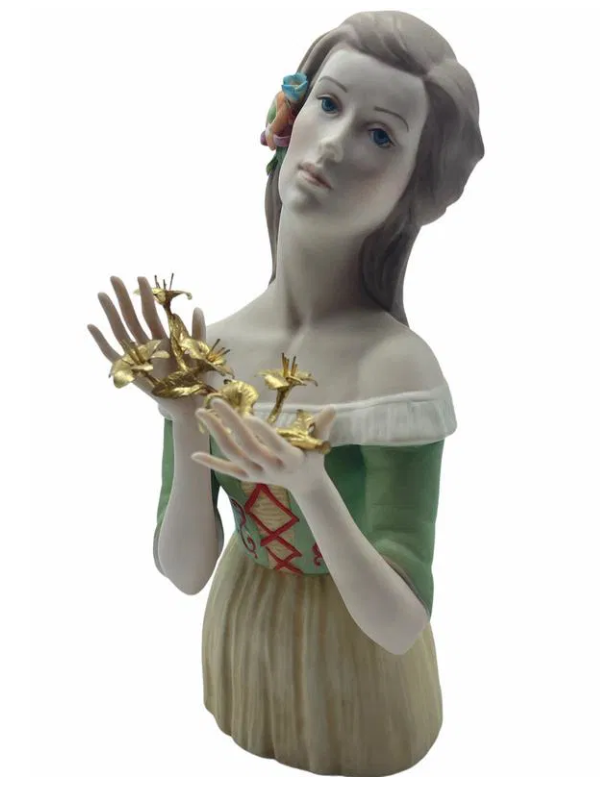 The spray of flowers held by Felicia is the gold element here. Her edition of 100 sold for $2500.
 The shofar is gold in this version of Tekiah.
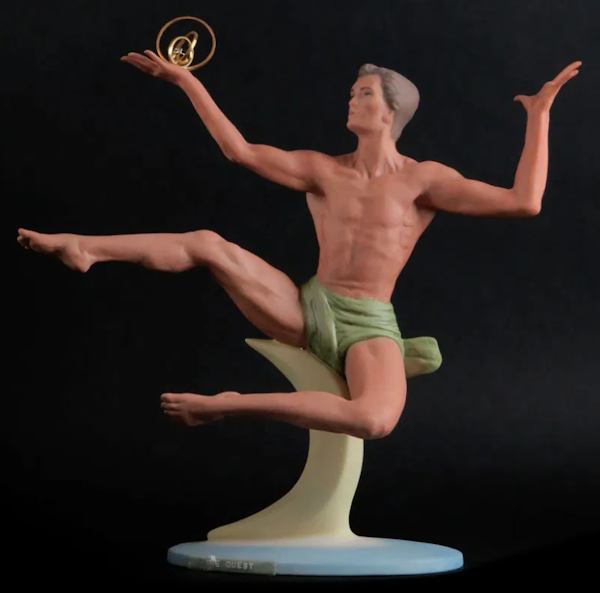 The title of this piece is The Quest. This was an edition of 50 with the gold orb.
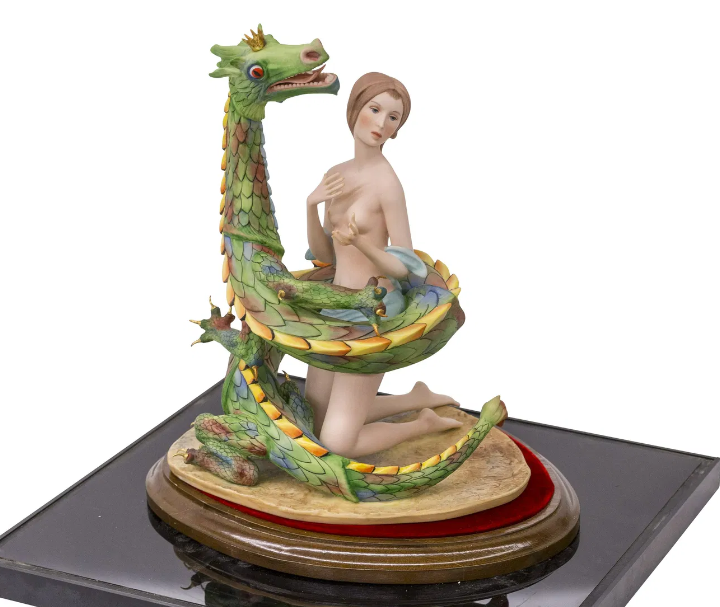 In this Beauty and the Beast, the dragon’s crown and all of his claws are gold. It was an edition of 75 priced at $4500. (The square stand in this photo did not come with the sculpture.)
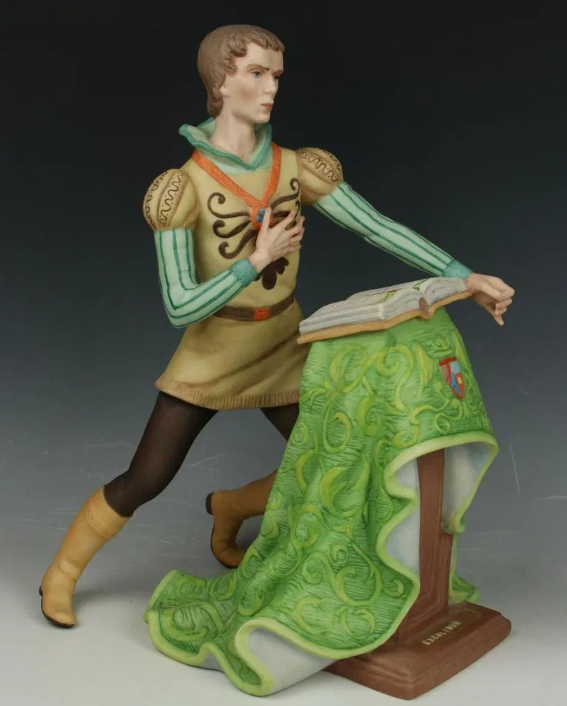 I could not find a photo of an Excalibur that still has either the gold sword or the porcelain one. In a complete sculpture, Arthur holds the sword in his left hand. This was an edition of 100 that sold for $3500.
Miscellaneous Porcelains
Laszlo Ispanky also designed items for the Franklin Mint and Lenox, in addition to producing the work of other artists in his own studio.
 Spring by Ispanky for Franklin Mint (the fp in the logo stands for ‘Franklin Porcelain’.) Items like these were produced in large-quantity “limited editions” in offshore factories.
 This decorative plate of the Ten Commandments was an Ispanky design produced in Goebel’s factory in Germany, not in the Ispanky facility in New Jersey. Items like this were similar to the Franklin Mint’s in that the edition sizes were typically in the multiple thousands.
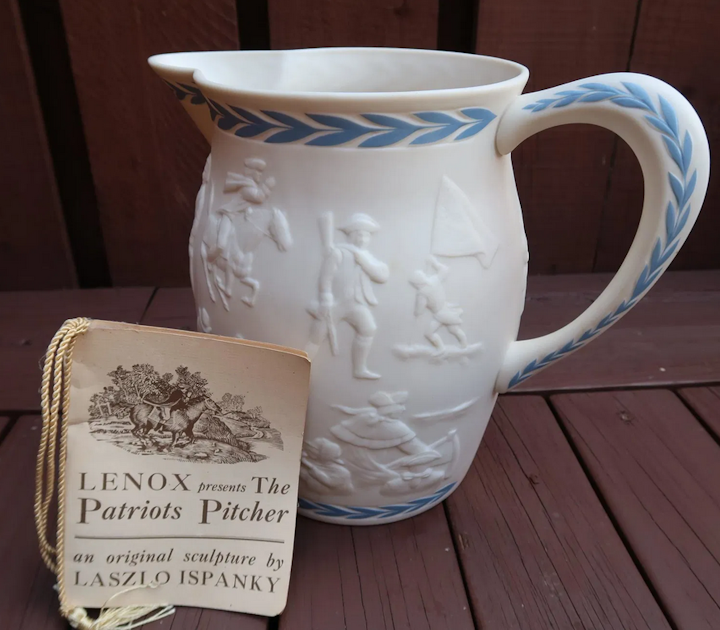 The Ispanky-designed Patriots Pitcher manufactured by Lenox features scenes from the Revolutionary War in relief on the surface.
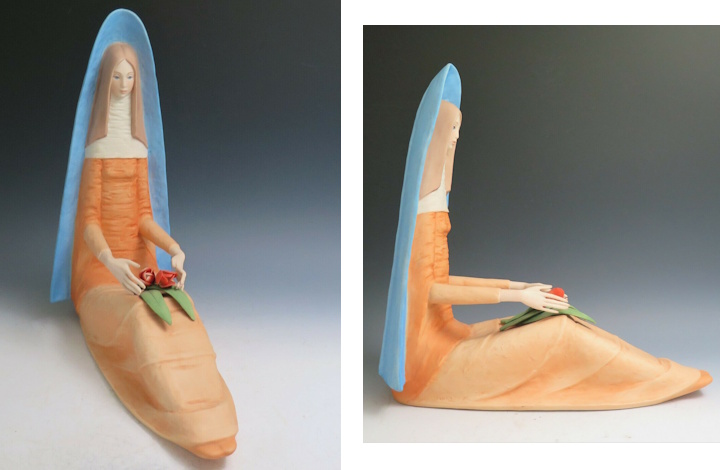 This unusual Ispanky studio sculpture is supposedly called Peace Nun, though I haven’t been able to find confirmation of that.
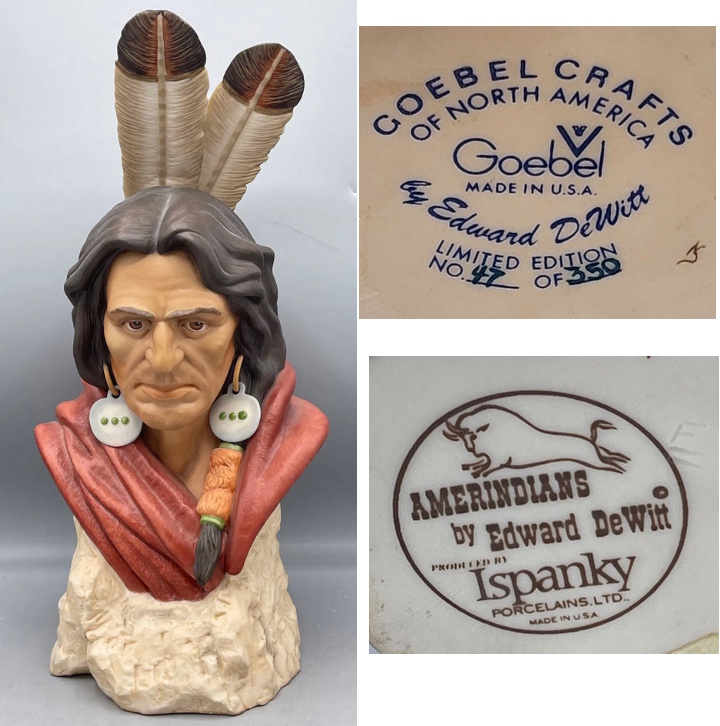 Edward DeWitt was a local New Jersey artist. This same bust, which is about 16” high, can be found with either of the two backstamps shown: the Goebel/Ispanky studio one, or the Ispanky-studio one!
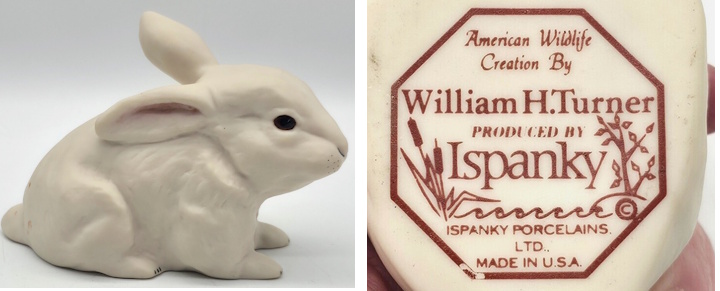 William H. Turner was a prolific wildlife artist who worked in bronze and in porcelain during the 1970s and 1980s. Other examples of his pieces are found with FP (Franklin Porcelain) and D.G. Porcelain backstamps, as well as hand-marked and numbered by Turner.
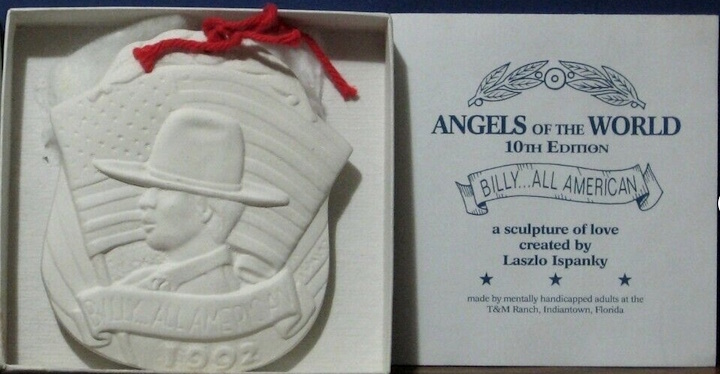
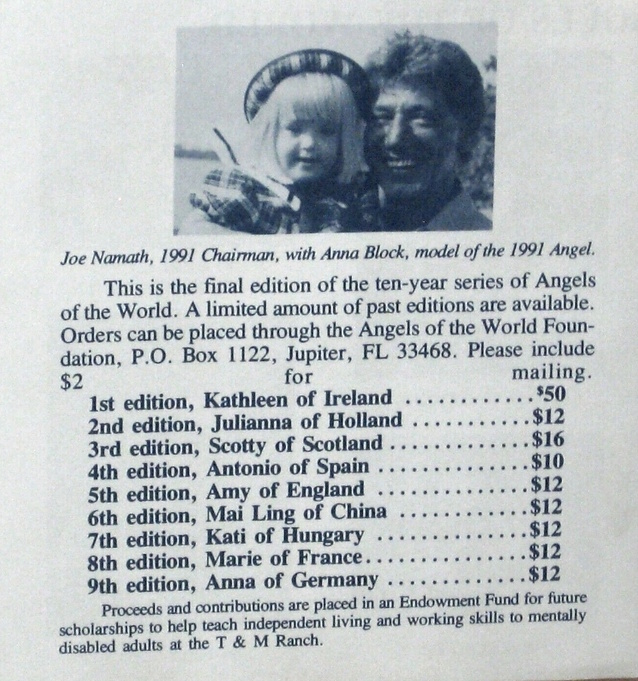 The Angels of the World ornament series was designed by Ispanky but manufactured at the T&M Ranch in Indiantown, Florida. Each ornament features a child from a different country.
Laszlo Ispanky died on July 9, 2010, at his home in New Jersey, more than 20 years after he stopped creating porcelains for commercial production. He was survived by his wife Susan and son Jason. Three months after his death, about 500 pieces of his art were consigned to an auction house in Hightstown, NJ. According to local news reports, a 1200-lb bronze sculpture measuring roughly 8′ x 9′ was among the offerings; originally commissioned by Golda Meir during the early 1970s, it was never sent.
Name Index of Cybis Sculptures
Visual Index (for human figures/busts only)
About the Cybis Reference Archive
What is Cybis?
Images of Cybis porcelains are provided for informational and educational purposes only. All photographs are copyrighted by their owner as indicated via watermark and are used here only as reference material. Please see the Copyright Notice in the footer and sidebar for important information regarding the text that appears within this website.
The Cybis Archive provides the most comprehensive range of information about Cybis ever compiled within a single source. It is not and never has been part of the Cybis Porcelain studio, which is no longer in business.
 THE CYBIS ARCHIVE