
The most elusive pieces of documentation surrounding Boleslaw and Marja Cybis are photographs of the home/studio that they built on Greenhouse Drive in Princeton. Such photos (and films!) were stored in filing cabinets at the Norman Avenue studio; I have spoken to someone who saw and personally handled those documents during the 1970s. Unfortunately, when Theresa Chorlton put the building up for sale in 2019 she did not bother to entrust them to a responsible permanent caretaker (as her husband had done with some 1950s and early-1960s documents he deposited with Syracuse University in 1970.) However, I have been able to reconstruct quite a bit of the story of the Cybis homestead through other methods. Fair warning: This is a long post, but the story is fascinating!
The History of the Property
In 1696, William Olden acquired approximately 330 acres of land originally owned by William Penn. It remained in the Olden family for several generations while being gradually subdivided via inheritances. One of the descendants, Charles Smith Olden, either inherited or purchased a parcel of about 48 acres in 1835 and named it Drumthwacket, after an estate that featured in a Sir Walter Scott novel. (You must admit that it is a fun name to say, especially if you put some emphasis on the second syllable!)
In 1893, Olden sold his estate to Moses Taylor Pyne, a financier and major benefactor of Princeton University. Pyne also acquired several parcels of adjacent land, increasing the total size of the estate to 183 acres. Elaborate gardens were created close to the mansion, a working farm and a dairy were established, ponds and a small lake were created, and several greenhouses were constructed at the rear perimeter of the property. The property ran between Stockton Street (the front entrance) and Mercer Street (the rear perimeter and access to the greenhouses.)
Moses Pyne died in April 1921, and his wife Margaretta died in April 1939. Because their oldest son, Moses Jr., had died in 1923, the estate passed to his only child (Agnes) and that is when the story of the Cybis property begins to be traceable. Agnes was 24 years old when she inherited the Drumthwacket estate.
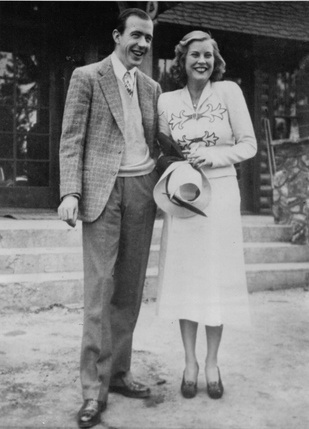 Agnes Langdon Pyne was a Manhattan socialite who definitely fit the stereotype; she married five times (not sure which husband this one is) between 1934 (at age 19) and 1968 (at age 53.) When she inherited Drumthwacket in 1939, she was living in Dallas with husband number four. By that time, the estate had been reduced to only about 11 acres and, having no real interest in New Jersey, Agnes sold it to Abram Spanel in 1941 and spent the rest of her life in Texas.
Abram Spanel founded the International Latex Corporation which not long afterward became Playtex. He lived at Drumthwacket after 1941 but there is no record of his making any major changes to the house or to the grounds, or of selling any of the approximately 11 acres that he acquired from Agnes Pyne. I had always assumed that Boleslaw Cybis bought the Greenhouse Drive parcel from someone other than Abram Spanel….probably from whomever Agnes Pyne had sold it to. This is where the story starts to get really interesting!
Unfortunately, there is no public record of the specific meets-and-bounds of the property that Spanel bought in 1941. However, there are aerial photographs taken of the property in 1930 and 1940 that do provide some clues – even if not definitive answers.
 This aerial photo was taken in 1930; I have identified the major landmarks and the streets. We can see three important structures: the Mansion, the Italianate Garden, and the Greenhouses. In 1930 Margaretta Pyne still owned the house and the adjacent gardens and, given that she was still living at Drumthwacket, the odds are that the greenhouses were still part of the estate. [In 1930, Boleslaw and Marja Cybis and fellow-artist Jan Zamoyski were traveling through Europe and Africa.]

 This photo was taken in 1940. I zoomed in on the important section, which includes the mansion/garden and the greenhouses. Notice that the access road (‘Greenhouse Drive’) remains, and I’ve also indicated the short street leading from it, which was later named Greenhouse Court. Notice also the area at the lower left that looks ‘dotted’ in this photo; those are young trees that had been lined out for propagation and are now large enough to be seen from the air. In the detail (second) photo, the structures with green lines pointing to them are the actual greenhouses; the pale areas on both sides are either cutting gardens or temporary ‘hoop houses.’ [In 1940, Boleslaw and Marja Cybis were living in NY at the Steinway Mansion studio; they had not yet come to New Jersey.]
The Cybises came to Trenton in December 1942, rented the buildings on Church Street for their studio, and partnered with Wilson and Greenberg in the Cordey China venture. I had always assumed that the Princeton land was purchased by him in1943 because, in the Timeline section of Cybis in Retrospect, it says under the section for 1944:
Cybis completes home, gardens and studio on old Pyne Estate in Princeton, New Jersey on Greenhouse Drive.
Although I was able to access online records pertaining to the purchase and sale of the Church Street (and, later, Norman Avenue) studio buildings, as well as some other odd real estate transactions, none of them involve Princeton during the 1940s. But there is something in a 1959 document that was very surprising!
Marja/Maria Cybis died in June 1958 without making a will, so her brother Cazimir was appointed as executor of her estate. Acting in that capacity, he sold the Cybis home property in January 1959. It was 5.49 acres and is described in the deed of sale as
Being the same premises that were conveyed to Maria Cybis on August 14, 1953 by Gladys E. Funk, single, by deed recorded in book 1248 of deeds, page 279…..
This means that Boleslaw and Marja Cybis did not own the land that they built their 1944 home/studio on….until 1953! We typically assume that someone owns the land that they build on, but that’s not necessarily so: A ‘ground lease’ can allow someone to build structures on rented land according to specific terms of the lease. In the case of Greenhouse Drive, it may even have been a ‘lease to own’ situation: The lease term was probably a typical 10 years (1943-1953), after which Marja/Maria would become the owner. If construction of the house began in1943, it makes perfect sense that it would have been finished in 1944, just as Cybis in Retrospect states. So who was Gladys E. Funk?
Gladys was one of several children of Alfred C. Funk who was a manager at the American Bridge Company in Trenton, which was a division of J.P. Morgan’s U.S. Steel Company, and one of the premier industrial firms in the nation. Alfred joined the company shortly after the plant opened in 1900 and was a senior manager there from its earliest days. The Funks always owned their home and appear to have been an upper-middle-income white-collar family. In 1940, Gladys was 38, still single and living with her 73-year-old recently-widowed father; she does not appear to have ever needed to work. Her father died in 1945, and she moved in with her sister and brother-in-law (a lawyer); she is shown living there in the 1950 census and working as a medical secretary. Oddly, I cannot find either a post-1950 marriage record or a death record for her; she seems to have disappeared into thin air after 1950.
What I also cannot discover is exactly when or how Gladys came to own a piece of the Moses Pyne estate. And how did Boleslaw and Marja Cybis come to know Gladys, especially so soon after they had arrived in Trenton? We will never know; only that at the end of what was probably a 10-year ground lease on the Greenhouse Drive lot, Maria Cybis became its new owner.
The Cybis Home/Studio
The best way to get a mental picture of the Cybis home is to take the few descriptions of it (from Cybis in Retrospect) and the available public records, and combine them with photos of the property as it exists today. But let’s begin with the puzzle of the house number!
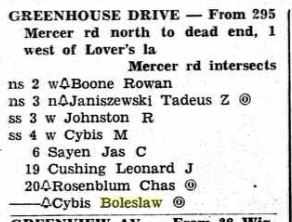 The earliest Princeton City Directory to mention the Cybis home is the 1954 volume which contains this snip and identifies it as #4. This makes sense because Marja did not own it until August 1953. Only four homes have a telephone. It seems as if Boleslaw arranged for the phone but because he isn’t the legal owner of the property he is placed at the bottom of the list: He owns the telephone but not the property that the phone line connects to.
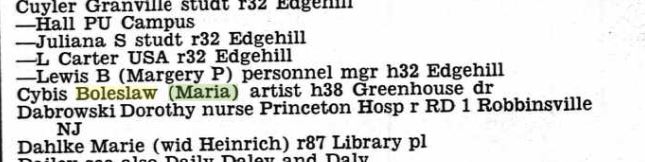 The 1955 (above) and 1957 Princeton City Directories are based on a different format; individual names instead of physical addresses. Now we see the house with an actual number: 38. (The letter h indicates a house, while r means a rented room.) When the local newspaper Princeton Town Topics reported Maria’s suicide in 1958, it gave her address as 38 Greenhouse Drive. The 1959 transfer of ownership deed does not specify a house number. At some point after 1959, the town of Princeton re-numbered the parcel as #46 Greenhouse Drive, as shown below:
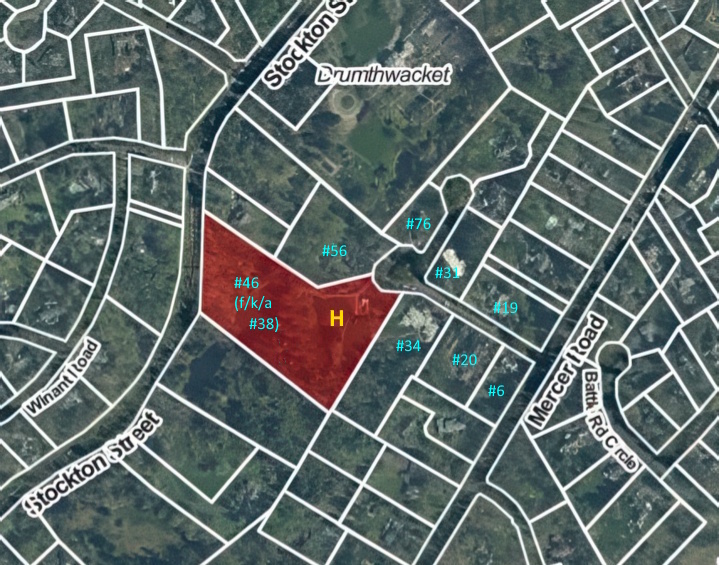 The red overlay indicates the Cybis property, with the yellow H showing where the house originally was. Let’s take a ride, courtesy of Google, down that street.
 Entering Greenhouse Drive from Mercer Road. The #6 house is on the left.
 The #19 house is a conversion and expansion of much of the original Pyne greenhouse seen in the 1930 and 1940 aerial photos; it is actually named The Greenhouse by its owners.
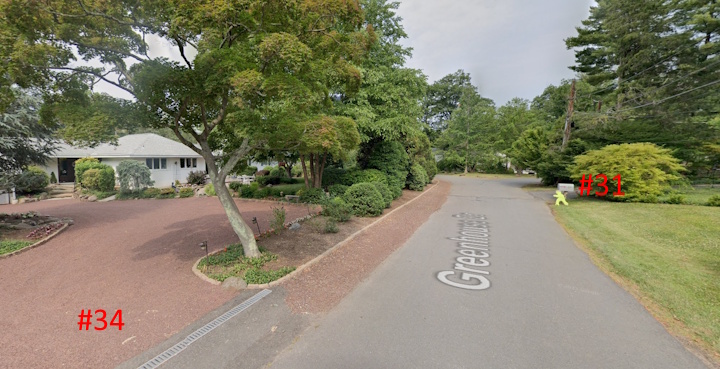
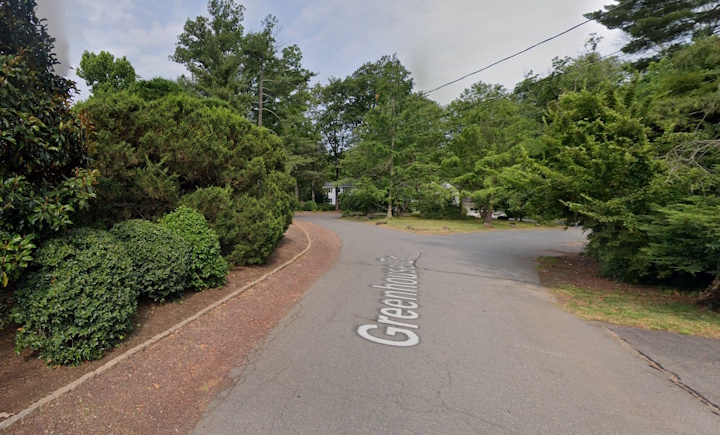
 The Cybis property is on the left side of the split.
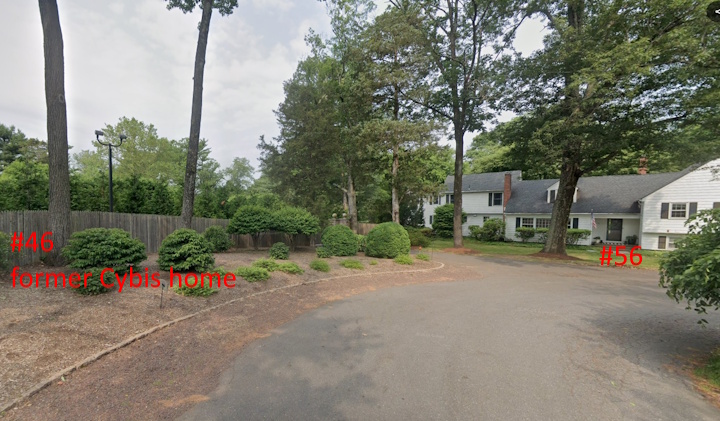
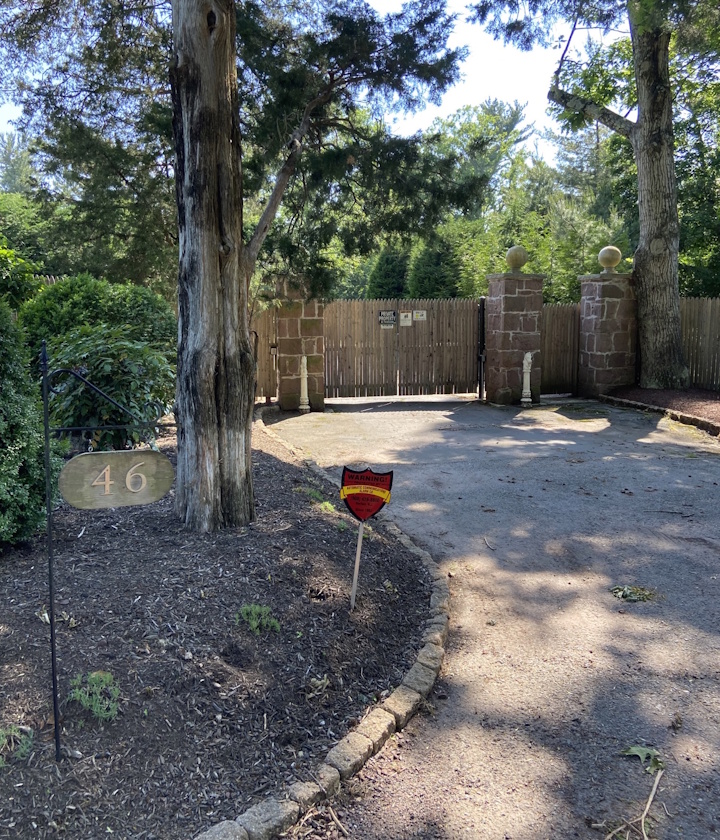 The wood picket fencing and gates are obviously newer but the brick gateposts are original. The small gate on the right offers foot access.
 The circular motif seen in this small section of paving in front of the walk-in gate will repeat itself within. Shall we take a stroll through the property?
A Walk Into the Past
Almost all of the things in these photographs and video screen shots are those that Boleslaw and Maria Cybis would have seen on a daily basis because they date from before 1941.
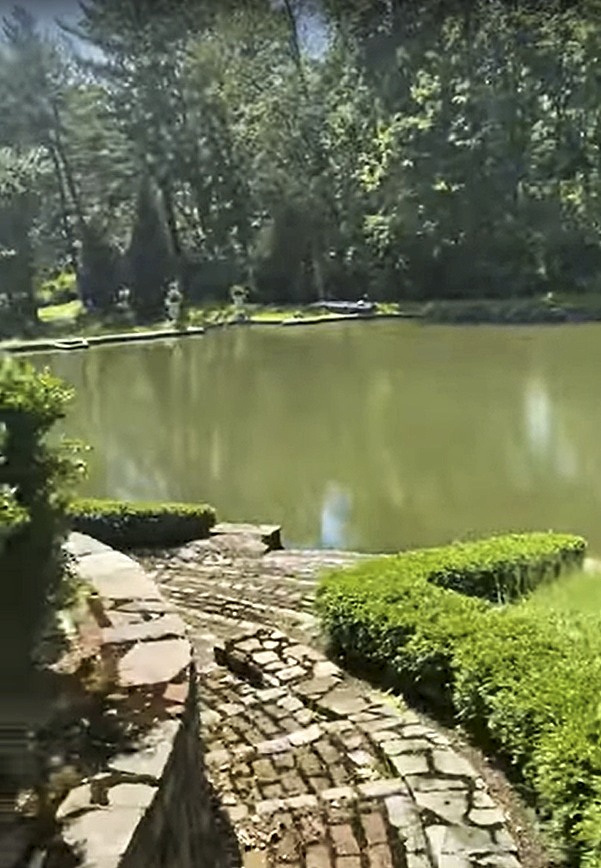 We’re starting at the lower (farther from the road) pond of two that were created by Moses Pyne damming this part of a stream, creating two ponds divided by a dam/walkway.
 The opposite side of the dam contains a gazebo from the Pyne era.
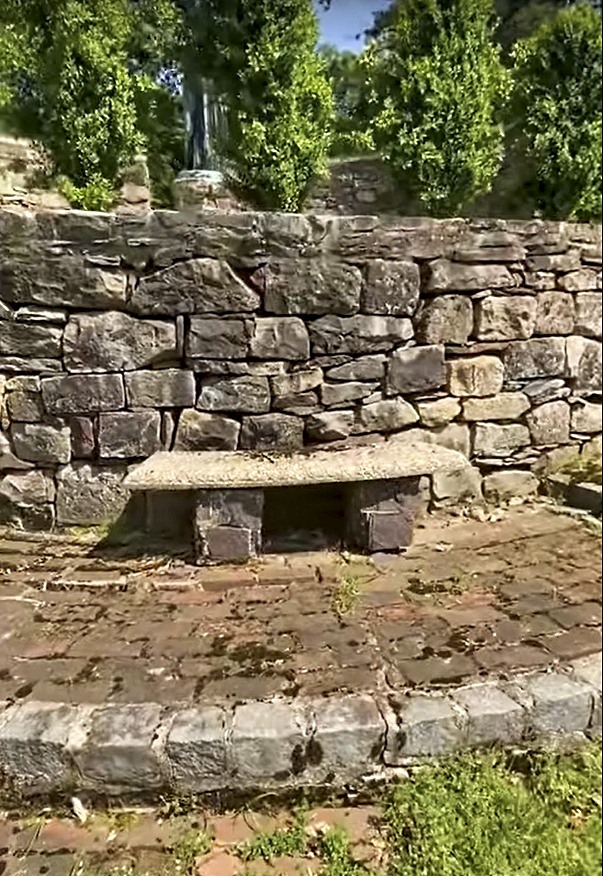 Turning around, with one’s back to the pond. The stone walls and most of the stone pathways are circa-1800s but the cast concrete bench seats are probably early to mid 1900s.
 These odd bright-white circular motifs may well be a later addition. The grey (zinc?) finial and its light tan base appear newer also. It’s possible that whatever originally topped these posts was removed (or disintegrated) and replaced by these three new elements, either during the 1920s or the 1940s. My guess is the 1920s.
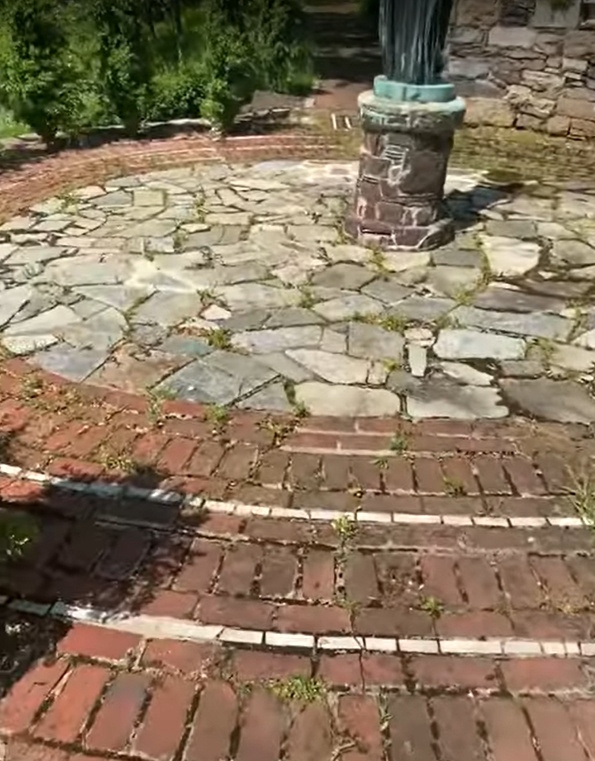
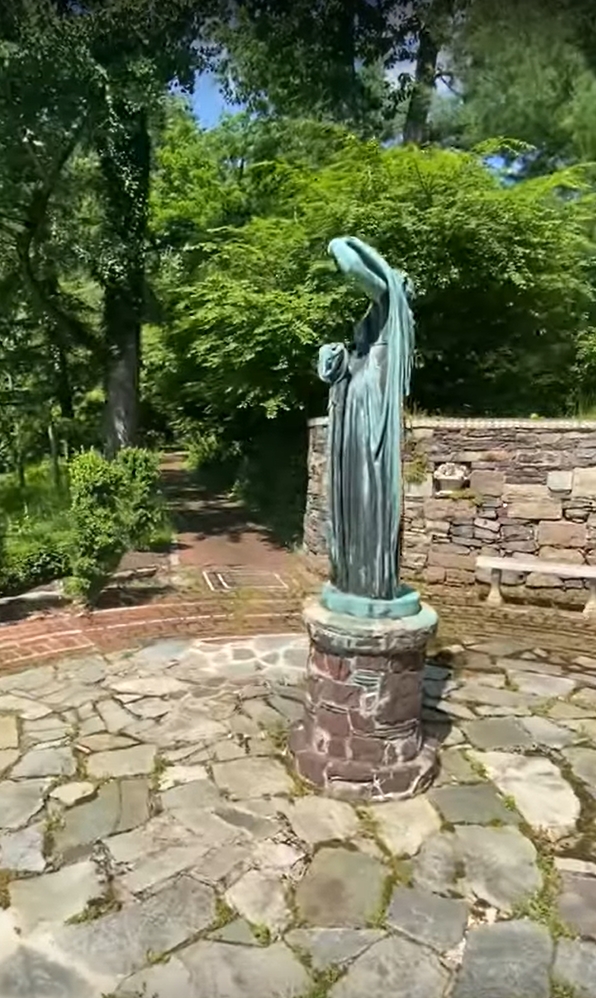 The circa-1800s paving on the raised area above the walkway and pond. The bronze statue probably depicts Venus. Notice how the noticeable white circles run along the top edge of the original wall.
 A photo of the statue appears in two of the Cybis catalogs with the caption “Classic figures grace the grounds.” The statue is signed and dated 1906. It was made by Sabatino DeAngelis & Fils, which was a foundry in Naples that made reproductions of Greek and Roman statuary during the Victorian and Edwardian era. The catalog caption, while not claiming that the “classic figures” were created by Boleslaw Cybis, also failed to say that they definitely were not.
 Ten steps rise from the ‘Venus patio’ toward a pair of plinths at the main grounds level.
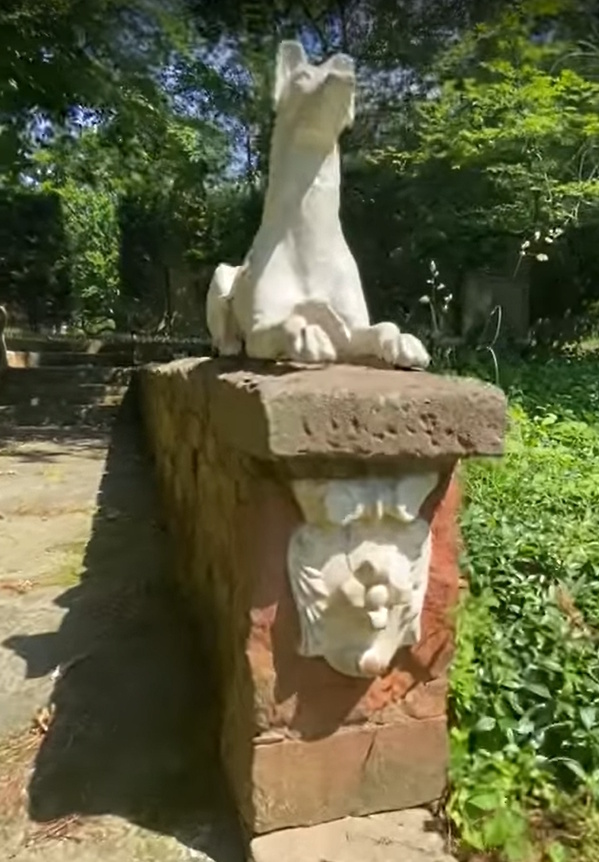 I continue to be puzzled by the stark whiteness of these elements…almost as if they have been spray painted or are brand-new, but I was assured by the current owner of the property that these have been here for more than a half-century.
 A stone walk extends past the dogs, to a short flight of steps up to yet another ca-1800s platform.
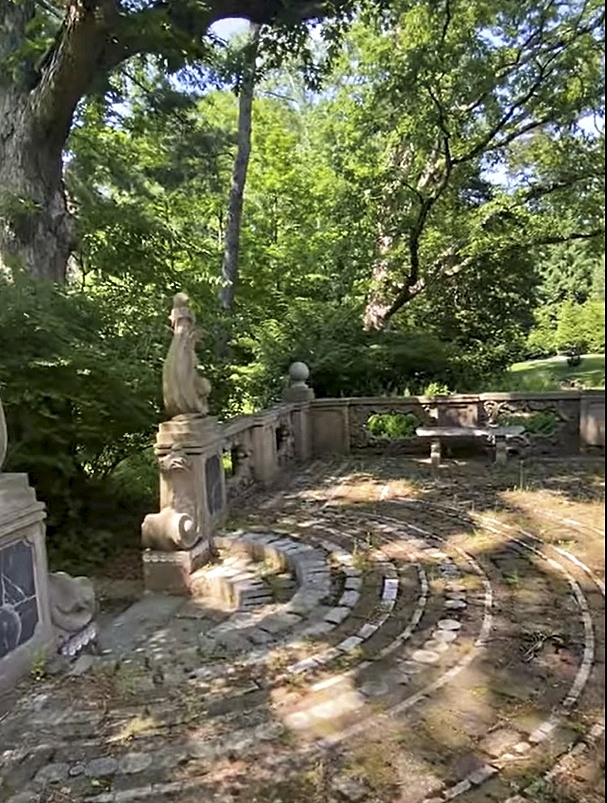 The plinths feature slate inserts in the center, and the paving of course contains circle motifs.
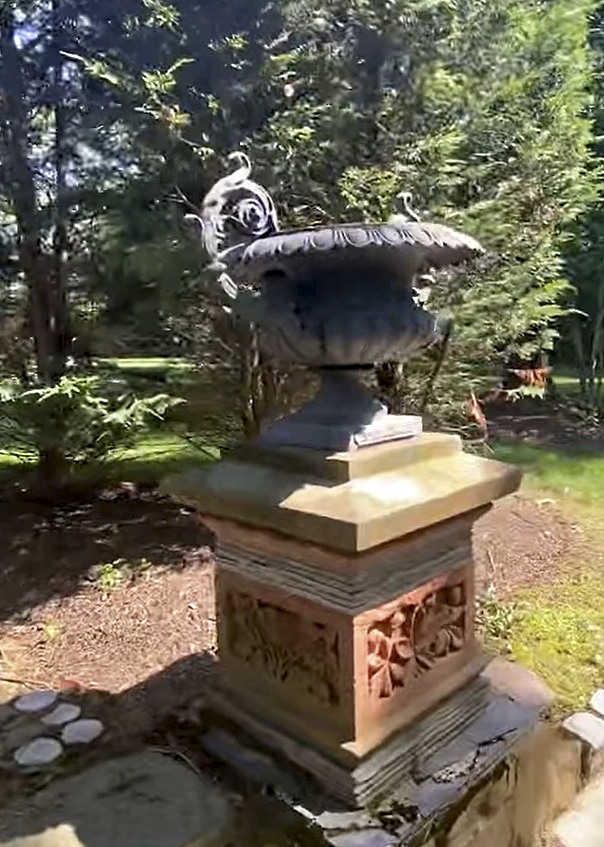 There is quite an assortment of materials on this plinth! The original pier may date from the Ogden ownership, or from ‘early Moses Pyne’. Then we have a terracotta box sandwiched between layers of slate (rather like phyllo pastry), then another terracotta layer, a beige stone (?) layer, and it’s all topped off with a zinc urn.
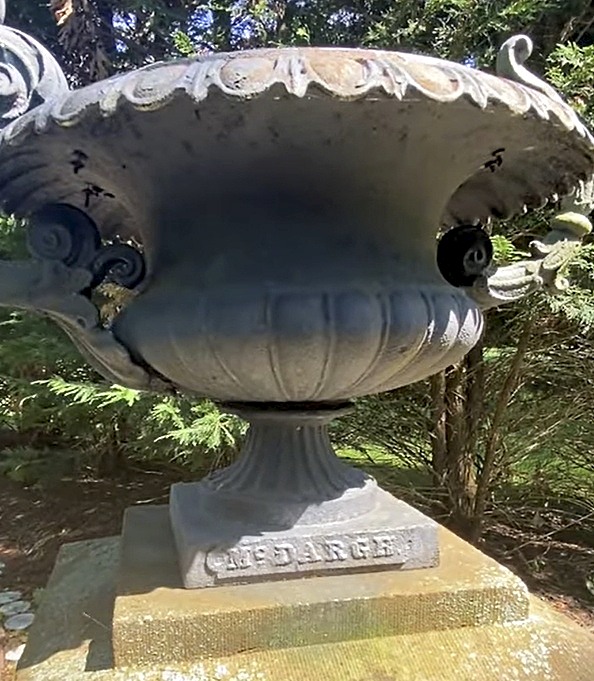 …which has the name McDarge on the base. Even my favorite AI search couldn’t come up with a match for that manufacturer.
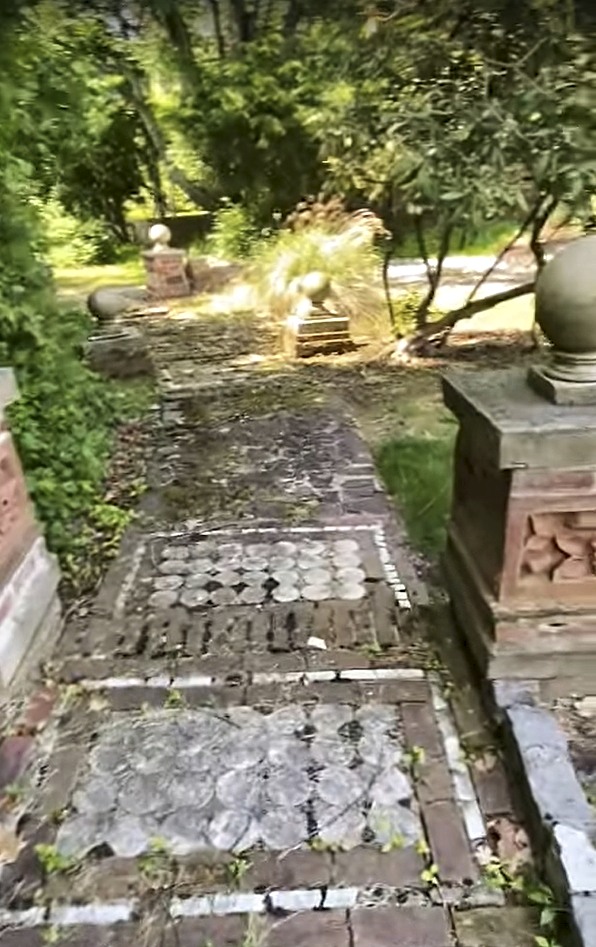 Walking down from this uppermost patio area toward the upper (closer to the road) section of the pond/stream. More circles!
 This pathway is rather long.
 Finally the end is in sight. Watch your step! ;-)
 Stopping for a moment to look at an unusual zinc panel that is set into the walkway.
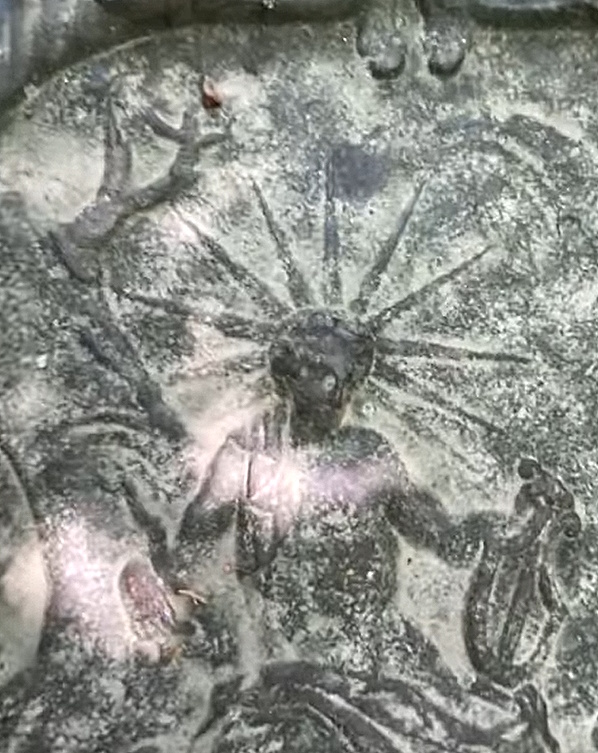 The presence of sun rays and a lyre suggest that it shows Phoebus Apollo, and so the female figure must be his sister, Artemis.
 This path ends at a zinc statue of Diana next to one of several small bridges that cross the stream. This is probably a good place to mention that Moses Pyne had quite a few water features created on the estate. Historical records show that there was a frog pond, a reflecting pool, an amphitheater pond, a forested retention pond, a natural wetland/marsh, and that “a stream was dammed to form several small ponds adorned with rustic bridges.” The two bridges in this photo are examples of those.
 Notice the stand of bamboo (yikes!) just past the zinc statue.
 J.W. Fiske was the foremost manufacturer of decorative cast iron and zinc garden ornaments, gates, fountains and fencing during the mid-1800s to the mid-1900s. Like Sabatino & Fils, they often copied classical statuary but also created their own models.
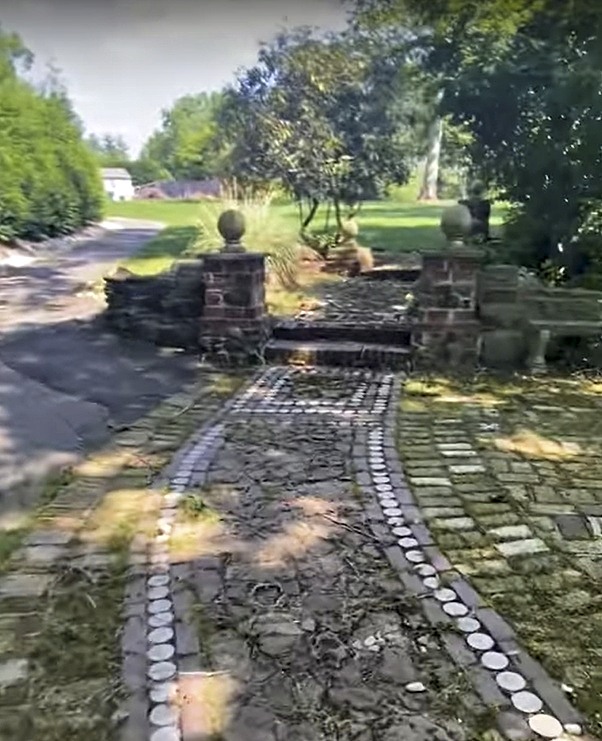 Returning to higher ground via the same pathway, we now approach the open area where the Cybis structures once were.
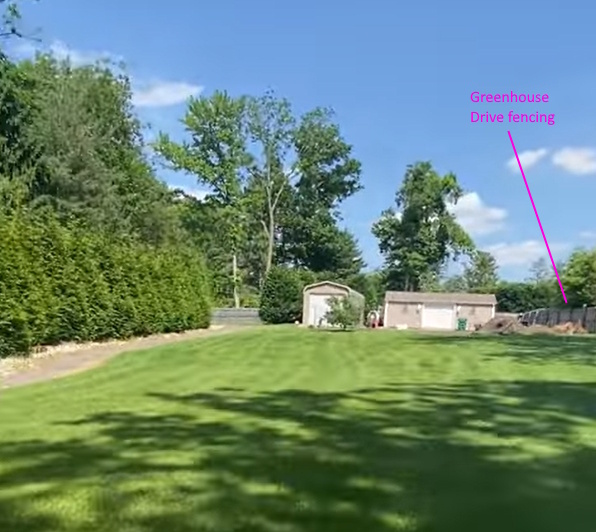 These modern-day outbuildings belong to the current owner of the property. The wood fencing along the Greenhouse Drive property line is indicated, for orientation.
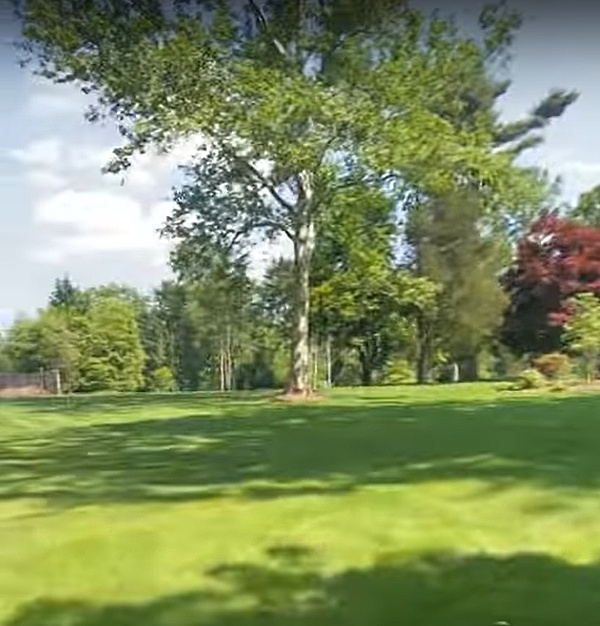 Walking into the open grassy area, several major trees are noticeable.
 Walking past the smooth-barked white poplar, into the clearing.
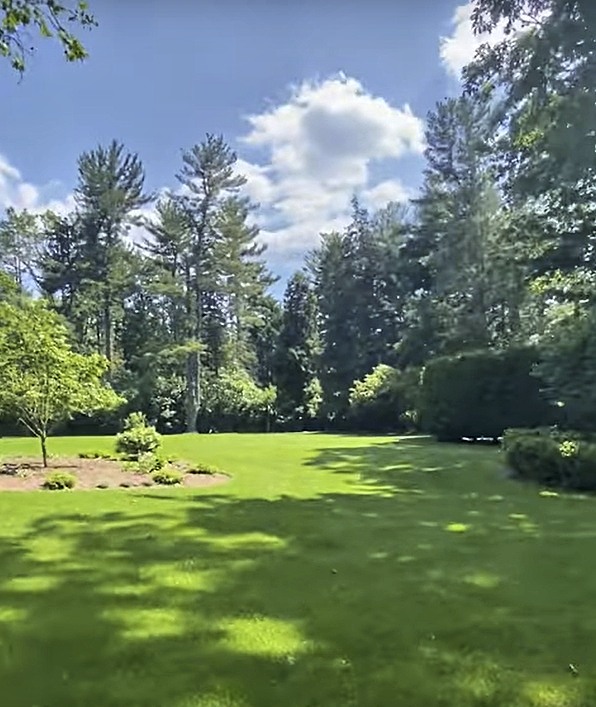 The area of grass directly ahead, in this photo, is where the Cybis home/studio stood.
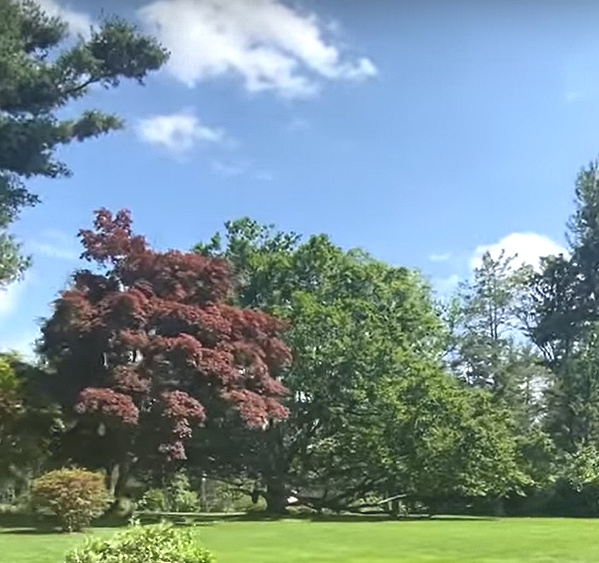 The other large tree, past the red maple, is a massive beech. Beech trees (Fagus species) are incredibly long-lived, with a typical lifespan of 300 to 400 years. Only the oak and sequoia can match or exceed them.
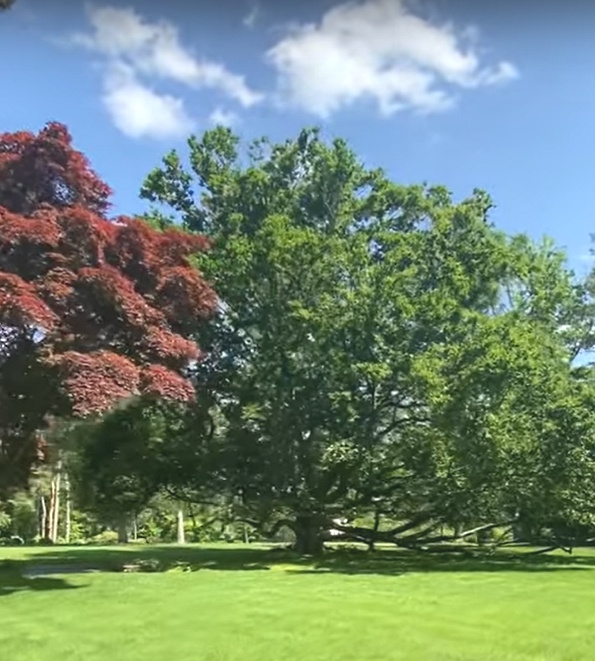
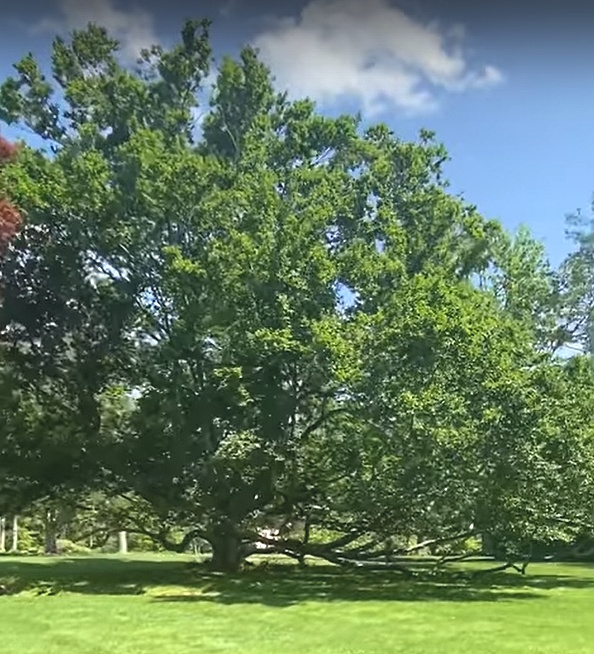 Closer views of this magnificent tree….a tree-climbing child’s delight!
 A last look at the area where the footprint of the Cybis house and studio were.
A family member of the person who bought the house in 1959 from Casimir Tym related to me that the Cybis house was two stories high and had a bedroom (just one) on the second floor. Their family used the downstairs area as an office space; they did not live there full-time, but instead used it as a guest house. It was described as being “dark, and stone”. After several years it became clear that the house required too much ongoing maintenance, so they decided to tear it down. They were surprised at how quickly and easily the structure came down, an indication that either it was not well built, or was not well maintained during the 14 years that Boleslaw and Maria Cybis lived there. Unfortunately, the Princeton Building Dept had no record of any plans or permits for the original 1943-1944 construction of the house…if there ever were any.
The Cybis-Approved Description
Only one publication (Cybis in Retrospect, 1970) describes the Cybis home/studio in any detail. Although she is not credited in that catalog, it’s obvious that the text portions were written by Hazel Herman who also wrote the text and captions for the 1970 Cybis retail catalog. I have transcribed the home-related portions here, and added my commentary and research-based corrections below.
But first, a caveat. When reading these Retrospect passages, please keep in mind that Ms. Herman was writing them at the Chorltons’ direction – and that the studio deliberately omitted certain parts of its history (such as Cordey!) and embellished others, for public consumption. And sometimes, they simply made mistakes! One only needs to look at the differences in some production year histories as published in Retrospect versus one of the retail catalogs, to see that. So, with that, let’s begin.
Princeton, New Jersey, where Cybis built his home and studio became the base for his artistic endeavors. The Cybis home, or sleeping quarters, drowsed between the studio and the greenhouse. Perched on a sloping hill, the studio dominated, overlooking a large Florentine garden and commanding a panoramic view of the lake and a modest waterfall.
Okay, there’s a lot to unpack here. The first is the mention of a greenhouse, which was almost certainly one of the original Pyne-era structures because we can see them in that 1940 aerial photograph. So we’re assuming that the greenhouse was already there, in that large grassy clearing seen in the final few photos above. According to this text, there were three structures in that clearing: a greenhouse, a house, and a studio. However, the person whose family purchased the property in 1959, six months after Marja Cybis’ death, told me that the only structure on the property was a house with one upstairs bedroom (the “sleeping quarters”, one assumes.) Is it possible that Marja had the studio building torn down after Boleslaw’s suicide in 1957? I think that is certainly a possibility, especially given her state of mind; the news report of her suicide a year later said that “she had been despondent since the death of her husband.” That would account for the studio not being on the property at the time of the 1959 sale. Was the greenhouse removed too?
Although the house and studio were on higher ground compared to the stream and pond, it was not a dramatic slope such as the Drumthwacket mansion itself is ‘perched’ on. Drumthwacket overlooks its own Italianate Garden in the way that Hazel Herman describes. (The difference between an ‘Italianate garden’ and a ‘Florentine garden’ lies in their relative formality and size, with the Italianate being larger, geometrical, and incorporating terraces.)
On one side of the wall near the studio Cybis painted a mural of African natives. On the other side of the house a huge birch grew out of a flagstone terrace. Cybis built a stage on the terrace and used it as a backdrop for changing works of art and for puppet shows where his wife, Marja, acted as puppeteer. She made puppet personalities of friends and neighbors and starred them in skits she wrote. Juries of artists also used the Cybis stage to judge local art exhibits; actors used it to rehearse a performance for the local playhouse. On many occasions, an orchestra performed there for some festive garden party.
We are assuming that Ms. Herman is describing the Cybis home here, when she says “the wall near the studio” and also “the other side of the house.” This launches the tree confusion: a “huge birch”? Birches grow tall (vertically) rather than wide; in growth habit they are similar to the white poplar in one of the foregoing photos. Beeches grow wide rather than tall. Look at the two trees in the photos above and consider which one would be more suited to being “a backdrop for changing works of art” and for a stage. Yup…the beech, no question. Not a birch. It’s not an unusual mistake for people to confuse those two tree names. However, I would cheerfully pillory whoever either planted a tree in the center of a stone terrace, OR deliberately built a terrace around one. That’s a terrible thing to do to any tree! (and not so great for the terrace either, because, you know…roots.)
The Studio, with its enormous open stone fireplace on one wall, a large tapestry on another and a hand-painted carpet on the floor, was the center of activity. An old grand piano, elaborate gold rococo candlestick holders, a throne chair and antique carousel horses used for seating completed the furnishings. Cybis worked at his easel or with his camera beneath an enormous skylight in the center of the room.
The mention of a skylight in the center of the room means that the Studio was either a separate small building, or a one-story wing off the house (“sleeping quarters”.) Several of the cited items appear in the newspaper ad for the first (May 19-20, 1959) auction of the contents of the Cybis home: “2 verdure tapestries; Florentine Palace chair; carousel horse.” One wonders where the contents of those sales are today!
Making films fascinated him, and Cybis experimented in mood, sound and color. The Studio artists not only designed and made strange backgrounds, exotic costumes and eerie masks, they also acted in Cybis productions. Editing the film and synchronizing it with other-worldly music fascinated the entire group. The Studio was also the scene of countless balls and masquerades which Cybis adored. He appeared as Bacchus or a faun to greet elaborately costumed guests, often titled nobility from the Old World he had left.
It is absolutely maddening to KNOW that those films still existed as recently as the 2000s but were never donated to a museum, as anyone with any shred of respect for history would do! And who were those “Studio artists”? Did they work only at the Greenhouse Drive home studio rather than at the Church Street ones? Or at both? Which location did the pieces seen in the 1940s Papka and Porcelain, the M.B. Cybis Items, and the M.C. Monogram posts come from: Church Street, or Greenhouse Drive? The above description doesn’t seem very compatible with the day to day work of making items intended to be sold at retail; but if this was an entirely different group of people than the Church Street employees/artists, then who were they? Questions, questions, questions…
Cybis sculptured his Florentine garden in textures, colors and shapes that changed magically with the seasons. A wild azalea walk complemented undulating hills of laurel and patterned terraces of wild flowers. A rhododendron cluster nodded in surprise at a single perfect rose. An island of white birch floated in the lake where, nearby, someone occupied a gazebo, for it was a bird watcher’s paradise.
This aerial zoom looks at that specific part of the pond/lake:
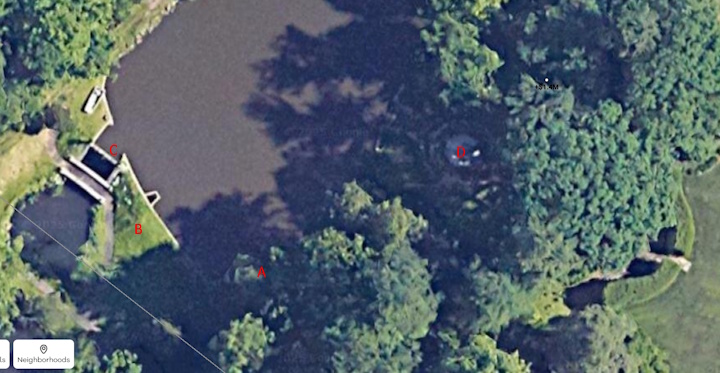 A is the gazebo, B is the ‘island’ which appears to have been structurally improved, C is probably the waterfall, and D is the raised area with the bronze Venus statue. The thin white line at the lower left indicates the boundary of the Cybis property along that side.I suspect that the ‘Florentine garden’ surrounded the second (upper) patio – the one just past the dog plinths, and with the McDarge zinc urn on one of the surrounding plinths, and which has the semi-circular hedge as a boundary ih this overhead photo. The stone steps emerge from it onto the flat ground where the structures were.
The 1978 Cybis catalog has a photo of what seems to be the “wild azalea walk”:
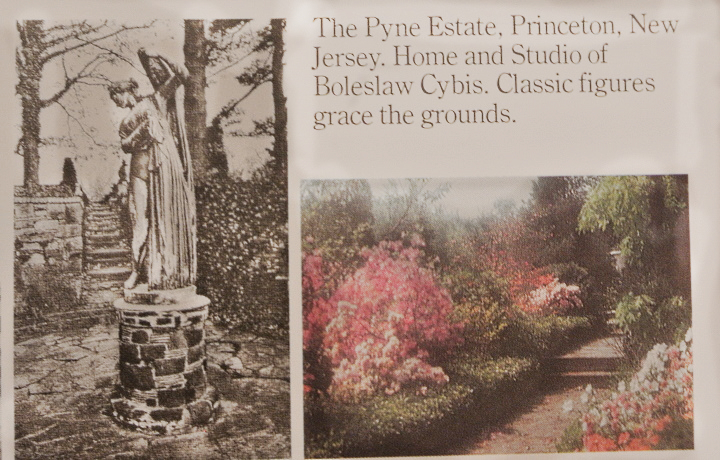 This may be one of the old paved walkways seen in the modern-day photographs, albeit in earlier decades. Some of her language is a bit over-the-top and Ms. Herman definitely wasn’t a botanist: rhododendron flowers grow in trusses, and in a half century of growing them I have never yet seen a rhododendron truss “nod in surprise” at anything. ;-) The gazebo is the one seen in the second ‘pond’ photograph in the property-walk section, and there appears to be at least one surviving birch on the adjacent ‘island’…but it is probably a river birch, Betula nigra, which has brown bark rather than white and is longer-lived than the white and paper birches.
In his greenhouse Cybis tended unusual plants with a botanist’s skill. He knew every flower by its Latin name, and he grew here a rare, yellow magnolia. Flowers and birds offered endless subjects for the sketchbook, and flocks of artists congregated like seasonal residents around the grounds or in the greenhouse. Summer or winter, Cybis, shirtless and in shorts, could be seen greeting someone in the garden, a mecca for a constant stream of friends and visitors.
This is a very far-fetched claim, because among the more than 100 Boleslaw Cybis drawings and paintings that I have chronicled here, the only ones that include any flowers at all are cacti… and there are less than a half dozen of those, all of them sketches from the 1930 trip to Africa. The very few art works that include any trees are usually leafless ones. It strains credulity to think that an artist who “had a botanist’s skill” and “knew every flower by its Latin name” would never choose to paint or sculpt any. It makes no sense. Yes, there are flowers in the headdress of The Bride, and a few scattered around Primavera; but I challenge you to find any flowers of note anywhere else in Cybis’ own art except for the aforementioned few cactus sketches. If you were an artist who loved plants and flowers, wouldn’t you want to draw and paint them, at least once in a while? But Boleslaw Cybis didn’t. And I have never heard or read even the slightest whisper of him having any interest whatsoever in flora, anywhere else than in this lone instance.
I strongly suspect that the wrong person was described in that paragraph. Given the fact that Marja is almost entirely ignored in Cybis studio literature, or at best given very short shrift, it may be that the greenhouse was her ‘thing’, not his…but the studio decided to pump up Boleslaw’s image at the expense of hers. It certainly wouldn’t be the first time, nor the last. As for the “rare yellow magnolia”, there is only one native magnolia in the USA (Magnolia acuminata) which has pale yellow flowers, but it has never been rare; it’s fairly widespread all across the Eastern part of the country and as far west as Missouri and Oklahoma. The yellow magnolias seen nowadays are all man-made hybrids derived from that species. The first of those hybrid crosses was done at the Brooklyn Botanical Garden during the late 1950s and introduced to the trade with great fanfare in 1977 as Magnolia ‘Elizabeth.’
The Importance of Legacy Preservation
I’ve stepped onto my soapbox more than once on this site when it comes to ‘doing the right thing for posterity’, because it’s always been a really big bee in my bonnet. Whether it’s hiding the identity of the artist who actually created a sculpture or a painting, or trying to rewrite the history of a company or a person, or a failure to preserve records that are likely to be of interest to historians….IMHO the caretakers of that information have an obligation to disclose, to be honest, and to preserve. After the death of Marylin Chorlton, the Cybis studio increasingly failed in those obligations but never more so than in the 1990s and 2000s. By that time, it was clear that the only two surviving American porcelain art studios were Cybis and Boehm. Say what you will about Helen Boehm – and there’s a lot to say! – she cared enough about the legacy of the studio that she and her husband launched, to preserve all of the records, even from the earliest days.
It is heartening to know that the land that Boleslaw and Marja Cybis called ‘home’ for 14 years (even though they only actually owned it for five, lol) has been kept respectfully intact by the subsequent owners. With the high value of land today, it could have been chopped into two smaller parcels (the minimum lot size allowed along Greenhouse Drive is two acres, and the Cybis property area is just under five and half) and a so-called ‘McMansion’ thrown up on it for a quick resale.
When you think about it, those 5.49 acres have seen quite a bit during the past 350 years. That magnificent beech tree could definitely be that old. It has seen everything from free-roaming deer and peacocks, to the lights and fireworks from Gilded-Age evening parties, to the young men who tended the greenhouses and the cutting gardens going off to fight a war in distant lands, to an expatriate artist and his wife bringing their own personal view of the world to America. One of the greatest minds in history, Albert Einstein, sat in its shade and talked about how the universe works after walking the half-mile from his own home to visit those artists. After the artists succumbed to their sadness and the scientist no longer came, the laughter of children echoed through the beech leaves as they climbed its branches to see who could go the highest. The children are grown now, and there are no parties or theatricals staged above its roots, but the beech tree remembers it all – a strong and silent witness to a unique chapter of American porcelain art history.
Name Index of Cybis Sculptures
Visual Index (for human figures/busts only)
About the Cybis Reference Archive
What is Cybis?
Images of Cybis porcelains are provided for informational and educational purposes only. All photographs are copyrighted by their owner as indicated via watermark and are used here only as reference material. Please see the Copyright Notice in the footer and sidebar for important information regarding the text that appears within this website.
The Cybis Archive provides the most comprehensive range of information about Cybis ever compiled within a single source. It is not and never has been part of the Cybis Porcelain studio, which is no longer in business.
 THE CYBIS ARCHIVE